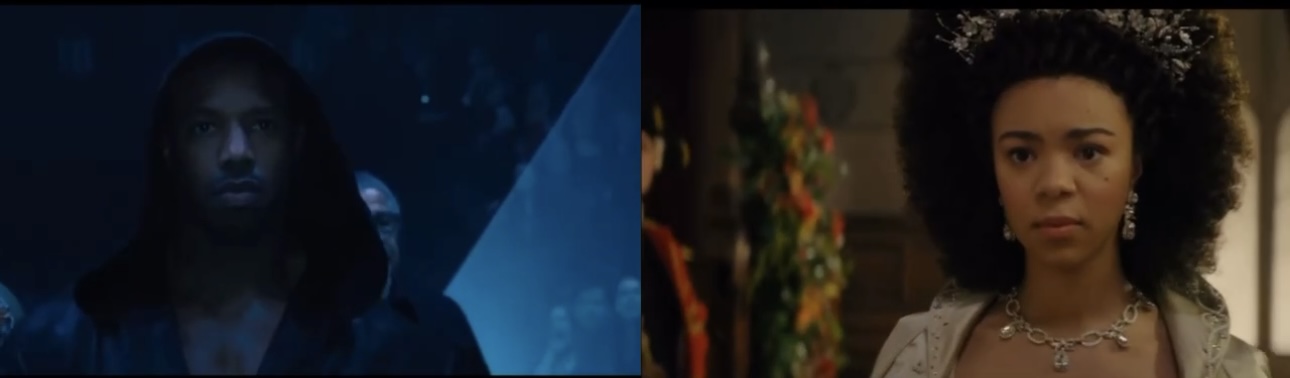
Figure 1 - Adonis Creed, left, prepares to enter the ring; Queen Charlotte, right,
prepares to marry into the English monarchy
[0.1] Abstract - Both Creed 2 (2018) and Queen Charlotte (2023) intervene in historically white cinematic genres by centering Black protagonists in fantasy worlds never built to include them. These works do not just simply add diversity to their respective genres, they reconstruct what kinds of bodies, histories, and subjectivities may occupy cultural spaces long imagined as the exclusive domain of whiteness.
[0.2] Keywords - oppositional gaze, racebending, adaptation, the black gaze, visibility, agency, historically white cinema, fantasy, genre fiction, masculinity, heritage cinema, boxing movies
[0.3] Trailer -
White-Wise, Hanajah. 2026. “Fantasy as Reclamation: Black Visibility and Agency in Queen Charlotte and Creed II,” Muhlenberg Visions. Volume 4, No. 1.
[1] Period dramas and boxing films do not appear, at first glance, to occupy the same cinematic universe. One is associated with elaborate costumes, aristocratic interiors, and the carefully curated nostalgia Claire Monk identifies as the defining visual logic of British heritage cinema; the other is rooted in sweat, violence, and the spectacle of the masculine body. Yet Queen Charlotte: A Bridgerton Story (2023, created by Shonda Rhimes) and Creed II (2018, directed by Steven Caple Jr.) share a surprising point of unification: both intervene in historically white cinematic genres by placing Black protagonists at the center of fantasies never originally built to include them. These works do not just simply add diversity to their respective genres, they reconstruct what kinds of bodies, histories, and subjectivities may occupy cultural spaces long imagined as the exclusive domain of whiteness.
[2] Shonda Rhimes’s Queen Charlotte is a dramatized reimagining of the romance and political struggles of Queen Charlotte of Mecklenburg-Strelitz. The series follows the young Charlotte as she arrives in Britain to marry King George III, only to discover the racial implications of her presence in a society unprepared for a Black queen. Her marriage becomes the catalyst for “The Great Experiment,” a royal decree integrating wealthy Black families into the aristocracy to legitimize Charlotte’s position. The show blends historical details, costumes, court rituals, and royal portraiture, with an openly fictional racial narrative, using its counterfactual world to foreground Black romance, sovereignty, and visibility within a genre that typically idealizes a white British past.
[3] Creed II, directed by Steven Caple Jr., continues the story of Adonis Creed, the son of legendary boxer Apollo Creed from the Rocky franchise. The film follows Adonis as he becomes heavyweight champion and accepts a dangerous challenge from Viktor Drago, the son of the man who killed his father in the ring. While the film includes the emotional and physical stakes expected of the boxing-movie tradition, its narrative centers Adonis’s struggle with legacy, fatherhood, grief, and self-worth. Instead of relying on stereotypes of “natural” Black physicality, Creed II frames Adonis’s body as the product of discipline, vulnerability, and emotional growth: the arc that Richard Dyer articulates in “The White Man’s Muscles,” where a built body is “is an achieved body, worked at, planned, suffered for…a triumph of mind over matter” (Dyer 1997, 153). Through this, the film reorients a genre historically built around white protagonists, from Rocky to Raging Bull, to make space for a Black hero whose muscular body carries narrative and symbolic meaning.
[4] These narrative foundations allow both works to resonate with bell hooks’s theory of the oppositional gaze, which insists on reclaiming and reorienting the act of looking in a cinematic landscape that has historically marginalized Black viewers and distorted Black representation. In Queen Charlotte, the gaze is redirected toward a Black queen who commands the visual language of European royalty. In Creed II, the gaze lingers on a Black male body that is expressive rather than objectified, emotional rather than monstrous, heroic without being racially coded as “naturally” strong. Together, these two texts reveal that fantasy, whether counterfactual aristocratic history or heroic boxing, can function as a powerful tool for Black visibility. Queen Charlotte and Creed II construct counterfactual fantasies of Black presence that reoccupy cultural spaces historically coded as white, from the British royal past to the conventionally white boxing-film tradition, revealing how Black embodiment and narrative agency can remake genre conventions and imagine alternative histories and futures. By comparing these works, I will show how both use Black embodiment, romance, authorship, and narrative agency (“for us and by us”) to challenge inherited cinematic traditions and imagine alternative histories and futures in which Black protagonists define the terms of their own representation. Far from escapist, the fantasies in Queen Charlotte and Creed II are political acts, rewriting who gets to belong in the genres that shape our cultural imagination.
[5] To understand how Queen Charlotte and Creed II reclaim spaces historically coded as white, it is useful to consider bell hooks’s concept of the oppositional gaze. Hooks observes that Black female spectators resist “seeing black women in the position white women have occupied in film forever,” critically reshaping their role as viewers (hooks 126). In both texts, the camera’s attention is redirected toward Black protagonists in ways that center their subjectivity, agency, and emotional complexity. In Queen Charlotte, the gaze affirms the authority and presence of a Black queen within the imaginative and and often fantastical space of heritage cinema, a genre traditionally reserved for whiteness. In Creed II, it lingers on Adonis Creed’s body as a focus of the discipline, vulnerability, and narrative significance that Richard Dyer argues has been the distinctive privilege of white masculinity, rather than as a spectacle defined by Black stereotypes. Considering the oppositional gaze provides a framework for understanding how these works not only place Black characters at the center of the story but also invite audiences, particularly Black audiences, to reimagine their role as active spectators and participants in cinematic fantasy.
Figure 1 - Adonis Creed, left, prepares to enter the ring; Queen Charlotte, right,
prepares to marry into the English monarchy
[6] As this reclamation of cinematic space becomes more visible, certain moments in each work crystallize the significance of the oppositional gaze on screen. The still image above (Figure 1) captures Queen Charlotte at the start of her walk down the aisle to be married; I have juxtaposed it with a shot of Adonis Creed making his entrance into the ring. The images are in many ways parallel. Even in this initial moment, the framing of both characters signals the narrative and symbolic weight they carry within their respective genres. Both stand on the threshold of spaces historically coded as white: the ceremonial aisle of British aristocracy and the archetypal boxing arena dominated by white protagonists like in Rocky or even Southpaw. In the Queen Charlotte scene, the camera aligns with Charlotte’s forward movement as she prepares to enter a royal space traditionally reserved for white monarchs. Surrounded by lavish architecture and with all eyes on her, she occupies the center of a heritage representation that has long excluded Black women. In Creed II, the image of Adonis at the start of his ring walk captures his focus and physical presence, foregrounding the emotional and narrative depth behind his body, an identity forged through discipline and vulnerability rather than racialized assumptions of this “natural” strength. In comparison, both protagonists are visually centered, embodying authority and agency as they step into spaces historically structured to deny Black presence. This brings bell hooks’s oppositional gaze into sharp relief, a gaze that resists marginalization and reclaims the right to look, to be seen, and to inhabit fantasy on one’s own terms. Through these parallel moments, the oppositional gaze becomes not merely a theoretical framework but a lived cinematic experience, one that invites Black viewers to reimagine who belongs at the center of these fantasy genres.
Clip 1: A multiscreen composition showing parallels between Adonis and Charlotte
(made by Hanajah White-Wise)
[7] In the multi-screen composition above (Clip 1), one can see the emotional weight of this parallel; Adonis says “I was afraid of this…expectations, I was afraid I couldn’t do what he couldn’t.” This act of vulnerability positions Adonis not as a “naturally” dominant Black athlete, but as a man overcoming grief, legacy, and his own fears regarding his self-worth. His entrance into the ring becomes a crossing into a space that, as Dyer argues, was historically structured around white masculine heroism. Placed beside Queen Charlotte’s ceremonial walk toward royal power, the pairing highlights how both protagonists confront expectations embedded in institutions that were never intended to include them. The combination underscores hooks’s oppositional gaze by revealing Black subjectivity, emotion, fear, and self-definition, at the center of genres that traditionally denied it.
[8] Another striking example of how Creed II reclaims white-coded cinematic space is the desert sequence featuring Adonis Creed, which is this film’s specific articulation of the boxing film’s mandatory training montage. Adonis is framed running through the barren landscape, pausing to look directly at the camera (Figure 2). This positions him as both physically commanding and emotionally introspective, emphasizing his agency and narrative centrality. Unlike the typical boxing montage in which the Black male body might be coded as merely aggressive or hypermasculine, this moment highlights discipline, vulnerability, and determination, qualities historically celebrated in white protagonists within heroic cinematic genres. The space around him visually isolates him, yet the camera’s gaze affirms his authority within the frame, aligning with hooks’s concept of the oppositional gaze by allowing Black viewers to engage with a Black hero in a space traditionally reserved for white bodies. This sequence, like Queen Charlotte’s wedding sequence, demonstrates how fantasy can be used as a tool for reoccupation. The genre’s visual and narrative conventions are preserved, but the racialized assumptions that reinforce them are actively challenged, making room for Black presence and subjectivity.
Figure 2: Adonis Creed’s determination is center-frame
[9] The desert training sequence in Creed II (Clip 2) offers a vivid illustration of Black reoccupation of spaces historically coded as white, both visually and narratively. In this scene, Adonis Creed is shown shirtless, drenched in sweat, flipping massive tires, and boxing under the harsh sun, his body framed as a site of effort, discipline, and emotional growth rather than “natural” or threatening strength.
Clip 2: A training montage that demonstrates Black determination, grit, and will
[10] This deliberate framing counters historical cinematic norms in which white male action heroes are depicted as idealized embodiments of power and control; as Dyer notes, “Tarzan, Hercules, Rambo and the rest show us ideal, hard, achieved, wealthy, hairless and tanned white male bodies set in a colonialist relation, of aid as much as antagonism, to lands and peoples that are other to them” (Dyer 1997, 161). In contrast, Caple Jr. presents Adonis’s body as earned, disciplined, and intimately tied to his emotional journey. The desert becomes a space of personal healing, resilience, and agency, reclaiming the cinematic gaze on the Black male body. Rather than reinforcing stereotypes of innate Black strength, the film highlights the intentionality, discipline, and vulnerability behind his muscularity, offering a nuanced, humanized vision of Black masculinity. Beyond its visual impact, the sequence also operates narratively as a form of genre reoccupation. Boxing films have traditionally centered white protagonists whose physical dominance conveys moral authority and heroism; moreover, these protagonists have often fought menacing, under-characterized Black opponents. By placing a Black man at the center of this narrative and visually emphasizing the effort behind his strength, Creed II reconfigures the genre’s conventions and asserts the legitimacy of Black heroism within a space historically coded as white. The desert, with its vast emptiness and harsh environment, mirrors the isolation of Adonis’s emotional journey, emphasizing that his power is cultivated through perseverance and self-determination rather than inherited or assumed. In this way, the scene exemplifies the broader project of Black visibility in cinema: it allows audiences to witness a Black body and subjectivity fully realized, emotionally complex, and narratively central, transforming a familiar cinematic space into a site of empowerment and imaginative possibility.
[11] Moreover, this exemplifies how genre conventions can be repurposed to center Black narratives. Boxing films historically feature white protagonists whose musculature signals moral and spiritual superiority, their bodies framed as a testament to self-control, heroism, and natural authority. In Creed II, the muscular Black body is similarly centered: strength is earned, vulnerability is visible, and emotional labor is inseparable from physical discipline. This visual and narrative strategy aligns with the broader concept of Black reoccupation of white-coded spaces, showing that agency and heroism are not culturally or racially predetermined but actively constructed through effort, creativity, and intentionality. These patterns of visual and narrative reclamation resonate beyond sports cinema. Just as the desert becomes a site of Black visibility and self-determined heroism, other traditionally white-coded genres, such as period dramas, can similarly be transformed through imaginative reorientation. The assertion of presence in spaces historically imagined as exclusively white, whether the boxing ring or the aristocratic halls of Britain, reveals how fantasy can be a vehicle for Black subjectivity, agency, and narrative authority. The ways in which Adonis inhabits the desert, claiming the gaze, redefining strength, and demonstrating emotional complexity, suggest the strategies employed in the limited series like Queen Charlotte: A Bridgerton Story, where Black characters occupy and reshape visual, social, and historical spaces previously denied to them. By linking bodily representation with agency and narrative significance, both Creed II and period dramas like Queen Charlotte highlight the political and imaginative possibilities of Black-centered fantasy, inviting audiences to reconsider who can occupy these stories and how they are seen.
[12] Having demonstrated how Adonis Creed occupies and redefines a space traditionally coded as white, it is equally instructive to consider how Black women reclaim visibility in similarly exclusive cinematic arenas. Just as the desert sequence reconfigures the heroic male body, Queen Charlotte reimagines period drama as a space in which a Black female protagonist exercises authority, intellect, and narrative importance. Historically, as Dyer notes in his book White (1998), films like Jezebel (1938, directed by William Wyler) placed Black women within rigid, highly controlled white spaces, “codes of behaviour and rules of conduct embodied in set-piece receptions, dinners, parties and balls”, while also showing how whiteness remained materially and emotionally dependent on blackness yet held ultimate sway (Dyer 1988, 54). In contrast, Queen Charlotte inhabits these aristocratic fantasy spaces with wit, agency, and political awareness; through her marriage, coronation, and the counterfactual “Great Experiment,” she asserts power visually, socially, and narratively. By centering a Black queen in a heritage drama, the series challenges these historical racialized expectations and creates a parallel with Creed II: both set the stage for a reoccupation of white-coded genres, offering complex, multidimensional visions of Black bodies in positions of authority and prominence.
[13] To further illustrate how Queen Charlotte reclaims heritage fantasy spaces for Black visibility, the series includes a pivotal moment in which Lady Danbury, a new Black member of the English aristocracy, urges Charlotte truly to embrace her role as the first Black queen. This speech directly positions Charlotte not just as an individual navigating royal life, but as a symbolic figure whose existence carries weight for Black spectators, reinforcing bell hooks’s notion of the oppositional gaze. This allows viewers to experience the emotional power of Danbury’s words, her tone emphasizing Charlotte’s responsibility as a pioneer for Black nobility and visibility:
[14] You are the first of your kind. That opened doors, so we are new. Do you not see us? What you are meant to do for us? I tell you to consummate. I tell you to become with child. I tell you to endure. For a reason. You're so preoccupied with whether a man likes you. You're not some simpering girl. You are our queen. Your focus should be your country. Your people. Our side. Why do you not understand that you hold our fates in your hands?
[15] Yet the scene also reveals the gendered expectations placed uniquely upon Black women. Danbury’s insistence that Charlotte must “open doors” because she is “the first of her kind” underscores how Black women are often compelled to hold the burden of racial representation, tasked with carrying their community forward while maintaining composure, dignity, and strength. Rather than presenting Charlotte as decorative, peripheral, or sexualized–traits historically imposed on Black women through the Jezebel stereotype, as Dyer critiques, the series reframes her body and presence through sovereignty, intelligence, and political agency. In this way, Queen Charlotte becomes not an object within royal spectacle but the originator of it, reclaiming a genre that has long excluded Black femininity from both power and visibility.
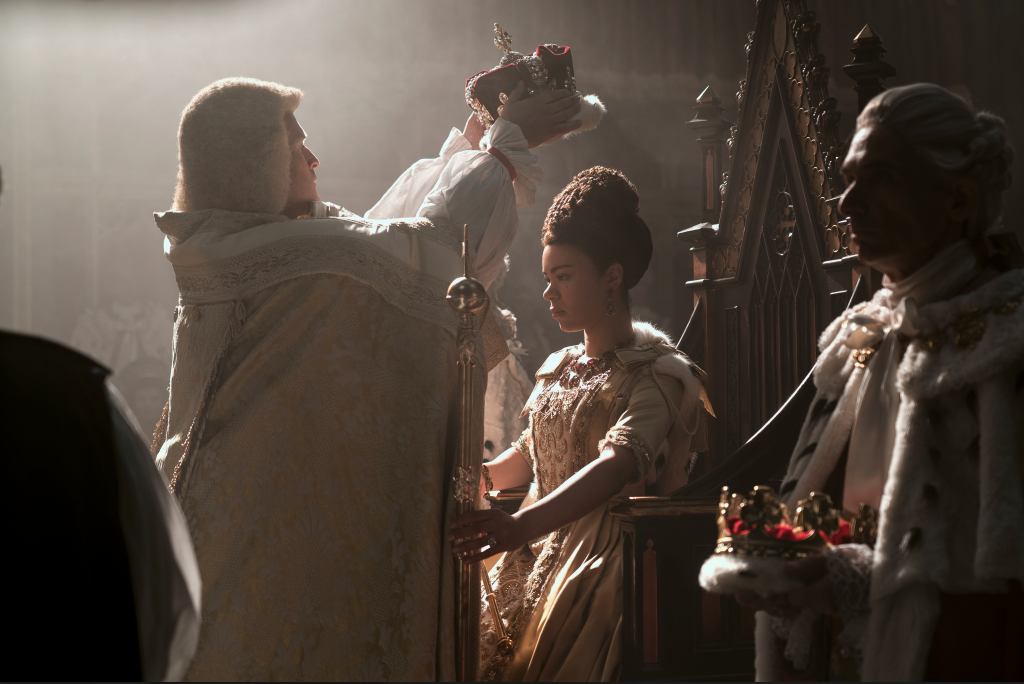
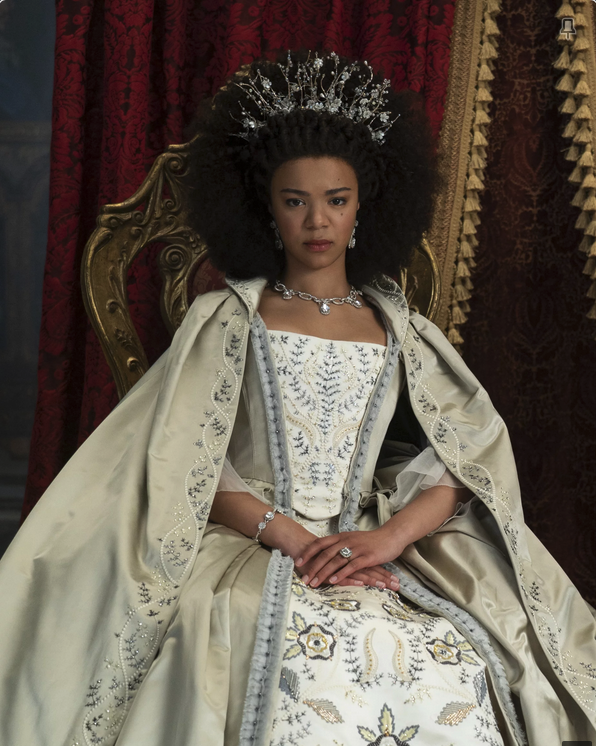
[16] This act of repositioning Charlotte at the center of royal power becomes even more significant when understood through the lens of British heritage cinema. Claire Monk argues many heritage films “appeal to or have been appropriated in ways that legitimise a reactive ‘Englishness’ which is politically conservative and expressly white” (Monk 195), arguing that the genre historically reinforces racial exclusivity and nostalgia for an imagined white past. By placing a Black queen at the center of coronation rituals, royal portraiture, and the visual codes of aristocratic ceremony, Queen Charlotte directly intervenes in this tradition. The series does not merely insert a Black character into a white-coded space; instead, it reconfigures the heritage aesthetic itself, transforming a cinematic space long associated with elite whiteness into one that centers Black visibility, authority, and desire. Charlotte’s coronation and royal portrait work to reclaim these visual traditions, challenging the assumptions Monk identifies and expanding what kinds of bodies can occupy, and redefine, heritage fantasy.
Figure 3 : Charlotte is crowned queen
Figure 4 : Queen Charlotte’s royal portrait
[17] This reclamation is illustrated in two key images from the series. Figure 3 captures Queen Charlotte being crowned, emphasizing her centrality and authority within a ceremonial space historically coded as white. The visual composition highlights how Black presence is not only included but celebrated, reinforcing the series’ imaginative reworking of heritage drama. Figure 4 shows Charlotte seated for her royal portrait, her gaze calm yet assertive, reclaiming aristocratic visual codes while challenging the historical objectification and marginalization of Black women on screen. Together, these stills demonstrate how heritage fantasy can serve as a tool for Black visibility, paralleling how Creed II reconfigures the traditionally white-coded boxing genre. Both texts use visual spectacle, whether the muscular, disciplined body of Adonis or the regal, commanding figure of Charlotte, to stage Black protagonists as active agents in spaces that were once exclusive, making room for narratives for us and by us and redefining audience engagement with cinematic fantasy.
[18] A crucial point of connection between Queen Charlotte and Creed II lies in their authorship, each crafted by Black creators who reshape genres historically defined by white fantasies and white bodies. Shonda Rhimes’s reimagining of the period drama and Steven Caple Jr.’s continuation of Ryan Coogler’s legacy in the Creed franchise both shift these genres from merely including Black characters to centering Black subjectivity, complexity, and overall agency. Authorship matters because it determines not only who appears on screen, but how they are framed, what stories become possible, and which fantasies can be imagined at all. In this context, both Rhimes and Caple Jr. refuse traditional cinematic limitations, instead constructing narrative spaces in which Black protagonists occupy positions of power, sovereignty, and emotional depth. Therefore, this recapture of narrative authority directly intersects with bell hooks’s theory of the oppositional gaze, which argues that Black spectatorship itself becomes an act of resistance through critical looking. As hooks highlights, “There is power in looking” (hooks 115). This power emerges not only in the act of the viewer looking back at the screen but in the deliberate choices filmmakers make about how Black bodies are seen, framed, and centered.
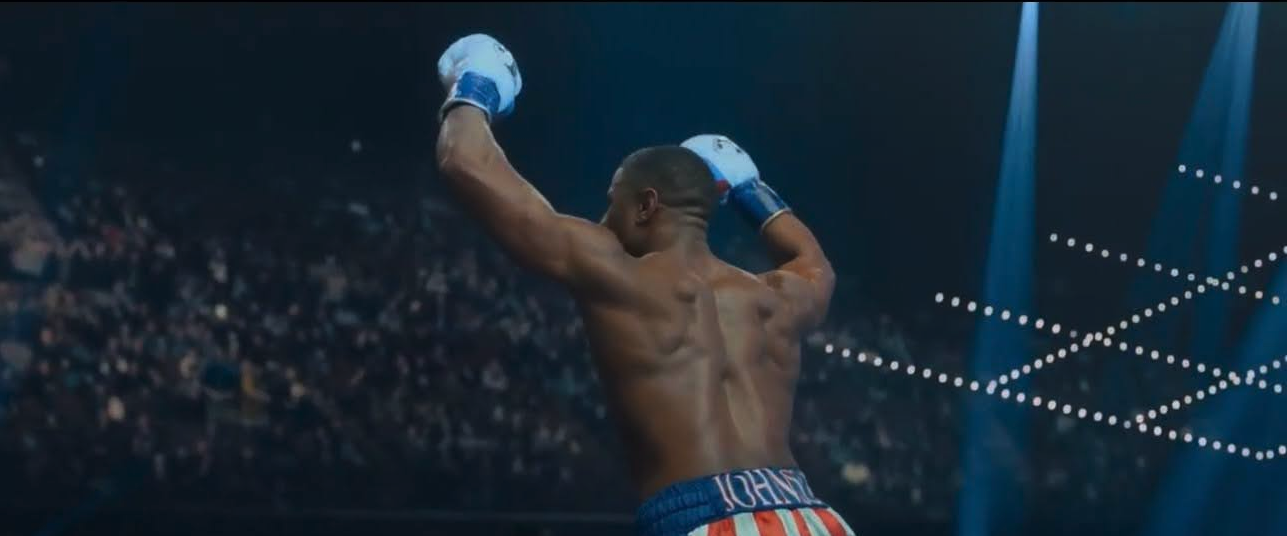
[19] In Creed II, that power manifests through Creed’s embodied presence, his muscularity earned rather than assumed, expressive rather than objectified, disciplined rather than stereotyped. Caple Jr. ensures that Adonis’s body is not a site of racialized spectacle but a canvas for humanity, grief, and transformation. In Figure 5 he raises his arms in triumph following his victory over his opponent. The still visually centers Adonis in the ring, a space historically coded and dominated by stereotypical portrayals of white male heroism. By framing him as victorious, disciplined, and fully in control of the narrative moment, this emphasizes how Caple Jr. constructs Adonis’s body as a site of agency, emotional depth, and earned accomplishment rather than innate physicality. The celebratory pose also embodies the oppositional gaze: Black audiences are invited to see themselves reflected in a position of triumph and stature, experiencing a moment of recognition, empowerment, and visibility that has been largely denied in traditional boxing films. The image complements the discussion of authorship by showing how visual storytelling reinforces Black creative authority, shaping not only who appears on screen but how they are allowed to be seen.
Figure 5: Black audiences are invited to see themselves reflected in a position of triumph
[20] Similarly, Queen Charlotte, shaped through Rhimes’s authorship, uses the visual language of heritage drama – its gowns, jewels, crowns, portraits, and aristocratic environments – to reconfigure who is allowed to inhabit the historical fantasies of British royalty. Charlotte’s presence, framed with regality and emotional complexity, interrupts the genre’s long-standing attachment to whiteness. The camera does not judge her as an object of exoticization or stereotype, but as a sovereign figure whose body carries political weight and possibility. In both texts, the radical potential of hooks’s ideology becomes clear–looking is not passive but essential. Black viewers are invited to recognize themselves in genres that once erased them, while Black protagonists are granted the visual authority that white cinematic traditions have reserved for whiteness. Together, these works demonstrate that fantasy, as genre, as visual form, as narrative possibility, is not escapist but transformational when shaped by Black creative vision. They raise parallel questions that signal the political stakes of reimagining traditionally white-coded spaces: What if a Black queen reshaped the aristocratic past? What if the heroic boxing narrative centered a Black man whose body signifies discipline, vulnerability, and humanity rather than threat? Through the authorship of Rhimes and Caple Jr., these hypothetical possibilities become not only imaginable but visible, reclaiming cinematic space in ways that redefine who is permitted to be central, powerful, and seen.
[21] In examining Queen Charlotte: A Bridgerton Story and Creed II, it becomes clear that fantasy, in its various forms, serves as a powerful tool for Black visibility and agency. Both works reclaim spaces historically coded as white – the aristocratic halls of British royalty and the cinematic boxing ring – placing Black protagonists at the center of narratives that reimagine power, heroism, and subjectivity. Through visual framing, narrative focus, and the intentional choices of Black creators, these texts challenge long-standing cinematic norms, offering complex portrayals of Black bodies that resist objectification and stereotype. The oppositional gaze, as articulated by bell hooks, is made tangible in these works, allowing Black audiences to see themselves reflected in roles and genres from which they were previously excluded. Adonis Creed embodies discipline, vulnerability, and emotional depth, while Queen Charlotte exerts political authority, intellect, and visual sovereignty. Both demonstrate that fantasy doesn’t need to be escapist, it can be a site of radical reimagining, where Black presence, power, and creativity are central, celebrated, and transformative. Ultimately, Queen Charlotte and Creed II exemplify the possibilities of for us and by us storytelling, showing that authorship matters as much as representation. By placing Black characters and Black creative vision at the center, these works not only reshape historical and genre conventions but also expand the cultural imagination, affirming that the act of seeing, and being seen, is itself a political, and liberatory act. In essence, together, these works remind us that when Black creators reclaim both narrative and visual space, fantasy becomes a tool of empowerment, where visibility and agency are not granted but actively enacted. In this way, Queen Charlotte and Creed II leave audiences with a clear message: to be seen is so powerful, and to imagine oneself at the center of a story is to claim the right to define one’s own world.
Dyer, Richard. 1988. “White.” Screen, Volume 29 (4): 44–65. https://academic.oup.com/screen/article-abstract/29/4/44/1646277
Dyer, Richard. 1997. “The White Man’s Muscles.” White. London: Routledge. 145-183.
hooks, bell. 1992. “The Oppositional Gaze: Black Female Spectators.” Black Looks: Race and Representation. Boston: South End Press, 115-31.
Monk, Claire. 2002. “The British Heritage Debate Revised.” in Claire Monk and Amy Sargeant. 2002. British Historical Cinema, Taylor & Francis Group: ProQuest Ebook Central. 193–208.