[0.1] Abstract - In Guillermo del Toro’s 2025 adaptation of Frankenstein, Victor is a disciplined mind who builds and displays a white male body. The Creature is a man who has had his body built by someone else. Questions emerge: What does it mean to be a male spectacle? And what does it mean to build a body?
[0.2] Keywords - the white male body, spectacle, mirror stage, gender politics, masculinity, bodybuilding, the male gaze, objectification, feminization, adaptation
[0.3] Trailer -
Blackwood, Wilhelmina. 2026. “The Original Built Body,” Muhlenberg Visions. Volume 4, No. 1.
[1.1] Mary Shelley’s Frankenstein has been adapted over four hundred times since its publication in 1818, each with a new interpretation and something unique to say about the classic tale. Guillermo del Toro’s 2025 adaptation is no exception. Highly anticipated mostly for his iconic visuals alone, del Toro more than delivers on mise-en-scene. Stunning compositions flood the film from top to bottom, marking it as a cinematic masterpiece. However, the spectacle does not stop at the image on the screen; it influences the theme, affecting the characters directly, using visuals to emphasize symbolic meaning. Character issues surface through a close analysis of key actions. Questions emerge: What does it mean to be a male spectacle? And what does it mean to build a body? Guillermo del Toro’s 2025 adaptation of Frankenstein confronts issues of superiority, triumph, spectacle, oppression, and gender while exploring what the process of building a body truly means for both Victor and his creation.
[1.2] For the sake of clarity, an overview of the film's plot will provide a basis for understanding how each element of my argument leads to the next. As in Shelley’s novel, Frankenstein opens with a ship stuck in the ice. It’s 1857, and Captain Anderson and his crew are attempting to figure out a way to get the vessel, the Horisont, back out on the water. An explosion draws their attention to an injured Victor Frankenstein nearby. When they transport him to the ship for care, a beast appears, attacking Anderson’s men with the intent of getting to Victor. Once the coast is temporarily clear, Victor tells Anderson his life's tale. He begins with his childhood, explaining his close connection with his mother and his distant one with his father. After his mother passes away in childbirth, Victor sets out with determination to be the one to cheat death. He labors away for years, studying and experimenting with the human form until he is able to present his work to his medical school. When they reject his work animating corpses as sacrilege, Victor finds opportunity and financial support in Henrich Harlander, who promises him anything he could possibly need in exchange for a future favor. The preparations begin immediately, and Victor promptly gets to work; tools are constructed, a tower is renovated, cadavers are gathered, and the process of building a body to animate begins. In the meantime, Victor begins to fall for his brother's fiancée, Elizabeth Harlander, who rejects his advances. Not long after, the body is complete, and the moment is upon him; a thunderstorm provides the crucial spark of lightning to restart his creation's heart. It appears to fail, and Victor goes to bed, distraught and defeated. When he wakes, his creation stands at the end of his bed. He tells him his name, admires his own work, and then guides him down to the sewers to be chained up. It is there Elizabeth discovers the Creature before Victor displays him to her and his brother, William. Frustrated with the Creature’s lack of intellectual advancement in the weeks following, Victor decides to burn the tower down, the Creature still inside. He loses a leg in the process before the film returns to the Arctic setting. The beast, known now to be Victor's Creature, has returned, this time to tell his tale. His story begins with his escape from the collapsing tower and his subsequent exploration of the world around him. He discovers a small house in a clearing and takes refuge from hunters in their grain mill. He stays there for a while, learning language by proxy and doing silent acts of kindness for the family. He eventually makes friends with the blind old man who lives there and learns to read and communicate. After a while, the Creature goes back to the tower to search for his origins. He finds what he was looking for, but when he returns to the small house, wolves have attacked the old man, and trigger-happy hunters chase him away. With a new determination not to be alone, the Creature sets out to find Victor, appearing on Elizabeth and William’s wedding day. In a fit of aggression, Victor accidentally shoots Elizabeth while aiming for the Creature who takes her away to pass under his watchful eye. Each infuriated with the other, the Creature condemns Victor to chase him across the Arctic, which leads the story back to its beginning. The chronicles of pain and suffering encourage forgiveness, and Victor ultimately dies in his creation’s arms. The Creature, freed from Victor's torment, sets out into the rising sun, but not before freeing Anderson’s ship from the ice.
[1.3] Naturally, such an old, well-loved story demands a new lens and fresh creative liberties with every adaptation, and Guillermo del Toro does not disappoint. Aside from creating juicy cinematic visuals, del Toro introduces a series of minor, yet surprisingly controversial, changes to the tale, which make it his own. I argue that some of these alterations make space to explore deeper ideas with the novel's characters as symbolic placeholders; they are crucial to conveying del Toro’s vision and say important new things about gender in film.
[2.1] It should come as no surprise by this point that Victor is, and always has been, the villain of Frankenstein. It is astounding how the most crucial aspect of Shelley’s novel still remains misunderstood by so many. If Guillermo del Toro spelling it out blatantly in this version isn't enough (“You are the monster.” [del Toro 2025, 2:06:46]), key aspects of Victor's character should make it apparent regardless. The man has problems. All of them stem from his childhood.
[2.2] Victor begins his tale by recounting warm, comforting days in his childhood spent with his mother, juxtaposed to the tyranny of his father's presence. His bond with his mother was close, very close, and such a connection at that age (somewhere in his teens), as well as the severity of the way he talks about her importance in his life, raises cause for concern. As Victor explains to Captain Anderson, his father “was absent from our lives, but when he came home, the entire household bent to his will. The rest of the time… the rest of the time, mother was mine,” (del Toro, 00:11:05). Later he tells Anderson how he felt after his mother’s death: that “my mother, whom I had come to consider a part of my very self, she who I thought would never leave, she who was life, was now death,” (del Toro, 00:16:36). This type of language is reminiscent of Freud’s psychoanalytic theory on the Oedipus complex, an attitude of attachment and desire, typically formed by boys for their mothers, developed during the phallic stage of psychosexual development. Freud described his theory of the Oedipus complex this way:
[2.3] In its simplified form the case of a male child may be described as follows. At a very early age the little boy develops an object-cathexis for his mother, which originally related to the mother's breast and is the prototype of an objectchoice on the anaclitic model; the boy deals with his father by identifying himself with him. For a time these two relationships proceed side by side, until the boy's sexual wishes in regard to his mother become more intense and his father is perceived as an obstacle to them; from this the Oedipus complex originates. His identification with his father then takes on a hostile colouring and changes into a wish to get rid of his father in order to take his place with his mother. Henceforward his relation to his father is ambivalent; it seems as if the ambivalence inherent in the identification from the beginning had become manifest. An ambivalent attitude to his father and an object-relation of a solely affectionate kind to his mother make up the content of the simple positive Oedipus complex in a boy. Along with the demolition of the Oedipus complex, the boy's object-cathexis of his mother must be given up. Its place may be filled by one of two things: either an identification with his mother or an intensification of his identification with his father (Freud 1961b, 31-32).
[2.4] The child's ego must then turn away from this complex through identification with either the father or the mother, the former of which is more typical (Freud 1961a, 176).
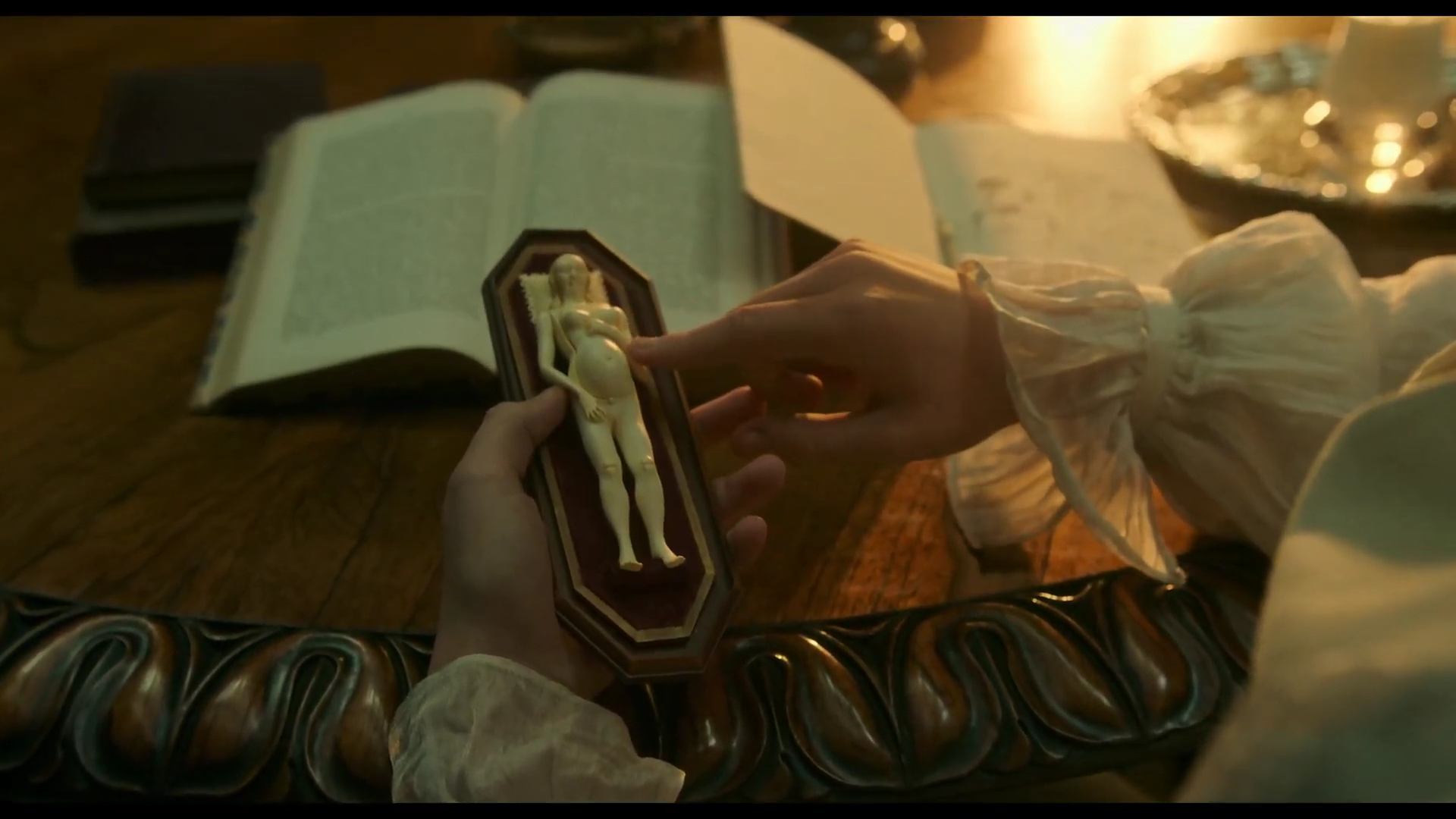
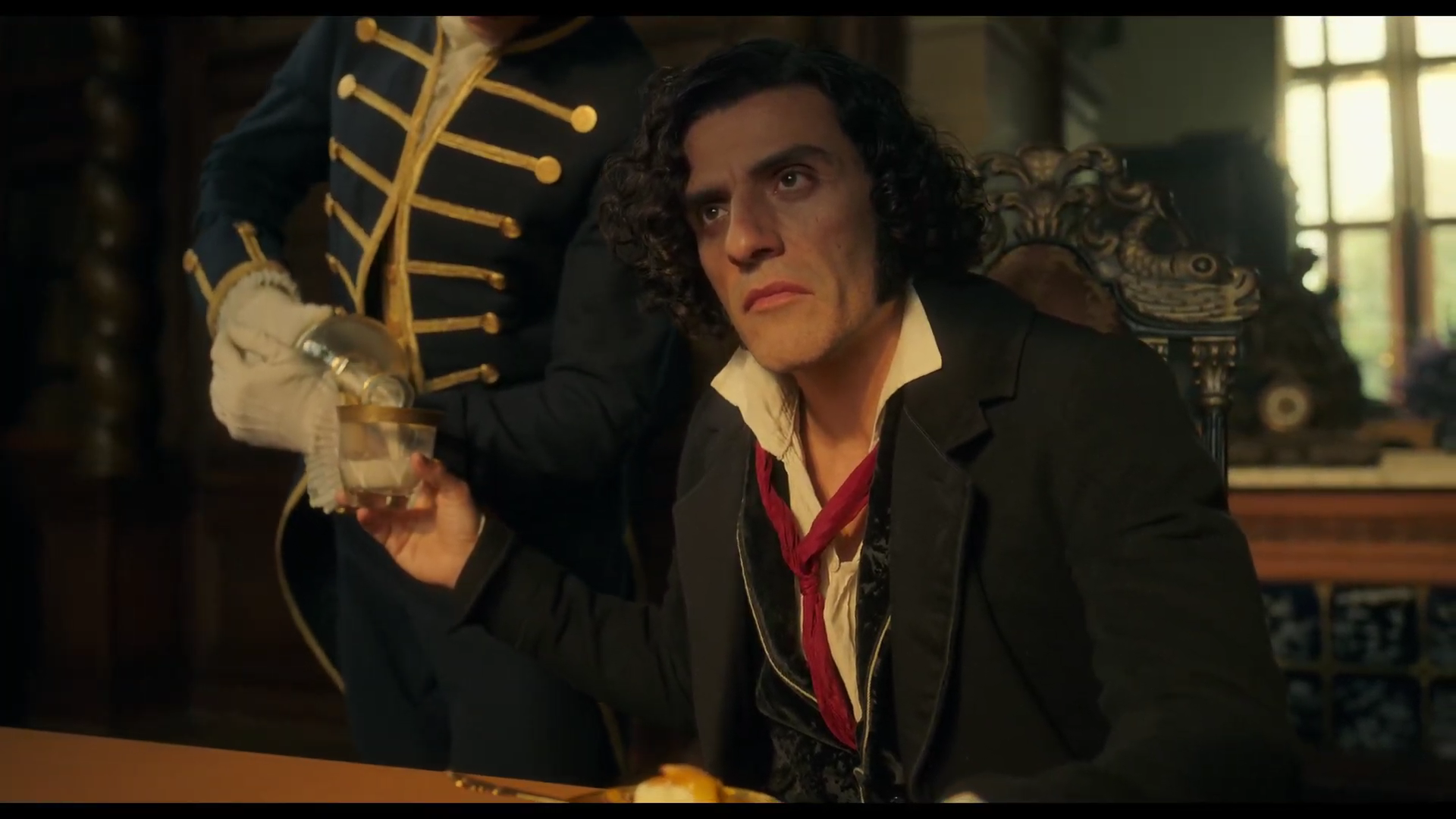
[2.5] However, this “turning away” that Freud describes in The Ego and the Id does not seem to have taken place fully in the case of Victor Frankenstein. Obsession with the mother (or the mother’s breast, as Freud says above) is still present, at least symbolically, as evidenced by the poignant pattern of Victor drinking milk exclusively throughout the film, which highlights his stunted maturity; the film also gives us the recurring image of an ivory puzzle shaped like a pregnant woman (Figures 1-4).
Figures 1 & 2: Victor drinks only milk throughout the film, perhaps a sign
of his infantile obsession with his mother
Figures 3 & 4: The recurring figure of an ivory puzzle shaped like a pregnant woman
[2.6] The film reminds us--now that Victor’s creation is near completion, near rebirth--of Victor’s mother, for whom he has been doing this for all along. All of the hard physical and mental labor we have just seen has been done in service of Victor’s mother, whom he has lost too soon. Where Victor's ego should have turned away from this Oedipus complex, he instead resents his father, blaming him for his mother’s death, and then overidentifies with his mother to the point of almost total absorption: Victor himself is now the mother to his own creation--his son, whom he only accepts in his final breaths: “forgive me… my son…” (del Toro, 2:16:48). Though, as is seen through his utter lack of parenting ability once his creation comes to life, Victor’s identity as a mother is not immediately recognized for what it is; instead, the film suggests the analogy of Victor as God, which is a much more masculine shaped life-bringer metaphor. The symbolic messaging of the operating table raising up in a crucified “Y” shape to imbue the Creature with life is blatantly clear (and also not new, as similar symbolic depictions are seen in Frankenstein (1931) and Bride of Frankenstein (1931)) (Clip 1). As much as the religious symbol equates the Creature’s suffering with Christ's, it simultaneously serves to tie Victor to Godhood metaphorically. He is playing with life force, and to do so is to play God.
Clip 1: the operating table raised into an upright, crucified position
[2.7] Assuming such a position entails taking on a certain sense of power and authority within oneself, and Victor thoroughly embodies that power. In “White,” Richard Dyer breaks down whiteness as an ethnic category in film. He explains that whiteness is difficult to identify head-on because “white power secures its dominance by seeming not to be anything in particular, but also because, when whiteness qua whiteness does come into focus, it is often revealed as emptiness, absence, denial, or even a kind of death” (Dyer 1988, 44). This ideal of assuming godhood rhymes with the idea of accepting white, often male, superiority as a baseline fact rather than as a choice or even a strange trait. It is not lost on me that Oscar Issac is Mexican, which muddies this argument for a specifically white sense of superiority over others. However, both del Toro and Issac have spoken about how this shared Latin identity has influenced their take on the story. Issac discusses how del Toro was vehemently adamant about how his Victor Frankenstein being Mexican was important to him and not just an accident of casting; Issac claims that, “This is like a very European story told in an extremely Latin point of view” (GQ 2025, 6:50). Despite this, the base story’s setting in a very white European mindset allows Issac to assume that sense of white male superiority from Frankenstein's original character. This status allows him the privilege to “expand the narrow limits of academia” (del Toro, 00:20:58) as well as access to everything and anything he could possibly need for his experiments. Henrich Harlander, another white male, is an enabler of this privilege; his power manifests through his money and through providing any and all technology Victor needs in his pursuit of science. Between Victor's intelligence and Harlander’s money, the two establish this project as a manifestation of just how far white male power can take them, even merely as the invisible support beneath the surface.
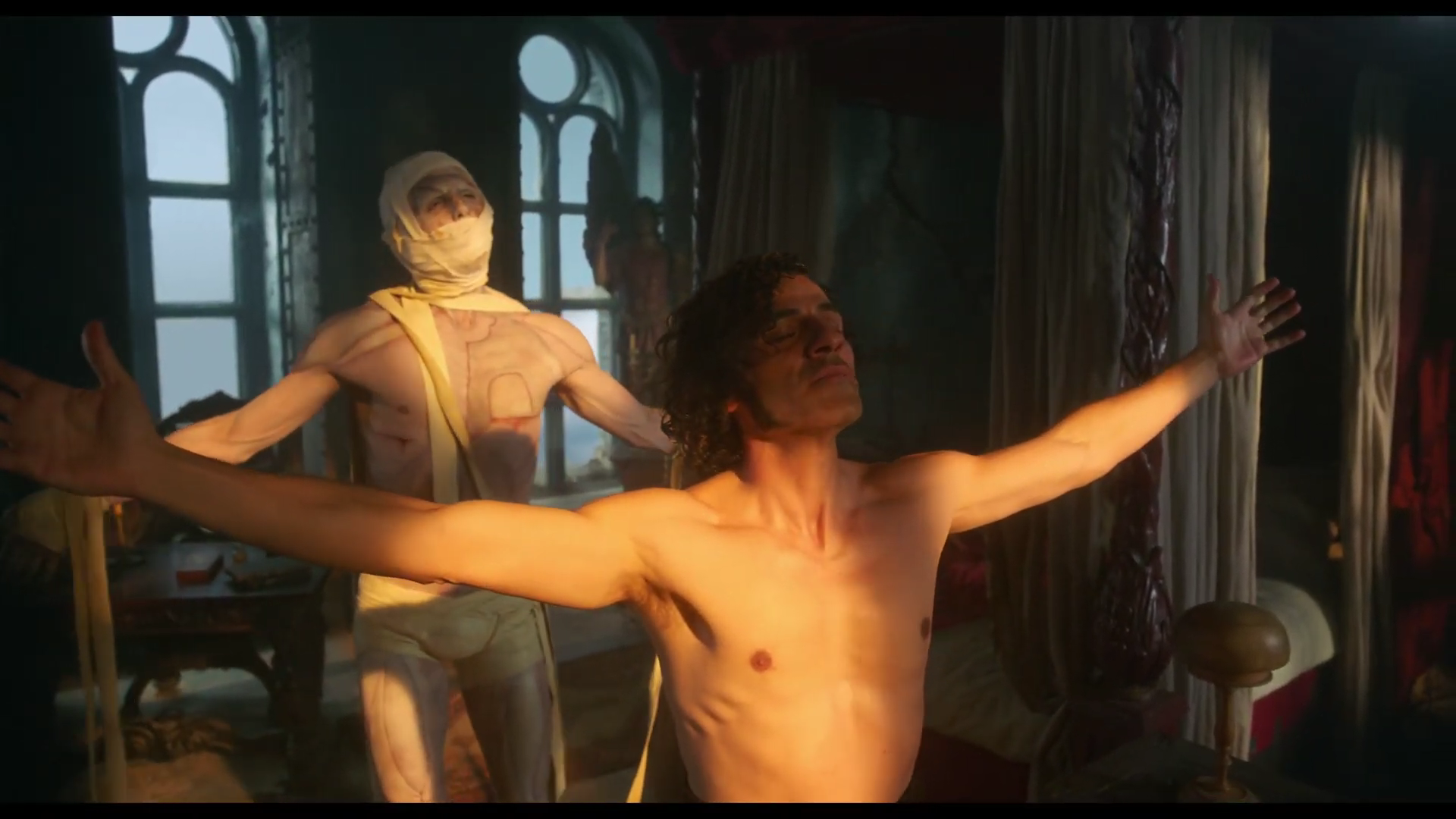
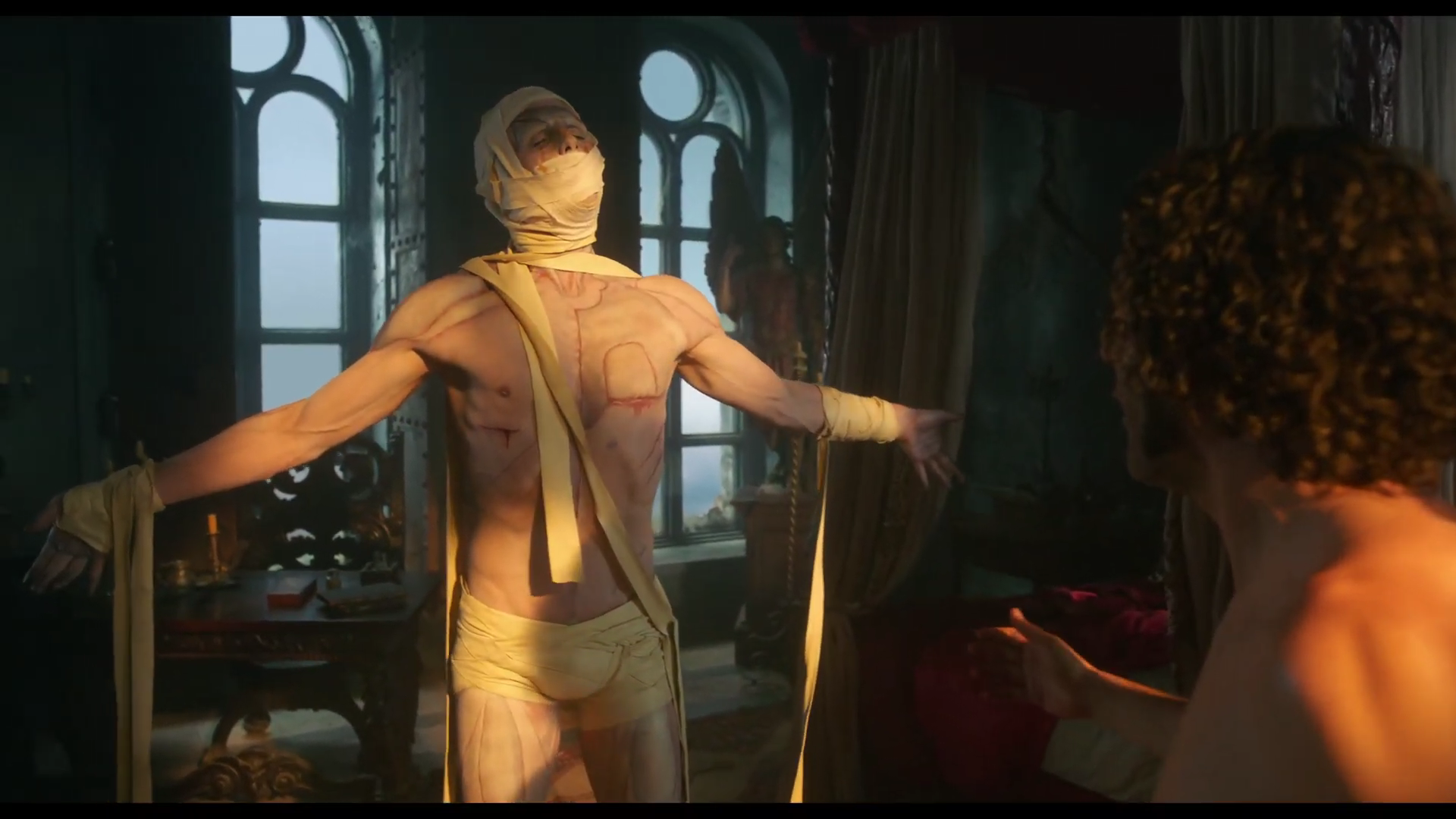
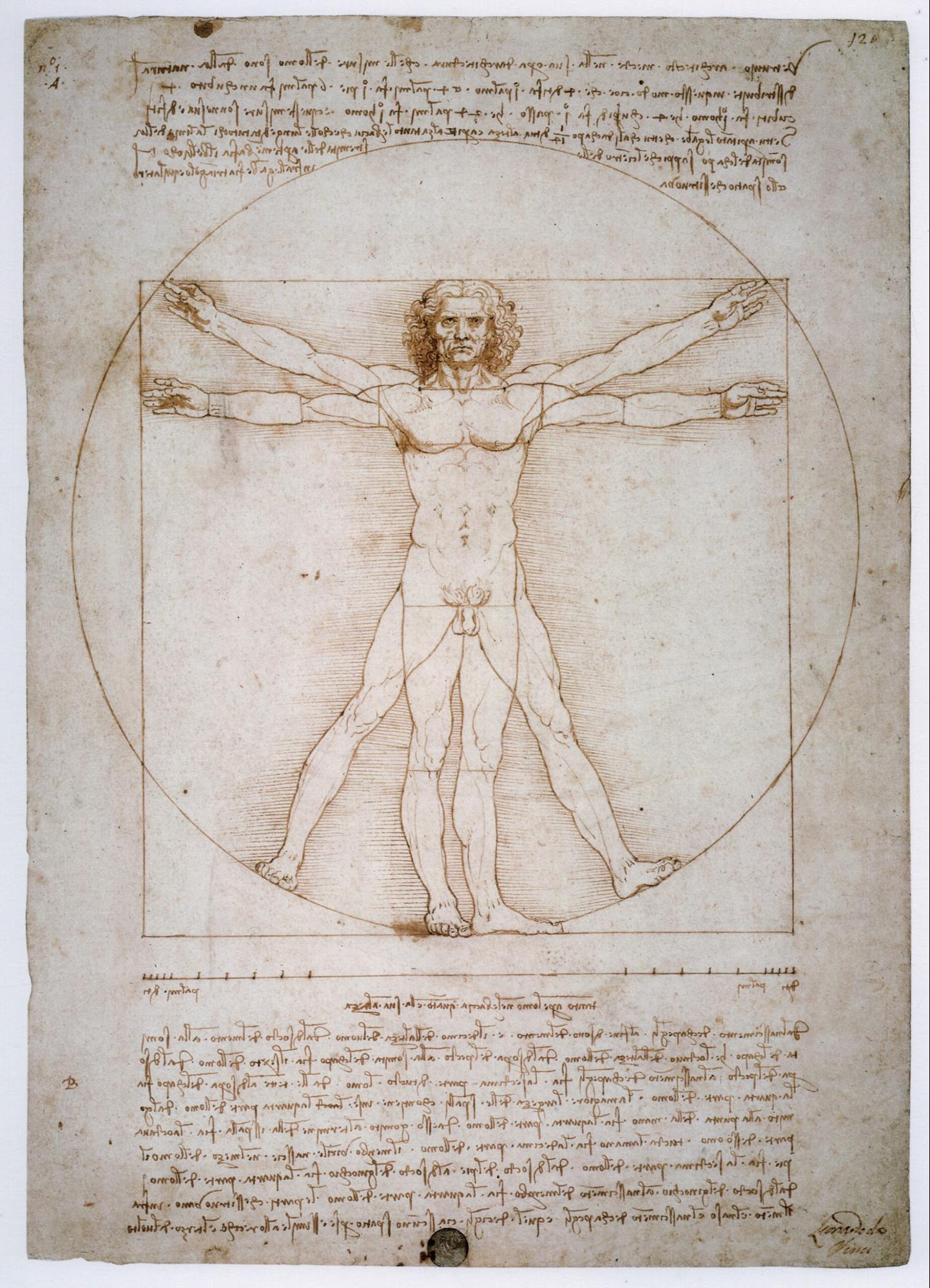
[2.8] The Christian implications of white power go even further. Even though Victor does not blatantly state it (he is focused more directly on the idea of conquering death), the idea of creating the perfect man haunts his work. That desire manifests through his carefully selected specimens (“No! No, do not take any bodies from the top or the bottom of the pile unless I mark them!” (del Toro, 00:51:42)), precise handiwork (“No coarse stitching needed by my own technique.” (del Toro, 00:22:59)), and the fact that the half of a man (presented center stage as a spectacle for the surgical theatres court) that he does reanimate doesn’t seem to be enough to be satisfactory. Had simply “cheating death” been his main goal, then Victor would have accomplished it at that stage. Instead, he persists, crafting a gigantic statue of a man. Guillermo del Toro has even stated that, “if Victor has been looking forward to creating that, it should look superior to man” (Netflix 2025, 4:13). His creation must be of the utmost perfection if it were to be superior to mankind. The Creatures motions not only evoke the crucifixion pose (Clip 1), but also the image of Da Vinci's Vitruvian Man. After Victor introduces his Creature to the sun, the Creature mimics him and spreads his arms, trying to embrace the warmth (Figures 5-7). This, while Christ-like, also demonstrates that Victor's pursuit of perfection has succeeded; he has meshed the earthliness of various corpses with the divine power of given life. It’s also no coincidence that The Creature is as loomingly tall as he is strong. He is the culmination of Victor’s lifelong work, and therefore, he must have certain qualities that the white man considers crucial to manhood.
Figures 5 - 7: parallels between Victor and the Creature’s crucified pose,
and DaVinci’s Vitruvian Man
[2.9] In “The White Man’s Muscles,” Richard Dyer explores the restrictions around seeing white male bodies semi-naked on screen. He delineates there are “set terms” that must be fulfilled in order for a spectator to be able to look at the naked white male body, explaining that, “the white man has been the centre of attention for many centuries of Western culture but there is a problem about the display of his body… a naked body is a vulnerable body” (Dyer 1997, 146). Dyer argues that representations of the white male body must be of absolute peak performance, physically showing power and domination through crafted musculature, aka bodybuilding [note 1]. He explains that, “the built body is an achieved body, worked at, planned, suffered for. A massive, sculpted physique requires forethought and long-term organization… In short, building bodies is the most literal triumph of mind over matter, imagination over flesh” (Dyer 1997, 153). While Dyer is referring to a male actor’s sculpting of his own body, in Frankenstein, Victor quite literally builds a perfect body, if through slicing and stitching rather than through disciplined exercise regimes. The Creature’s body is thus an external representation of his own personal “triumph of mind over matter,” a demonstration of his intellect and the highest achievement of his career. Victor’s success establishes his sense of superiority, which, for bodybuilders, is of the body, but for Victor also proves, if only to himself, that he is better than his father, “the most distinguished doctor of his day” (del Toro, 00:18:09). In that sense, Victor seeks to prove his white male mental superiority, though he is using very much the same process that bodybuilders use to establish physical superiority.
[2.10] Dyer also establishes that muscleman films, which show off the male body, often include “sequences showing such disciplined physical preparation… their bodies… carry the signs of hard, planned labour, the spirit reigning over the flesh” (Dyer 1997, 155). Instead of a training montage, we watch Victor slave over the tedium of assessing, cutting, examining, combining, stitching, and cleaning. For nearly five minutes straight (del Toro, 00:52:37 - 00:56:06, Clip 2), we watch Victor hard at work as the Creature is built, bit by bit, by his own hands. Perfection is certainly taken into account here; his movements are calculated as pieces come together until the Creature is finished. Years upon years of discipline, knowledge, planning, and studying are put to use in every carefully orchestrated move. The “forethought and long-term organization" that Dyer finds characteristic of displays of the “built” body is clearly visible in not only his actions but also in the overwhelming amount of notes that fill any empty space in Victor's laboratory. This more technical display fulfils the same purpose as the training sequence. The process serves as a source of authenticity of his work; in the same way that the bodybuilding montage proves that male physical superiority is the determination and triumph of carefully conforming to a regime. The film visually proves Victor’s intellectual superiority and his own triumph “reigning over the flesh” in a much more literal, godlike sense. In this way, Frankenstein is the story of the original “built” body.
Clip 2: bodybuilding montage sequence]
[2.11] This is why it is unfathomable to Victor when the Creature ends up, alive and breathing, at the bottom of his bed. A new problem has arisen: Victor can no longer simply objectify the dead cadaver on his operating table. Now he must take the will he himself has inscribed into this body into account. The body that was serving as an extension of both his own body and mind is now disconnected, and the metaphorical umbilical cord has been cut. In short, a separation has occurred where this body, this built form made to showcase all of Victor's intellect, this triumph, no longer belongs to him. It may initially be thrilling, yes, (Victor does admire and hold his creation tenderly in their first moments together, if only to check for a heartbeat), but the next time they are seen, Victor is guiding the Creature into the sewers to chain him up and leave him there, alone (Clip 3). Victor does not know what to do with him, as he admits when he says, “I never considered what would come after creation” (del Toro, 1:07:21), other than to reestablish his superiority over the Creature through physical restraint and oppression.
Clip 3: Victor chains up the Creature
[2.12] Outwardly, this scene feels like the warm early connection and play between father and son. Victor attempts to explain water and fire as he shows the Creature the world, but dread sets in when the first shackle goes on. Anxiety can be heard lacing Victor’s laugh as he first observes the Creature’s strength; he is afraid. In “White,” Richard Dyer argues that zombies in horror movies are nearly always white because zombification [note 2] is particularly terrifying to white people (and thus more cinematically scary). Dyer goes on to explain that this is because, “‘the fear of one's own body, of how one controls it and relates to it’ and the fear of not being able to control other bodies, those bodies whose exploitation is so fundamental to capitalist economy, are both at the heart of whiteness” (Dyer 1988, 63). This holds true in Frankenstein, too; Victor is terrified and unable to cope with suddenly not being able to control the body in front of him, the body he once was God over. The Creature can now speak and act on its own accord. Victor’s superiority is now secondary to that of the body that represents his work; no longer an object, but instead the paradigm of the perfect, muscular white man. Victor claims, when asked by Elizabeth, that chaining the Creature up is “for his own safety, and for mine, and it’s easy to clean and, uh, maintain it. And it doesn't know any better” (del Toro, 1:16:16) but it is obvious, perhaps even by the way the words come vomiting nervously out of his mouth, that this is an excuse. The real reason is that it is the only thing he can think to do to regain some semblance of power and superiority over the creature he built to be male perfection itself. Similarly, Victor refuses to have the creature seen by the Royal Medical Society; as the body he has built is external and not his own, Victor does not feel personally represented by his work. Victor claims that, “the achievement felt unnatural… void of meaning. And this troubled me so” (del Toro, 1:07:33), admitting that having all of his hard work be ripped away to reside in another body deprives him of any triumph the act was supposed to provide him.
[2.13] In despair and frustration over what he impatiently sees as utter failure, Victor blows up the tower. In her article “Her Body, Himself,” Carol Clover explores the use of phallic symbols in regards to gender dynamics in slasher films. She discusses various kinds of weaponry as being charged with different metaphorical sexual drives, but, as Clover notices, “all phallic symbols are not equal” (Clover 198). In Frankenstein, phallic symbols appear as extensions of Victor’s intelligence, heightening the superiority complex of his masculinity. Three notable ones are prominent. The first is a boxed set of prongs he uses during the building montage that screws into the crown of the operating table to conduct the electricity (Figure 8). The second is the lightning rod system situated above (Figure 9). The connotation here with both is that these are the transmitters of the spark of electricity needed to jumpstart the lymphatic system, the life givers. The fact that the lightning rod system must extend multiple times to be in the correct position simply adds to the phallic power of this symbol. And the final phallic symbol is the tower itself (Figure 10). It sits tall, formidable and mighty on the cliff face, wide shots allowing for long moments of admiration for the building and what it symbolizes.
Figures 8-10, phallic symbols in Frankenstein
[2.14] The tower is the home to all of Victor’s progress, the physical location where his triumph of life over death, “imagination over flesh,” takes place. In many ways, the tower is Victor himself: it has been renovated to fit his every need, and the looming phallic shape of it reinforces his male status. To set it on fire and have it explode is a metaphor for Victor’s intelligence and superiority failing. It is self-destruction. Not only does Victor lose the tower and everything in it, but he also loses a limb as well (Clip 4), another symbol of phallic power. Destroying a piece of himself does not come without consequence; the white male does not want to submit to vulnerability, and this sequence shows just how drastic that can be through the symbolism of Victor’s tower exploding.
Clip 4: The tower exploding
[2.15] So if this is what the story does to Victor, what does it mean for the Creature?
[3] The Creature's Tale
[3.1] In Victor’s failure, a new soul is reborn. The victim comes into this world, not to screams, but to looks of perplexed astonishment. He is visually revered just as much as he is repressed; the two go hand in hand. If Victor is the disciplined mind who built a body, what implications does that have for the man who lives within it, whose body has been built by someone else?
[3.2] As fundamental as the act of building the body is to Victor’s character, being the body is just as crucial to the Creature’s. Dyer delineates that, “the built white body is not the body that white men are born with; it is the body made possible by their natural mental superiority. The point after all is that it is built, a product of the application of thought and planning, an achievement. It is the sense of the mind at work behind the production of this body that most defines its whiteness” (Dyer 1997, 164). But this is a problem in Frankenstein because this highly sculpted picture of perfection is the body the Creature was born with. He was not the mind that worked, even slaved, over his form, and in fact, his mind likely did not even come from the same bodies the rest of him did. Without asking for it, the Creature is thus thrust into a status of being the highest of achievements, the perfect male form. Where this achievement brings a sense of triumph and intellectual superiority for Victor, the Creature has no preconceived stake in the matter and he is not necessarily concerned with achieving a sense of white male superiority in the same way. Victor’s precise handiwork forces the Creature into a performative role, placing him in the unique situation of contradictory authorship over the discipline his form suggests.
[3.3] There is something intrinsic in the way the Creature’s built body becomes spectacle. Victor has worked very hard on him, perfecting each stitch to create the ideal superior shape of man, his personal Adam, and so it follows that the result would be a beautifully, highly cared-for manifestation. Guillermo del Toro reinforces this idea, saying, “I don’t want it to look like an accident victim, I want it to look like something newly minted, firstborn. So I do no scars with stitches or blood. And we wanted to make him beautiful…” (Netflix 2025, 4:01) to highlight Victor's crafted talent and dedication to divine perfection. The Creature is the main source of spectacle; del Toro’s movie revolves around him as the centerpiece of a complete piece of visual pleasure.
[3.4] Laura Mulvey discusses spectacle in her article "Visual Pleasure and Narrative Cinema”, establishing that the woman is the typical central piece of visual fascination in film. She writes that, in a patriarchal society,
[3.5] “The determining male gaze projects its fantasy onto the female figure, which is stylized accordingly. In their traditional exhibitionist role women are simultaneously looked at and displayed, with their appearance coded for strong visual and erotic impact so that they can be said to connote to-be-looked-at-ness… The presence of women is an indispensable element of spectacle in normal narrative film, yet her visual presence tends to work against the development of a story-line, to freeze the flow of action in moments of erotic contemplation” (Mulvey 19).
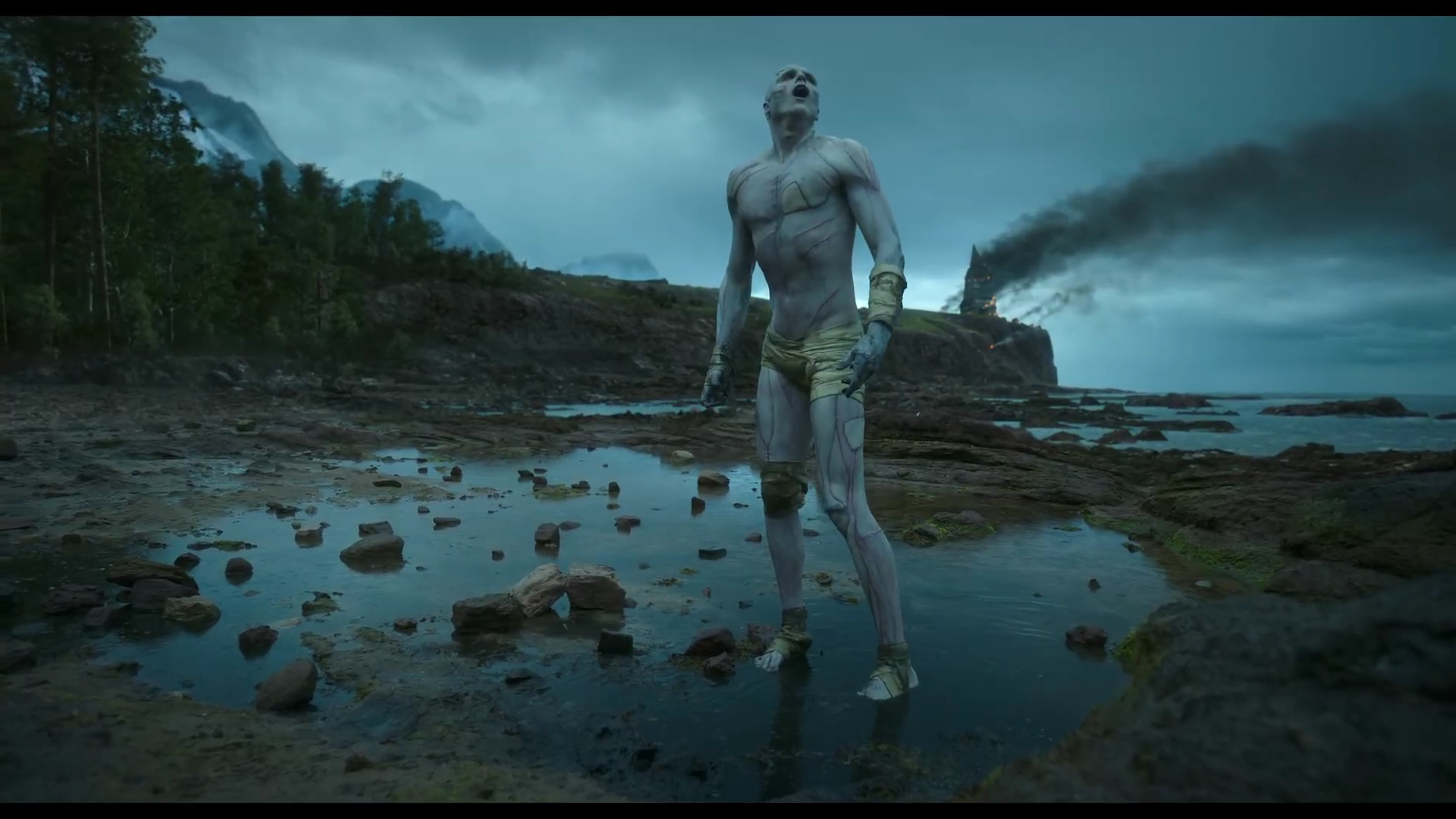
[3.6] Where for Mulvey it is women that are the bearers of the look, here it is the Creature, and rather than explicit erotic contemplation, the spectacle is here for spectacle's sake, a fascination for both the aesthetically pleasing image of Elordi’s makeup transformation as well as Victor’s fine detailed patchwork (Figure 11) [note 3]. Victor's initial gaze at his body is of awe, still lacking comprehension that what he is seeing is the truth, alongside a narcissistic personalized sense of pride for his own handiwork, now in a living form to be admired and looked at from a different angle/perspective. Naturally, due to the manner of his existence, the Creature is “stylized accordingly” to Victor’s design, and his purpose of being a display of his intellectual abilities situates him quite firmly in this female role. Despite the hypermasculinity of such an intensely built body, there is a contradiction in the way the Creature is treated that makes his gendered position blurry at best.
Figure 11: a long shot of the Creature standing up, offering space for gazing
[3.7] Mulvey also uses further Freudian psychoanalytic theory to discuss the spectacularization of women on the screen, with part of this theory being the idea of fetishes, where a piece of the body is taken out of the context of the whole as a specific site for desire. She explains that this is an element of the male gaze that often manifests through fragmented shots of the female body, writing, “the beauty of the woman as object and the screen space coalesce; she is no longer the bearer of guilt but a perfect product, whose body, stylised and fragmented by close-ups, is the content of the film and the direct recipient of the spectators' look” (Mulvey 22). While women are often cut up into cinematic pieces for sexual emphasis, Frankenstein offers a much more embodied equivalent. The Creature is literally made up of pieces, the best pieces of varied men, in fact, not unlike how the male gaze cuts up women into the most attractive and desirable parts to be ogled at. Perhaps he is not outwardly sexualized, but the feminization of being a form made of perfected parts to be gazed at and studied by onlookers' eyes is an inherently feminine position that challenges any notion of implied masculine gender [note 4]. However, this idea of a body cut up is also reinforced by bodybuilding; Dyer establishes the visual and symbolic connections between the bodybuilder and suits of armor or Greek statues, stating, “the built body is hard and contoured, often resembling armour… the skin stretched over pumped up muscle creates a taut surface, the separation of groups seems, as bodybuilding jargon has it, to ‘cut’ into the body as into stone” (Dyer 1997, 152). Once again, the body is being cut into purely desirable parts, but this time in a very masculine way. Victor’s work, as previously stated, makes him a collage of perfect male pieces, cut and stitched into place until his statuesque figure is complete. Both of these notions can be and are true at the same time. Embodying the two simultaneously leads to a deep sense of gender confusion that is reinforced by the actions of those around him.
[3.8] This collective feminization thread is why the Creature’s connection with Elizabeth, while original to del Toro and debated upon in reviews, is crucial to understanding the deeper issue of gender confusion. There is a mirrored exploration of one another when they first meet in the sewer system. Elizabeth’s look is one of curiosity, and the Creature’s in return is one of searching for similarity; the same seeking gaze he holds for everything new, the same for himself in the mirror and the same for the carving on the wall. A sense of maternal connection is established in their first meeting: this “older fascination with looking… at the mother’s face…” arises in a new opportunity to determine the self from others, not unlike him contemplating his hands as “same” as Victor's (Mulvey 18). He allows her to look, to marvel and explore, likely as habit from Victor’s initial paternal awe, and understands, and reciprocates, the curiosity she holds for him. As a parallel, Elizabeth sees herself in his chained oppression just as much as she feels this motherly sense of protection towards him. Elizabeth’s wardrobe is a close second on the list of the most emblematic, striking spectacles in the film. Like the Creature’s meticulously built body, Elizabeth’s intricately made gowns represent her identical issue with being a passive feminine figure, her voice repressed and ignored (“Surely you’ve heard my niece expound on the matter before” (del Toro, 00:34:37)); she, too, is treated her simply as a mindless, inactive, objectified spectacle. When Victor confesses his affections for her, she feels betrayed; the man with whom she thought she had a mutual bond of understanding, a similar affinity for odd science, is just the same as all the others who see her merely as a female object. She sees that pain and misunderstanding reflected in the Creature through just the spectacle of his body, his genuine curiosity for the world, and the way Victor oppresses him [note 5]. Such a status creates a lonely existence, as being perceived as a pretty object does not allow for genuine connection. As she fades, bleeding out in the Creature’s arms, Elizabeth says, “I sought and longed for something I could not quite name. But in you, I found it… better this way, to fade, with your eyes gazing upon me” (del Toro, 2:07:25). Her final words imply that the Creature’s gaze is safer and more genuine than the oppressing male gaze they both suffer under. This admission of their intimate understanding relationship truly solidifies the Creature's position as a feminized character.
[3.9] Being looked at manifests in another, reversed form in this film as well. Mulvey explores the audience's visual fascination with film as a circumstance of scopophilia and the fascination with the human form, but the same basic ideas can be applied to the characters within Frankenstein. She states that, “the conventions of mainstream film focus attention on the human form” and emphasizes that it is there that, “curiosity and the wish to look intermingle with a fascination with likeness and recognition: the human face, the human body, the relationship between the human form and its surroundings, the visible presence of the person in the world” (Mulvey 17). The Creature lives this experience as he explores the world for the first time. Truly a newborn, he is curious about all of his surroundings as he tries to figure out what or who he is and where his place in the world may be. As Mulvey states, “it is an image that constitutes the matrix of the imaginary, of recognition/misrecognition and identification, and hence the first articulation of the I, of subjectivity” (Mulvey 18). The Creature learns by looking, watching, and mimicking, using the images of the world he sees around him to experience and explore, even at a stunted, oppressed pace. In their first meeting, Victor introduces himself by pointing to his chest and saying his name, an action the Creature immediately copies (Clip 5).
Clip 5: the Creature mimics Victor's movements and introduction
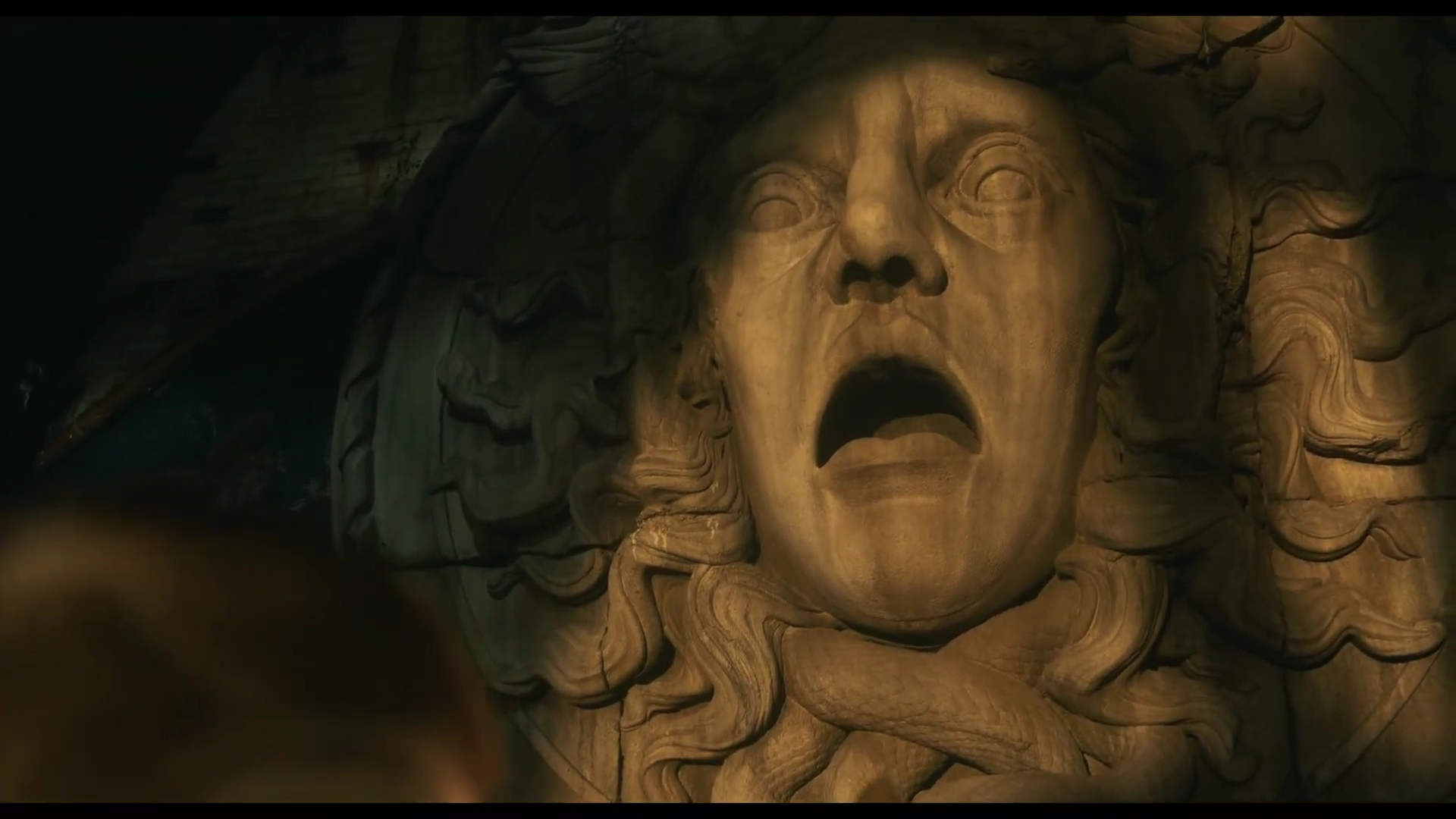
[3.10] Misrecognition occurs here in how he believes himself to be Victor as well; similarly to early childhood stages of development, he does not understand where he begins and ends, believing himself to be merely an extension of the parent. He also copies Victor’s Vitruvian pose, imitates Medusa’s face on the wall (Figures 12 and 13), reciprocates Elizabeth’s curiosity, and matches Victor’s anger (Clip 7). Through this process, he, like a child would, discovers himself, what he is and where he stops, and begins the growth of autonomous individuality.
Figures 12 & 13: the Creature mimics Medusa's expression
[3.11] Mulvey also mentions Jacques Lacan’s description of how “the moment when a child recognizes its own image in the mirror is crucial for the constitution of the ego” and describes the ways in which this moment leads to self-identification by saying,
[3.12] “Recognition is thus overlaid with misrecognition: the image recognised is conceived as the reflected body of the self, but its misrecognition as superior projects this body outside itself as an ideal ego, the alienated subject which, re-introjected as an ego ideal, prepares the way for identification with others in the future. This mirror moment predates language for the child” (Mulvey 17).
[3.13] A mirror scene showcasing this development appears shortly after the Creature’s rebirth. Victor has him seated to shave his head in order to check on his healing scars, but the Creature will not sit still, instead far more interested in his own reflection in a mirror nearby. Victor, begrudgingly, allows him the moment, confirming “yes, that's you” (del Toro, 1:08:37, Clip 6) as the Creature takes in his appearance next to Victor's. Separated. External. Recognizing that the “Victor” who introduced himself initially in the sun may not also be himself (Clip 5). And it certainly predates language; his vocabulary of merely this one word that represents his whole world only expands after this moment when he meets Elizabeth. Suddenly there is a second option, and it is from then on that he begins to recognize and determine how his self-identification is shaped. A good while after fleeing the burning tower, after freedom has allowed him to build his own identity rather than being molded by Victor's oppression, the Creature decides, “I want to know who I am. Where do I come from?” (del Toro, 1:47:41).
Clip 6: the Creature recognizes himself in the mirror
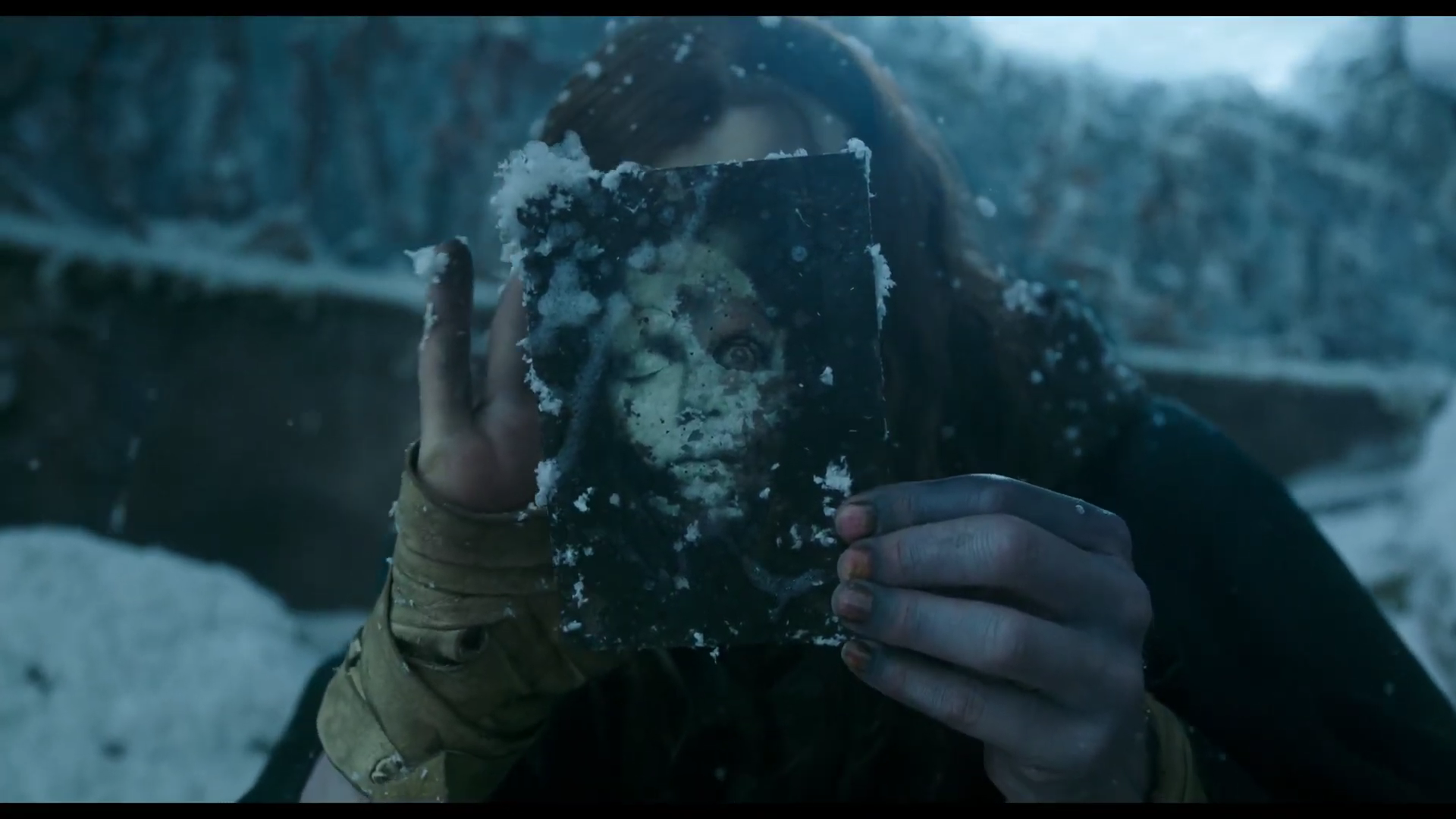
[3.14] Upon returning to the remains of the tower, he finds one of Harlander's photos of his body in progress. In holding the photo in front of his own face, a "long love affair/despair between image and self image” is born (Mulvey 18), and he finally understands the truth of what he is (Figure 14). With the knowledge that he was merely an object to Victor, he can reject him to reclaim the individuality and subjectivity Victor denied him at his rebirth. The initial mirror moment is crucial for the Creature’s overall development because it establishes the groundwork to allow him to actively choose who and what he identifies with later.
Figure 14: cadaver photo over the Creature’s face
[3.15] Action is a crucial aspect of man's sense of superiority. In her discussion of spectacle, Mulvey determines that the weight of gazing is unbalanced:
[3.16] “In a world ordered by sexual imbalance, pleasure in looking has been split between active/male and passive/female… An active/passive heterosexual division of labour has similarly controlled narrative structure. According to the principles of the ruling ideology and the psychical structures that back it up, the male figure cannot bear the burden of sexual objectification… Hence the split between spectacle and narrative supports the man's role as the active one of advancing the story, making things happen. The man controls the film fantasy and also emerges as the representative of power in a further sense: as the bearer of the look of the spectator, transferring it behind the screen to neutralise the extra-diegetic tendencies represented by women as spectacle.” (Mulvey 19 - 20)
[3.17] Victor aggressively claims the role of active male: he is the builder of the body, he is the director of the gaze, and the Creature truly would not have been reborn without his action. This naturally feeds back into his white male superiority God complex. He feels entitled, if not obligated, to chain the Creature up when he realizes he can no longer control him. The feminization starts in this scene: the act of chaining the Creature up keeps him passive and unable to take any action of his own (Clip 3). Not only is Victor ensuring he is the sole controller of the narrative, but he now controls the Creature’s actions as well. The Creature is taught, through actions alone, that he has no autonomy when it comes to Victor's guiding hand; he is meant to be there as a spectacle alone. Victor's demands are contradictory in that he desperately wants him to develop intelligence, yet will not allow him to do anything; repressing his agency stunts his progress, which in turn irritates Victor. This gets frustrating quickly, first displayed through the Creature's aggravated shakes of his shackles when Victor first shows him to Elizabeth and William and then later manifested in an outburst of rage after Victor hits him (Clip 7). He has learned that Victor’s action is forceful and demanding and, now that he’s at a breaking point, brutal.
Clip 7: the Creature retaliates against Victor's abuse
[3.18] Since Victor has established himself as the active male, moving the narrative forward, it is extremely threatening when the Creature, whom he has forcibly tried to demote to female status, takes his own action, primarily through acts of violence. Victor has accidentally taught the Creature violence as dominance through demonstration, each hit solidifying a sour sense of superiority against degradation [note 6]. The only way the Creature can escape the feminizing position Victor has forced him into is to meet him at the same level, utilizing his physical advantage to excel far beyond his creator in the violence Victor thinks masculinizes him. Taking this action is the reversal/mirror of Victor’s Oedipus complex; after an initial, very strong, self-identification with the father, he has learned that pain and suffering come at his hands, leading to a rejection and turning away as he embraces the mother in Elizabeth’s kindness. However, the Creature only reciprocates aggression after being antagonized. Some complaints about this adaptation are regarding the lack of unprompted violence that the Creature displays; one of the conflicting moral linchpins of the novel concerns the Creature’s affinity for violent outbursts, some of which are unmotivated and some that are made with spite toward Victor. As pertinent as this is to the complex moral issues of the novel, del Toro’s decision to restrict the Creature’s violence to retaliation and self-defense opens up consideration for this deeper sense of gender confusion. He does not necessarily want to be a violent creature, but he is a slave to his own strength in the body Victor built [note 7]. The only way he can be taken seriously as a male figure, to gain recognition as an individual rather than just an extension of his creator, is when he feeds into his body's strength. According to scholar Kate McCarthy, the desire for violence “taps into an old blues tradition, the assertion of manhood, of ‘somebodiness,’ through acts of violence against a world whose more subtle violence the protagonist can no longer bear” (McCarthy, 27). The Creature insists he is “not something, someone. You made someone” (del Toro, 2:02:28), and when Victor does not believe him, he must prove it, throwing him, with the unnatural power Victor blessed him with, through the posts of his bed (Clip 8). As a parallel, the entire film associates spectacle with the creature, so it follows that the spectacle of gore and violence would be linked to him as well. So in some ways, the film itself does not allow him to fully escape the feminization of spectacle even as he chases masculinity.
Clip 8: The Creature shows his strength
[4] Closing Thoughts
[4.1] Guillermo del Toro’s Frankenstein is a cinematic masterpiece on all fronts. His take on the classic story has given it such a rich revamp, full of stunning visuals, emotional depth, and complex themes. His personal added elements enhance the iconic tale with a deep sense of personal vulnerability; his changes are crucial for the larger concerns he is attempting to convey. Both monsters are abundantly full of meaning. Victor’s quest for Godhood showcases his obsession with perfection and male superiority to a self-destructive level. The Creature embodies a challenging battle with gender confusion; such a deep dive into the complex feminizing allegory of his character may hopefully shine some light on why female audiences have connected with the creature so strongly, both in this interpretation and others. Guillermo del Toro has created a fresh landscape for delving into the deeper issues lying just below the surface and hiding in every symbol within the world of one of the most revered stories of all time.
Notes
1. It is no mistake that the only time we see Victor naked is when he discovers the key to reanimation; he is at the height of his mental capacity at that moment, equating the power of the vulnerable body with his intellect.
2. The feeling of zombification is also felt simply through the amalgamation of dead body parts the Creature is made out of; his stark whiteness enhances Dyer's connection of white people to zombification if just through visuals alone. Dyer also establishes a connection between whites and the fear of losing the cerebral (“The first recalls the liberal critique of whites as ruled by their heads; as the radio announcer says, ‘Kill the brain and you kill the ghoul’ since, it seems, zombies/whites are nothing but their brains.” (61)). Since so much of Victor's existence is driven by his dedication to proving his intelligence, it makes sense that this concern would be reinforced this way.
3. If you’ll recall from paragraph 2.9, Dyer writes that being naked is fundamentally vulnerable and therefore unacceptable to the white man. This shot of the Creature dually places him in the position of embodying the female spectacle while also fully displaying Victor's proud achievement of perfect manhood; it is an acceptable shot only because the Creature is the pinnacle of ideal form though it’s simultaneously damning as feminized erotic vulnerability. As the Creature progresses through self awareness and maturity, he becomes increasingly more clothed up until he is barely visible underneath multiple layers of wraps and furs (the ending/beginning arctic scenes). This conscious action allows the Creature to reject both the male position of embodying the perfect sculptured form as well as the degrading, feminized position as an objectified spectacle by hiding the body he is solely meant to be seen as in either position. This act does not resolve or clarify the Creature’s gender confusion.
4. This idea of female figures as pieces of a whole is also initially established long before the Creature is even created through Victor's ivory pregnant puzzle (see Figures 3 and 4). Here, another symbol feminizes the Creature before he is even complete; Victor clearly takes inspiration from this puzzle while still in the building process, subconscious degrading feminizing influences likely taking hold.
5. Elizabeth reinforces that Victor does not understand his creature nor parenting, suggesting other worldviews other than his hypermasculine one, when she says, “Perhaps not as you understand it” (del Toro, 1:20:13) after Victor claims he doesn’t have ‘the spark of intelligence’ that he had anticipated.
6. Reinforced here is also the generational trauma of physical abuse that Victor endured as a child from his own father. That is the only kind of paternal love he knows, having improvement drilled into him through the strikes of a cane (mirrored by the iron bar Victor hits the Creature with in Clip 7), and so he feels the need to do the same to the Creature when other methods fail him. This abusive action is his one true attempt at parenting.
7. The Creature's appearance directly causes him pain; on multiple occasions, he is attacked, unprompted, merely for appearance alone. Hunters in the woods shoot at him without taking even a moment to consider what they're looking at, and Anderson’s men attack without hesitation before the Creature even gets close enough to do any harm. This spontaneous violence complicates the idea of spectacle more; where once he was revered and admired for his figure, he is now harmed without hesitation for no explained reason.
Clover, Carol J. 1987. “Her Body, Himself: Gender in the Slasher Film.” Representations, no. 20: 187–228.
del Toro, Guillermo, director. 2025. Frankenstein. Double Dare You, Demilo Films, Bluegrass 7.
Dyer, Richard. 1988. “White.” Screen, Volume 29 (4): 44–65.
Dyer, Richard. 1997. “The White Man's Muscles.” White, Routledge, pp. 145-183.
Freud, Sigmund. 1961a. “The Dissolution of the Oedipus Complex.” The Standard Edition of the Complete Psychological Works of Sigmund Freud, The Hogarth Press, pp. 173-179.
Freud, Sigmund. 1961b. “The Ego and the Super-Ego (Ego Ideal).” The Standard Edition of the Complete Psychological Works of Sigmund Freud, The Hogarth Press, pp. 28-39.
GQ. 2025. Oscar Isaac: The Star Wars Resistance & Frankenstein’s Real-Life Roots. YouTube, https://youtu.be/XciB_FC2fzs?si=9f66I6y4N8SWMffm.
McCarthy, Kate. 2001. “Deliver Me From Nowhere: Bruce Springsteen and the Myth of the American Promised Land.” In Mazur, Eric Michael, and Kate McCarthy, eds. God in the Details : American Religion in Popular Culture. New York: Routledge: 20-40.
Mulvey, Laura. 1989. “Visual Pleasure and Narrative Cinema.” Visual and Other Pleasures. Bloomington and Indianapolis: Indiana University Press London Afterall Books. 14–26; first published in Screen in 1975.
Still Watching Netflix. 2025. How Guillermo del Toro Made Frankenstein - Film School. YouTube, https://youtu.be/tThIpKCXfJI?si=Lur1bBdezdm3xCRm