[0.1] Abstract - Laura Mulvey sees objectified women in film as linchpins of the patriarchal system, but The Texas Chainsaw Massacre films put unrepressed, less-feminine women at their center.
[0.2] Keywords - horror, slasher, fetish, male gaze, gender, performance, phallus, pleasure, scopophilia, violence, body genres
[0.3] Trailer -
Dlugos, Kristin. 2026. “The Massacre of Social Constructs: Subverting Traditional Gender Roles in The Slasher Sub-Genre,” Muhlenberg Visions. Volume 4, No. 1.
[1] Introduction
[1.1] Between the years of 1974 and 1986, Tobe Hooper released two films in a franchise that would soon make a long-lasting impact on the slasher genre. Within this time period there was an evolving aesthetic not only in the film industry, but also in the world of feminism. The “Final Girl” was a new trope that belonged to the sub-genre of film we call horror (or slashers). Women were often seen as “second” to men within the film industry, but this trope brought new perspectives. The Texas Chainsaw Massacre, released in 1974, is a living nightmare that follows a group of friends heading to a homestead in Texas, where a killer family resides just next door. These five young people are picked off one by one by this family of cannibals, who live in a house filled with bones, skin, and mummified corpses. The sole survivor, Sally Hardesty, having nearly met her demise time after time, manages to escape by dawn with the help of a passing truck driver. The sequel, Texas Chainsaw Massacre 2, is set in a new time period with new victims. Now known as The Sawyers, the cannibals are an older yet much more successful family due to their business in the meat industry. We meet Stretch Brock, a young and aggressive woman working for a radio station. After Stretch discovers a crime committed by the family through her broadcast, Mr. Sawyer sends Chop-Top and Leatherface after her. She manages to swindle The Sawyers by out-smarting them and their psychotic ways and lives to see another day.
[1.2] These films' gruesome moments were monumental in the history of the slasher genre, which shifted many traditional social and film norms for years to come. The role of the main killer, Leatherface, has many qualities beyond pure insanity. Though he wields a large chainsaw and relentlessly butchers his victims, there’s more to him than what meets the eye. Through the various masks he wears, both male and female, he showcases a feminine embodiment through his un-fixed, constructed gender identification. The mask he wears is indicative of the “role” he wants to play in that given moment. Stretch’s character in The Texas Chainsaw Massacre 2 showcases a new kind of final girl who not only outsmarts the killer, but unleashes a new side of the monster. By utilizing scholarly articles by Laura Mulvey and Carol J. Clover, I will analyze Leatherface and the two Final Girls, Sally Hardesty and Stretch Brock. Mulvey’s article describes objectified women as linchpins of the patriarchal system, but The Texas Chainsaw Massacre franchise puts unrepressed, less-feminine women at the center. With Clover’s analyses, I will utilize the structure of the horror genre to examine particular scenes in Texas Chainsaw Massacre through the lens of sex and gender.
[2] Analysis of The Slasher Genre
[2.1] For as long as anyone can remember, society was raised to act civilized. Respectability was always the prevailing norm, that is--until the horror genre began to develop. Carol J. Clover, author of “Her Body, Himself: Gender in the Slasher Film,” examines the role horror films play in society, referring to slashers as the “horror of horrors” (Clover 187). The slasher has solidified itself as a sub-genre under the overall horror genre where “a psycho killer who slashes to death a string of mostly female victims, one by one, until he is himself subdued or killed, usually by one girl who has survived” (Clover 187). What makes a sub-genre interesting is its ability to showcase unique conventions that set it apart from a typical horror film. While a viewer may enjoy a jumpscare, they may not want to see gore or explicit violence. The slasher genre is hardly considered respectable, but could audiences look beyond the violence? The Texas Chainsaw Massacre defies normative expectations and good taste and instead throws its audiences into a living nightmare. In the original version released in 1974 Tobe Hooper takes gore to a new level. Instead of cutting away from a character getting murdered, the audience is forced to watch the action happen before them. This film was one of the very first to showcase such grotesque violence on-screen. The horror genre is at its best when the audience feels a certain way: horrified. In the same manner that pornography causes pleasure, horror causes shock, revulsion, and disgust. “Cinema, it is claimed, owes its particular success in the sensation genres (witness the early and swift rise of vampire films) to its unprecedented ability to manipulate point of view” (Clover 189). Within The Texas Chainsaw Massacre, Hooper’s signature shots are drawn-out, a hostile move which forces the audience to recoil in disgust. In the original Texas Chainsaw Massacre released in 1974, there is a particular moment that emphasizes the nightmare Hooper hoped to depict.
Clip 1: Pam is chased by Leatherface and dragged back inside
to be hung on a hook as he waves his chainsaw.
[2.2] In this scene, Pam, one of the friends, ventures into the house to look for Kirk, her boyfriend. This house is referenced by Clover as The Terrible Place; as she explains: “What makes these houses terrible is not just their Victorian decrepitude but the terrible families– murderous, incestuous, cannibalistic– that occupy them” (Clover 197). Unbeknownst to her, Kirk has been bludgeoned with a sledgehammer and killed by Leatherface. Pam stumbles upon carcasses, human bones, and various other terrifying human remains and murderous paraphernalia while walking through their home. As shown in this clip, the camera follows Pam as she’s grabbed by Leatherface and quickly taken to meet her demise. This moment is unique, as it does not show her getting killed, but tortured. The camera cuts to a focused shot of a meat hook, hinting to the audience what is soon to come. This shot puts the phallic symbol front and center, instilling the fear of death or torture (and a symbolic rape) within the audience. As Leatherface props Pam on the hook, impaling her through the back, she is left writhing in pain. The audience is thus subjected to engage in the torture by use of the cameras manipulation. As Clover explains, “The horror, of course, lies in the elaboration.” (Clover 192). By continuing to shoot Pam’s torture and not cut away from the act, the audience’s physical reaction only deepens. The audience must then experience it and face the fear. Through both the manipulation of the camera and the act of a prolonged view of torture, The Texas Chainsaw Massacre finds itself incredibly unrepressed. By engaging with perverse, violent actions that are often kept repressed, the slasher film feeds on viewers’ fear and puts them in direct contact with it. The question is raised: who wants to see these movies? Clover has an answer:
[2.3] The audience for that story is by all accounts largely young and largely male– most conspicuously groups of boys who cheer the killer on as he assaults his victims, then reverse their sympathies to cheer the survivor on as she assaults the killer. Our question, then, has to do with that particular audience’s stake in that particular nightmare; with what in the story is “crucial” enough to warrant the price of admission, and what the implications are for the current discussion of women and film. (Clover 192)
[2.4] This particularly raises questions of patriarchal representation in film. Why are slasher films more catered to the male than the female? Why can’t women be seen in the audience along with men? What does it say of a woman who attends slasher films?
[3] Women In The Slasher Genre
[3.1] Structural sexism has long existed in film culture. Looking to the slasher genre, it has perpetrated a significant number of sexist films. Laura Mulvey published a landmark essay titled “Visual and Other Pleasures: Visual Pleasure and Narrative Cinema” in 1975, just one year after The Texas Chainsaw Massacre was released. Mulvey examines how traditional cinema places the viewer in a masculine position: while the woman remains passive, it’s the active male role that holds importance. As Mulvey explains, “The determining male gaze projects its fantasy onto the female figure, which is styled accordingly. In their traditional exhibitionist role, women are simultaneously looked at and displayed, with their appearance coded for strong visual and erotic impact so that they can be said to connote to-be-looked-at-ness” (Mulvey 19). The horror genre takes this male gaze to a new level. In any typical horror film, the woman is most commonly the victim. In order for the gendered hierarchy to be satisfied, the woman must be victimized and subjected to eroticized violence to cater to the male gaze. But The Texas Chainsaw Massacre features a key character that would change this dominant structure for years to come. The “Final Girl” was formally invented as a concept by Carol J. Clover, who examines this role as the protagonist of the narrative. The original Texas Chainsaw Massacre features Sally Hardesty, who is singularly important in the narrative. As Clover explains, “The image of the distressed female most likely to linger in memory is the image of the one who did not die: the survivor, or Final Girl” (Clover 201). The Final Girl stands out as something different from her counterparts; She survives long enough to see the fate everyone else around her has suffered. In the case of the 1974 Texas Chainsaw Massacre, Sally endures a cat-and-mouse game with the slaughterhouse family for nearly thirty minutes of uninterrupted screen time.
[3.2] The original Texas Chainsaw Massacre is arguably best-known for the dinner scene. After Sally believes she’s escaped the grasp of this psychotic family, she wakes up after being knocked unconscious right back where she started. Faced with Leatherface, The Hitchhiker, The Cook, and the infamous Grandfather, Sally faces her most horrific ordeal yet: she is strapped to a chair at a terrifying “family” dinner.
Figure 1: Sally tied to a pair of hands as she dines with the cannibal family, paralyzed with fear.
[3.3] Clover describes the Final Girl as “abject terror, personified” (Clover 201), and there’s no better way to understand this image (Figure 1). Sally looks death in the face as this family watches her and laughs at her fear. In the dinner scene, she is bound to a chair and gagged while the family toys with her. She manages to survive the family’s torture; most impressively, she lives through the granfather’s effort to strike a hammer to her temple. Escaping their grasp, she runs for her life to the nearest highway. As Clover explains, “For nearly thirty minutes of screen time - a third of the film- we watch her shriek, run, flinch, jump through windows, sustain injury and mutilation” (Clover 202). Sally survives through what can only be described as sheer luck. Her eventual escape closes the film, but what are we left with? A tortured, traumatized woman? Clover quotes Alfred Hitchcock whilst he was filming The Birds. “I always believe in following the advice of the playwright Sardou. He said ‘Torture the women!’ The trouble today is that we don’t torture women enough,” (Clover 206). What is it that makes the victimization of women so critical to film ? Where is the Final Girl that wins, not just put on display as an object of torture?
[3.4] The Final Girl has dramatically changed over the years. What Sally endured in 1974 is not the same as Final Girls now. Hooper’s second installment, The Texas Chainsaw Massacre 2, brought us a new face. Released in 1986, the sequel follows a family of cannibals now known as The Sawyers, who are looking for new victims in a new era. As Carol Clover notes, “Between 1974 and 1986, however, the formula evolved and flourished in ways of some interest to observers of popular culture, above all those concerned with the representation of women in film” (Clover 194). Women in the 70s were viewed differently as opposed to the 80s. The years after the original Texas Chainsaw Massacre was released, a new narrative of horror was coming to light. No longer limited to a stereotype, women began to solidify themselves in roles that were multifaceted. As women began to find a new place in society, taking charge and challenging stereotypical gender roles, there was a shift in women’s depiction in film. Hooper’s second film introduces Stretch, a radio DJ who overhears the murder of two men calling into her show. Because of this, she becomes The Sawyer’s next target. Mr. Sawyer, now nicknamed The Cook, sends Chop-Top and Leatherface to the station to eliminate any liabilities. At the pivotal moment where Leatherface has Stretch right where he wants her, the movie takes a turn that solidifies the true power of the Final Girl.
Clip 2: Leatherface uses his chainsaw to toy with Stretch,
which becomes phallic as she seduces him.
[3.5] Stretch is put on display for both Leatherface and the audience from the moment he encounters her. This is a case of “fetishistic scopophilia,” which is the pleasure in looking at another as an erotic object and which “builds up the physical beauty of an object, transforming it into something satisfying in itself” (Mulvey 21). According to Mulvey, there are two different ways in which women are looked at. The sadistic-voyeuristic gaze is controlling, with displeasure towards women and sadism offering a sexual attraction. The other, fetishistic scopophilia, fetishizes the female body through the male gaze. We watch Leatherface examine Stretch’s figure as she asks him “Are you mad at me?” Leatherface is inherently fetishizing the female body by using his chainsaw to investigate the area between her legs in a clear pornographic metaphor - he has a phallus and is contemplating using it. But his chainsaw dies - or to put it another way, Leatherface loses his erection in the face of Stretch’s humanity. Through watching his chainsaw die, Stretch quickly grasps the psychodynamics of the situation and saves herself from death by talking to him in ways that overtly turn the situation into a sexual encounter between human beings. Though she proves to be wise, the camera still fetishizes her. As Mulvey explains, “The presence of woman is an indispensable element of spectacle in normal narrative film, yet her visual presence tends to work against the development of a story-line, to freeze the flow of action in moments of erotic contemplation,” (Mulvey 19). Take the following two images into account (Figures 2 and 3):
Figure 2: Stretch manipulating Leatherface into keeping her alive through erotic dialogue.
Figure 3: Stretch’s legs displayed open as Leatherface examines her with his chainsaw.
[3.6] Mulvey tells us that, “Going far beyond highlighting a woman’s to-be-looked-at-ness, cinema builds the way she is to be looked at in the spectacle itself” (Mulvey 25). At one point, Stretch gains the autonomy to control the situation. Through her use of erotic language, Stretch turns the encounter into a sexual one, and Leatherface, discovering sex, loses his desire to kill her. We see her as a whole being through her expression of agency here, in her actions and through the camera’s display. Clover analyzes Leatherface as a “childlike” figure: “Like Norman Bates, whose bedroom still displays his childhood toys, Hitchhiker/Chop Top and Leatherface are permanently locked in childhood. Only when Leatherface ‘discovers’ sex in Part Two does he lose his appetite for murder” (Clover 195). In neither the original film nor the sequel is there any reference to a mother figure. Instead, we see the preserved corpse of a grandmother and a twisted family line that now consists only of men. Leatherface’s childhood was presumably stunted due to these events, thus adding weight to the sexual encounter he has with Stretch. Leatherface displays vulnerability in a way that audiences had never seen before. We see beyond his chainsaw and experience his vulnerability first-hand. In watching this moment unfold, we examine it through the I-Camera position. We see the erotic action precisely from Leatherface’s point of view. Stretch moves between being a person and nothing but a body, an object of the male gaze (again, see the difference between Figures 2 and 3); “One part of a fragmented body destroys the Renaissance space, the illusion of depth demanded by the narrative; it gives flatness, the quality of a cut-out or icon, rather than verisimilitude, to the screen,” (Mulvey 20). Mulvey argues that a difference in sexuality poses a threat of castration. Due to this, male viewers channel their anxiety through investigation or fetishization of the female character. With this research, it’s clear that slasher films spend a considerable amount of time looking at women and putting them in exploitative situations. In the Texas Chainsaw sequel, there is a considerable shift in Stretch’s character as she comes to spend more time with The Sawyer family. What made Leatherface vulnerable? How did Stretch manage to flip the narrative?
[4] The Sub-Genre Monster
[4.1] The Texas Chainsaw Massacre franchise is widely credited for creating one of the greatest killers of all time. With his butcher’s apron and variety of “personas,” Leatherface slaughters with the help of three separate masks. The first is the “killing mask” which is male-presenting. The second and third masks, though, show something quite different. Referred to as the “old lady mask” and the “pretty woman mask,” they leave considerable room for discussion of Leatherface’s gender role within the franchise. Clover describes the killers in a typical slasher sub-genre as “emphatic misfits and emphatic outsiders” (Clover 196). Leatherface comes from a family of outsiders that is composed of only men, with no mention of a mother figure. The audience encounters a moment when Leatherface’s father reprimands him, causing him to cower in fear.
Clip 3: Leatherface, dressed like a woman, has an abusive encounter with his father.
[4.2] The first thing to notice is Leatherface’s physical appearance. Wearing a wig, apron and a mask with makeup, he showcases a look resembling that of a housewife. Though he is often characterized by his chainsaw and tendency to kill, his role in the family places him somewhere else entirely. As Clover explains, “Likewise, in muted form, Hitchhiker/Chop Top and Leatherface in The Texas Chainsaw films: neither brother shows overt signs of gender confusion, but their cathexis to the sick family– in which the mother is conspicuously absent but the preserved corpse of the grandmother (answering the treated body of Mrs. Bates in Psycho) is conspicuously present– has palpably arrested their development” (Clover 195). A significant number of scenes showcase Leatherface in the kitchen as he prepares dinner, which is often associated with women. He runs in fear from his father’s masculinized rage and abusive language, which puts Leatherface in the passive position. The role of Leatherface showcases gender construction through his mask and choice of attire. In the original film, Leatherface does nearly all of his killing in the kitchen by dragging his victims there, which adds a domestic element to the process. His perpetual position within the kitchen connects him to a highly feminized domestic labor tradition. The makeup he wears enhances his appearance, while the camera’s position aids in setting him apart from the rest of the family. By placing Leatherface in the center of the camera, his femininity is on display.
Figure 4: The camera’s close angle of Leatherface in feminine makeup.
[4.3] When he meets Stretch in Texas Chainsaw Massacre 2 , Leatherface then grows to understand his erotic desires. His gender identity is complex and un-fixed, represented by his variety of masks displayed throughout the film. As Clover sums up: “Unmediated by otherworldly fantasy, cover plot, bestial transformations, or civilized routine, slasher films present us in startingly direct terms with a world in which male and female are at desperate odds but in which, at the same time, masculinity and femininity are more states of mind than body” (Clover 188). However, gender in The Texas Chainsaw Massacre franchise is not a state of mind. By viewing the variety of gender identities exhibited through Leatherface it is evident that gender is a performance. Many slasher films paint the villain to be masculine, full of rage. Instead, Tobe Hooper shows Leatherface as something more complex, even submissive.
[5] The Woman’s Psychological Advantage
[5.1] Stretch manages to survive the cannibal family after the encounter at the radio station, but she’s not done yet. As a Final Girl, Stretch has to be "watchful to the point of paranoia; small signs of danger that her friends ignore she takes in and turns over” (Clover 204). After Leatherface and Chop-Top flee the scene, Stretch watches intently and decides to follow them. It seems as though she can’t get enough of this family, entering their underground labyrinth through a trap door. We are greeted with a new Terrible Place. Still covered with carcasses and bones, it is decorated with various string lights and brings a new look to the franchise as we know it. Stretch hides from the Sawyer Family, watching Leatherface as he peels the flesh off the face of another victim. She is soon caught by him and as he throws up a blade, she pleads “No! No good.” Leatherface seemingly accepts her command, throwing his blade to the side. She’s begun to pick up on their language, saving herself from what is her closest dance with death yet. As she begs Leatherface for help, he places the flesh-turned-mask on her face. He begins to dance with her, as though she is no longer a victim to him.
[5.2] Since the erotic encounter between Stretch and Leatherface, we can see a new victim-killer dynamic. Though she still fears him, Stretch plays a game and engages with Leatherface’s willingness to protect her from the rest of the family. Her encounters with him continue as she tries to find her way out. She says things such as “This is not gonna work out,” and “I’m trying to be open with you,” (which is girlfriend language) in order to use Leatherface’s vulnerability to her advantage, knowing she has psychological power over him. Her sexuality is her superpower, and she uses it to manipulate Leatherface. When the remainder of the family discovers Stretch is still alive, she is referenced as Leatherface’s girlfriend. The father begins to discuss sex with Leatherface, saying “You got one choice, boy. Sex or the saw. Sex is, uh, nobody knows, but the saw? The saw is family.” This ties in with Clover’s analyses of the slasher narrative: “Killing those who seek or engage in unauthorized sex amounts to a generic imperative of the slasher film” (Clover 200). It is pertinent to note that while Stretch has been sexualized by the camera as well as the family for the majority of the film it hasn’t led to her demise. Texas Chainsaw Massacre 2 showcases a new dynamic of a killer developing adult erotic feelings for his victim. Leatherface, having developed an affection for Stretch, chooses against infantile murder time and time again. If Stretch hadn’t grasped his emotional confusion, she wouldn’t have survived for as long as she did.
[5.3] In order for her to survive she learns she also must fit in by whatever means necessary. Soon enough she finds herself in immense danger, dining with the Sawyer Family as the guest of honor in a nod to the first movie’s famous dining scene. The father says to Stretch, “Grandfather sure looks forward to meeting you.” Then, in the same manner that Sally was a victim to the cannibal grandfather, Stretch is met with the hammer. Stretch’s life is just barely spared when Lefty, Sally’s uncle, makes his way through the labyrinth to the dinner table. Wielding a massive chainsaw, he prepares to save Stretch and eliminate the cannibal family entirely. This is the third occasion in the film where Stretch evades murder, and like other Final Girls, “She alone looks death in the face; but she alone also finds the strength either to stay the killer long enough to be rescued (ending A) or to kill him herself (ending B),” (Clover 201). Stretch runs from the scene, Chop-Top following her closely. She is tackled, choked and tormented as she tries to save her own life. She puts up a fight and utilizes every survival instinct possible. The way in which Stretch exhibits survival skills and utilizes the environment to her advantage sets her apart from Sally Hardesty in the first film. Instead of running in fear, she engages with the family. Clover says that, “The fact that horror film so stubbornly genders the killer male and the principal victim female would seem to suggest that representation itself is at issue– that the sensation of bodily fright derives not exclusively from repressed content, as Freud insisted, but also from the bodily manifestations of that content” (Clover 209). This narrative is challenged by The Texas Chainsaw Massacre 2 as showcased by Stretch’s ability to fight back against the Sawyer Family. She bites Chop-Top's hand and punches him relentlessly, subverting the usual victim role and rising to power. She runs from certain death only to be faced with the grandmother’s corpse.
Figure 5: Grandmother Sawyer’s decayed corpse, a chainsaw sitting on her lap.
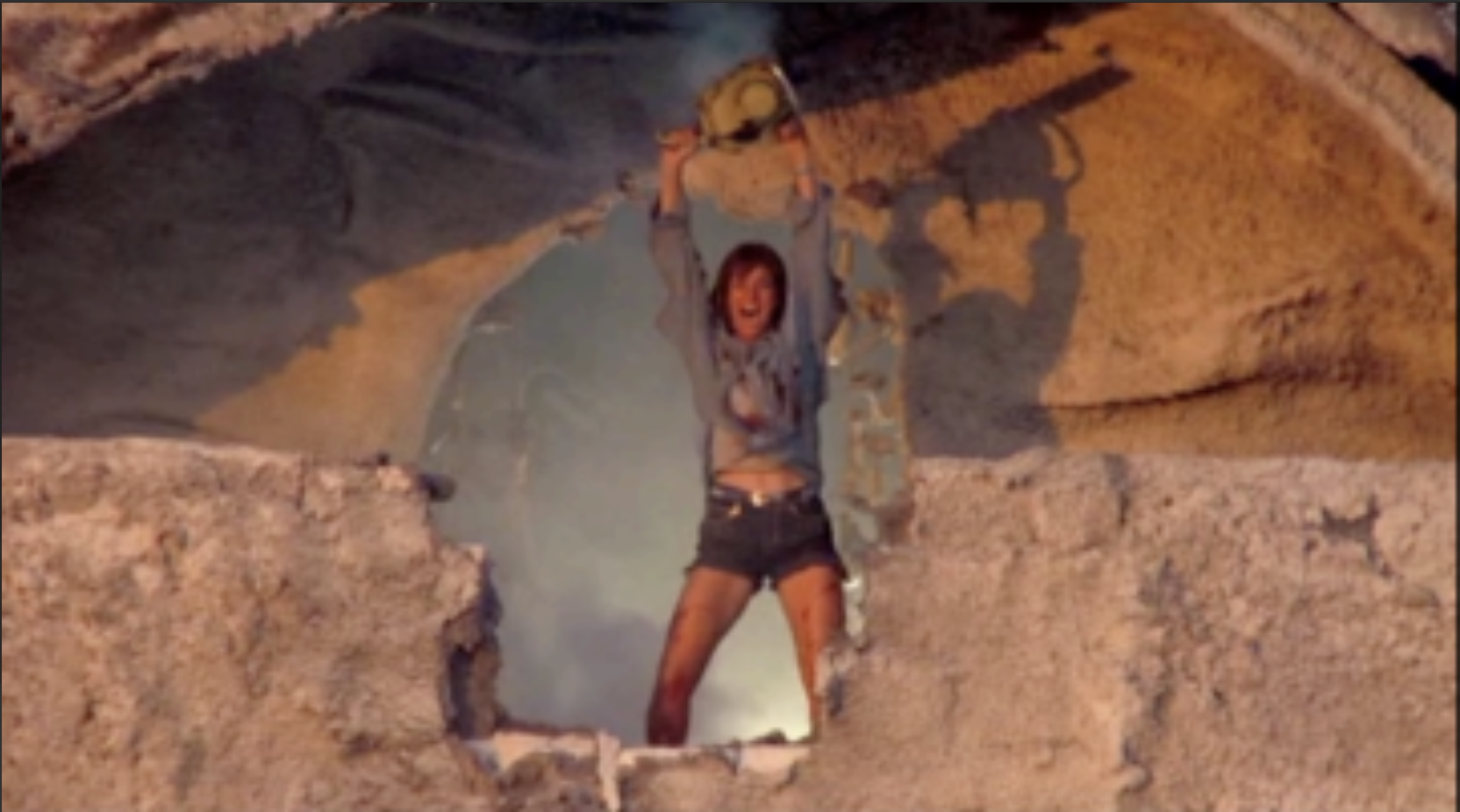
[5.4] Coming face-to-face with what seems to be the most valued cannibal family member, Stretch takes initiative in a way that subverts the Final Girl trope. She becomes messier, more violent than any other Final Girl. She pries the chainsaw off the grandmother’s decaying body, disrupting the family’s traditions and structure (or perhaps becoming part of them). Chop-Top accuses her of “killing her,” as though the Grandmother needs the chainsaw to survive. By wielding the phallic object that personifies this family’s evil, Stretch becomes the villain in their story (or perhaps a replacement matriarch) and survives her own.
Clip 4: Stretch attacks with Grandma Sawyer’s chainsaw,
taking on the family’s monstrosity for survival.
[5.5] Clover argues that in the slasher tradition, “No male character of any stature lives to tell the tale. The one character of stature who does live to tell the tale is of course female. The Final Girl is introduced at the beginning and is the only character to be developed in any psychological detail,” (Clover 207). Though Stretch gets out alive, is she still The Final Girl?
Figure 6: Leatherface recklessly throwing a chainsaw after Sally escapes.
Figure 7: Stretch mirroring Leatherface’s “dance” as she escapes the Sawyers.
[5.6] Clover argues that “The Final Girl has not just manned herself; she specifically unmans an oppressor whose masculinity was in question to begin with” (Clover 210). Stretch dissects Leatherface’s almost sensitive, fragile gender structure from their very first encounter at the radio station. This leads her to “win” the fight, leaving her as the sole survivor. By mirroring Leatherface’s actions from the end of the original Texas Chainsaw Massacre, does she inherit the role of the monster? By replacing who wields the chainsaw, she holds the power. Her screams echo throughout the caves, placing us in the forefront of her descent into madness--or, perhaps, the total loss of her own repression. It may be a victory, but will she ever be the same again?
[6] Conclusion
[6.1] Slasher films exploit women's sexuality and the gratuitous violence committed against them, but also use the trope of the Final Girl to uplift women’s strength and independence. As Clover says:
[6.2] Abject terror may still be gendered feminine, but the willingness of one immensely popular current genre to re-represent the hero as an anatomical female would seem to suggest that at least one of the traditional marks of heroism, triumphant self-rescue, is no longer strictly gendered masculine. So too the cinematic apparatus. The classic split between “spectacle and narrative,” which “supposes the man’s role as the active one of forwarding the story, making things happen,” is at least unsettled in the slasher film. When the Final Girl (in films like Hell Night, Texas Chain Saw II, and even Splatter University) assumes the “active investigating gaze,” she exactly reverses the look, making a spectacle of the killer and a spectator of herself. (Clover 219).
[6.3] The Texas Chainsaw Massacre defined the slasher sub-genre in many more ways than one. It exemplifies the themes Clover discusses, subverting the stereotypical gender dynamics of film. First, Sally Hardesty escapes the troubled cannibal family by the skin of her teeth, running for her life like the classic Final Girl. Then The Texas Chainsaw Massacre 2 brings us a Final Girl who is feminine, yet incredibly masculine in her ability to face violence and near-death experiences. When Stretch faces Leatherface for the first time she discovers his erotic curiosity and uses it to her advantage. Stretch is both discussed and viewed as a sexual object throughout the film, but that doesn’t lead to her demise. Though sexual women are often killed for their sexuality within the horror genre, Tobe Hooper turns that idea upside down to bring us a complex, psychologically intelligent Final Girl. Hooper also gives us a new kind of killer. Leatherface constructs his gender identity between his various masks, playing housewife and killer. The majority of his scenes in the 1974 Texas Chainsaw Massacre take place in the kitchen, solidifying his role within the domestic household. He’s unsure and insecure, not just the film's monster. The slasher sub-genre is complex and examines new conventions and tropes; The Texas Chainsaw Massacre films go further and show the significant differences in sexual attitudes between 1974 and 1986 through their depictions of the Final Girl as well as the monster. Credited with subverting normalized gender roles, the slasher genre is one of the most influential tropes in film history.
Clover, Carol J. 1987. “Her Body, Himself: Gender in the Slasher Film.” Representations, no. 20: 187–228. https://doi.org/10.2307/2928507.
Hooper, Tobe, Director. 1974. The Texas Chainsaw Massacre. Film.
Hooper, Tobe, Director. 1986. The Texas Chainsaw Massacre 2. Film.
Mulvey, Laura. 1989. “Visual Pleasure and Narrative Cinema.” Visual and Other Pleasures. Bloomington and Indianapolis: Indiana University Press London Afterall Books. 14–26; first published in Screen in 1975.