[0.1] Abstract - Shutter Island, as well as other psychological thriller films with twist endings, focuses on the idea of a lack of control for its male characters, with the cause of this loss being the mystery. I posit that Shutter Island is a film that represents the white male anxiety of losing one’s dominant societal role through a loss of control of the mind and body.
[0.2] Keywords - thriller, puzzle films, white male anxiety, loss of control, reversal of the gaze, male objectification
[0.3] Trailer
Batzar, Lindsay. 2026. “The Horrors of Losing Control: Theories of Psychological Perplexity in Shutter Island (2010),” Muhlenberg Visions. Volume 4, No. 1.
[1.1] Films with twist endings can be alluring to viewers and addictive to watch. Each film takes the form of a puzzle, sparking viewers to engage with what is onscreen in order to piece together a narrative based on the little information they receive. When watching these films, the viewers are often identified with the protagonist, and both are equally lost within the plot. However, when the true narrative is revealed, the film can provide a sense of catharsis for the viewers, who are either delighted to learn the true narrative of the film after such confusion or are excited that they have successfully figured it out. Additionally, the first watch of this type of film is rarely the last. Viewers often find pleasure in rewatching these films and identifying the clues that lead up to the twist along the way. With a second rewatch, viewers can utilize their knowledge of the ending to identify the film’s elements that were previously invisible. Films with twists thus repay multiple viewings.
[1.2] Martin Scorsese’s 2010 film Shutter Island exemplifies this type of film. Shutter Island follows U.S. Marshal Teddy Daniels as he investigates the disappearance of a patient at the high-security mental ward Ashecliffe, which is isolated from society on Shutter Island. Teddy’s trauma resurfaces throughout the film, which is made evident by frequent hallucinations of his wife, who has passed away, and visions of Dachau, where he served in the army and witnessed the horrors of the Holocaust. Throughout his stay at the facility, Teddy notices things getting stranger and stranger, and he falls deeper into psychosis, losing his grip on reality and beginning to question the motives of the facility. As Teddy becomes more and more confused, so do the viewers, until the end of the film reveals that Teddy (AKA Andrew Laeddis) had been a patient at Ashecliffe the entire time, and that the head psychiatrist, Dr. Cawley, has let him play out his delusions of being a U.S. Marshal and not a patient, in hopes that he would break out of it and become lucid.
[1.3] Shutter Island, as well as other psychological thriller films with twist endings, such as The Sixth Sense and Psycho, tends to focus on the idea of a lack of control for its male characters, with the cause of this loss being the mystery. I posit that Shutter Island is a film that represents the white male anxiety of losing one’s dominant societal role through a loss of control of the mind and body. This film stands as an anxiety-provoking experience for viewers as well, as the film’s puzzles conceal the meaning behind the film’s chaos, as Teddy/Andrew’s character strays away from the societal norm.
[2.1] Since the 1990s, Hollywood has made innovations to what Warren Buckland calls the puzzle film, or films that aim to confuse the viewer and compel them to solve a puzzle to better understand the film’s narrative (Buckland 1). Buckland argues that these films have appeared out of “new technological, historical, and social circumstances,” sparking directors to make these films, and also incorporating these themes into the films themselves (Buckland 2). For example, the Netflix anthology show Black Mirror (2011-present) uses puzzle film-like strategies in each of their episodes, ranging from 45 minutes to 1 hour and 30 minutes long. These episodes both use technological innovations to produce the episodes themselves, such as the “choose your own destiny” structure in 2018’s Bandersnatch, in addition to each episode expressing a fear of technology in a future society, such as replaying one’s memories, surveillance and control over sight, and “blocking” someone in real life.
[2.2] Puzzle films can be confusing to viewers due to their use of “fragmented spatio-temporal reality, time loops, a blurring of the boundaries between different levels of reality, unstable characters with split identities or memory loss, multiple labyrinthine plots, unreliable narrators, and overt coincidences” (Buckland 5). Additionally, viewers experience cognitive dissonance through the clashing of beliefs viewers hold about the narrative and what actually happens in the plot. This cognitive dissonance “incites in viewers an urge to make meaning,” which can be difficult when the film does not supply the tools to do so (Kiss & Willemsen 6).
[2.3] Quite early into the history of puzzle films, Alfred Hitchcock released Psycho in 1960. Psycho tricks its viewers into thinking the film is about a woman, Marion Crane, stealing money for her boyfriend to pay off his alimony so they can be together. However, when Marion arrives at the Bates Motel, the film takes a dark turn towards a murder mystery, and Marion soon becomes one of the victims - a shocking twist that Hitchcock pleaded with his audiences not to reveal (Redmon 255). At the motel, the viewers become acquainted with Norman Bates, the motel’s owner. Norman acts suspiciously, yet viewers are unable to discern the cause of his behavior or the identity of the murderer.
[2.4] At the end of the film, viewers discover that Norman has been behind it all along, though he developed split personality disorder when his mother passed away and became his mother to murder his victims. Due to the audience switching narrators mid-film and being stuck with a character with split identities (though it does not become evident until the end), figuring out the film’s ending is a complicated puzzle that viewers cannot easily solve, but it becomes pleasurable when the twist is explained at the film’s conclusion.
[2.5] M. Night Shyamalan’s 1999 film The Sixth Sense serves as a more recent example of the Hollywood puzzle film, particularly around the time this type of film became more widespread. The Sixth Sense utilizes an unreliable narrator and a blurring of the boundaries between different layers of reality. The film begins with counselor Dr. Malcolm Crowe and his wife, Anna, who are celebrating Malcolm’s award from the city of Philadelphia. The night quickly goes awry as the couple realizes that their house has been broken into, and one of Malcolm’s old patients stands, distressed, in their bathroom. He berates Malcolm for not helping him and proceeds to shoot Malcolm, then himself. After a time jump, Malcolm meets his newest patient, a young boy named Cole Sear, who claims he sees dead people. Malcolm helps Cole through his distress surrounding seeing these spirits, which includes helping the spirits achieve their final wish. Throughout the film, Malcolm and Anna seem estranged, yet the reason for their estrangement is unclear. At the end of the film, finally, Malcolm realizes that he was dead all along, and that helping Cole through his distress was his final wish. Anna was never mad at Malcolm or ignoring him – he was simply never there to begin with.
[2.6] Because the film’s viewers are identifying with Malcolm, they see what he sees, and he does not see the world as it actually is. Through his eyes, he is still alive, which renders him an unreliable narrator. Unless viewers are able to detach from Malcolm’s view of the narrative, which would be very difficult, they are not prompted to notice anything wrong with the story they consume, though the reality presented is not the true reality of the film.
[3.1] Upon starting Shutter Island, viewers are led to believe the plot of the film is entirely different than what it shapes out to be. Set in 1954, the film begins on a boat, which is transporting U.S. Marshal Teddy Daniels (Leonardo DiCaprio) and his partner Chuck Aule (Mark Ruffalo) to Shutter Island, which houses the mental facility Ashecliffe. The two were called to Ashecliffe to investigate the disappearance of Rachel Solando, a patient at the facility who had drowned her three children. Chuck and Teddy meet with several groups at the hospital, including the lead psychologists, Dr. Cawley (Ben Kingsley) and Dr. Naehring (Max von Sydow), some of the patients, and the nursing staff. Throughout his stay, Teddy sees hallucinations of his wife, Delores (Michelle Williams), who was burnt alive in their apartment by arsonist Andrew Laeddis. He also sees a combination of memories and false hallucinations from when he served in the U.S. Army during World War II, mostly surrounding his time liberating the concentration camp, Dachau. Teddy confides to Chuck that he aimed to investigate Ashecliffe because he believes that Laeddis is a patient there. Teddy breaks into the most dangerous ward of the facility to find Laeddis, but instead runs into a patient named George Noyce, and they seem to have known each other before this moment. Noyce warns Teddy that sinister operations are happening on Shutter Island, particularly in the lighthouse.
[3.2] Chuck and Teddy later investigate the lighthouse, but Chuck falls off a cliff and leaves Teddy to investigate alone. While climbing down the cliff, Teddy finds a small cave and meets Rachel Solando– “the real one”– who claims she was a doctor at the facility, but threatened to expose these nefarious operations, so they threw her into the facility as a patient. Teddy wakes up the next morning and leaves the cave to investigate the lighthouse, only to find that Dr. Cawley is waiting for him there. He reveals that Teddy had been a patient of Ashecliffe for the past two years, and that this entire time, the whole facility had been participating in an elaborate role-play scenario to get him out of his delusions. Earlier, in Rachel Solando’s room, Teddy had found a piece of paper that read, “the rule of four” and “who is 67?” Dr. Cawley explains that the rule of four reveals an anagram for “Teddy” and his wife’s names, both in real life and in this delusion. Edward Daniels is an anagram for Andrew Laeddis (Teddy’s real name), and Rachel Solando is an anagram for Delores Chanal. Andrew begins to remember that he ended up at Ashecliffe because he murdered Delores after she drowned their three children in the lake. Rachel was the name of his youngest daughter, who kept appearing as a dead body during his flashbacks of Dachau.
[4] Reversing the Gaze
[4.1] Though viewers may not realize it, Shutter Island inverts the typical cinematic male gaze, which can be unconsciously uncomfortable to audiences. As viewers immerse themselves further in films, they tend to learn the types of filmic languages that these films offer. When films stray from these norms, viewers get increasingly uncomfortable, as getting used to these deviant films can seem like rewiring the filmic language one has already learned, or even learning a new language altogether. In her landmark essay, “Visual Pleasure and Narrative Cinema,” Laura Mulvey explores the many pleasures of cinema, highlighting the pleasure that derives from the gaze of the viewer to the character and between characters. Mulvey mentions that one of the pleasures that cinema offers for viewers is scopophilia, which is pleasure in looking (Mulvey 16). Cinema offers pleasure by focusing attention on the human form, such as “the relationship between the human form and its surroundings, [and] the visible presence of the person in the world” (Mulvey 17). Shutter Island complicates this notion, as it follows a human who has difficulty functioning in the world– particularly, a human who has difficulty seeing the world as it is. As viewers look at Andrew/Teddy, they cannot associate pleasure with looking at him, as seeing him, and seeing through him, is not seeing clearly. Viewing Andrew as Teddy is introduced as pleasurable in the beginning of the film, as Teddy is first introduced as a male savior-type character, coming to help Ashecliffe and rescue a disappeared patient. However, as he begins to descend into madness, the viewer’s confusion begins to grow, and the gaze begins to become less pleasurable. Additionally, the viewer cannot obtain pleasure from the “human form,” as Andrew/Teddy does not function as a typical human. Andrew/Teddy and his environment exist in chaos, which again confuses and unnerves the viewer.
[4.2] Additionally, Mulvey explores the gendered norms around the gaze, highlighting that men tend more frequently to be the subject of the gaze, whereas women are the object. She refers to men as the “bearer of the look,” and mentions that due to “sexual imbalance” in the world, “pleasure in looking has been split between active/male and passive/female” (Mulvey 19). In addition to men bearing the look, Mulvey also asserts that the division of labor is assigned accordingly. She posits that men “cannot bear the burden of sexual objectification,” therefore, men take on the role of “advancing the story [and] making things happen” (Mulvey 20).
[4.3] While Teddy/Andrew is supposed to play the active role a male character typically holds, he is unable to do so due to his mental restrictions; thus, he is feminized into the female role of being the object of the gaze. Principally, Teddy/Andrew is gazed at by each character through the process of the role play, in hopes that he breaks out of his delusions. Additionally, as an actor, Leonardo DiCaprio is frequently subjected to the gaze, as he became a major pop culture sex symbol after his role in Titanic (1997). In this film, DiCaprio is feminized to be a spectacle that should be gazed at. However, as the film begins with DiCaprio in the typical active male role, viewers can be perplexed as to how Teddy/Andrew regressed into the feminized role because we do not understand his loss of grip on reality until we understand that he was a patient the whole time.
[5.1] At its core, Shutter Island represents white male anxiety, particularly anxiety surrounding losing control of one’s body and one’s senses. As Teddy/Andrew plummets deeper into insanity, his ability to control his body and see correctly also declines, which is anxiety-provoking not only for him, but for the viewer as well. Richard Dyer’s “The White Man’s Muscles” explores this phenomenon further, corroborating Mulvey’s gendered concept of men in an active, controlling role in cinema.
[5.2] In his essay, Dyer argues that white bodybuilding men use their sculpted bodies to further subvert other groups. He posits that white men are depicted at “where they are socially by virtue of biological, that is, bodily superiority,” explaining that because they are seen as physically superior, they are superior overall (Dyer 147). Additionally, he characterizes the white male body as holding qualities of “expansiveness, enterprise, courage, and control (of self and others),” mentioning that “when doubt and uncertainty creep in, women begin to take centre stage” (Dyer 184). This image of men affects the way that society views them overall, even if the bearer of the gaze is not also a man. Overall, men are seen as superior and in control of their bodies; thus, it is satisfying and feels orderly when men are portrayed in that way. As mentioned earlier, this concept is similar to the learned filmic language– because men are so frequently portrayed as dominant and in control, to show them in any other way would be uncomfortable, as it would stray from the learned language.
[5.3] The beginning of the film undoubtedly establishes Teddy as a strong white man with control over himself and the situation. Much like Dyer’s white male qualities suggest, Teddy is first looked at as a hero, rather, a white male savior who comes in to provide order to the chaos that Ashecliffe is facing. Additionally, his characterization as a former U.S. Soldier in World War II adds to this characterization. In a flashback scene, we see Teddy kill a German soldier who was bleeding out on the ground. He reaches for the gun a few inches away from him, but Teddy slides it away from him and walks away. To even a viewer who is not educated on World War II and the Holocaust, the film makes it clear that Teddy’s moral compass was calibrated by these horrific events. Several flashback scenes show the brutal violence that occurred while Teddy was stationed in Dachau. He also frequently sees images of a little girl whose body is piled on top of many frozen dead bodies in the camp. She wakes up and asks him, “Why didn’t you save us?”
[5.4] As viewers get an upfront view of Teddy’s past serving in the war, they trust him to remain strong and help the facility find their patient, just as men are supposed to act as heroes. However, our faith in him begins to plummet when Teddy first visits Ward C. For the first time, Teddy begins to show signs of unprovoked violence, as a patient taps him and yells, “Tag, you’re it!” and Teddy begins to chase him. After catching the patient, Teddy strangles him until Chuck stops him. As he wanders through Ward C and discovers George Noyce, viewers feel lost trying to understand the two men’s conversation, as many context clues (i.e., them knowing each other from being roommates in the facility) are purposely concealed (Clip 1). Teddy’s abrupt jump from acting lucid to completely deranged invalidates his trustworthiness, and he begins to become feminized as he shows traits of doubt and uncertainty in his own brain.
Clip 1: Noyce and Teddy’s talk
[5.5] Even until the last moments before Teddy realizes his true identity, he remains strong physically (though not mentally). When he hallucinates Chuck falling off the cliff, he climbs down to find him, demonstrating his strength and willingness to help out his partner. After visiting a hallucination of “the real” Rachel Solando, he decides to finally break into the lighthouse and expose any sort of operation being performed there. He knocks out a security guard, steals his gun, and busts into the lighthouse. After using his gun to bust down the door, he discovers that Dr. Cawley is waiting for him, and Cawley begins to explain the truth.
[5.6] As Cawley speaks to Teddy/Andrew, provoking his memories by saying phrases like, “Focus, Andrew!” and revealing details about his true life to him, the viewer identifies with Teddy/Andrew’s confusion, as we are piecing together the details in real time alongside him. Viewers follow Teddy/Andrew throughout the entire film, and his loss of control of his body and sight affects the viewers’ control over comprehension. Since the film is told from Teddy/Andrew’s perspective, the audience can only see what he sees, and he does not see correctly. As this transition from a hero in control at the beginning of the film to an unstable, high-risk mental patient is so stark, viewers become disturbed at this loss of control and their changing of perspective. Furthermore, as Teddy/Andrew’s character strays from the “normal” role of a white male character, this reversal of roles complicates the viewers’ learned filmic language, causing discomfort.
[6.1] Expanding upon the concept of losing control as discussed through Dyer’s work, we can see that Shutter Island also focuses on repressed fears, which explains the chilling response of the audience when watching the film. In her essay, “Her Body, Himself: Gender in the Slasher Film,” Carol Clover draws on the work of Sigmund Freud to make claims about the pleasurable nature of watching horror films and getting scared. In the essay, Clover posits that horror is “crucial enough to pass along” due to “its engagement of repressed fears and desires and its reenactment of the residual conflict surrounding these feelings” (Clover 191). In other words, horror maintains itself as a genre because it successfully scares its viewers by bringing repressed fears and desires to light, while also showing how one’s life can be affected by the fear. Clover maintains that viewers find pleasure in horror films that reveal these fears, as they are able to watch this fear play out in someone else’s life without living it themselves.
[6.2] Shutter Island engages various common fears, most of which are uncomfortable to watch play out. For one, the film expresses the fear of being trapped, particularly in a mental facility, but also on a remote island. Mental hospitals are often portrayed like prisons, and especially since some of the patients are not right in the head, being trapped there stands as a common repressed fear. Additionally, Teddy/Andrew’s mental state disturbs viewers who fear losing control over their own body and mind. To be in a place you don’t recognize– with people you’ve met before but don’t remember– can be very scary. Having clarity in a situation can help people feel less anxious, whereas in this case, Teddy/Andrew has none and has lost the ability to regain it.
[6.3] Finally, and most importantly, Teddy/Andrew is stuck in a loop, forced to relive this fantasy of his over and over, unable to break out of it and regain consciousness of reality. As viewers see the world through Teddy/Andrew’s eyes, we can easily sympathize with him because we understand what it’s like to see what he sees. Furthermore, as viewers see the film unfold through Teddy’s eyes, we are able to witness the way this repressed fear can unfold from start to finish, almost going through the process ourselves, yet retaining our awareness of the real world. As Clover mentions, this process can satisfy an unconscious desire to revisit a repressed fear and watch it play out with no consequences to a viewer’s actual life.
[7.1] Because viewers are tied to Teddy/Andrew throughout the whole film, they must use other tools to learn to see, which can be difficult. Teddy/Andrew serves as an unreliable narrator; thus, he cannot give the audience clues as to what’s going on through his own eyes– the audience must piece together clues on their own. Eric Faden’s 2020 video essay, “Amuse-oeil,” discusses the process of “seeing” a film. Playing off of the idea of an “amuse-bouche” being a treat for the mouth, an “amuse-oeil” would be a treat for the eye. Faden emphasizes the work of French director Jacques Tati, who tends to fill the frame with various actions happening synchronically. He argues that when watching these films, viewers must interact with the entire frame, otherwise they would miss out on everything the film has to offer. Faden engages with the idea of film being a learned language, and believes that seeing correctly would mean rewiring one’s filmic language.
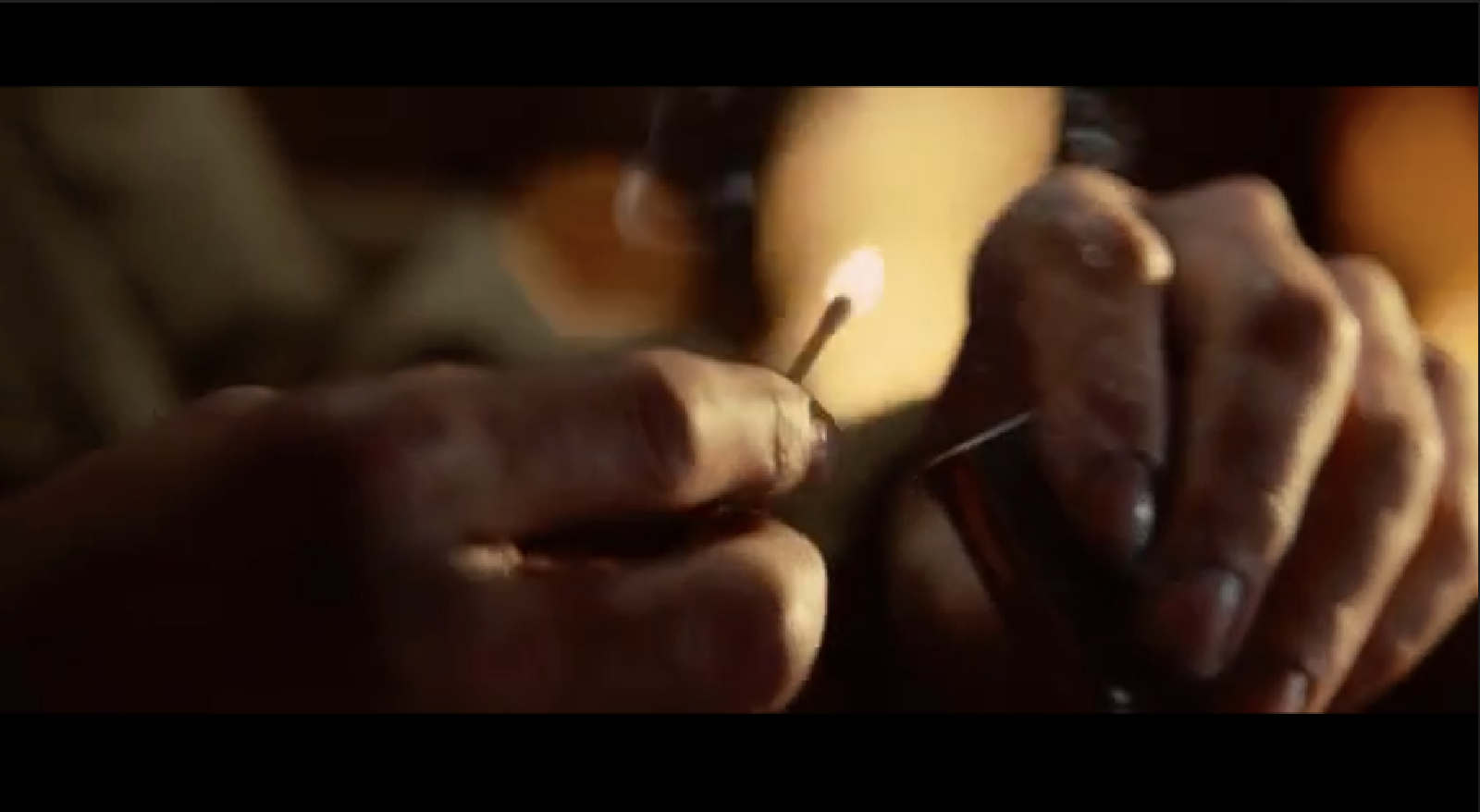
[7.2] Faden’s ideas apply perfectly to Shutter Island, as the frame cannot only be absorbed at face value– in order to truly swallow the whole film, viewers must learn to see to their fullest potential. Scorsese implements motifs throughout the entire film that clue the viewer into the true situation. For example, the most prevalent clue into the situation is the dichotomy between fire and water in the film, of which fire represents Teddy/Andrew’s delusions (the fake Andrew Laeddis is blamed for Delores’s death as he wrongly lit the apartment on fire) and water represents reality (as Delores drowned her and Andrew’s three children in the lake). Teddy/Andrew’s dream-like sequences reveal clues– for example, when Teddy meets “Laeddis,” the first extreme close-up shot of the film shows Laeddis lighting a match (Figure 1). The next and only other time an extreme close-up of a hand lighting a match appears is when Teddy explores Ward C (Lacombe 2015) (Figure 2). This parallel hints to the viewer that Teddy and Andrew Laeddis are, in fact, the same person.
Figure 1 & 2: Shots of matches being lit draws parallels between two characters
[7.3] Additionally, the dream sequence where Delores and Teddy are in their old apartment offers significant clues as to the true plot of the film (Clip 2). Feeding into Teddy’s narrative, the scene shows ash floating around the apartment as Teddy and Delores talk. Delores tells Teddy that “she’s still here,” to which Teddy asks, “Rachel?” (their daughter). Delores nods and says she never left. Delores walks to the window, which displays a gorgeous image of the lake (where she drowned the kids), and laments about how happy they were when they stayed at the cabin in the summer (they weren’t). The scene then reveals Delores’s back, which is completely burnt. Teddy hugs Delores and puts his hands on her stomach (where he shot her), and blood and water pour out as Delores’s hair gets wet. She tells him that he needs to wake up, and that she’s real (Rachel) and so is he (Laeddis). Delores turns to ash, and the apartment suddenly bursts into flames. The couple also wears the costumes they wore during the (real) flashback scene to when Andrew discovers Delores after drowning the kids and kills her. To an untrained eye, many clues in this scene can go over one’s head, yet much of it reveals important plot points that expose Teddy’s true identity and past.
Clip 2: Delores and Teddy dream sequence
[8.1] To many, rewatching puzzle films is not only satisfying, but also necessary to better understand the plot. Once a viewer is aware of the puzzle film’s ending, being able to rewatch without the burden of confusion becomes a pleasurable experience. As discussed throughout, Shutter Island represents a repressed fear of losing control of one’s body and mind, which can make the viewing process uncomfortable. Rewatching the film with the knowledge of the film’s ending is a way to regain control and cancel out that fear, as viewers are aware going into the film that Teddy Daniels is not who he says he is, instead of originally viewing him as the hero he is portrayed to be. On the second watch, viewers will have to deal with the consequences of feeling sympathy for Teddy/Andrew, as they will go into the film aware of the role-play scenario.
[8.2] In typical puzzle films, viewers are able to reconstruct the plot as part of solving the puzzles given to them. Being aware of the plot aids the viewers in rewriting/reconstructing the story given to them, which is only possible after the first watch (Redmon 261). Reconstruction can include further noticing and meaning-making of these clues and filmic motifs already given to viewers. Watching the ending gives the audience the tools they need to see, which allows them to perform such reconstruction. Additionally, this practice does not just stop at the second rewatch– if viewers are willing to participate, watching a film “a second, third, or fourth time can implicate spectators in the same ongoing process of construction and reconstruction” (Redmon 262).
[9.1] Overall, Shutter Island acts as a typical Hollywood puzzle film and portrays white male anxiety similarly to predecessors such as Psycho and The Sixth Sense. The film portrays this fear successfully through its complex characterization of the Teddy Daniels/Andrew Laeddis character. One of the film’s most successful modes of concealing reality is through viewers’ identification with the character who is unable to see, which affects the audience’s ability to see as well. As Teddy/Andrew lives out his role-play fantasy, viewers are led to believe that the fantasy is real life, yet the realization that this is false does not occur until the very end of the film.
[9.2] However, this film produces anxiety in the viewers, as watching a dominant white man lose control reverses societal norms and causes feelings of discomfort. Rewatching the film allows viewers to reclaim the experience, taking back the control that was stolen from them during the first watch. The film’s success as a Hollywood puzzle film sustains it as an influential film of the genre.
Buckland, Warren. 2014. Hollywood puzzle films. Routledge.
Clover, Carol. J. 1987. “Her Body, Himself: Gender in the Slasher Film.” Representations.
(20) 187–228. https://doi.org/10.2307/2928507
Dyer, Richard. 1997. “The White Man’s Muscles.” White. London: Routledge: 145-183.
Faden, Eric. 2020. Amuse-oeil. Vimeo. https://vimeo.com/486448874
Kiss, Miklós & Willemsen, Steven. 2017. Impossible puzzle films : a cognitive approach to contemporary complex cinema. Edinburgh University Press. https://search.ebscohost.com/login.aspx?direct=true&scope=site&db=nlebk&db=nlabk&AN=1584881
Lacombe, Thibs. 2015. “How does mise en scene and cinematography shows Teddy daniels’ deteriorating mental state? with reference to a specific sequence. (Shutter Island, Martin Scorsese 2010) by Thibs Lacombe.” thibswatchesfilms. https://thibswatchesfilms.wordpress.com/2015/11/13/how-does-the-mise-en-scene-and-cinematography-help-the-audience-descend-into-teddy-daniels-deteriorating-mental-state-with-reference-to-a-specific-sequence-shutter-island-martin-scorsese/
Redmon, A. H. 2015. “‘After Everything I’ve Seen…’: Rewatching Shutter Island as a Knowing Audience.” Adaptation. 8 (2) 254-267.
