[0.1] Abstract - Although Vera Chytilová’s Daisies was made almost ten years before Laura Mulvey’s famous essay, “Visual Pleasure and Narrative Cinema,” it explores many of the same issues Mulvey discusses and aggressively subverts the male gaze.
[0.2] Keywords - male gaze, feminist cinema, fetishism, scopophilia, Czech new wave, avant-garde cinema
[0.3 Trailer]
Bakirtzis, Charis. 2026. “Daisies and Laura Mulvey’s ‘Visual Pleasure,’” Muhlenberg Visions. Volume 4, No. 1.
[1.1] Vera Chytilová’s Daisies (1966) is a significant film of the Czech New Wave and a key example of feminist cinema. When it was released, Communist authorities banned it. The story follows two young women, both named Marie, who decide that if the world is spoiled, they will be spoiled too, before going on to respond to a patriarchal society with mischief, excess, and chaos. Although Daisies was made almost ten years before Laura Mulvey’s famous essay, ‘'Visual Pleasure and Narrative Cinema,”' it explores the same issues Mulvey discusses, especially the “male gaze.” Mulvey says that mainstream film is based on a “pleasure in looking,” where men are active and women are passive and “connote to-be-looked-at-ness” (19). In Daisies, the Maries seem aware they are supposed to be decorative girls who attract men, but they both exaggerate and reject that role. More specifically, this paper will examine the recurring motif of excessive food, from restaurants to the overwhelming abundance and destruction in the film’s climactic banquet sequence. It will analyze the women’s numerous dates with older men, where the men are dismissed, humiliated, and turned into the “other” rather than the women. It will also thoroughly analyze the fetishistic and scopophilic food-cutting scene, which parodies classical erotic display. Finally, the paper will consider how costumes and mise-en-scene contribute to the film’s exaggeration and disruption of the “decorative girl” image. Overall, Mulvey’s theory will be used to understand how Daisies unsettles the roles of the active man and the passive woman, and how the film turns the “to-be-looked-at” woman into someone who exposes and mocks the male gaze rather than serving it.
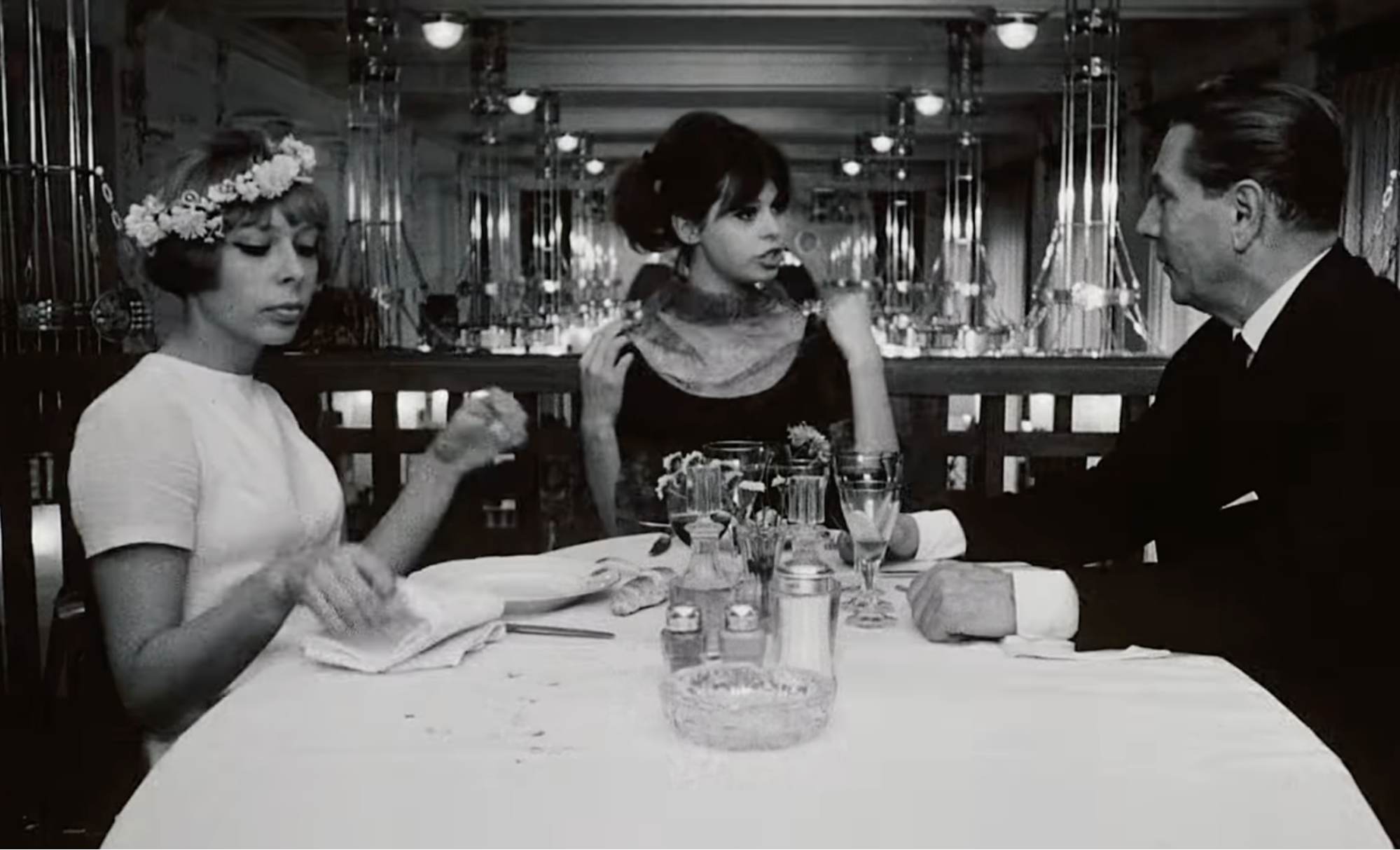
[2.1] In the numerous date scenes, Chytilová begins by setting up the gendered model Mulvey describes, and then proceeds to sabotage it. Each older man meets the Maries at a restaurant, dressed in a dark suit that signals seriousness and authority. The Maries wear dresses, scarves, carry bags, and even wear bows or flower crowns on their carefully styled hair. (Figure 1) Mulvey notes that mainstream cinema often treats the woman as an “icon,” “isolated, glamorous, on display, sexualized,” eventually falling in love with the male protagonist and becoming his property, while the man remains aligned and in control of the story (21). The Maries’ clothes echo the kind of “looking” that Mulvey describes, as they mark them as decorative and arranged for the male eye. At first glance, these scenes appear to serve the male gaze; however, that’s Chytilová’s exact intention.
Figure 1: The Maries, decoratively dressed for their “pretend” date with a suit-clad gentleman.
[2.2] Once the scene starts to play out, though, the Maries’ behavior completely clashes with what their appearance may signify. The “decorative girl” look here does not lead to shyness or passivity. Instead, the Maries messily devour tons of food, lean back in their chairs, smoke cigarettes, ask confrontational questions, and talk over the men. Mulvey argues that classical narrative films are usually organized so that the male character “controls the film fantasy,” while the woman bears the burden of being looked at (20). She also adds that “pleasure in looking has been split between active/male and passive/female,” and in these dates, the exact opposite happens (19). The men become passive, interchangeable, and powerless as they talk, plead, and pay, making no real decisions. It is the Maries who actively control the story and the visual image, “othering” the male. Their clothes still make them look like Mulvey’s decorative “icons,” but their actions refuse to match that image. By reversing who the “other” is, Chytilová ironically uses Mulvey's model to satirize male-centered social structures. At the same time, the “to-be-looked-at” female figure gains power by remaining visually decorative, but on her own terms.
[3] “Cutting” the Fetish
[3.1] The cut-up food scene takes the Maries’ refusal to act like proper “decorative girls” even further, and directs it toward fetishism. In this sequence, the two girls play with phallic-shaped food that very obviously recalls sexual imagery. They thread food through rings, cut sausages and eggs with scissors, stab pickles, and place food near their mouths and bodies in almost pornographic ways. The camera isolates hands, mouths, and feet in close-ups that slide into erotic suggestion, but the tone is closer to destructive mischief and grotesque humor than to seduction. Instead of letting the spectator enjoy a fetishized image, the scene keeps drawing attention to the subtle aggressive message of what is happening.
[3.2] This is where Mulvey’s distinction between voyeuristic and fetishistic scopophilia becomes useful. She writes that “fetishistic scopophilia builds up the physical beauty of the object, transforming it into something satisfying in itself,” while voyeuristic looking works by judging and controlling another person as an object (21). Even more specifically in the cinematography, the shot of Marie 1’s foot, which can only be seen through Marie 2’s scissors cutting up food, is a deliberate choice that punishes the viewer’s scopophilic/fetishistic tendencies. (Figure 2) Chytilova’s camerawork does not glamorize the women’s bodies, and instead mocks the expectation that the female form should be polished and consumable. Similar to the date scenes, Chytilová seems to begin with the kind of fetishization Mulvey describes, only to disrupt it. Instead of “building up” the objects into something ideally fetishistic, the Maries literally cut them apart, essentially punishing that type of looking. What could be fetishized is ruined, and the food that might normally function as a pornographic symbol becomes disgusting and ridiculous, and the close-ups no longer offer pleasure but a kind of anti-fetish.
Figure 2: Cutting up sausages near dirty toes disrupts fetishistic looking
and also threatens the phallus
[3.3] Furthermore, Mulvey explains that “the male figure cannot bear the burden of sexual objectification” (20) and must remain the bearer of the look rather than an object of it. However, in the scene, a man’s voice on the phone continues to plead and profess love, but his words are background noise, detached from any body. The Maries render him into an object of ridicule and mockery, and by extension into a literal object (the phallic-shaped foods) which they hold power over and destroy. The scene still plays with fetishistic elements and suggestive shapes, but the pleasure belongs to the Maries, who entertain themselves, not anyone else. By taking the visual language of fetishism and turning it into a destructive game, Chytilová shows what happens when the “to-be-looked-at” girl takes control of the objects and images that were meant to define her, and uses them to attack the logic of fetishistic and scopophilic pleasure that Mulvey describes.
[3.4] A different scene also directly confronts fetishistic fragmentation, in this case, turning it into a literal game, specifically in the scene where the Maries play with scissors and cut each other into pieces. (Figure 3) They trace each other’s arms, legs, and torsos with the scissors, and through editing, their bodies suddenly appear separated into isolated parts. This experimental visual trick recalls the way women’s bodies are cut into fragments for erotic inspection and pleasure, something Mulvey identifies as central to the way the female figure is turned into an object of fetishistic looking (19–21). However, in the context of the scene, and as the Maries usually do, they’re the ones who control the narrative. They laugh as they cut each other, and though the viewer still sees isolated legs, arms, and faces, it is clear that the visuals do not serve the male gaze. Performing this fetishistic and scopophilic fragmentation that is imposed on female bodies in such a way, it turns into a silly, innocent game, with Chytilová exposing the absurdity of this type of looking. In both the cut-up food and cut-up bodies scenes, the literal meaning of “cutting” is pulled out of the patriarchal elements of cinema and placed in the hands of the “to-be-looked-at” girls, who use it to attack and mock this fetishism/scopophilia.

Figure 3: The Maries playfully cut themselves into pieces
[4.1] Moving on, the banquet sequence is the climax of the film’s excessive food motif. The scene begins in an empty, formal dining hall, with a long table covered in meat, cakes, fruit, and wine. (Figure 4) The room is symmetrical and orderly, the food untouched, and the space certainly feels like it belongs to some kind of authority. When the Maries stumble upon it by accident, after their shock at the discovery, they quickly start eating, drinking, and playing, only growing more chaotic over time.
Figure 4: Long tables neatly set for a banquet
[4.2] As the scene continues, the Maries stomp on the table, break bottles, and throw food at each other. Similar to the two previous scenes, there are no male characters present to be the “active controllers of the look” (21). The pleasure of the scene thus comes from watching the lone Maries misbehave in a space where they’re expected to be their absolute most “passive/female” selves. Mulvey, adding onto the model of the “decorative girl,” explains that “her visual presence tends to work against the development of a storyline, to freeze the flow of action in moments of erotic contemplation” (19). In the sequence, the opposite happens, as the Maries are central to the spectacle, but instead of freezing the action into a still, erotic image, they create a new kind of spectacle through chaos and excess. The beautiful banquet, embodying that very still image and static fantasy, is willingly destroyed by them for fun. Even the mise-en-scene here works against the usual direction of the gaze. The carefully arranged food, the long white tablecloth, and the high ceiling would typically create a space of authority and control, but once the Maries take over, that authority is destroyed. The table turns into a messy playground, the room stops framing them as ornaments, and by the end, the viewer sees a ruined, non-erotic feast and two girls treated a supposedly untouchable display as something to unsettle and overturn. (Figure 5)
Figure 5: The Maries create chaos and destroy the banquet for fun
[5.1] Beyond these individual scenes, Daisies, as a whole, speaks to Mulvey’s call for a different kind of cinema, one that does not merely reproduce the pleasures of the male gaze. In the second part of her essay, Mulvey explains that the success of the Hollywood style comes from its “skilled and satisfying manipulation of visual pleasure,” and she insists that this pleasure, which reinforces a patriarchal way of seeing, must be broken apart (16). She also adds that “analysing pleasure, or beauty, destroys it” (16). Even though Daisies predates her statement, it feels as if Chytilová was already putting that intention into practice. The dates, the cut-up food, the fragmented bodies, and the banquet all begin with a recognizable pleasure, only to end in some form of mess, mockery, or excess. Daisies anticipates the “alternative cinema” that Mulvey imagines, one that is “radical in both a political and an aesthetic sense” and that “challenges the basic assumptions of the mainstream film” (15). Chytilová still offers pleasure, but it is one that comes from the disruption of basic assumptions. The viewer may enjoy the colors, jokes, and sheer energy of the Maries, yet that enjoyment is also mixed with discomfort and a sense that the usual rules of “looking” do not apply here.
[5.2] In conclusion, reading Daisies through Mulvey’s visual theories shows just how much the film exaggerates, grows out of, and pushes against the structures of male-centered classical cinema. Chytilová utilizes many of the elements Mulvey describes, such as the decorative young woman and pleasurable looking. Still, the “to-be-looked-at” Maries may remain at the center of attention, but they do not serve the male gaze. Rather than offering the smooth, ego-reinforcing content of the Hollywood style, Daisies associates more with the “alternative cinema” Mulvey imagines, presenting a new pleasure reshaped through a disruption of the old one. In that sense, through Daisies, Chytilová anticipates Mulvey, showing how a seemingly simple spectacle of two mischievous girls can become a way of exposing and subverting the visual habits that have been prevalent for decades.
Video Essay
Mulvey, Laura. 1989. “Visual Pleasure and Narrative Cinema.” Visual and Other Pleasures. Bloomington and Indianapolis: Indiana University Press, London Afterall Books. 14–26; first published in Screen in 1975.


