[0.1] Abstract: In this paper, I explore the ways that effective uses of the child’s perspective are actually crafted and translated onto the screen, and then use that to understand how these films become a uniquely immersive spectator experience, primarily for adult viewers.
[0.2] Keywords: perspective, child’s gaze, filmmaking, spectatorship, memory boom, innocence, nostalgia, capitalism, symbolism
Stein, Sophie. 2025, “Seeing Like a Child: Filmmaking and Perspective,” Muhlenberg Visions, Volume 3, No 1.
[1] Introduction
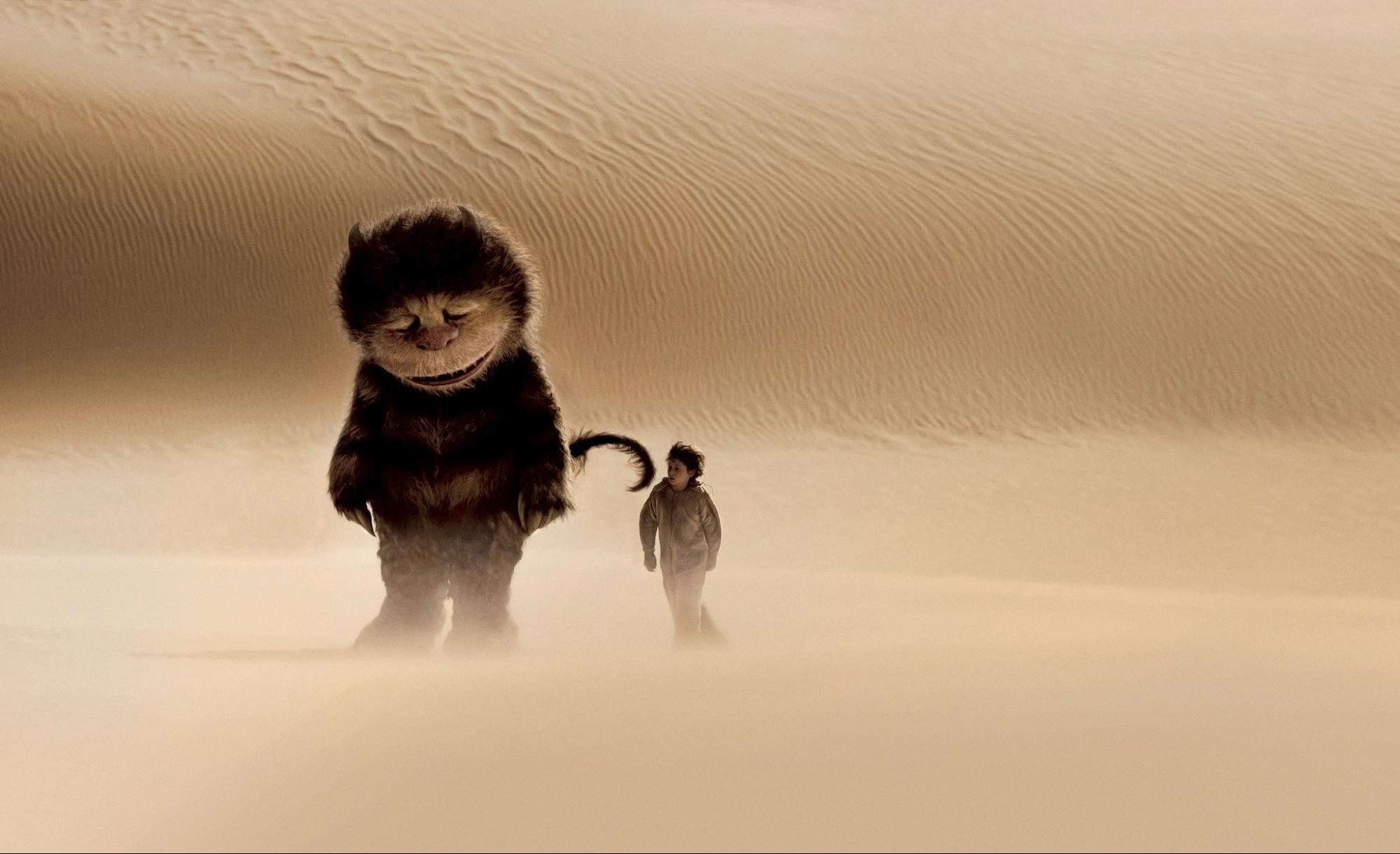
[1.1] “Carol? Did you know the sun was gonna die?” asks Max, a nine year old boy dressed in a worn wolf suit, his eyes filled with an obvious mix of wonder and sadness, brows furrowed.
[1.2] “What?” replies Carol. He looks up at the sun for a moment. “I never heard that. Oh, come on! That can’t happen. You’re the king. And look at me. I’m big! How could guys like us worry about a tiny little thing like the sun?”
Figure 1: Still from Where the Wild Things Are
[1.3] This is a scene from Where the Wild Things Are (2009), directed by Spike Jonze, in which Carol, one of the titular Wild Things, shows their remarkably young new king Max around the kingdom. As they walk through a desolate area of the land, Max mulls over a lesson from science class: one day, the sun will die. This simple moment between the two of them does not mask the somewhat existential nature of what Max is asking. To be blatant, this scene is one in which a young boy grapples with the finitude of life, his childlike wonder in tension with this serious contemplation about the world. While this may seem like an awfully weighty theme for a film centered on a child protagonist, this juxtaposition is precisely what makes Where the Wild Things Are a distinctively immersive experience. This film has the ability to reconnect viewers with a way of seeing the world that is often left behind at the start of adolescence. Children perceive and experience the world in ways that differ fundamentally from adults. While wonder, creativity, and fear are emotions understood universally, their intensity during childhood often fades from memory with age. Films that successfully capture these emotions for an audience offer an incredibly compelling window back into the world of childhood.
[1.4] Focusing on Where the Wild Things Are and Room (Lenny Abrahamson, 2015), this paper examines effective uses of the child’s perspective in cinema—both the way that it is created, as well as the impact it has on viewers. Despite their innate differences, both films accomplish the feat of translating what it is to be a child onto the screen. This idea intersects with broader film theories of spectatorship, particularly when looking at adult audiences. An adult watching a film from a child’s perspective is urged to temporarily set aside their experiences and adopt an entirely different lens. One that they once knew, but have long since forgotten. Upon viewing, these films result in a very specific kind of spectatorship, causing adults to experience what is known as spectatorial immersion and flexible identification. Spectatorial immersion refers to the process by which a viewer becomes deeply engaged or absorbed in a film, often losing awareness of the external world—audiences feel fully transported into the world created by the film. Flexible identification refers to the shifting process where viewers engage with multiple characters, perspectives, or subject positions in a film, rather than aligning exclusively with one fixed character or point of view. Effective uses of the child’s perspective can result in these two experiences for adult audiences. However, not all films with a child protagonist can do this. There are nuances to the way that a child’s perspective is crafted, which affect the impact that it will later have on audiences. Therefore, by analyzing two specific filmmaking techniques employed to convey a child’s perspective, this paper argues that Room and Where The Wild Things Are create an immersive spectatorship experience that reconnects adult viewers with a long-forgotten way of seeing the world, ultimately challenging the boundaries between childhood innocence and adult experience.
[2] Literature Review: Contextualizing the Child’s Perspective in Cinema
[2.1] To begin, it is necessary to contextualize the child’s perspective in cinema. Many of the sources used in this review are international, while the two films that this paper is mainly exploring are American. This, however, does not undermine their relevance, as the experience of a child is one that is familiar to everyone. The point of view is not one that is bound to any specific culture, and while the experience of being a child can certainly vary greatly from place to place, at the core, everyone, regardless of location, has once seen the world through that lens. In a 1957 article, “The Case for Children’s films,” Robert W. Wagner argues for the need to create films specifically for children, from their perspective respectively. American studios like Disney mainly produced films for family or general audiences, rather than directly for children. He discusses how children see the world differently than adults do, and their films should reflect that perspective. He also suggests involving children in the filmmaking process, as it would result in more authentic films (Wagner 481-482). Wagner’s critique was made in the late ‘50s, and the cinematic “child’s perspective” has evolved greatly since then; that said, the push for an authentic child’s perspective is not limited to that era. In her introduction to a 2013 special section of the Journal of Educational Media, Memory, and Society on Children’s Films, Bettina Kümmerling-Meibauer discusses the growing field of children’s film studies. She argues for a mix of disciplinary approaches, including media studies, film studies, education, and psychology, to better represent the child’s point of view. Kümmerling-Meibauer explains that today’s children's films are growing more complex and often use sophisticated techniques and themes that would generally be seen in more mature films—for example, narrative strategies such as first-person narration, flashbacks, multiple perspectives, etc. Children’s films also now tackle “difficult, sensitive, or taboo topics” (Kümmerling-Meibauer 39) and themes such as loss, fear, and personal growth, which were perhaps avoided in earlier children’s films. Evidently, the child’s point of view has become more developed over time. Although this paper is examining the child’s perspective in films aimed at adults, a basic understanding of the evolution of this viewpoint throughout film history will help in expanding upon it later. With this evolution comes much critique and commentary, and it is essential to now explore what has already been said of this more complex, more commonly employed child’s perspective in modern cinema.
[2.2] The role of the child in cinema has been experienced in a multitude of ways, but is commonly written about by scholars as a “symbolic” role. In an article by Sarah Thomas from 2017, she looks at how two Spanish films from what is called the "memory boom" era, La lengua de las mariposas (1999) and El viaje de Carol (2002), differ from the earlier 1973 film El espíritu de la colmena in how they represent childhood. She argues that El espíritu de la colmena offers a more complex and ambiguous view of a child's perspective, while the later films simplify the child into a nostalgic "object" rather than portraying children as fully developed subjects. The children in these films are “instrumentalized” as innocent characters, resulting in a surface level, weakened portrayal of both the child and the historical events. Thomas’s example is beneficial in understanding a less effective and meaningful version of a child’s perspective. This paper is interested in exploring the exact opposite—an authentic, genuine portrayal of childhood. In this way, Thomas’s ideas can be usefully applied to Room and Where The Wild Things Are.
[2.3] Partially in congruence with Thomas, Susan Ferguson in “Capitalist Childhood in Film: Modes of Critique” from 2013 examines how cinematic representations of children often serve as a vehicle for critiquing broader socio-economic structures. In her article, she looks at three adaptations of the Oliver Twist story (Oliver Twist [1948], Oliver! [1968]), Oliver Twist [2005]), Slumdog Millionaire (2008), and a lesser-known Korean film, Treeless Mountain (2008). Through these films, Ferguson discusses the ways in which children’s innocence and vulnerability are depicted in their representations in cinema, employing a critical political theory framework to analyze how these films expose the contradictions within capitalist societies. She finds that these children are portrayed as both shaped by and resistant to the demands of capitalism, and in this way, argues that childhood in capitalist societies is commodified. Like Thomas, Ferguson finds the use of the child’s perspective simplified to represent something other than their unique view of the world. This is useful for better understanding the different ways that the child’s role can be seen as “symbolic” of something else in cinema.
[2.4] While Ferguson sees this representation of children within societal and political contexts to be negative, Harald Salomon argues that this role has been quite compelling. In his 2017 article “‘Children in the Wind’: Reexamining the Golden Age of Childhood Film in Wartime Japan,” Salomon explores the surge of children’s films in Japan during the late 1930s and early 1940s, known as the "Golden Age of Childhood Film." (Salomon 103) Despite being about children, many of these films, such as Children in the Wind (1937) and A Pebble by the Wayside (1938), resonated with adults very strongly. Salomon discusses how this trend emerged alongside societal changes, including the 1939 film law restricting children from certain films. He argues that the focus on childhood reflected a societal need for solace during wartime, portraying children as resilient figures of hope. Unlike Ferguson’s argument that using a child’s role to critique society ends up commodifying childhood, Salomon asserts that this very perspective was exactly what people needed to see in such a difficult time.
[2.5] Lastly, and perhaps most significantly for this paper, Karen Lury in her 2005 Screen article “The Child in Film and Television” argues that the presence of children in film often challenges adult authority and invites the audience to reconnect with a more intuitive, emotional way of seeing. While she is in agreement with Thomas and Ferguson in that she too describes the child’s role as often “symbolic” of “political and personal agendas at work” (Lury 314), Lury differs in her writing through discussing effective uses of this perspective in cinema. She sees children in cinema becoming symbolic figures at the center of cultural discourses, representing society’s hopes and anxieties. In the article, she draws on theorists such as Adam Phillips and Lee Edelman, exploring how children disrupt traditional narratives, particularly through their unfiltered way of seeing the world, as opposed to the adult tendency of "showing" or guiding perception. She uses as an example the film The Sixth Sense (1999), discussing the tension between the child's raw, spontaneous perspective and the adult's desire to control and categorize this vision (Lury 309). Lury’s analysis provides a framework for better understanding complexity within this perspective. This source is certainly the closest in relation to what this paper is interested in exploring, which is important to note moving forward.
[2.6] While written about in varying tones and with a multitude of arguments, much of the existing literature on the child’s perspective in cinema generally agrees that children are often used as symbols for something greater than themselves. The above scholars argue that children in film frequently become emblematic of concepts such as innocence, hope, resilience, or societal critique, sometimes effectively, and sometimes weakly. However, as previously stated, this paper is interested in exceeding that idea. The child’s perspective is so much more than a representation of something else. Simply looking at the perspective itself and what it is able to do is quite captivating. Therefore, this paper will use this scaffolding to explore how Where the Wild Things Are and Room go beyond this idea of the child as a symbol, by exploring the ways in which this perspective is crafted, and then examining spectatorial immersion and flexible identifications with adult audiences.
[3] Subverting and Complicating these Findings with the Central Films
[3.1] Within the context of the existing literature on the child’s perspective in film, this section will examine Where The Wild Things Are and Room. Room by Lenny Abrahamson subverts many of these earlier expectations of a child’s role in cinema. It follows the story of Joy and her 5-year-old son, Jack, who live in a small, confined space they call "Room." Joy has been held captive there for seven years, and Jack, born in captivity, has never experienced the outside world. The film explores their life in captivity, their escape, and the challenges they face as they adjust to freedom. Even as the film deals with quite a serious plot, it is told through the perspective of Jack. “Room” is shown to the viewer through the eyes of a child. Often, representations of children are thought to “tap into a prevailing impulse … the nostalgic linking of the innocent child and romanticized past,” according to Sarah Thomas (Thomas 156). As stated earlier, she argues that these reduced depictions weaken both the role of the child and the specific events dealt with in the film. Room could not fall further from this categorization. Jack’s limited and trapped perspective should be enough to distinctly set the film apart from those that deal with simplified innocence or a nostalgic look back at a simpler time. In addition, the film explores Jack’s realization that he has been born into captivity, as well as the trauma and suffering that he and his mother are subject to even upon gaining freedom. In this way, the subject matter only becomes more painful, more nuanced with a child’s perspective.
[3.2] To expand upon this complexity, Jack’s perception of “Room” as a complete universe is not portrayed as naive, but rather as a sophisticated coping mechanism born from his mother’s efforts to protect him from trauma. The film does not objectify him as merely innocent or nostalgic, instead presenting his understanding of the situation as much more nuanced. Additionally, Jack is not some passive observer or object of adult action in the film; rather, he plays a pivotal role in his own rescue and that of his mother, Ma. His participation in the escape plan is what allows them to survive. By placing Jack at the center of this escape and such an intense journey thereafter, the film positions him as an agent of change rather than a symbolic bystander. Jack’s character also embodies a tension between innocence and the effects of trauma. His upbringing in “Room” shields him from understanding the full extent of his and Ma’s situation, yet he still does experience moments of being able to partly perceive what is going on. The film portrays this tension with honesty, neither idealizing nor pitying Jack, but instead presenting his growth and adaptation as a testament to his complexity. It is this very upbringing that so strongly challenges this idea of “nostalgia” or idealization of childhood. Room presents incredibly harsh realities for Jack’s early life, but does so alongside a much more innocent sense of wonder. Jack’s ability to find joy and meaning, even in the dire circumstances of “Room,” is part of an incredibly layered depiction of childhood as both a period of vulnerability and strength.
[3.3] This can be connected back to the portrayal of children as resilient figures of hope, as discussed in Saloman’s article on childhood film in Japan. Jack’s role as a source of hope can be seen as making Salomon’s argument that childhood representation in film is meaningful for people during times of pain. In Room, Jack is the reason that Ma gets up everyday, the reason why she keeps going. He is the reason that she plans their escape and continues to fight, despite the utter hopelessness of their situation. His resilience inspires Ma and it becomes a catalyst for change. Similarly, in the films Salomon examines, children embody hope that resonates with adult audiences seeking comfort during extremely difficult moments.
[3.4] Where The Wild Things Are by Spike Jonze follows Max, a lonely and emotionally turbulent young boy who feels misunderstood by his family. After a fight with his mother, Max runs away and finds himself in a mysterious world inhabited by huge, fantastical creatures called the Wild Things. Max, like Jack, is not idealized or reduced to an emblem of childhood innocence. The film is not afraid to explore the not-so-pretty sides of childhood, and in no way idealizes it to be some blissful time where everything was simpler. The film actually emphasizes the lack of simplicity, the utter chaos and “out of control” emotions that children often experience. While there certainly are elements that make Where The Wild Things Are feel nostalgic, Jonze does not let the film become defined or simplified by this component, and instead, uses it to further complicate childhood as messy, chaotic, and filled with contradictions. And while Max is not necessarily used as any sort of symbol, he is such an intricate character that the Wild Things are, in fact, often seen as symbols of his internal struggles, with each Wild Thing representing aspects of his personality or relationships with family back home.
[3.5] Additionally, Max is not a passive figure within the narrative. Becoming king of the Wild Things, Max makes all the rules for their world, which helps him to learn just how complicated being in charge can be. Where The Wild Things Are exemplifies the sort of film that Lury writes about, as Max invites the audience to reconnect with a more intuitive, emotional way of seeing. Lury discusses how children disrupt traditional narratives, particularly through their unfiltered way of looking at the world. There is no better example of this than a world full of Wild Things running around aimlessly in the woods, accompanied by a nine year old king. Through Max’s interactions with the Wild Things, the film captures a perspective that is not necessarily logical to an adult mind—it is more about the messy, intuitive ways children process the world around them. And as Max navigates his role as king, his decisions—both playful and impulsive—challenge the audience to embrace this child’s sense of spontaneity. The unconventionally-structured plot thus disrupts the traditional narrative arcs often guided by adult logic and resolution. To further explain, even though there is not much that actually happens plot-wise in Where The Wild Things Are, a lot happens to Max, and therefore, the audience is bound to the way that he experiences his time with the Wild Things. Max feels that he has experienced a whole lifetime by the time he goes home at the end of the film. Even then, his time with the Wild Things is abruptly cut short when he decides it’s time to go home—another testament to the movie’s unconventional arc. In most films, everything gets resolved. A clear lesson is learned by the main character and all the loose ends are tied into a neat bow. But this resolution does not occur in Where The Wild Things Are, as Max simply decides it’s time to go back home, in the midst of ensuing chaos. He gets on a boat and sails back home, making it just in time for dinner. This treatment of time is childlike in itself, and that rather distinctive story structure invites viewers to step into a space where emotions and imagination are the drivers of the story, epitomizing the perspective that Lury describes.
[4] Techniques Used for Effectively Conveying the Child’s Perspective
[4.1] This paper has thus far examined various interpretations of a child’s perspective in cinema, but has yet to deeply delve into the perspective itself. Specifically, how is this perspective created? What elements must combine with each other in order to portray this specific worldview on screen? An effective portrayal of a child’s perspective goes far beyond simply featuring a child protagonist or incorporating themes of childhood. It has the ability to become a spectatorially immersive experience for audiences, giving adults a world seen through the eyes of a child. This perspective notices details that adults might overlook, finds meaning in unexpected places, and is extraordinarily shaped and affected by the sheer vastness of the world. Childhood is both frightening and exhilarating—a time of feeling powerless yet deeply alive, where the lack of control over one’s life is balanced by the ability to experience fascination in ways that often fade with age. So the scale in which to measure an effective portrayal of childhood vs. an un-effective one lies in how genuinely these feelings are able to be adapted to the screen, and consequently, its ability to create spectatorial immersion and flexible identification.
[4.2] In order to fall on the “effective” side of the scale, filmmakers use a variety of different techniques. This paper will specifically be examining two in particular: the creation and implementation of sound design, and the collaborative process of working with child actors. These techniques both produce very visceral results —the approach to sound design and collaboration with child actors have the ability to make or break the effectiveness of the film. Music is universally known to capture even the most esoteric of emotions. This is partly due to the fact that it is intensely tied to memory, and has the power to link a song to a specific life experience or moment. What is childhood to adults if not a distant memory? There is also much to learn from the child actors who take on the roles of children in film. If an adult director is attempting to capture a child’s perspective, what better place to pull from than the actual child playing the lead in the film? The way that the director works with the child is crucial for the outcome of the perspective created. Therefore, these approaches have the ability to transform the child’s perspective from a simple narrative device into an experiential one, resulting in spectatorial immersion and flexibility of identification, ultimately melding the space between childhood and adulthood. This paper will now explore how such techniques are used in Where the Wild Things Are and Room to craft immersive and genuine depictions of childhood that challenge less effective portrayals.
[5] Sound Design in Where The Wild Things Are
[5.1] Michel Chion, in his book Audio-Vision: Sound on Screen (1993), explores the relationship between sound and image in film, arguing that sound shapes the audience’s perception of what they see on screen. His theories address how sound adds meaning, emotional depth, and spatial awareness to visual elements, creating a cohesive and immersive audiovisual experience. Drawing on Chion’s concepts, this section will explore Karen O and the Kids’ score for Where The Wild Things Are, and the ways in which it roots the audience in Max’s experience of the world.
[5.2] In order to understand how the score impacts the audience's experience watching Where The Wild Things Are, it is important to discuss the way that the score was made. Karen O’s creative process drew heavily on inspiration from the Langley Schools Music Project, whose album Innocence & Despair (Bar None Records, 1976) is a collection of recordings featuring children singing unconventional, emotionally charged renditions of pop songs. As Jonze explains in a behind-the-scenes featurette about the making the soundtrack of the film, the appeal of the Langley recordings lay in their authenticity: “It’s probably like 5th graders singing in the gymnasium... This cool music teacher in the ‘70s decided that he didn't want to teach these kids whatever the kids songs were—what you were supposed to teach kids. Kids didn't really like them either.” (Ramone) This influence guided his decision to incorporate untrained children’s voices into the score. Karen O noted that having a children’s choir was “really appealing because we thought it just added a certain kind of magic to the music, which already was kind of written like it was for a kid anyway.” (Ramone)
[5.3] Spike Jonze and Karen O were deliberate in ensuring the vocal performances remained as authentic to the children singing as possible. Jonze described the process of recording with the children, explaining that they wanted to avoid over-rehearsing or polishing their voices. There had originally been a woman at the studio, warming up their voice and trying to get them all to sing on key in perfect harmonies. But Jonze stepped in, saying “We didn’t want them to be warmed up; we just wanted them to be like kids... We got them to have fun with it, it was amazing.” (Ramone) This choice enhances the soundtrack’s ability to immerse audiences in Max’s perspective, where the sounds feel very instinctive. As Karen O explains, the goal was not to write music that “pandered too much to kids in a conventional way” but rather to create “emotional and really honest music that kids could really identify with.” (KarenOandTheKidsVEVO) Jonze elaborates on this idea, explaining the importance of honesty in capturing childhood experiences: “Kids know what it's like to feel lonely, and when a song captures what it feels like to be lonely in an honest way... I would relate to that.” (KarenOandTheKidsVEVO) The vocal performances, described by Jonze as “very deeply felt” but with “something sort of innocent or naive about them,” are meant to feel unguarded, in the same way that children interact with the world. (KarenOandTheKidsVEVO)
[5.4] Using this background on the creation of the Where The Wild Things Are score, we can now explore Michel Chion’s key theories from his book Audio-Vision: Sound on Screen (1993), about sound and its relationship to the moving image, particularly in how it shapes audience perception. Chion outlines three ideas that are interesting in relation to Where The Wild Things Are: empathetic music, rendering, and synchresis. Firstly, the idea of empathetic music (Chion 8-9). Chion’s concept of empathetic music refers to music in film that aligns closely with a character’s emotional state, working to amplify what they are feeling in a specific moment. Empathetic music serves to further the audience’s identification with the character by, in a sense, translating their emotions into sound. This is in contrast to music that operates independently of the on-screen action (a concept Chion calls anempathetic music [Chion 8]). Empathetic music as a concept provides a way to better understand Karen O’s compositions. Unlike traditional film scores that usually prioritize polished orchestration, the raw quality of the music is incredibly reflective of a child’s view of the world—one which oscillates between joy and loneliness. Allowing the kids on the recording to be authentic and actually enjoy the recording process contributes to the score as empathetic music. Chion suggests that empathetic sound deepens the connection between the audience and the characters by translating emotion into a sonic language. In the case of Where the Wild Things Are, the children's voices and imperfect melodies from the score are able to extend beyond representing Max’s feelings; they actually work to embody his point of view, creating this bridge between the viewer and his experience.
[5.5] An example of how empathetic music is able to increase this sense of emotional resonance in Where the Wild Things Are would be the dirt clod fight scene. (Clip 1) Max comes up with an idea for a game in which the group splits into two groups, with the sole goal of throwing dirt clods at each other. Quite a revolutionary game. What starts as playful and lighthearted quickly spirals into an extremely chaotic fight, which begins to expose a lot of underlying tension within the group. Carol, one of the Wild Things, accidentally gets stepped on by K.W., and Douglas gets hit in the head painfully. Karen O’s score subtly, yet effectively, is able to mirror the transition from play to warfare. At first, the music is very lively and rhythmic, meant to reflect the fun, carefree spirit of the game. This music helps the audience to feel joyful, in the way that Max is feeling at the start of the scene. However, as the mood darkens and the fight becomes more aggressive, the music grows dissonant and very erratic. This time, the music is capturing Max’s growing unease.
Clip 1: Excerpt of Karen O’s Dirt Clod Fight from the Where The Wild Things Are Soundtrack
[5.6] When the fight ends, the score softens, in accordance with the regret of the aftermath. Max wishes he hadn’t started this game, as it completely blew up and ended with everyone upset. Through this empathetic alignment, the music is able to amplify the emotional weight of his realization that his attempts to lead and connect with the Wild Things are faltering.
[5.7] Additionally, Chion’s theory of rendering is especially pertinent when considering the ways in which the soundtrack evokes sensory and physical experiences (Chion 108-111). Rendering, as Chion defines it, involves using sound to make the on-screen environment more tangible and immediate to the audience. Rendering creates an auditory impression of what it would feel like to inhabit the world on screen, instead of just accompanying the visuals. In Where the Wild Things Are, there is a lot of rhythmic clapping and stomping layered into the sound in scenes when Max and the Wild Things are playing. This all works to intensify the physicality of Max’s adventures for the audience. Loud noises in film scores, especially when in a theater, can actually be physically felt in the body. Sound waves can travel through the body and cause vibrations, most noticeably in the chest. Therefore, when the Wild Things are stomping around the forest, or hurling themselves at trees, the audience is able to really feel all those moments of impact. In this way, the interplay between sound and image doesn’t just support the narrative; it transforms the experience into a fully embodied one, almost as if the audience is running alongside Max and the Wild Things in the woods.
[5.8] Perhaps most significantly, the film’s sound design aligns with Chion’s concept of synchresis. This is the idea that sound and image are able to fuse together, and almost become a single entity in the audience's perception (Chion 64). In Where the Wild Things Are, the synchresis is especially effective, again, in scenes where Max and the Wild Things are playfully running around in the woods with each other. (This is what most of the film consists of, as likely gathered by now). The score is able to blend with the frenetic camerawork and wild movements of the characters, in a way that creates this unified audiovisual experience for the audience. At points, the music can feel like it is coming directly from Max’s imagination, a possible interpretation of the film, where the line between diegetic and non-diegetic sound is blurred. This fusion further contributes to the film’s ability to present the world not as it objectively is, but as Max perceives it, allowing the audience to share in his perspective.
[5.9] An example of synchresis occurs during the scene in Where the Wild Things Are when Max is crowned king. As the Wild Things place the oversized crown on Max’s head, the moment is accompanied by the sound of deep, echoing drums and a light hum. The act of crowning itself is a very simple gesture, and the audience hasn't spent enough time with the character yet for this to be an extremely significant moment, on its own. However, the score comes in with the echoing drums and adds this real emotional weight, completely transforming the scene into one with quite a lot of meaning. This is the case for many emotional scenes in the film—the sound and image fuse in the audience's minds, creating this singular, weighted impression.
[5.10] The score of Where The Wild Things Are is a massively important tool that was treated with a lot of care, and was able to be used in such a way that completely transformed the visual aspect of the film. The music, by incorporating the authentic voices of young children and crafting melodies that are really meant for them to identify with, helped immensely in creating this effective form of a child’s perspective. This perspective allows audiences to inhabit Max’s emotional and sensory world, in a way that feels very genuine and real.
[6] Working with the Child Actor in Room
[6.1] Similarly to the effect of the score in Where The Wild Things Are, there is a lot to be said about the actual children who play the child characters in these films, and the way that directors work with them. Working with child actors is notoriously known to be challenging, but the way that challenge is dealt with can contribute a great deal to the effectiveness of the perspective shown, particularly in regards to authenticity. After all, what is the child’s perspective without the child? In Room, director Lenny Abrahamson’s meticulous approach to working with Jacob Tremblay, the actor who plays Jack, speaks to the importance of creating an environment that allows the child actor’s natural instincts to shape the storytelling. This section explores how Abrahamson’s techniques, including his emphasis on playfulness, protection, and immersion, helped Tremblay deliver a genuine portrayal of Jack, further enhancing the child’s perspective as central to the film.
[6.2] Abrahamson first discovered Tremblay during the audition process. He remembers watching his audition tape and immediately noticing that Tremblay had already done some commercial work, because his acting seemed a little done-up. He thought “wow, that kid’s kind of extraordinary, but is he kind of real? Will he hold the screen and will we believe him or will he be a very precocious child actor?” (Blyth) But after giving some notes, and seeing that Tremblay was able to listen and adapt, Abrahamson realized there might be something there with this actor. He reflects:
[6.3] Then I just got where I could take away all that maybe over-coached quality or that sweetness maybe, or what he thought he was supposed to be, which kids are taught, to be ultra-sweet, that’s what they’re praised for. But he got that really quickly and he dropped that really quickly and I just discovered this amazing boy, this really sweet kid who’s just very real. (Blyth)
[6.4] This can be related back to the process of creating the score from Where The Wild Things Are. If recalled, Karen O and Spike Jonze went through a similar process of trying to avoid the over-polished, over-rehearsed performance from children. Perhaps kids are taught to be a version of themselves that is deemed acceptable. But in a film that aims to accurately portray an honest depiction of what childhood actually feels like, that overly-sweet version needs to be stripped, to reveal something much more real and inherent.
[6.5] Having cast the child actor, Lenny Abrahamson was primarily concerned with protecting him from the extremely heavy themes and plot points of the film; Tremblay was only eight years old at the time of filming. In order to protect his actor, Abrahamson had to be incredibly thoughtful about the working environment and the way in which everyone on-set would interact with him. Abrahamson decided to create a sense of play for Tremblay, instead of a serious, high-stress working environment. Tremblay described his experience as feeling like “a playing movie,” (Rojas) where much of the acting was more of an extension of his natural curiosity and imagination than anything else. For instance, Abrahamson reframed scenes involving Old Nick, the captor, as fairy-tale scenarios, presenting Jack’s experiences as part of a story where he was a hero in a cottage surrounded by a dark forest. This creative adaptation of context allowed Tremblay to act with the emotional depth required for his role, while simultaneously protecting him and his innocence. Brie Larson, who plays the role of Ma, recalled in an Actors on Actors interview, “Room became this awesome place that we got to play in every day.” (Variety) This also maintained the balance between Jack’s understanding of the world and the audience’s awareness of the story’s gravity. Additionally, Abrahamson and Brie Larson worked closely to help Tremblay feel comfortable and confident in his role. Larson recalled how they spent time together before filming to build a strong rapport, allowing Tremblay to see her as a trusted presence, often eating pizza and playing Legos together. This bond was another safety net that helped Tremblay engage in these emotionally demanding scenes in as comfortable a way as possible. Another important approach to Abrahamson was emphasizing the importance of the physical space of “Room.” Rather than using an artificially expanded set, the production actually adhered to the confined dimensions of the screenplay’s 10 x 10-foot shed. Removable panels allowed cameras to operate without breaking Tremblay’s immersion in the space, although they rarely even utilized this feature while filming. This allowed Tremblay to fully inhabit his character’s perspective, in the most physical sense.
[6.6] There’s a scene in Room in which Ma attempts to tell Jack about the outside world. Until that point, she had let him believe that “Room” and everything inside it were the only reality, while everything else existed only on television. However, after learning that Old Nick had lost his job and might not be able to afford feeding them for much longer, Ma realizes they need to escape. She tells Jack the truth: “Room” is actually a shed in Old Nick’s backyard where she had been abducted to when she was 17 years old. She didn’t even know Old Nick’s real name. Jack, unable to process this revelation, becomes upset and begs Ma to tell him a different story. The scene is incredibly tense, with mother and son yelling at each other. During filming, however, Jacob Tremblay struggled to shout at Brie Larson. Despite multiple takes, he couldn’t deliver a convincing scream. As Abrahamson explained in an American Film Institute (AFI) interview, eventually Tremblay whispered to Abrahamson, “I don't want to shout at her because she’s very nice and shouting is rude.” In response, Abrahamson got the whole crew to do a shouting competition to make Tremblay more comfortable. (American Film Institute) This is a great example of how Abrahamson adapted to Tremblay’s needs, transforming potentially overwhelming scenes into opportunities for encouragement and play.
[6.7] Abrahamson’s commitment to close collaboration enabled Jacob Tremblay to deliver an incredibly authentic performance in Room, far removed from a polished or cliché depiction of childhood. Tremblay’s natural curiosity was able to take lead in his role, and the emphasis on playfulness while filming allowed him to intuitively connect with his character. This honesty created an unforced performance, resulting in a very effective use of the child’s perspective. In Room, Jack wasn’t aware of his tragic situation; because of the protection from Ma, Jack was a happy kid and found wonder and fascination in “Room” every day. In real life, this protection was mimicked with the relationship between Tremblay and Abrahamson, which allowed for an honest perspective to come through.
[7] Spectatorial Immersion and Flexible Identification: Adult Audiences
[7.1] In the above section, this paper explored the ways in which sound design and close collaboration with child actors are able to bring the child’s perspective to life. However, the effects of these techniques are far more complex than just their technical execution. For adult audiences, something rather fascinating happens when a child’s perspective is conveyed effectively in cinema: it creates a specific kind of spectatorship where adults are drawn so deeply into this viewpoint that the boundaries between childhood and adulthood start to blur. This final section will explore how this works through Christian Metz’s theory of spectatorial immersion and Linda Williams’ concept of flexible identification. Both theories help to understand how these films create a unique viewing experience for adults—one that reveals the connection between childhood and adulthood.
[7.2] Metz’s apparatus theory suggests that cinema has the ability to absorb spectators into its world, replicating the experience of a dream. For Metz, this isn’t just about what’s happening on screen; it’s about how the viewer engages with the film on an emotional and psychological level. Film creates a space where audiences are able to step out of their rational selves. The experience, then, is almost unconscious. Metz draws on psychoanalytic theory to describe this as a form of regression—a temporary return to an earlier state of being, where logic and critical distance give way to a more emotional form of immersion. Where this becomes particularly interesting is in films that use a child’s perspective, such as Room and Where The Wild Things Are. Childhood is often associated with pre-linguistic, instinctive ways of perceiving the world—ways that adults, over time, have buried or forgotten. Metz’s theory helps explain how cinema can tap into this buried experience. When adults are immersed in an effective use of a child’s point of view, the emotional intensity of childhood can feel startlingly real. It’s as if these films are unlocking something within the adult viewer, allowing them to experience the world in a way that feels both new and oddly familiar. The immersive qualities of the child’s perspective—including the sound design and instinctive performances from child actors—create a kind of spectatorship that temporarily disrupts the boundaries between adult rationality and childlike emotional perception.
[7.3] Metz’s ideas around immersion can also be seen as a response to the inherently dreamlike quality of cinema. In Room and Where The Wild Things Are, this dream state becomes even more pronounced because childhood itself is often remembered through a haze of nostalgia and imagination. The viewer, drawn into this perspective, regresses in a way—not literally, but emotionally and psychologically—to a state of seeing that prioritizes wonder and instinct over anything else. According to Metz, the significance of spectatorial immersion lies in the idea that watching films is more than a passive act of observation—it is the experience of feeling as though one is living within the world of the film.
[7.4] While Metz focuses on how cinema immerses audiences into a film’s world, Williams introduces a different but complementary concept: flexible identification. Traditionally, film theory has described identification as a process where spectators align with one character or perspective—usually the protagonist—and see the story through their eyes. Williams complicates this idea, arguing that spectatorship is not fixed but dynamic. Viewers don’t just align with one character; they shift between different emotional and narrative positions as the story unfolds. This fluidity allows spectators to navigate conflicting viewpoints, creating a more nuanced experience of the film. In the context of Room and Where The Wild Things Are, flexible identification works on two levels. On one hand, adult viewers are drawn into the child’s world: its chaos, its unfiltered emotions, and its raw sense of wonder. This can feel deeply nostalgic, reminding viewers of a way of seeing that has long been lost to them. But at the same time, adult viewers bring their own perspective to the film. They might also align with the adult characters—Max’s mother and Jack’s mother, Ma. Additionally, they will likely relate to the more mature struggles in the films, such as responsibility, trauma, or loss. This creates a kind of dichotomy, where viewers move back and forth between identifying with the child’s point of view and reflecting on the film’s deeper, more adult implications. Williams’ theory helps in understanding why this kind of spectatorship is so impactful. Watching these films doesn’t just reconnect the audience with childhood or cause them to reflect on adulthood—it enables these two experiences to exist alongside each other. Flexible identification allows adult viewers to engage with both perspectives simultaneously, creating a viewing experience that is both emotionally felt and intellectually reflective.
[7.5] What happens when Metz’s immersive spectatorship and Williams’ flexible identification intersect in Room and Where The Wild Things Are? The result is a kind of spectatorship that challenges the idea that childhood and adulthood are separate stages of life. Instead, it reveals them as deeply intertwined, with elements of one always lingering within the other. Metz’s theory explains how the films immerse viewers in the world of Max and Jack, bypassing logic and allowing adults to temporarily regress into a more instinctual way of seeing. Williams’ theory explains how viewers can navigate multiple perspectives within the same film, shifting between the child and the adult. Together, these theories reveal how the films create a viewing experience that blends the two states.
[37] This idea has broader implications for how childhood should be thought about in cinema. As the scholars of existing literature on the child’s role in cinema have noted, representations of childhood can be seen as only serving larger themes. However, when adults engage with a child’s perspective in film, they are not just watching a story about a child. They are confronting their own emotions, grappling with unresolved tensions between their past and present selves. Metz’s and Williams’ theories help to explain why this process feels so powerful: it’s not just about identification or immersion, but about the way this perspective allows audiences to hold multiple experiences in tension with each other.
[8] Conclusion
[8.1] Scholars have often written about children in cinema as symbolic figures. The existing literature tends to focus on the ways that children are instrumentalized to represent nostalgia, societal critique, resilience, or something else. In many cases, the child is reduced to a mere symbol of innocence or idealism, serving a larger narrative that speaks more to adult anxieties than to the child’s actual perspective. This paper, however, has argued that there is another way to think about the child’s role in cinema. By focusing on the child’s perspective itself—how it is created and how it is experienced by adult viewers—we can see how films like Room and Where the Wild Things Are are able to do something far more complex. Through Christian Metz’s theory of spectatorial immersion, this paper ultimately argued that cinema allows adult viewers to regress into a childlike way of seeing. Linda Williams’ flexible identification further reveals how this process allows spectators to move fluidly between the perspectives of the child and the adult. This kind of spectatorship challenges traditional ideas about childhood and adulthood as separate and oppositional. Instead, it shows that the two states are deeply connected. The experience of childhood doesn’t disappear as we grow older; it simply becomes buried beneath the responsibilities and rationality of adult life. Films with an effective use of the child’s perspective remind audiences that these feelings are still within them. In rethinking the role of the child in cinema, it is important to move beyond the idea of the child as just a symbol. The child’s perspective is something that has the power to transform how audiences experience film itself—not just as viewers, but as humans existing together in a vast, wonderous world.
American Film Institute. 2015. “ROOM filmmakers Lenny Abrahamson & Emma Donoghue on working with Child Actor Jacob Tremblay,” YouTube. October 20. Online at: https://www.youtube.com/watch?v=wF4K-Tnwaec
Blyth, Antonia. 2015. “Lenny Abrahamson: ‘Room’ Was “The Hardest Thing I’ve Ever Done As A Director,” Deadline. Jan 5. Online at: https://deadline.com/2015/01/lenny-abrahamson-director-room-1201674631/
Chion, Michel. 2019. Audio-Vision : Sound on Screen. Edited by Claudia Gorbman. Second edition. New York: Columbia University Press.
Ferguson, Susan. 2013. Capitalist childhood in film: Modes of critique. Jump Cut: A Review of Contemporary Media. Fall. Online at: https://www.ejumpcut.org/archive/jc55.2013/FergusonChildhood/text.html
Harris, Aisha. 2015. “The Director of Room on Translating a Kid’s Perspective From the Page to the Screen,” Slate. October 14. Online at: https://slate.com/culture/2015/10/lenny-abrahamson-on-directing-room-how-he-brought-emma-donoghues-acclaimed-novel-to-the-screen-video.html
KarenOandTheKidsVEVO, 2010. “Various Artists - A Conversation With Karen O And Spike Jonze,” YouTube. March 24. Online at: https://www.youtube.com/watch?v=_IGcim7C-KE
Kümmerling-Meibauer, Bettina. 2013. “Introduction: New Perspectives in Children’s Film Studies.” Journal of Educational Media, Memory & Society 5 (2): 39–44.
Langley Schools Music Project. 1976. Innocence & despair [Album]. Bar/None Records (Reissued 2001).
Lury, Karen. 2005. “The Child in Film and Television: Introduction.” Screen 46 (3): 307–14.
Metz, Christian. 1982. The Imaginary Signifier: Psychoanalysis and the Cinema / Christian Metz; Translated by Celia Britton ... [Et Al.]. Bloomington: Indiana University Press.
Ramone, Watty. 2010. “Karen O - Where the Wild Things Are,” YouTube. Feb 27. Online at: https://www.youtube.com/watch?v=CioGmPoHr9k&t=1s
Rojas, Morgan. 2015. “Brie Larson, Jacob Tremblay, Joan Allen, Lenny Abrahamson & Emma Donoghue on ‘Room,’” Cinamacy. October 15. Online at: https://cinemacy.com/brie-larson-jacob-tremblay-joan-allen-lenny-abrahamson-emma-donoghue-on-room/
Salomon, Harald. 2017. ““Children in the Wind”: Reexamining the Golden Age of Childhood Film in Wartime Japan.” In Child’s Play: Multi-Sensory Histories of Children and Childhood in Japan, 102–20. https://doi.org/10.1525/luminos.40.f.
Sragow, M. (2013). Putting Oz into The Wizard of Oz. In Victor Fleming: An American movie master. University Press of Kentucky.
TheWrap, 2015. “'Room' Director Lenny Abrahamson Reveals Initial Doubts About Child Star Jacob Tremblay,” YouTube. Nov 16. Online at: https://www.youtube.com/watch?v=H8gNBX7a-ts
Thomas, Sarah. 2017. “Sentimental Objects: Nostalgia and the Child in Cinema of the Spanish Memory Boom.” Revista Canadiense de Estudios Hispánicos 42 (1): 145–71.
Variety. 2015. “Brie Larson on Jacob Tremblay, the Making of ‘Room’,” YouTube. December 16. Online at: https://www.youtube.com/watch?v=ECjpQgRQZDE
Wagner, Robert W. 1957. “Film: The Case for Children’s Films.” Audio Visual Communication Review 5 (2): 476–82.
Williams, Linda. 1984. “‘Something else besides a mother’: Stella Dallas and the maternal melodrama.” Reprinted in Kaplan, E. Ann. 2000. Feminism and Film. Oxford [England]: Oxford University Press: 479-504.