[0.1] Abstract - Films such as All Quiet on the Western Front (2022) and The Boy and the Heron (2023) demonstrate visual techniques that elicit emotional responses in the viewer, psychologically uniting the audience and immersing the viewer in grief.
[0.2] Keywords - film studies, filmmaking, psychology
Rahmanian, Darius. 2025. “The Psychology of Grief and Its Visualization on Screen,” Muhlenberg Visions. Volume 3, No. 1.
1. Introduction
[1.1] Film is an emotional medium; without emotion, it is impossible to sit down and enjoy a film. Emotion is the catalyst for change in many films; it could be anger, happiness, jealousy, sadness, or a combination of these. The emotion that I am focusing on in this paper is just that: a combination of many different emotions known as grief. Film in many ways is a culmination of thousands of years of artistic evolution. Cavemen drew on the surfaces of caves, ancient Romans put on plays, Renaissance men crafted magnificent sculptures, and Vincent van Gogh painted pictures. Film in many ways is all of that put together; it is a visual and auditory medium that allows artists to tell magnificent stories that transcend the screen. It is a combination of scriptwriting, acting, directing, set creation, lighting, and sound that all work together to tell a story. But how is this story told, and what kind of stories are told? What kind of message is the director and writer trying to convey to the audience, and how do they do it? These are all important questions that we must ask when examining films, and they have particularly interesting answers in films that attempt to express and show the emotion of grief.
[1.2] I chose two films, The Boy and The Heron (2023) and All Quiet on The Western Front (2022), specifically for their unique and various depictions of the grieving process. This process is shown through the characters, visuals, and storytelling. The Boy and The Heron is an animated film. However, its powerful representation of grief can not be overstated. While it may be harder to connect with a world that is not like ours and characters that do not look like us, it is for exactly this reason that I chose this film. Hayao Miyazaki telling this story in an animated medium allows for grief to be shown in poetic and fantastical ways beyond the realistic, as we are transported to a world that could only exist in animation. It is in this world that Miyazaki works through characters like Mahito and Himi to speak to not only the grieving process but the process of life as well. Miyazaki uses these characters to tackle the hard realities of life, such as the meaning of life, grief, the importance of family, and how to find balance. He does this by using the film to teach us to live in the moment, to appreciate the beauty of our world, and to enjoy every moment, no matter how fleeting it is. This lets Miyazaki deeply connect to the spiritual side of the grieving process, as the animated movie shows us scenes that simply would not look satisfying in live action. All Quiet on The Western Front, on the other hand, is the exact opposite: a very realistic film, the antithesis of The Boy and The Heron. Instead of a fantastical world, we are in the trenches of Germany during World War I. This is a stark contrast from the colorful animation of Miyazaki’s film; however, this contrast is necessary. All Quiet on The Western Front depicts a grieving process that we all hopefully never have to see, one of widespread death and destruction. The film shows us a dull and depressed Germany along with brutal action scenes, showcasing the horrors of war in an effort to scare the audience so that we may never repeat it. Both of these films contribute a lot to film scholarship, as they are two radically different approaches that still speak to the human condition about love, loss, and how to move forward. By looking at the directors’ motives for these two films, film scholars can better understand why and how artists create stories such as these.
[1.3] Alongside Joanna Dovalis and John Izod’s Cinema as Therapy: Grief and Transformational Film (2015), Richard Armstrong’s Mourning Films: A Critical Study of Loss and Grieving in Cinema (2012) is the single most significant scholarly work that I have come across in my research. While there is much scholarly work and research related to grief and film, there seems to be a gap when it comes to the psychology of grief in cinema. This is to be expected, however, as psychology is an advanced field. Although psychology has many overlaps with film, a film scholar is more likely to study how grief is depicted in film, rather than dissecting the actual psychology of grief in film. However, I found that through a close analysis of these two movies, I can add to the work of Armstrong, Izod, and Dovalis, using psychology to perform an in-depth case study so as to better understand why the filmmakers behind The Boy and The Heron and All Quiet on The Western Front made the narrative, visual, and audio decisions they did. My in-depth case study will apply both Armstrong’s and Elisabeth Kübler-Ross’s models of grief to The Boy and The Heron while utilizing the concept of transformative film from Cinema as Therapy: Grief and Transformational Film to perform an in-depth psychoanalysis of Hayao Miyazaki as a director. This study seeks to better understand why he made certain decisions in his film while also using Anton Kaes’s book Shell Shock Cinema: Weimar Culture and the Wounds of War (2009) to explain how war fits into the story. Izod and Dovalis’s theory about film as a psychological mirror will help me to highlight the parallels between Miyazaki’s personal life and that of Mahito, the main character of the film. Kaes’s Shell Shock Cinema is integral to my in-depth study and breakdown of All Quiet on The Western Front as it reinforces the film theory of a photographic medium that can only be accomplished by filmmaking.
2. A Review of Scholarly Literature
[2.1] Film Studies has done much scholarly research on the topic of grief in film. A majority of these works focus on one main concept, and that is the idea of film as a visual medium that is used for expression. Looking at the current work in academia regarding the discussion of grief in film, we can map a few key texts. Cinema as Therapy: Grief and Transformational Film by John Izod and Joanna Dovalis dials in on the psychology of grief and how depicting it on screen can transform the audience. Throughout their work, Izod and Dovalis utilize the theoretical concept that film is a mirror. This is one of the few pieces of film literature that applies in some way a psychological approach to film. They provide one of the best overviews of the psychological side of both grief and film, forming a connection between the two that many scholars overlook. A lot of their main argument can be traced to the end goal of transformation. Their work raises the question of how a film can be used to invoke a psychological change in the audience so that the spectators leave different compared to when they first arrived. For example, All Quiet on The Western Front had a wide impact on both audiences and critics, as both groups went home knowing the terrors of war. This is evident through the various film journals that were published following the film's release, highlighting just how impactful and harrowing the film really was. Doug Girardot from America Magazine called the film “An unflinching portrayal of war’s terror” (Girardot). Manuel São Bento from First Showing called it “One of the most uncomfortably realistic (anti-)war movies I've ever witnessed” (Bento).
[2.2] In Cinema as Therapy: Grief and Transformational Film, Izod and Dovalis write: “The goal of transformation is individualization, the process of psychic growth that occurs independently of the ego’s will” (Izod and Dovalis, 3). We can apply this goal of transformation to All Quiet on The Western Front and see that it succeeded, as is shown by the various headlines and film journals. The film’s brutality left them shocked.
3. Cultural Understandings of Grief and All Quiet On The Western Front
[3.1] Transformation takes the idea of a moving film one step further and actually lays out exactly how we should grow psychologically after consuming films that deal with topics like grief. Another argument that Izod and Dovalis bring up is the idea that Western civilization often lacks the structure to bring about this transformation. As they explain:
[3.2] Individuals need to develop the capacity to grieve in order to mature fully. Yet most Western movie audiences live in cultures that do not teach people how to engage in this necessary process. Personal growth becomes stunted, choices limited by what has been left behind. For that reason, depth therapists find that much of their work becomes devoted to clients' unresolved grief. (Izod and Dovalis, 1)
[3.3] This argument is directly supported by the fact that the two films I will be analyzing, The Boy and The Heron by Hayao Miyazaki and All Quiet on The Western Front by Edward Berger, are both foreign films with All Quiet on The Western Front partly being about the lack of a grief process and its consequences. You almost never have time to grieve in war, often burials are quick, and the dead are stripped of their belongings so that the living can use them to survive.
Clip 1: The Uniform of the Dead Soldier
[3.4] This example from All Quiet on The Western Front shows that there is no time to grieve in war, as we see bodies being buried by the dozen and their uniforms being shipped off to be repaired and cleaned for the next poor young man to wear and die in, only for the cycle to start again. This process can only be made fully visible through film, and it is no mistake that Berger places the camera by the ground so that we can get a close up of a dead soldier’s jacket being taken off. It is because of the visual expression of death that we can not only see the horrors of war and the thousands of casualties that it leaves in its wake, but also how the other soldiers act after all of these deaths. There is no funeral service, no proper burial with goodbyes, but rather a wooden coffin and some dirt. This is integral to Edward Berger’s anti-war messaging, as seeing these bodies cold and dead in the filthy mud, stripped of their bloody clothes just for the next guy to wear them and meet the same fate, makes war look terrifying, and it is. While Miyazaki utilizes grief in The Boy and The Heron to teach the audience about the importance of letting go and moving on, Edward Berger uses grief to show the deaths and horrors of war in hopes that the audience will not let go, but rather that these images will stick with the audience after they have finished watching the film in the effort to show just how bad war can be and how we should avoid it at all costs.
4. Spirituality and Religion
[4.1] If we look at the other side of scholarly literature regarding grief and film, we see works that tackle the concept of spirituality and religion and how they deal with grief as well as emotion, which once again speaks to the human condition and film as a psychological mirror. The collection Dreams, Doubt, and Dread: The Spiritual in Film (2016), edited by Zachary Settle and Taylor Worley, is in many ways the opposite of a psychological approach to film. This collection focuses on the depiction of religious experiences in film, which often overlap with grief in an effort to find closure and comfort. Spirituality in film often deals with religion and is antithetical to psychology because psychology seeks to understand human behavior and emotion. On the other hand, many could argue that spirituality is a way of grappling with something that can not be fully comprehended. A good example of this in regard to grief is a situation where a loved one passes away, and a family member says, “That's just what God wanted and had planned for him.” By convincing oneself that this tragic event was supposed to happen all along, a person can use spirituality as a coping mechanism. This actually aligns very closely to psychology because this is the human brain at work. If we look at the Kübler-Ross model of grief (familiar to many as the "Five Stages of Grief," which include denial, anger, bargaining, depression, and acceptance), the statement above may look a lot like bargaining in an effort to find meaning in loss. In Saudade in Brazilian Cinema: The History of an Emotion on Film, Jack Draper also goes in depth about how film can be used to express emotion in a visual form, specifically that of saudade, which is the Portuguese word for grief, longing, and loneliness. Draper focuses on how these human emotions can be translated from body to screen.
5. Visualizations of Grief
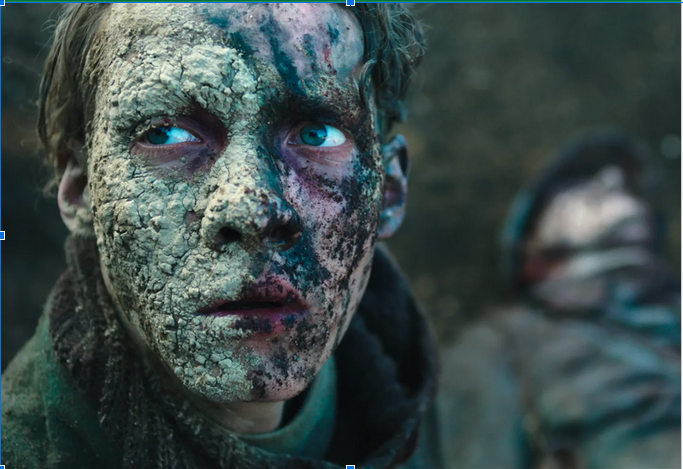
[5.1] As for scholarly work, specifically regarding how film is used as a visual medium to express grief on screen, there are a few pieces. Shell Shock Cinema: Weimar Culture and the Wounds of War by Anton Kaes focuses heavily on film as a form of expression, as he dives into the films made in a postwar world. These films use the medium as a means to express the grief, horror, and PTSD that can only be shown through a photographic artform, as it allows for a visual expression of these emotions and feelings. Below is a shot from All Quiet on The Western Front, and it compliments Kaes’s words on the importance of film as visual medium because without film, we would not see the dead soldier in the background or the ashy handprint on one side of Paul Baumer’s face and the mud on the other. (Figure 1) All of these little details work together to paint a picture that tells a story: one of death, war, and guilt. This story could not be told if we did not have film.
Figure 1: Mud and a handprint on Paul Baumer’s face in All Quiet on the Western Front
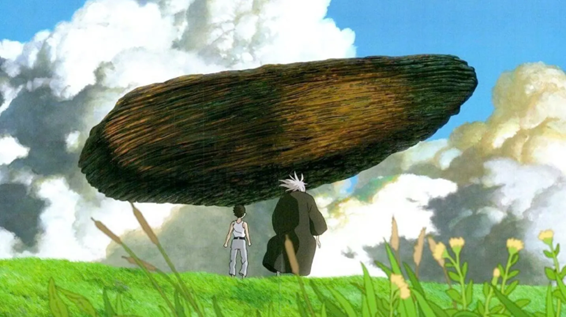
[5.2] The Boy and The Heron also relies on visuals to tell its story; however, its importance is both unique and different from that of All Quiet on The Western Front because it is animated. The Boy and The Heron is a film made from hand drawn animations, which are integral to creating the story and translating grief on screen. Every single detail that we see on screen had to be drawn by an artist, which gives it more meaning. Animation is a great medium to showcase the spirituality of grief because spirituality is not something we can touch in the material world. Spirituality is full of stories about the creation of the world and what lies beyond our human comprehension; however, the only things we have to go off of are stories and paintings. Animation allows Miyazaki to bring spirituality to life by interpreting it as he sees fit and drawing it on the big screen. Spirituality is heavily tied in with Miyazaki’s message about the grieving process and moving forward. We see Miyazaki’s version of what would be “God” in The Boy and The Heron, and Miyazaki uses animation to show a representation of our world through building blocks. (Figure 2) “God” is using those blocks to shape our world, and now he is handing it off to Mahito, giving him a choice to start building his own world. This is a perfect example of how animation can show worlds beyond our own and depict concepts that are purely spiritual, as we also see Mahito standing next to “God” in what seems to be a field located outside of space and time. (Figure 3) It is through animation that we get these fantastical representations of ideas that we the audience tackle every day.
Figure 2: “God” using blocks to shape our world in The Boy and the Heron
Figure 3: Mahito stands next to God in a field beyond time and space
6. The Boy and The Heron
[6.1] Hayao Miyazaki is regarded as one of the most gifted and beloved filmmakers in not just animation but the entire world of the visual arts. He has won numerous Academy Awards for his animated films, winning best animated feature film in 2002 for Spirited Away (2001) and in 2024 for The Boy and The Heron (2023). Hayao Miyazaki founded Studio Ghibli which has made dozens of beloved animated films such as Howl's Moving Castle (2004), Ponyo (2008), My Neighbor Totoro (1988), Castle in The Sky (1986), and many more. Miyazaki’s films are so widely loved due to their hand drawn animation and charming fantastical worlds. These worlds appeal to children, yet they have incredibly complex themes that will make adults cry or sit in their chair for ten minutes after the film ends, contemplating what they have just witnessed. Miyazaki is no stranger to complex themes.
[6.2] His latest film, The Boy and The Heron, is, at face value, about a young boy going on a grand adventure, but it is really about grief and loss, showcasing the inevitability of death and the importance of living in the moment. The protagonist, Mahito, loses his mother in a fire and moves to the countryside in Japan where his father works selling aerospace equipment to the military during World War II. While living in the countryside, Mahito must learn to live with his grief, and with the help of a heron, he goes to a fantastical world where he must find closure while also coming to terms with reality and realizing that there are brighter days ahead.
[6.3] The film is a masterclass in storytelling, particularly about grief and closure. Using Armstrong’s stages of grief model (manifestation, realization, acceptance, and release) along with the more familiar Kübler-Ross model (denial, anger, bargaining, depression, and acceptance), I will go more in depth into understanding why Mahito did the things he did throughout the film. First, it is important to understand Hayao Miyazaki’s background and what he had to go through growing up and look at the parallels between this film and his upbringing. In The Boy and Heron, Mahito moves to a rural home after losing his mother. It is through Mahito’s eyes that we observe how he grieves his mother but also how he perceives everything else in the world. Mahito’s father produces aerial fighter equipment for the war in the Pacific; however, since we see the world through Mahito’s eyes, we never know specific details about the war or even what war is going on. All that we observe are small glimpses of his busy father or Mahito walking in a room to see dozens of pieces of equipment laid out, but he is blissfully unaware of the larger historical context. Mahito’s father cares deeply for him; however, he is almost always busy with work. As an audience, we could perceive this as Mahito’s father burying himself in his work to cope with the loss of his wife.
[6.4] Izod and Dovalis talk about the importance of film as a mirror, especially one of personal expression. Anton Kaes also talks about the importance of film as a source of visual storytelling which illustrates how different people process war. This is significant because The Boy and The Heron opens with Mahito fleeing Tokyo with his father to live in the Japanese countryside. Hayao Miyazaki also lived in Tokyo as a child and fled from the city to live in the Japanese countryside during World War II. Mahito’s father produced airplane parts and munitions for the Japanese army during World War II, as did Miyazaki’s father. Miyazaki uses this film as an outlet to express his own grief, and he does that through the character of Mahito. The journey that Mahito takes through this fantastical world teaches him a lot about learning to let go and not hold onto things.
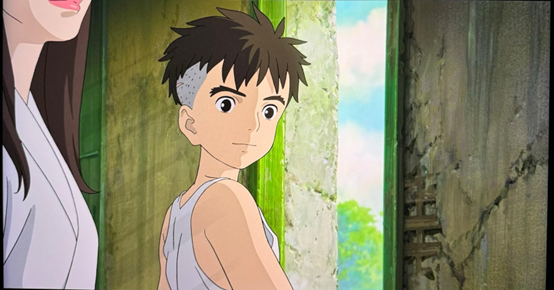
[6.5] The key part of my case study revolves around the ending of the film and Miyazaki’s legacy. If we apply the last two stages of grief from Armstrong’s model, acceptance and release, we can better understand Mahito’s journey and the message that it is supposed to leave with the audience. The most important moment in the film is right before the ending when Mahito must return from the fantasy world back home to the real one. But during his journey in this fantastical world, he meets his mother years before her death. Throughout the film, they traverse this world together, though ultimately they must return to their own points in time. Mahito’s mother Himi says something to him before he goes through a door to his own time that has stuck with me after viewing the film. She tells him, “My door is a different one.” Himi knows that returning back to her point in time means affirming the inevitable outcome of her death; however, she embraces it and is not afraid, knowing that she gives birth to Mahito and is very proud of him. Mahito fights back against his mom’s departure; however, she helps him come to terms with reality, which allows him to move on. Mahito looks back at his mother one last time before they return to their points in time (Figure 4); however, this time, he does not look at her with fear or sadness but rather acceptance, as he has released himself from the grief that has burdened him for so long. He has now come to terms with the loss of his mother and takes one last look at her before releasing himself from that grief and returning home. The portrayal of grief in The Boy and The Heron is not one of sadness and loneliness, but instead, it is one of recovery and moving forward. The film teaches the audience that it's okay to mourn and it's okay to grieve while also showing that we cannot hold onto grief forever, and we need to move past this grief and into brighter futures.
Figure 4: Mahito looks back at his mother with acceptance, released from grief
[6.6] While a lot of Mahito’s story mirrors Miyazaki’s, it is important to note that Miyazaki’s mother did not die while he was young. This is significant because I believe that Miyazaki also made this film as a form of grief to mourn his legacy. Miyazaki has come out of retirement multiple times to make new films, and The Boy and The Heron was no exception. Miyazaki has yet to find a successor to his work, and I believe this film is him coming to terms with the idea that he might not find one. In The Boy and The Heron, the “God” figure of the film is looking for a successor in Mahito. He hands building blocks to Mahito and tells him to build a world the way he wants to; however, Mahito declines. I believe that this scene is a metaphor for Miyazaki and his own creative work. He has created countless stories across countless worlds, and now he wants to hand his creative tools to someone else so that they can build their own world. However, since he has failed to find a successor, Miyazaki may be grieving his legacy, as he will have no one to continue his work. It is through this film that he realizes that everyone has their own stories to tell, and you cannot hand someone the keys to someone else's story, but you must allow people to build stories by themselves.
7. Humor and Grief
[7.1] Another useful work of scholarship is “The Lighter Side of Grief: Loss in Contemporary American Cinema” by Bryan Brown. Brown tackles the idea of why we make humorous films to deal with such a profound and heavy emotion. The primary focus of his research is to ask why Hollywood is moving towards humorous depictions of grief on screen rather than using humor as a way to move through grief. Grown Ups (2010) is an example of a film that tackles grief through a humorous lens, and while it is not a serious film, not every film about grief needs to send a serious message to its audience about the grieving process. We can look at how the theme of grief is taking a backseat to the humor. This choice heavily ties into the psychological aspects of grief, as we can unpack why the director went for a comedic approach to such a heavy topic to further understand the story. Izod and Dovalis bring up the idea that film is like therapy, and I believe that comedy in film can be a part of that therapy. In real life, many people resort to comedy as a coping mechanism to handle grief, and that is not because they do not care about the loss of a loved one. Rather, they are trying to cope with the reality of what has happened.
8. The Five Stages of Grief
[8.1] As previously noted, the five stages of grief in the Kübler-Ross model are denial, anger, bargaining, depression, and acceptance. To understand these stages of grief, we must break them down. It is important to note that Kübler-Ross actually created the five stages of dying, rather than grief, in her book On Death and Dying (1969), which focuses on terminally ill patients. However, her model was so profound that the five stages of dying that she created were adapted by various medical professionals into a broader model about the grieving process. [8.2] Psychologists Aditi Dawar, Praneeth Dara, and Akeem Sule did a study which “structured discussions to analyse themes, social determinants and psychiatric correlations following bereavement in a Bollywood movie” (Dawar et al). They published their results in BJPsych Open as an “Examination of Kübler-Ross Model of Grief from the Perspective of Bollywood Cinematic Media.” This research breaks away from a focus on Western audiences to use the Kübler-Ross five stages of grief as an outline for analyzing the Bollywood film Goodbye (2022) by Vikas Bahl. Dawar, Dara, and Sule note that Bollywood movies both are similar to and vary from Western depictions of grief. This work is closely related to Bryan Brown's work on comedy and grief; you can apply a lot of Brown’s theories to Dawar, Dara, and Sule’s research of Goodbye, as that film is a family comedy-drama.
9. Grief in Cinema
[9.1] Mourning Films: A Critical Study of Loss and Grieving in Cinema by Richard Armstrong is the foundation on which most of my research and film analysis is based. Armstrong’s work has been regarded as the first of its kind for being such an in-depth case study of film history, psychology, and grief. Armstrong also developed his own stages of grief based on current day grief counseling. This, as previously noted, consists of four stages: manifestation, realization, acceptance, and release.
[9.2] Armstrong also heavily emphasizes the importance of film as a specifically visual medium in his introduction, noting that grief is often silent and steals language:
[9.3] The intrinsically limited nature of language is a recurrent theme in films that treat themes of grief and mourning. In Morvern Callar (Lynne Ramsay, 2001), the bereft protagonist retreats into a kind of muteness, as do the grievers in Three Colors: Blue (Trois Couleurs: Bleu, Krzysztof Kieslowski, 1993), Genova (Michael Winterbottom, 2008), and I Have Loved You So Long (Il y a longtemps que je t'aime, Philippe Claudel, 2008). In Hiroshima mon amour (Alain Resnais, 1959), the very sound and feel of words in the mouth is emphasized. This "loss" of language has implications for the representation of grief, and for the theorization of the images with which films deal with grief.
The failure of words to communicate the ebbs and flows of grief is a recurring theme in this book. Of course, something of the experience is expressible in language. In the consoling family member, in the funeral platitude, in grief counseling, in religious ministry; in the real world it is primarily through language that grief is communicable. (Armstrong, 77)
[9.4] All Quiet on The Western Front uses this “loss of language” and muteness perfectly in its ending. The protagonist, Paul Baumer, is moving through the trenches and killing countless soldiers without saying a word, all in silence. All you hear are the struggles of enemy soldiers as he shoots, fist-fights, and bashes enemies with a rock until he stumbles into a bunker, only to be stabbed through the heart. It is at this moment that we really see the muteness that Armstrong references as Baumer again walks out of the bunker and through the trenches, seeing all the death and destruction around him before he, too, dies. When we apply Armstrong’s idea of muteness and “loss of language” to this scene as a representation and theorization of grief, we see that the two perfectly blend together. Baumer, as he silently walks through the trenches after killing countless other men throughout the course of the film, is now faced with his own demise, and there is nothing he can do to fight it. He walks in silence and takes in all of the death around him, and this is how we the audience grieve, too. We grieve the countless men that died horrendous deaths in World War I, we grieve the soldiers that Baumer killed, and now we grieve Baumer himself.
Clip 2: Paul Baumer is killed and dies in silence
[9.5] Izod and Dovalis also emphasize the importance of film as a visual medium. This is because the film captures so much and is as close to real life as we can get. This is important because it allows filmmakers to create a reality that almost feels real. The creation of this fake reality allows us to meet new characters and explore complex emotions and ideas that we can see and hear. Izod and Dovalis emphasize that film is a communal experience to be shared with other people. In a theatre, everyone is seated waiting for the lights to drop, the screen to turn on, and the sound to vibrate throughout the theater. This is a shared experience that everyone enjoys together. Izod and Dovalis believe that the shared experience of watching a film in the theater is crucial:
[9.6] We should mention that we believe it is difficult to experience films with intense emotional engagement anywhere other than the cinema. Being in an environment that is not prone to interruption produces a more creative relationship. (Izod and Dovalis, 2)
[9.7] Psychologically, this is an important part of filmmaking for many reasons. When the audience goes to the movie theater and sits next to a stranger, they are no longer strangers, as they have one thing in common. They are part of an audience; they are both seated for the same film, and so are the dozens of other people who are all seated at the same time in the same place to enjoy something new. The fascinating thing is that all the dozens or even hundreds of people who are seated to watch the same film as you may all leave feeling different emotions or even perhaps have taken away different messages than you did from that experience.
10. Apparatus Theory, Film as a Mirror
[10.1] Film being a mirror largely speaks to the human condition, and there is nothing more human than death, particularly within the societal structures of the West, which can view death differently than other parts of the world. Izod and Dovalis bring up the following regarding the concept of film as a mirror:
[10.2] The large screen functions in this manner as a psychological mirror of images and sounds that simultaneously partake of and invest in the two realities, the inner and outer lives that occupy healthy people. Within the affect-charged psychological realm that cinema sustains, self-reflection may occur and the meaningfulness of the experience evolve. In the darkened auditorium, the threshold of consciousness is lowered, opening the way to an encounter behind the curtain of the phenomenal world. (Izod and Dovalis, 2)
[10.3] This is an integral part of the psychology of grief and how it is portrayed on screen because the screen acts as bridge between the director’s vision and the audience, allowing the audience to take in both visually and auditorily the story that is being told to them. We can also apply apparatus theory to the grieving process in film because grief and its depiction on screen can vary greatly because of the different social constructs that make up different parts of the world, as well as different cultures, traditions, and customs tackling death and grief. Both All Quiet on The Western Front and The Boy and The Heron utilize the theory of the mirror because both of these films speak to the human condition, particularly that of growth, love, death, loneliness, and the human bond.
11. Conclusion
[11.1] The work of Armstrong, Izod and Dovali, and Kaes on the psychology of grief in film has allowed me to unpack All Quiet on The Western Front and The Boy and The Heron to understand how Edward Berger and Hayao Miyazaki applied their skills as filmmakers to create visual depictions of grief for the audience. Combining psychology and film allows for a much deeper analysis of not only the film, but also the director. However, this is not exclusive to film, as we can apply these particular theories and models to multiple different artistic mediums, such as painting. If we look at the painting and what emotions are being visually represented, we can then not only understand the painting, but also the painter. That said, these psychological theories are only a tool. It is of course possible that we misunderstand the artist, which makes it equally important to understand that these methods are a way to better help the audience connect with the director. It is not a biographical or true psychological account of said person's actions. But warning aside, applying psychological theories of emotion to film can make for interesting case studies and allow us to further expand scholarly knowledge not only of film but also of filmmakers.
Armstrong, Richard. 2012. Mourning Films: A Critical Study of Loss and Grieving in Cinema. McFarland.
Bento, Manuel S. 2022. “Review: Edward Berger’s Adaptation of ‘All Quiet on the Western Front.’” FirstShowing. Online at: www.firstshowing.net/2022/review-edward-bergers-adaptation-of-all-quiet-on-the-western-front/.
Brown, Bryan. 2008. “The Lighter Side of Grief: Loss in Contemporary American Cinema.” Visual Anthropology 22 (1): 30–43.
Dawar, Aditi, Praneeth Dara, Akeem Sule. 2023. “Examination of Kubler Ross Model of Grief from the Perspective of Bollywood Cinematic Media.” BJPsych Open 9 (1): S18–S19.
Draper, Jack A. 2018. Saudade in Brazilian Cinema: The History of an Emotion on Film. Intellect Books Ltd.
Girardot, Doug. 2022. “Netflix’s ‘All Quiet on the Western Front’ Is an Unflinching Portrayal of War’s Terror.” America Magazine. Online at: www.americamagazine.org/arts-culture/2022/11/11/all-quiet-western-front-netflix-244120.
Izod, John, and Joanna Dovalis. 2015. Cinema as Therapy: Grief and Transformational Film. Routledge.
Kaes, Anton. 2011. Shell Shock Cinema: Weimar Culture and the Wounds of War. Princeton University Press.
Settle, Zachary and Taylor Worley, eds. 2016. Dreams, Doubt, and Dread: The Spiritual in Film, Wipf and Stock Publishers.