[0.1] Abstract - This paper explores the exploitation of actors in cinema, examining historical and contemporary cases of on-set abuse.
[0.2] Keywords - film ethics, exploitation, cinema hierarchy, actor abuse, social media activism, gender and class in film, on-set safety, intimacy coordination, consent, film activism, director-actor relationships, method acting controversies
Do, Quynh. 2025. “Performing Under Pressure: Examining the Actor’s Role in Extreme and Provocative Cinema,” Muhlenberg Visions. Volume 3, No. 1.
[1] Introduction to the Exploitation in Film Production
[1.1] As film students, we gain a deeper understanding of the medium than the average viewer. From studying visual theories to mastering technical effects, we are exposed to knowledge that goes beyond what typically happens behind the scenes. However, there is a darker side to filmmaking that is often excluded from scholarly discussions and lectures. Like a carefully hidden crime, it took decades for the truth to come out about one of the most popular yet controversial productions in film history: The Wizard of Oz (1939).
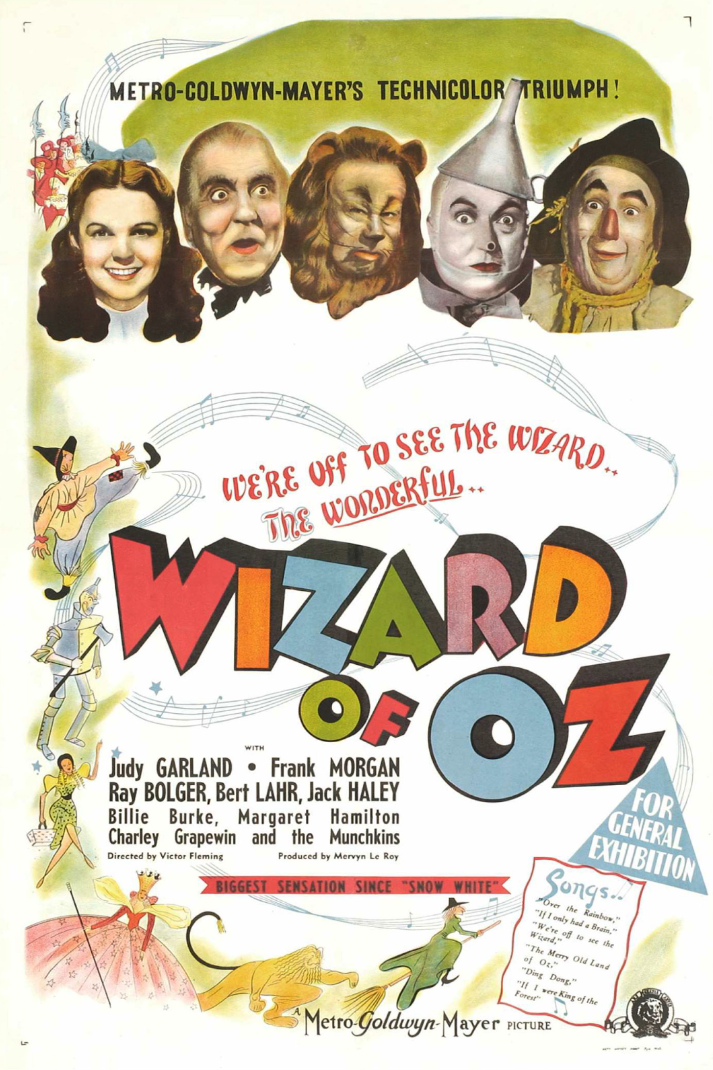
[1.2] This groundbreaking film, one of the earliest to be shot in Technicolor (Figure 1), captivated audiences with its whimsical story and revolutionary use of color. The Wizard of Oz became a cult classic beloved by all ages. Yet behind the charm and fantasy lay an abusive environment that affected nearly all the actors involved. The people we see on screen go to great lengths to create images that we analyze and admire. However, the method used to create these iconic moments is not always ethical. In some cases, filmmakers have pushed boundaries so far that the safety and well-being of actors were compromised, all for innovation and attention in an industry where people are desperate to stand out.
Figure 1: Wizard of Oz poster emphasizing the revolutionary Technicolor technology
[1.3] Throughout film history, certain productions have subjected actors to such intense conditions that they were left physically and emotionally scarred. For years, these stories went unnoticed, even when actors bravely spoke out. And so the cycle of abuse continued behind closed curtains, hidden from public scrutiny, until the rise of social media. With its mass adoption in the 21st century, social media has become a powerful platform for activism and storytelling. Abusive practices from historical productions have resurfaced as tales that fuel various activism movements, including those for gender and race. Soon after, the demand for accountability and reform within the industry grew. There are stories that catch the attention of people outside of the industry; audiences who once viewed cinema purely as entertainment now see its darker side as well. Today, actors also use social media to share their own experiences, revealing that these cycles of exploitation persist.
[1.4] This paper will examine some of the most infamous cases of psychological and physical abuse behind the scenes, explore how the industry’s structure enabled these abuses to remain hidden for decades, and emphasize the urgent need for reform.
[2] The Production Hierarchy: Levels of production
[2.1] The production of a film, whether a small independent project or a major blockbuster, requires the combined efforts of a team. On bigger productions, specific departments are formed, each with their own management. However, the overall framework of the production hierarchy in filmmaking is consistent. This paper focuses primarily on the so-called “above-the-line” positions seen in a film’s budget list. This list exists to help guide budget and manage specific pay rates for different positions in a production. Above-the-line positions refer to people who shape and direct the creative and artistic vision, process, and narrative of a film. Some individuals in this position are also responsible for the budget and cost that goes into making these artistic decisions come to life. Above-the-line positions can be compared to a corporate chain of command, with clear hierarchies that separate those who hold power from those with little to no authority. But as Kerry McElroy argues in her 2021 doctoral thesis, Class Acts: A Sociocultural History of Women, Labour, and Migration in Hollywood, Hollywood was particularly abusive in its treatment of workers. As McElroy explains:
[2.2] As in any industrial system based on capitalist economy, Hollywood relied on a hierarchical labor scale for the profit of its managerial classes. However, what was particular about its organization in comparison to other industries in the U.S., entertainment or otherwise, was its dehumanized treatment of all workers. This emerged not only from the attitudes of the producers and top executives, but also from the assembly line nature of studio-era production. (McElroy, 204)
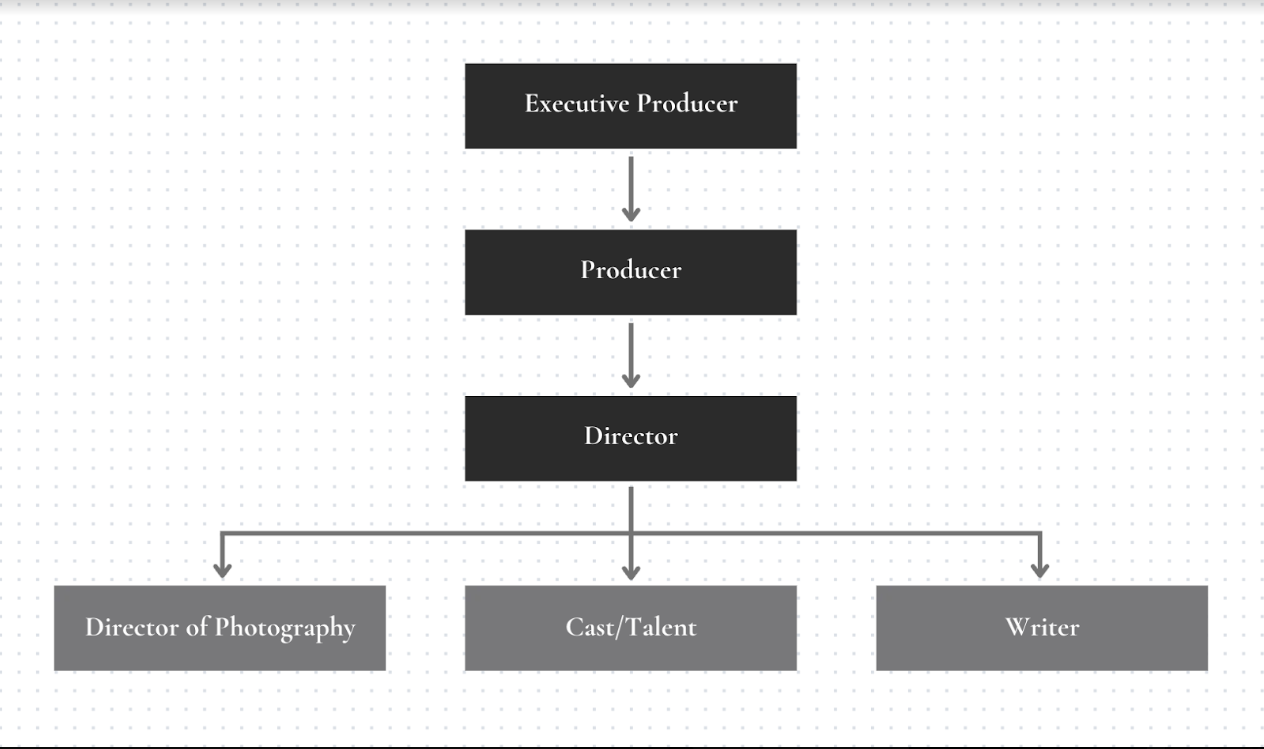
[2.3] At the top of the hierarchy is the Executive Producer, who oversees all aspects of the production and manages its finances. Next is the Producer, who works more directly with the day-to-day production and ensures that all moving elements run smoothly. The Producer often provides the financial report and any production report to the Executive Producer. Below them is the film’s Director, in charge of every artistic aspect of the production, and arguably the most visible figure in the creative process behind the screen. Supporting the Director are roles such as Director of Photography (DP), Cast/Talent, and the Writer (Team Clapboard). (See Figure 2)
Figure 2: A hierarchy of roles “above-the-line” in a film
[2.4] This hierarchical system ensures that tasks are performed efficiently, with final decisions centralized among a few key individuals at the top. While this structure promotes organization, it also creates significant disparities in authority for those lower in the hierarchy. Therefore, actors, especially those in minor roles, often find themselves at the bottom of this hierarchy, with little involvement in the decision-making process. This includes both how they appear as characters on screen and how they are treated as working actors on set. Even A-list celebrities and actors, unless they hold significant clout or personal connections within the hierarchy, are vulnerable to demands and pressures imposed by filmmakers. At the end of the day, they are still subject to the whims of those in power. For many, though not all, this vulnerability has led to moments of abuse, both physical and psychological, throughout their careers. This paper will delve deeper into these instances, shedding light on the hidden truth behind the creations of movies we love.
[3] The Production Hierarchy: The Contemporary System
[3.1] The film industry is constantly evolving and expanding. While United Artists was founded by actors including Mary Pickford, Charlie Chaplin, and Douglas Fairbanks, they were the exception rather than the rule; typically actors had far less influence in the production industry than they do today. The concept of celebrity and the idolization of actors grew alongside the industry itself. As audiences began recognizing familiar faces and wanting to see more of them on screen, the power dynamics started to shift. Many actor celebrities today have a major influence, since many audience members choose to watch a movie solely because their favorite actor stars in it.
[3.2] Hollywood now possesses a wide pool of globally recognized names. Filmmakers understand the value that A-list celebrities bring to a project, both in terms of their box office appeal and their creative input. Especially in production, the most famous of these names have more control over the process; they have a say in what they want and don’t want to do. Acclaimed actors who have been in the industry for decades can even hold power comparable to that of directors or producers. Fame, in some cases, acts as a loophole in the production hierarchy.
[4] Exploitation Behind the Scenes: The Wizard of Oz
[4.1] One of the most notorious cases of exploitation in film production—and the inspiration for this research topic—is the making of The Wizard of Oz. This example highlights how even a seemingly innocent film can be built on a foundation of mistreatment. Filmed in 1938 - 1939, the film was a representation of hope in America’s darkest time of the Great Depression. Being one of the first films to introduce color to cinema, it successfully did so with brightly colored sets and costume designs that emphasize different colors representing each character. But what made this film so magical also made it one of the most dangerous sets for the majority of the actors.
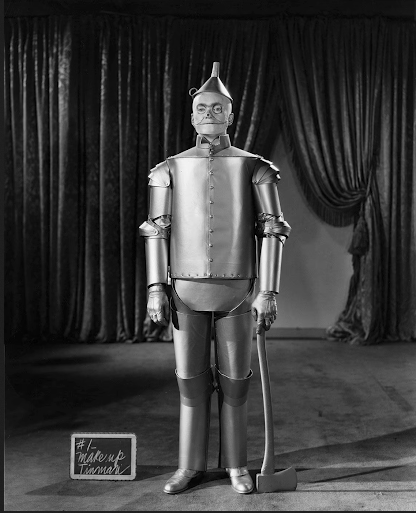
[4.2] The actor Buddy Ebsen, who was originally cast to play the Tin Man, was painted in pure aluminum makeup to get the realistic tin man look. (Figure 3) But the production team overlooked the danger of inhaling pure aluminum, which led to Ebsen being hospitalized for aluminum poisoning and ultimately replaced by Jack Haley. While the production then switched to aluminum paste, the filmmakers still disregarded the dangers of direct contact with aluminum in their pursuit of the perfect Tin Man. As a result, Haley developed an eye infection, though fortunately it did not lead to more severe complications. In another scene, Margaret Hamilton, who played the Wicked Witch of the West, was severely burned while filming her entrance in a cloud of smoke. Additionally, many stunt doubles were hospitalized due to fires caused by a lack of safety on the faulty set. Little regard was given to stunt performers, who were provided with cheap gear and wiring, which also led to fall-related injuries (Forbes Contributor).
Figure 3: Buddy Ebsen Test Makeup Tin Man
[4.3] The story of Judy Garland, who played Dorothy, was perhaps the saddest of all. Garland was 16 during the production but had to portray a character younger than her actual age. In order to fit the character description of a young girl, Garland was forced to stay on a strict diet of coffee, cigarettes, and chicken soup to stay thin. Her mother had previously given her substances at a young age during acting roles to keep her awake for long periods of time. The filmmakers of The Wizard of Oz noticed this and further encouraged the practice, making Garland work longer hours than the other actors. In a recorded interview, Garland revealed the harsh reality of her work, explaining that, “[A]fter four hours [of sleep] they’d wake us up and give us the pep pills again so we could work 72 hours in a row. Half of the time we were hanging from the ceiling, but it was a way of life for us” (Bertram). After the production, Garland developed a dependency on the drugs, which severely affected her health and ultimately led to her death. Moreover, Garland was underpaid for her portrayal of the main character, making less than some of her co-stars who had fewer appearances on screen. It was reported that while she made $500/week, the actors portraying her companions—the Scarecrow, the Tin Man, and the Lion—all made roughly $2,500-$3,000/week individually (L.A Times Archives).
[4.4] These are only a few of the countless actors and crew members that were mistreated on the set of The Wizard of Oz. It shows how many laws and regulations have been put in place since the so-called Golden Age of filmmaking. Aljean Harmetz, author of The Making of The Wizard of Oz explained that, “There were no unions at that time. Stars and lesser players were indentured servants [for] studios” (Forbes Contributor). The filmmakers brought an original narrative to life, but it came at the cost of the actors—the very people we see perform on screen. While the film won two Oscars, the permanent damage inflicted on some actors cannot be overlooked. Some of the actors, like Judy Garland, passed away before their stories were heard, but their legacy left a profound impact on actors' rights today. While it is unclear if it led directly to stricter safety regulations and labor laws, the production of The Wizard of Oz remains a highly discussed topic and continues to be analyzed by scholars to this day.
[5] Exploitation in Front of the Camera: The Cinema of Excess
[5.1] When a film is tagged as “too much,” we often assume that is articulating the audience’s perspective. A movie can be too gory, too disgusting, or too sexually graphic for the eyes, making spectators feel uncomfortable simply through its visuals and sound. But little attention may be paid to the plight of the actors, who have to physically enact and endure these moments on screen. Just as these films influence the minds of their audiences, they also leave a lasting impact on the actors who experience their extremes firsthand. Film scholar Mattias Frey examines the impact of extreme content in cinema, particularly on both audiences and actors. In his essay, “The Ethics of Extreme Cinema,” Frey describes this genre as “Extreme Cinema,” which he defines as “a production trend of ‘quality’ films that, because of violent, sexual or other graphic content, create critical and popular controversy” (Frey, 145). Frey also examines the intentions behind these films and their marketing strategies. By sparking controversy, these films generate discussion, regardless of whether the reactions are positive or negative.
[5.2] We see a positive interpretation of this genre in recent films by A24, a production company that focuses on producing unconventional films with unique visuals and narratives rarely found in mainstream cinema. With award-winning films like Everything Everywhere All At Once (2022) and Midsommar (2019), A24 emphasizes the unique creativity of each director, resisting the limitations of mainstream influence to create films that cater to specific audiences rather than the general population. These films with their loose narratives are highly dependent on how the directors guide audiences through the narrative without giving them the literal message; in that way, they treat film as an art form. Through creating an intense immersive experience, filmmakers put these audiences into a world not seen in conventional cinema. This process is explained by Jennifer McMahon’s idea of “Perceiving Intention in Order,” which she articulates in her book Art and Ethics in a Material World. McMahon’s analysis of how the audience can interpret contemporary art is similar to how an audience can interpret Cinema of Excess, where both art forms are not literal and conventional. By guiding their audience through the construction of their cinematic art, a director can help the audience understand not only the narrative but also the feelings behind the director’s thought and process when directing these scenes. A24 has done an excellent job recreating this process in their films, but this cannot be said the same for many films of excess that came before them. Some filmmakers have portrayed their bad intentions on screen through their sexual fetishes and deranged thoughts, creating images that can provoke complex emotions in the viewers. By masking it as “art,” they can claim these films as new, progressive, and never-before seen. In reality, filmmakers are crossing the boundaries between art and exploitation, showing glorified sex scenes, pornography, and horror. As Mattias Frey has put it:
[5.3] This production trend depends on (offending) culturally inscribed boundaries between art and exploitation. This is the paradox of extreme cinema: These productions attain the status of “art” by using the very tools of the lowbrow--the gratuitous or disturbing sex and violence or pornography, snuff films, horror, and action movies. (Frey, 145)
[5.4] There is no denying that these “extreme” or “excessive” films have a different attraction than more conventional Hollywood fare, even in today’s age with independent studios coming out with more creative takes on cinema. Film history has come a long way and, like it or not, there isn’t as much creativity in film as there was before, with growing restrictions and most importantly, the monopoly of Hollywood itself. Immersive films give spectators something different that they have longed for in cinema. With an available market and demand, filmmakers have the incentive to meet these needs, hence producing extreme cinema. However, one must understand that in order to achieve the depiction of strong or authentic emotions, some filmmakers manipulate actors’ raw emotions when filming, putting them into emotionally vulnerable, and potentially abusive places.
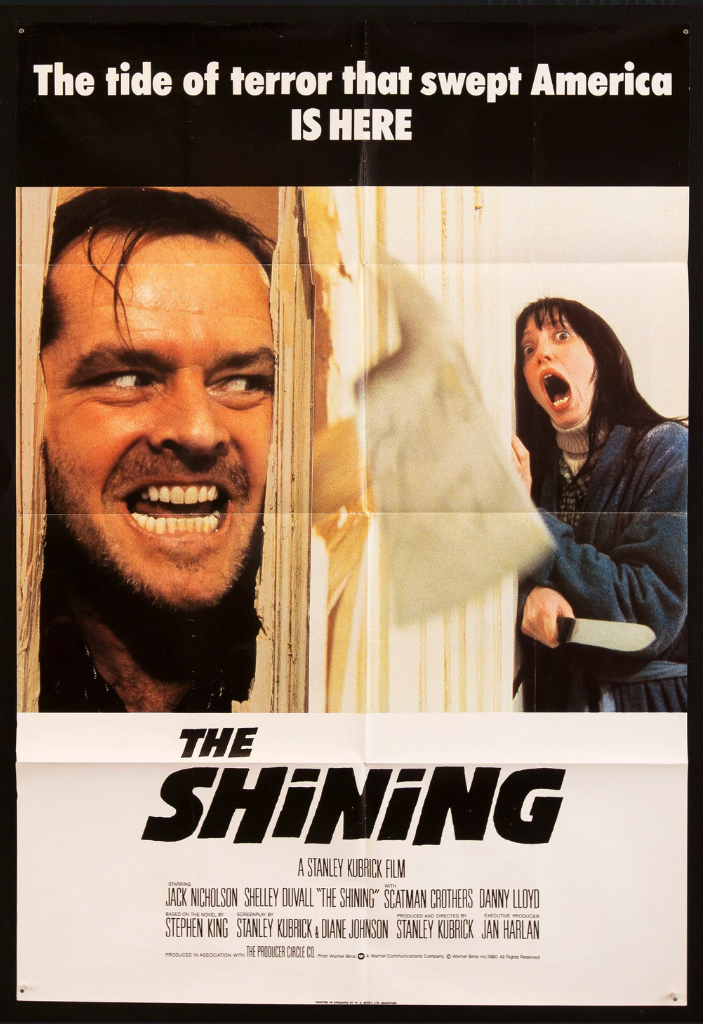
[5.5] The Shining was one of the first mainstream horror films to immerse viewers. The minimal use of non-diegetic sound, long takes, and raw method acting perfectly recreate the emotion of suspense. In what is probably the most famous scene in the film, the character of Wendy, portrayed by actress Shelley Duvall, screams as her maniacal husband Jack (played by Jack Nicholson) axes his way into the bathroom. A close-up of his ominous facial expression became one of the posters used to promote the film (See Figure 4). In this scene, Duvall screams repeatedly, turning to look and then hiding her face in pulses of fear. The long take lasted almost 30 seconds. She was praised for her role and specifically this scene, for perfectly capturing the fear of being trapped, as she hopelessly clings to a small knife, her only hope in a hopeless situation. What viewers forget is the possible physical and emotional damage that prolonged screaming can cause. It was reported that this scene took 127 takes where director Stanley Kubrick made her scream again and again simply because he was not satisfied with the emotion she was portraying. This left Duvall exhausted—constantly forcing herself into a state of panic and fear, while also damaging her voice, which required rapid healing to continue production. When you yourself are not experiencing it firsthand, it is easy to forget the human limitation. Big-name directors are praised for their work because they are able to capture the perfect shot and will not stop until it is achievable, but this sometimes comes with a lack of consideration for the actors redoing takes that are not so easy to do repeatedly.
Figure 4: British poster for The Shining (1980)
[6] Exploitation in Front of the Camera: Sexual Exploitation in Films
[6.1] Some intimate scenes in films dehumanize the actors, or more likely and specifically, actresses. While male actors are often clothed or have their intimate parts covered, the same treatment is not given to female actors. Films often fully expose their naked bodies, sometimes with no purpose within the narrative. This idea can be connected back to French philosopher Luce Irigaray’s social feminist theory, where she proposed her theory: that a woman’s body was a commodity with a price tag on it in a society organized by men; in other words, women’s bodies are “on the market” (quoted in McElroy, 205). When applied to the Hollywood system, the objectification or sexualization of a woman not only draws attention to the actresses themselves but to the films as well. As McElroy explains, “The exchange-value of an actress relates to her value as a sexualized object, constructed as such by Hollywood’s publicity strategies and cinematic conventions” (McElroy, 206).
[6.2] Filmmakers put a price tag on their work based on who appears in their films. In terms of women specifically, Hollywood uses conventionally attractive actresses or popular bombshells in their respective time periods to sell more tickets because of their “value.” For a long time, these actresses were known not for their acting talent but for the spectacle of their bodies, a selling point that filmmakers exploit to appeal to targeted audiences, usually men. Laura Mulvey made this observation in her famous essay, “Visual Pleasure and Narrative Cinema.” She ultimately claimed that the film is a visual representation of unconscious patriarchy where women still suffer under male control. Within the cinematic hierarchy, actresses are under the control of male-led productions, and their objectification serves to fulfill the unconscious sexual desires of men, as shaped by the society we live in. This next section will look at director Bernardo Bertolucci’s Last Tango in Paris (1972) and the case of the actress Maria Schneider. Mulvey would classify Bertolucci’s objectification of Schneider as an act of fulfilling his ego and sexual desire; as she explained, “Although the instinct is modified by other factors, in particular the constitution of the ego, it continues to exist as the erotic basis for pleasure in looking at another person as object” (Mulvey, 17).
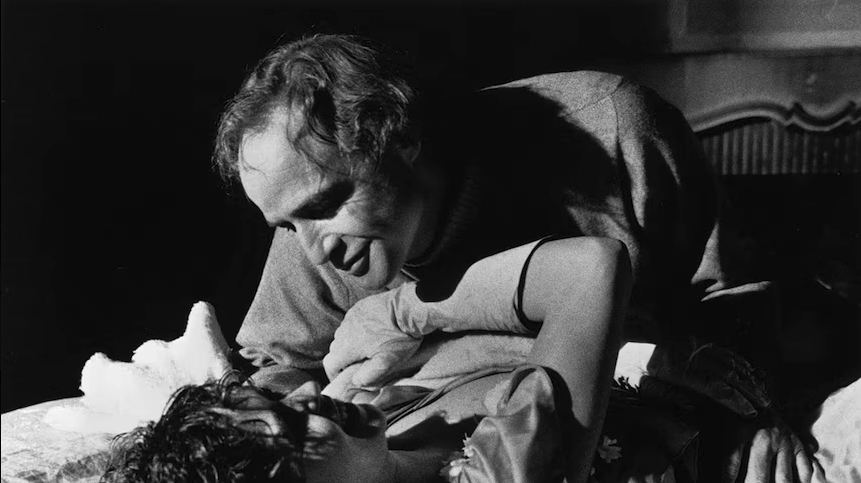
[6.3] Last Tango in Paris was released in 1972 and recently made waves again —not for its artistry under director Bernardo Bertolucci, but because of a 2013 interview clip. In the interview, Bertolucci admitted to filming a nonconsensual rape scene, an admission which gained renewed attention during the rise of the #MeToo movement. This came decades after the actress in the scene, Maria Schneider, spoke out about her assault while working on the film and her exclusion from the creative decision made by the director and her co-star, Marlon Brando. It took almost 40 years for Bertolucci to be condemned by the film industry, despite clear evidence appearing in most interviews and press conferences long before the 2013 interview clip. It is important to note that Bertolucci was an acclaimed director who has won many awards, including Oscars, Golden Globes, and the Palme d’Or at the Cannes Film Festival. His status and influence in the film industry played a major role in delaying his condemnation. Building up to the infamous rape scene, Schneider was repeatedly sexualized through intense, violent, and degrading encounters, and often filmed naked. As a result, the rape scene did not come across as shocking, as the film had already established itself as highly sexual and pornographic. In this scene, Schneider was informed of what was about to happen only moments before filming by people who had known about it for a long time, including her co-star, who played the rapist. She was pinned to the floor, lubricated with butter by her co-star, and anally raped. (Figure 5) While she was not actually penetrated during the filming of the scene, this doesn’t take away the humiliation Schneider felt while filming and seeing it on the big screen. In an interview, she stated that she was raped by both Marlon and Bertolucci. Bertolucci's decisions while filming were apparent; he wanted to capture a raw moment, and he admitted this in the 2013 interview, saying “I wanted Maria to feel, not to act.” The butter, a last-minute decision, added to Schneider’s intense rage and humiliation. It had no narrative significance but was simply used to humiliate and sexualize her. Last Tango In Paris’s explicit sexual and pornographic scenes were its main selling point upon release. Excessive nudity and sex sparked feminist debates questioning the ethical decisions of the Motion Pictures Associations in both France and America regarding the approval of this film for screening, even though it was rated 18+ and X in both countries and censored worldwide. As Sabrina Mor explains in her essay, “Before #MeToo: Maria Schneider and the Cultural Politics of Victimhood,” Schneider also suffered after the release in interviews with Brando, due to inappropriate speculations about an offscreen sexual relationship with her co-star and inquires as to intimate details of her personal life and sexuality arose due to how raw her emotions seemed on screen (Moro 32). As is often typical of the cinema of excess, all these events lead to one thing: attention and commercial success for the film.
Figure 5: The Last Tango in Paris, The Rape Scene
[6.4] Maria Schneider was vocal about sexism in the film industry throughout her whole career. Her case, along with many similar ones, added another factor to the established film hierarchy: gender. Acting, like many occupations, is gendered by society. Successful and respected actors are often expected to be male. Actresses, on the other hand, are often valued purely for their physical appearance, which often determines their casting. After Last Tango in Paris, Schneider became a symbol of sexual desire rather than being recognized for her acting. Even afterward, her reputation was defined not by her acting career but her personal life and the scandals surrounding it. Bertolucci, on the other hand, was praised for his unconventional and experimental take on sex scenes. He claimed that these scenes were meant to provoke political debate but disregarded the obvious visual choices that catered to the male gaze. This is evident in his admission that he deleted a scene in which Brando was fully naked, while Schneider was not given the same consideration. He stated, “I cut it out of shame for myself. To show him naked would have been like showing myself naked” (Michener 1973). This double standard has always existed in the film industry, even before Last Tango in Paris. The unconscious patriarchy in cinema reflects what happens behind the scenes. Women in the industry are at the bottom of the hierarchy, and figures like Bertolucci acknowledge this power discrepancy. He abused the system to get his way, knowing that there would be little to no repercussions on his side. Maria Schneider, on the other hand, not only faced the sexual abuse on set but also then had to endure criticism from society based on her sexual portrayal on screen—one from which Bertolucci profited, not her.
[6.5] Sex scenes are complex in how they are filmed and how they affect the audience. The purpose is to evoke a similar or familiar feeling in the spectator using only visuals and sound. Cinema has become a reflection not only of the filmmaker but the viewer, as sex scenes in film serve as a learning tool for audiences to discover what appeals to them. Film is still an industry governed by rules and regulations, and screening uncensored sex in mainstream movies is against these rules that have existed for almost 100 years. Filmmakers can still evoke this sensation in viewers by manipulating their imagination. Sometimes, the idea that a couple on screen has had sex is discreetly implied, but in today’s cinema, sex scenes are shown almost as if they were filmed in real time. However, by manipulating camera angles, editing, and sound, they can film a choreographed performance that imitates the act and sensation as if it were real (Williams, 1-12). Additionally, the way movie theaters are set up contributes to audience immersion. As Mulvey described, “...the extreme contrast between the darkness in the auditorium (which also isolates the spectators from one another) and the brilliance of the shifting patterns of light and shade on the screen helps to promote the illusion of voyeuristic separation” (Mulvey, 17).
[7] Exploitation in Front of the Camera: Horror / Psychological Exploitation
[7.1] A successful horror film is a movie that is able to scare the audience while also having a captivating narrative. Most horror films, both past and present, revolve around a main character or victim facing a physical representation of what we as humans fear, either in the form of a human or a fictional monster. The victim, in this case, represents the average person— a mirror to the audience—most of whom have common or ordinary backgrounds. We see this in mainstream horror films like IT (2017), where a group of normal kids faces a scary killer clown, and The Conjuring (2013), where an average family confronts supernatural forces haunting their house. All of this serves to achieve the ultimate effect of immersion, placing the audience in a similarly vulnerable situation as the characters on screen. For this effect to work, the actors themselves must portray this vulnerability and convincingly show fear, an act easier said than done. Fear is one of those emotions that is difficult to replicate. I have already referenced a notable example: The Shining, where actress Shelley Duvall had to endure countless takes to achieve that essence perfectly. This method, however, is time-consuming, and not every actor can even achieve it, no matter how many takes. This leads some directors to think that the best way to capture fear perfectly is to make the actors feel real fear. This can be achieved by keeping actors completely unaware of what is about to happen in certain scenes. But many ethical issues arise with this method. The physical environments actors are placed in for horror settings are not always ideal, potentially exposing them to physical and psychological harm. Additionally, the ethics of withholding information from actors before shooting is questionable, as seen in the case of Bertolucci and Maria Schneider. To analyze both points, I will look at The Blair Witch Project (1999), a film that revolves around the idea of found footage, achieved by having actors film the entire movie.
[7.2] The Blair Witch Project follows a group of three college students as they uncover the mystery of a town they had only heard rumors about. The documentary-style film received mixed reactions, particularly among scholars. To this day, the film is still being studied; from an artistic standpoint, the film pioneered a unique approach to horror, inspiring modern works like Incantation (2022) and Unfriended (2014). However, its filming methods sparked debate among film scholars, who labeled it a “mockumentary.”The film had a loose narrative with no dialogue—everything was improvised by the actors, including filming itself. The actors were given general directions on where to go and rough guidelines on what to say to steer the story. According to co-director, Daniel Myrick, the fear seen on-screen was genuine, as the crew played unsettling sounds, such as children laughing, and shook the actors' tent at night without prior warning. The actors played versions of themselves, even their real names. In an analysis of a similar production, Borat: Cultural Learnings of America (2006), this technique was defined as using “social actors,”—individuals aware they are being filmed and given direction but placed in a controlled environment designed to elicit real emotions they may not have agreed to display. This raised an ethical question for both films: is it justifiable for directors to deceive their actors in pursuit of an ideal performance?”
[7.3] In an interview, Joshua Leonard, one of the actors in The Blair Witch Project, described the conditions he experienced while working on the film. All actors were physically placed in the environment as if they were their characters. They had to set up tents and received limited food. While this was an effective way for the actors to embody the characters, these harsh conditions eventually led to tension, with Joshua admitting that he forgot about the job and genuinely felt frustrated with the other actors. In their chapter, “Cinema as Mirror and Face,” Thomas Elsaesser and Malte Hagener describe the ways identities can blur in the movies:
[7.4] [C]inema’s fascination with stories of Doppelganger and exchanged identities has always implicitly acknowledged the problematic dynamic of identification and self-estrangement, fleshing out into narrative terms or turning into allegory the spectator’s own uneasy or uncanny awareness of the characters as his or her delegates and doubles, ideal selves or dreaded alter egos.” (Elsaesser and Hagener, 57).
[7.5] While this concept is typically viewed from the audience’s perspective as the spectator mirroring the characters, it can also apply to actors embodying their roles, potentially putting their identities at risk. The directors’ intention to capture authentic emotions was evident, but in doing so, they risked damaging the actors’ psychological health and identities. Method acting has been widely questioned in the industry. While Joshua’s case was mild, becoming too immersed in a character can pose risks to an actor's identity and affect other cast and crew members. In addition, leaving actors in the dark—especially in a horror narrative—can potentially trigger trauma. This can happen even in conventional acting, where actors know what will occur. However, for the sake of narrative and production efficiency, directors may sometimes push actors beyond their limits without considering past triggers (Bennett, 11-16). Additionally, this can also create new triggers, as seen in Jennifer Lawrence’s role in Mother! (2017), where she revealed in multiple interviews that she developed trauma after filming the final scene. (D’Alessandro)
[7.6] Some of the most iconic horror scenes are unscripted and improvised, and while there may be times that it is effective to attempt to capture raw emotion , the risk for the actors is sometimes too high. The danger of normalizing this practice falls upon actors and actresses, possibly leaving them in a state where they cannot act anymore. The actors of The Blair Witch Project did not pursue acting after the production, and their interviews reveal the danger of achieving an “authentic” feel by placing actors in a vulnerable position. The production was close to crossing the line into causing harm to the actors, but directors’ interviews showed a lack of concern, making it apparent that capturing the perfect emotions on screen overshadowed the risk to the real people they worked with.
[8] Philosophy and Ethics of Film
[8.1] Like any art form, film is a manifestation and reflection of the artist—which some see as chiefly being the director. The scenes from the case studies I have analyzed above are not inherently unethical to create. However, the way they were shot that calls the directors’ ethical choices into question. A rape scene can be crucial to a narrative, and it is not always unethical to include these scenes in cinema. We see this in Sweet Sweetback’s Baadasssss Song (1971), a movie about oppression and police brutality. Sweetback, as the main character, is the victim to this system; he grows up in a brothel, where he is raped and looked down upon by the people he lives with. This only makes his character arc even more inspiring as he fights against systemic oppression. Similarly, a scene requiring powerful emotion does not necessarily have to put actors in vulnerable situations. At the end of the day, actors are just people working their jobs and they deserve respect for their well-being. The emotions of fear, anger, and humiliation can be recreated in many creative ways, evoked differently and shot differently to maintain authenticity while respecting the actors. Directors ultimately have complete artistic freedom when bringing their vision to life. They can either choose the easy route and film the scenes as they are, putting the actors in the same position as the characters, or they can come up with creative strategies that capture the vision while still considering the actors. Furthermore, the philosophical impact of cinema is greater than filmmakers may think. Thomas Wartenberg’s analysis in Thinking on Screen: Film as Philosophy emphasizes the profound impact film can have on audiences—sometimes surpassing that of even the most famous philosophers. Matthew Turner summarizes Waternberg’s argument:
[8.2] films have the ability to illustrate a particularly complex philosophical theory, function as thought experiments in a philosophical context, or put us directly in the position of one of the characters of the film so that we are led to “perceive” (in the sense of understand or come to know) what the character perceives, which experience imparts philosophical content (Turner 438).
[8.3] What Wartenberg concludes is that film essentially constructs how we view the world, that film does philosophy, placing the power to shape a better or worse world in the filmmaker's hands. In the age of media, the impact of film on a person’s development cannot be overstated. A skilled filmmaker can inspire a better society through their work and ethical practices, setting an example for younger generations of filmmakers. However, an unethical filmmaker wields the same influence, with the potential for negative impact.
[9] Social Media and Public Awareness
[9.1] There has been little to no change in the Hollywood system over the years. From The Wizard of Oz production in 1939 to The Blair Witch Project in 1999, directors and producers have taken advantage of the power they have in the industry, fostering a toxic work environment for future generations. All the case studies I have analyzed above only gained attraction in recent years. Does this mean the system has changed, or is there another reason why these issues are only being widely discussed decades later? To answer the first question, the system has only changed to a certain extent. Evidence for this lies in a five-episode documentary released in March 2024, titled Quiet on Set: The Dark Side of Kids’ TV. This documentary took over the internet within hours and became one of the most talked-about topics online at the time. All eyes were on Dan Schneider, the Nickelodeon producer who created some of the network’s most famous shows for children from the 1990s to 2010, including iCarly, Victorious, Drake & Josh, and more. One key difference from the case studies thus far is that Schneider was a TV producer; with the exception of some film spin-offs he created for his shows, his main focus was television. But for the most part, both TV and film producers oversee production and are ultimately the people in charge and who bear responsibility. That said, there are some major differences between film and TV producers;for instance, in the amount of time and power these producers have. I have explained briefly a film producer’s role over budget and artistic decisions in a film production. A television producer works on a project for much longer due to the nature of TV shows. That is why they are responsible for many more aspects of production to maintain continuity over a longer period. These responsibilities include those of a film producer, along with writing, directing, project planning, and management—all major factors that, in a film production, are more evenly distributed among people. It is no surprise that TV producers are paid more than film producers. Just as directors are the controlling force of their movies, producers are the controlling force of their shows.
[9.2] Quiet on Set: The Dark Side of Kid’s’ TV reveals the harsh reality behind the fantasy Schneider created for kids—the abuse behind the camera, along with the disturbing things he forced his actors to do on screen for his own gratification. Dan Schneider was the Golden Boy of Nickelodeon. His position as a producer already placed him high in the production hierarchy and his success in the industry elevated him even further—not just within Nickelodeon but also in the broader children's television market. It was revealed that Schneider abused this power by fostering a toxic work environment on set, affecting both his crew and his actors. Former employees revealed that Schneider forced his female employees to split their salaries with him and give him massages. His hostile behavior created an atmosphere of fear, making crew members, writers, and actors feel uncomfortable on set. They constantly had to walk on eggshells to avoid getting on his bad side and ensure a "good day" at work. His overwhelming control over his shows is evident on screen, where he made actors perform scenes that were unnecessary to the plot, often sexualizing and fetishizing his young cast. A well-known example involves actress Ariana Grande in Victorious, where she was instructed to put her foot close to her face and bite her toes. At the time, she had yet to rise to fame and, like all of Schneider’s actors, was still young and lacked power in the industry. He also included numerous other inappropriate innuendos, primarily involving his actresses, many of whom were underaged at the time. For a children’s television show, these suggestive “Easter Eggs” served no purpose, as most young viewers could not comprehend their implications. Purely for his own gratification, Schneider made his actors and actresses perform these actions, knowing they could not refuse due to the power imbalance he maintained over them.
[9.3] At the end of the day, actors and actresses are still on the bottom of the production hierarchy. While they have the power to speak up and shed light on issues, doing so often leads to one of two outcomes: either no one believes them, or the executive producers and the network ignore the issue to keep production running. The worst case scenario is termination from the production. Unless an actor has already made a name for themselves in the industry, they are essentially dispensable. This is the harsh reality of both film and television production. At its core, the industry is a business, operating as a structured chain of production. Any disruption can lead to catastrophic financial losses if a project does not go as intended. Especially for shows and sitcom productions where episodes are expected to come out on a schedule, these “minor inconveniences” aren’t worth the risk of cancelling million dollar projects.
[9.4] Most of the case studies in this paper took place decades before any global awareness of these issues. Thanks to the internet, information now spreads faster than ever, and platforms like Youtube, Tik Tok, and Instagram have informed me as to what happened behind the scenes. These platforms bring light to past stories of actors while providing a direct channel for current actors to speak up about their experiences. Big movements like #MeToo also help bring awareness to film production exploitation. Other sectors in the production hierarchy have also spoken out about abusive practices in Hollywood and the film industry; for instance, the Writers Guild of America, whose 2023 strike gained mainstream media attention through its coverage on social media. These social media platforms amplify voices that were historically silenced, creating a public dialogue around the mistreatment of actors, including their emotional manipulation, the filming of non consensual intimate scenes, and the overall lack of safety of the work environment. Additionally, raising awareness among fans and advocacy groups empowers the audience to hold film companies accountable for their actions, making change more likely to happen than if actors were standing alone. By fostering widespread awareness and collective outrage, social media not only highlights these issues but also contributes to a growing demand for systemic change in the entertainment industry.
[10] Conclusion / Solutions: The Role of Intimacy Coordinators and On-Set Protections
[10.1] A majority of Hollywood films are transparent about having intimacy coordinators on set for intimate scenes. Among other protections in Hollywood, these laws and best practices were made possible because of unions and advocacy against unsafe practices in the past. The role of an intimacy coordinator is to provide a safety net for actors on screen, ensuring their protection and boundaries while also assisting in coordinating the director’s vision in a safe way that does not delay production. Overall, this role protects both parties in this specific aspect of cinema. An intimacy coordinator is recommended to be hired for sets that involve simulated sex scenes and nudity. This rule is increasingly common in Hollywood, but what about indie films? As an aspiring film student, I feel that education on safety protocol on set is important, even for a small production. Not every small production can hire an intimacy coordinator; as a result, the responsibilities lie with the person in charge of the film’s vision, the director. Even in Hollywood productions, it is important for the director to understand the boundaries of actors and how to respect them. Only then can they work with a coordinator (SAG-AFTRA).
[11] Further Recommendations
[11.1] The ultimate responsibility for a production rests with the filmmakers—with the top of the hierarchy, the directors and producers. They are accountable not only for their crew and their actors but also for the messages conveyed to audiences through cinema. Many of the abuses and oversights seen in past productions could have been prevented if these issues were addressed proactively. Incorporating training for directors and producers early in their careers could play a crucial role in fostering a more ethical industry. As much fun as learning about theories and camera work is, this ethical responsibility of filmmakers should not be overlooked. It deserves to be a formal part of the film curriculum or offered as a dedicated class. The history of filmmaking provides ample material for reflection, discussion, and the creation of clear ethical guidelines. My hope with this paper is to inspire future filmmakers, including myself, to reflect on past mistakes and actively work to prevent the cycle from continuing. However, this is easier said than done. The intense desire to create something innovative or groundbreaking can often overshadow the need to prioritize ethical practices. Only through reflection and education can we hope to balance our creativity and our responsibility.
AFTRA, SAG. 2024. “Standards and Protocols for the Use of Intimacy Coordinators.” SAG. Online at: www.sagaftra.org/standards-and-protocols-use-intimacy-coordinators-0.
Aster, Ari, director. 2019. Midsommar. A24.
Bennett, Anita. 2023. “Trauma in the Acting Process: My Role as Camae in The Mountaintop and the Implementation of Practical Techniques for Empowerment.” MFA Thesis, University of Central Florida. Online at: stars.library.ucf.edu/etd2020/1858/.
Bertolucci, Bernardo, director. 1973. Last Tango in Paris. United Artists.
Bertram, Colin. 2024. “Judy Garland Filmed The Wizard of Oz under Grueling Conditions.” Biography. www.biography.com/actors/judy-garland-pills-diet-wizard-of-oz.
Clapboard, Team. 2022. “A Full-Stack Creative Services Marketplace.” Clapboard, December 12. www.clapboard.com/blog/The-Definitive-Film-Crew-Hierarchy-Chart.
Clift, Robert. 2013. “Uncomfortable Viewing: Deauthorized Performances, Ethics, and Spectatorship in Sacha Baron Cohen’s Borat.” In Cine-Ethics: Ethical Dimensions of Film Theory, Practice, and Spectatorship, edited by Jinhee Choi and Mattias Frey, 96–110. New York, NY: Routledge, Taylor & Francis Group.
D’Alessandro, Anthony. 2017. “Jennifer Lawrence on Becoming Mother!: ‘This Is the Only Time I’ve Lost Myself.’” Deadline, December 5. Online at: deadline.com/2017/12/mother-jennifer-lawrence-darren-aronofsky-oscars-interview-1202218420/.
Elsaesser, Thomas, and Malte Hagener. 2009. “Cinema as Mirror and Face.” In Film Theory: An Introduction through the Senses, edited by Erica Wetter, 55–77. New York, NY: Routledge, Taylor & Francis Group.
Entertainment, Legal. 2024. “‘Wicked’ Dangers behind the Classic The Wizard of Oz Production.” Forbes, December 9. Online at: www.forbes.com/sites/legalentertainment/2024/12/09/wicked-dangers-behind-the-classic-the-wizard-of-oz-production/.
Fischer, Jenna, and Steve Carell. 2017. The Actor’s Life: A Survival Guide. Dallas, TX: BenBella Books, Inc.
Fleming, Victor, director. 1939. The Wizard of Oz. MGM/UA.
Frey, Mattias. 2013. “The Ethics of Extreme Cinema.” In Cine-Ethics: Ethical Dimensions of Film Theory, Practice, and Spectatorship, edited by Jinhee Choi and Mattias Frey, 145–162. New York, NY: Routledge, Taylor & Francis Group.
Hoad, Phil. 2018. “How We Made The Blair Witch Project.” The Guardian, May 21. Online at: www.theguardian.com/culture/2018/may/21/how-we-made-the-blair-witch-project.
Kwan, Daniel, and Daniel Scheinert, directors. 2023. Everything Everywhere All at Once. A24.
McElroy, Kerry. 2021. “Class Acts: A Sociocultural History of Women, Labour, and Migration in Hollywood.” PhD Thesis, Concordia University. January: 203–280.
McMahon, Jennifer. 2014. “Perceiving Intention in Order.” In Art and Ethics in a Material World, 29–50. New York, NY: Routledge, Taylor & Francis Group.
Moro, Sabrina. 2022. “Before #MeToo: Maria Schneider and the Cultural Politics of Victimhood.” In Screening #MeToo: Rape Culture in Hollywood, edited by Lisa Funnell and Ralph Beliveau, 29–46. Albany, NY: SUNY Press.
Mulvey, Laura. 1989. “Visual Pleasure and Narrative Cinema.” In Visual and Other Pleasures, 14–26. London, England: Palgrave Macmillan.
Staff Writer. 1989. “By the Numbers: Wizard of Oz Facts.” Los Angeles Times, September 5, 1989. Online at: www.latimes.com/archives/la-xpm-1989-09-05-ca-1562-story.html.
Staff Writer. 2024. “Television Producer vs Film Producer.” Zippia, April 5. www.zippia.com/television-producer-jobs/television-producer-vs-film-producer-differences/.
Sur, Debadrita. 2024. “Shelley Duvall’s Awful Experience While Shooting The Shining.” Far Out Magazine, July 11. Online at: faroutmagazine.co.uk/shelley-duvall-experience-stanley-kubrick-the-shining/.
Turner, George E. 1998. “Behind the Curtain: The Wizard of Oz.” American Cinematographer, December. Online at: http://theasc.com/articles/behind-the-curtain-wizard-of-oz.
Turner, Matthew. 2009. “Thinking on Screen: Film as Philosophy by Wartenberg, Thomas E.” Journal of Aesthetics and Art Criticism 67 (4): 438–440.
Van Peebles, Melvin, director. 1971. Sweet Sweetback’s Baadasssss Song--Trailer. Cinemation Industries.
Williams, Linda. 2008. Screening Sex. Durham, NC: Duke University Press.
Wingard, Adam, director. 1999. The Blair Witch Project. Lionsgate Films.