[0.1] Abstract - By integrating scholarship on Hayao Miyazaki’s themes with existing film theory, I explore how he is able to build bridges between the spectator and landscape/nature by using non-human beings in his films.
[0.2] Keywords - animation, Japanese culture, eco-criticism, film theory, non-human characters, landscape, nature
Lee, Mayu. 2024. “Hayao Miyazaki: A Man Of The ‘Other,’” Muhlenberg Visions. Volume 2, No. 1.
[1] Ghibli Studios’ Hayao Miyazaki stands as an internationally acclaimed and well-regarded animator, filmmaker, and manga artist. His easily recognizable films, such as My Neighbor Totoro (1988), Spirited Away (2001), Kiki’s Delivery Service (1989), and Howl’s Moving Castle (2004), are watched by native Japanese and foreign audiences alike. His creation of fantastical worlds and marvelous adventures are enjoyed by viewers of all ages; the range of spectators reaches beyond his presumed young demographic. How he is able to draw in such a diverse following might have something to do with his ability to build connections and transcend the cultural barriers that would otherwise restrict and hinder him from reaching as big of an audience. His use of wondrous and out-of-this-world creatures, despite initially contradicting our understanding of empathy and relatability, somehow engages and prompts the audience to look past the screen and consider their own relationships with the world around them. Thus, while the culturally-specific elements of his films, particularly surrounding the reverence of nature and landscape, may not always serve as a point of connection for an international audience, Miyazaki is able to compel them refer to their own, more accessible worldviews in order to recognize the underlying messages that he conveys. These subtle suggestions to incorporate one’s personal perceptions and understandings allows the audience to accept, rather than deny, the analytical impossibilities presented. By analyzing Miyazaki’s body of work, exploring common themes in his films, and putting them in conversation with existing film theories, we can consider Miyazaki’s use of the non-human to negotiate between character and space in order to symbolize and visualize the relationship between human and landscape. To further my exploration into Miyazaki’s themes, I will look at a few of his films in particular (My Neighbor Totoro, Spirited Away, Princess Mononoke, Howl’s Moving Castle, and Nausicaä of the Valley of the Wind), and then consider how Miyazaki illustrates some differences between Western and Japanese culture. After the deconstruction and analyses of these particular elements in his films, I will use my findings to interpret and decode Miyazaki’s newest film, The Boy and the Heron (2023).
[2] There is much current scholarship investigating individual themes that Miyazaki illustrates in his films. In Conceptualizing Anime and the Database Fantasyscape, Brian Ruh defines anime and examines the role that it plays within the larger media world. In understanding how Japanese animation has and continues to influence the art world and beyond, one can consider how animation is regarded by spectators. In addition to the history of animation, particularly in relation to Western culture, Susan J. Napier, author of The Problem of Existence in Japanese Animation, examines the way in which Japanese animation provides the viewer the opportunity to delve into other realms that shift away from our conceptualizations of reality. Regarding this relationship between fantasy and liminality, Montserrat Rifa-Valls explores the representation of girl power in Miyazaki’s films, introducing the topic of spectatorship and identification and as well as contemplating the audience’s interpretation of character and plot. While there is some diversity in the themes that are examined in regards to Miyazaki’s films, a majority of the scholarship that surrounds his works highlights the environment and nature/landscape as their main subject. Both Gwendolyn Morgan and Amy Murphy discuss the use of the apocalyptic trope as a critique of human influence on the natural world. Lim Tai Wei uses one of Miyazaki’s most popular films, Spirited Away, to interpret environmental themes in Miyazaki’s work, while Nathaniel Heggins Bryant does the same, writing about industrialization in connection to imperialism, warfare, and ecological ruin in Nausicaa of the Valley of the Wind. Ethical and aesthetic explorations of landscape within Miyazaki’s body of work are discussed in Pamela Gossin’s “Animated Nature: Aesthetics, Ethics, and Empathy in Miyazaki Hayao’s Ecophilosophy.” Sema Mumcu and Serap Yilmaz’s “Anime Landscapes as a Tool for Analyzing the Human-Environment Relationship” also emphasizes Miyazaki’s insistence of the importance of creating responsible landscapes through his own animated landscapes. These ecological and environmental observations of Miyazaki’s films work well when put into conversation with two other, more general, analyses of landscape: Yuanyuan Chen’s review of Chris Pallent’s edited collection Animated Landscapes: History, Form, and Function, along with D.W. Meinig’s “The Beholding Eye: Ten Versions of the Same Scene” both lay a foundation on which the scholarship about Miyazaki’s films can stand. Work by authors such as Noriko Reider, which considers explicit and implicit representations of Japanese culture, and Napier’s “Matter Out of Place: Carnival, Containment, and Cultural Recovery in Miyazaki’s Spirited Away,” through which she examines said film as an example of “cultural boundedness,” put Japanese culture in particular at the forefront of the conversation. One notable piece of criticism by Chris G. Hall concentrates distinctly on the role that non-human entities play in the connection between human-self and nature. I build upon Hall’s work using not only the previously-mentioned scholarship, but also by bringing in film theories concerning realism, spectator identification and familial representation. Through the integration of Miyazaki scholarship and existing film theories, I explore how Miyazaki is able to build bridges between the spectator and landscape/nature by using non-human beings in his films.
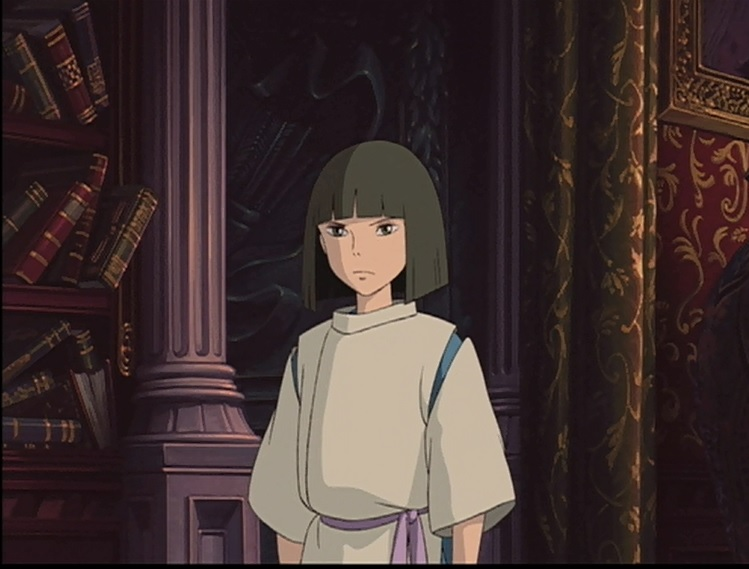
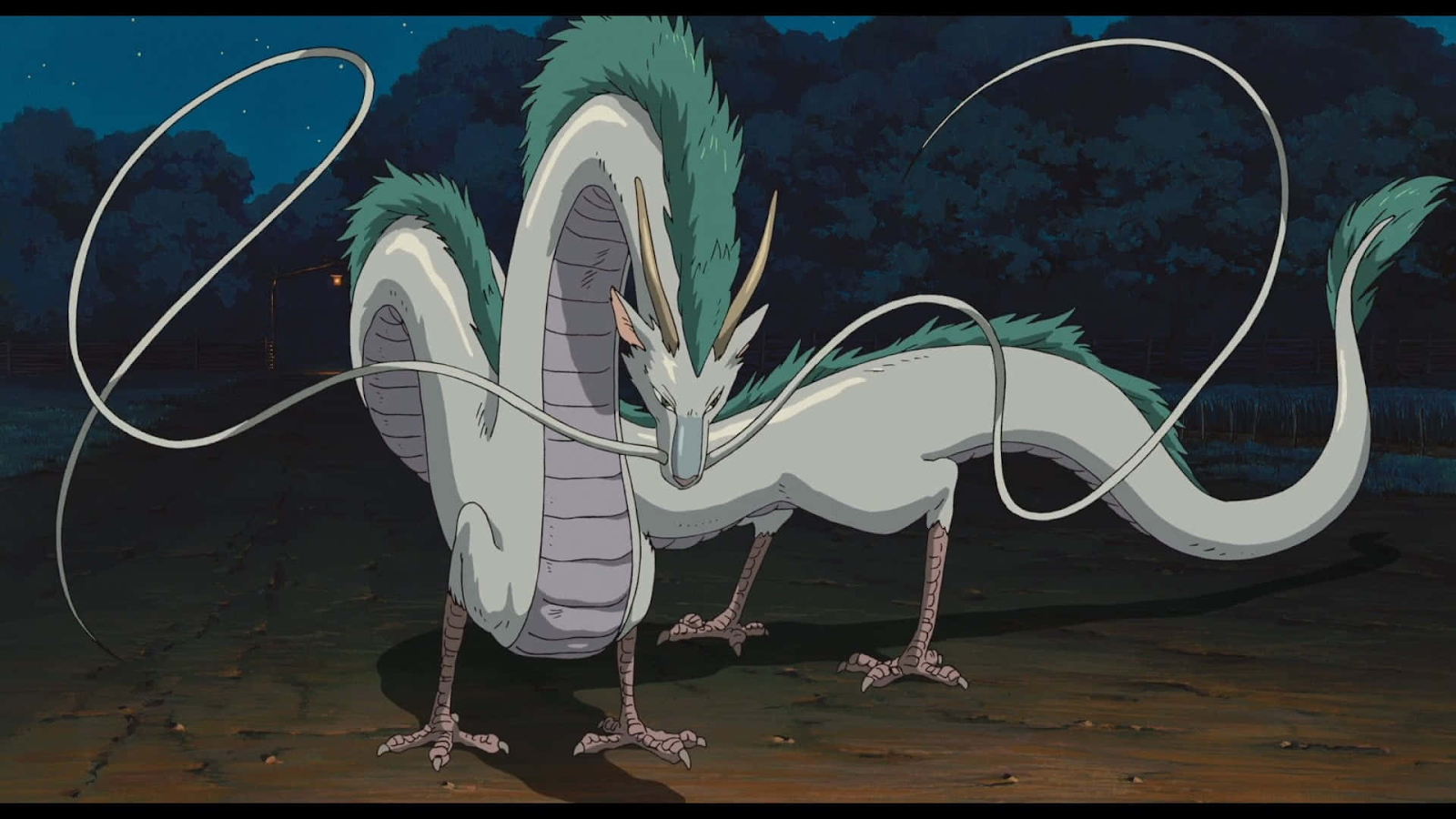
[3] In Japan, landscape is regarded as sacred and representative of not only one’s ability to live amongst nature (rather than in stark contrast to it) but also the influences of existence and Japanese expectations concerning how one regards and treats the land on which they reside. The reverence with which the Japanese people view the countryside, the structure with which houses and towns are incorporated into a landscape rather than interrupting the flow of the mountains or the course of a river, and the maintenance of structures and ecosystems that have existed for thousands of years, serve as a few examples of how they consider their cohabitation with (not occupation of) their land and its many other dwellers. Spirited Away’s Haku (seen in both human and spirit form in Figures 1 and 2) serves as a great example of Miyazaki’s acknowledgement of Japanese culture, religion, and interpretation of the natural world: this character, along with a few others from the film, bears a close resemblance to the revered “kami,”’ or gods/deities of nature that holds the spirit and divinity of every natural phenomenon, such as mountains, rivers, trees, animals, echoes, and oceans.
Figures 1 and 2: Spirited Away’s Haku exists in both human and spirit form
[4] From an outside (foreign) perspective, Japanese animated films can be one of the best ways to get exposure to and understand the thoughtful and deliberate cohesion between the act of living and the space within which we live itself, which isn’t as apparent or practiced in the Western world. Landscape in Japanese animation (in this context, landscape is regarded as “setting”or “background”) is representative of more than a location for characters to populate: it reflects the culture, art, expectations, and etiquette of the Japanese people. As Yuanyuan Chen writes in her review of Animated Landscapes: History, Form and Function, animated landscape offers to “rebalance the long-term bias existing between character and landscape” (Chen 174). Because animation allows the two to occupy the space as equals (they are created from the same materials, come alive on the same two-dimensional screen surface, and serve the same purpose of recounting a story or message to the spectator), how the characters regard, interpret, and interact with the landscape they inhabit proves more intentional and memorable than the interrelatedness that would perhaps be present in a live-action film. And while Japanese animated films occupy a specifically Japanese (or more generally, Asian) context, its themes, which often cross cultural, social, temporal, religious, and political boundaries, can help international audiences identify with the characters and plot, thus allowing these spectators to better understand what otherwise would be overlooked, misunderstood, or ignored. Amy Murphy, author of Traditions of Nature, would consider some of the more malleable themes to be more “transportable,” because of their universality (Murphy 9). Japanese animation, in the way that it flattens the landscape and characters into one plane, puts two elements that are very rarely at equilibrium on a somewhat even scale, allowing the spectator to observe the relationship between them more openly.
[5] Despite landscape being most commonly understood as “nature,” there have been a few academic interpretations of how landscape extends beyond this singular definition. In an essay titled The Beholding Eye: Ten Versions of the Same Scene, American geographer D.W. Meinig lists and details the ten evaluations of landscape: landscape as (1) Nature: separates man and the natural environment, (2) Habitat: nature as home, as nurturing and sustaining man, (3) Artifact: landscape as man-made creation, (4) System: connection and combination of elements to create, preserve, or change it, (5) Problem: landscape as needing of correction, (6) Wealth: monetary value-focused, future-oriented, (7) Ideology: revealing a society’s values, morals, and ideals, (8) History: a chronological view, (9) Place: considering the elements that make the landscape unique, and (10) Aesthetic: looking at bare essentials and basic commonalities. Each of these positions highlights a different aspect of landscape that changes the relationship between a human and his surroundings. Meinig writes, “any landscape is composed not only of what lies before our eyes but what lies within our heads” (Meinig 34): this notion that what one sees is composed by the lens through which they are observing can be translated to film spectatorship as well: what each member of an audience makes of what is on screen differs, depending on how they connect with certain themes, identify with certain characters, and/or use their worldview or experiences to comprehend and make sense of a film, as “facts take on meaning only through association; they must be fitted together according to some coherent body of ideas” (Meinig 34). Considering the way in which Japanese animation films are so explicitly Japanese (Japanese animation is stylistically and thematically distinct), in order to draw an international audience, animators need to consider how they will trigger relevant associations for their foreign viewers, in order to keep them invested in the story and characters.
[6] While Meinig outlines the ten “roles” that landscape holds, historian and environmentalist Roderick Frazier Nash proposes seven foundational values on which an effective defense of nature can be built: these values—scientific, spiritual, aesthetic, heritage, psychological, cultural and intrinsic—illustrate a similar yet distinct categorization of landscape as it relates to humans (quoted in Gossin 211). Pamela Gossin applies Nash’s seven foundational values to Hayao Miyazaki’s works—particularly My Neighbor Totoro, Princess Mononoke, Nausicaä of the Valley of the Wind, Porco Rosso, and Howl’s Moving Castle—in order to exemplify the ways in which Nash’s values do and do not encompass all of what Miyazaki has offered. Gossin specifically points to the differences in Western and Eastern understandings and interpretations of the natural world; in contrast to the (general) Western hierarchical system in which nature landscapes are viewed predominantly as a source of wealth, and thus are subjected to exorbitant use/manipulation/exploitation, Miyazaki gives the audience a chance to shift their gaze towards landscape to a less profit-focused mindset. As Gossin explains:
[7] In viewing Miyazaki’s animated nature, his audiences are constantly offered opportunities to perceive the nature of things from a relativistic and humble perspective, fully considering the roles of contingency and unpredictability in the universe. (Gossin, 224)
[8] Thus, a cultural divide that would have otherwise been an issue of separation between a Western audience and the subjects on-screen, becomes a moment of altered narrative, identification, and interpretation.
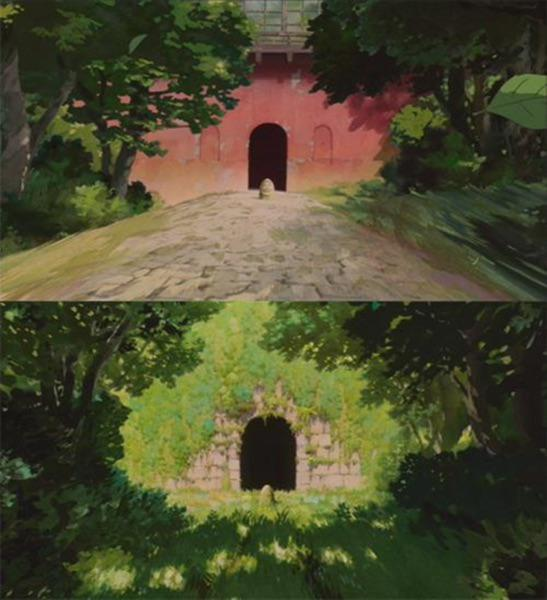
[9] Miyazaki, who is known to take inspiration from Japanese cultural items and artifacts such as scrolls, folding screens, and woodblock prints, embeds much of his understanding of Japanese history and his interaction with it into his own art. Miyazaki’s unwavering expression of "Japanese-ness" and Eastern reflection means that Nash’s model, which works well in a Western setting, may not be fully capable of capturing the different type of relationship that Japanese people generally have with nature and landscape. But beyond the relationship between self and landscape/nature, there are a few other boundaries that differ between an Eastern country like Japan and a Western country like the United States, that can manifest in how one would internalize a film by Miyazaki. First, because of how American animation (Disney, Pixar, Looney Tunes, etc.) is geared towards children, American adults are expected to feel a bit more hesitant to pick a Miyazaki film to watch in comparison to their Japanese counterparts: while there is certainly animation that is marketed towards children in Japan as well, its pictocentric culture, which has “long possessed a pictorial narrative tradition,” has generally led its people to feel comfortable continuing to watch animation as they get older (Napier, 73). Naturally, having a large animation (anime) market, which has been growing and gaining popularity internationally, makes embracing of this medium easier as well. Additionally, anime blurs the boundaries between what Westerners would either call real or fake, making it difficult to use Western notions to categorize or classify certain aspects of Japanese film topics, themes, and features. (Figure 3) Susan J. Napier writes, “Animation challenges our expectations of what is ‘normal’ or ‘real,’ bringing up material that may seem more appropriately housed in dreams or the unconscious, and this can be a deeply disconcerting process” (Napier, 73). While "real" and "fake" are distinctly separate in the Western world, the blending of varying levels of realism (while also being in an art form that would be considered by theorists such as André Bazin to be less realistic—although in an artform like animation there is more than simply explicit physical realism to strive for—allows for a relationship to the content that isn’t simply bound to our perceptions of what is logically possible.
Figure 3, The entrances to the spirit realm (top) and the human world (bottom) in Spirited Away; places identical in location but distinctly different in the form of the surrounding nature, a rare example of a distinction between levels of reality.
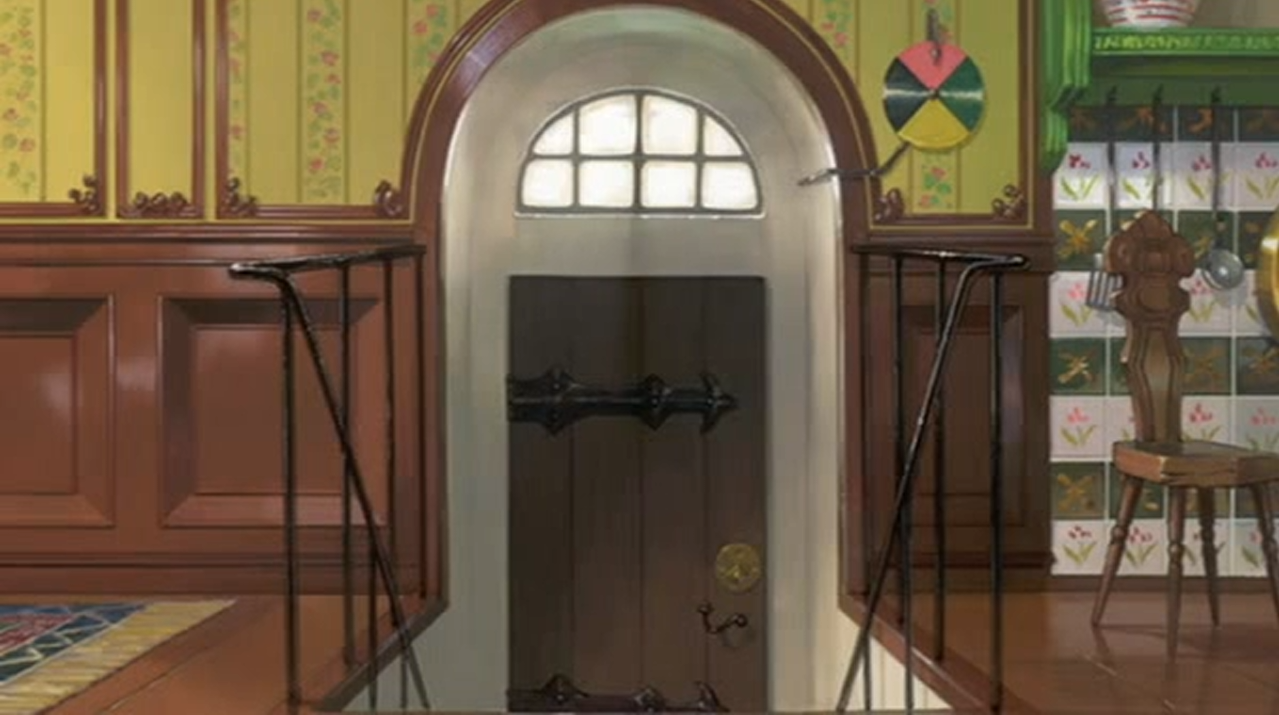
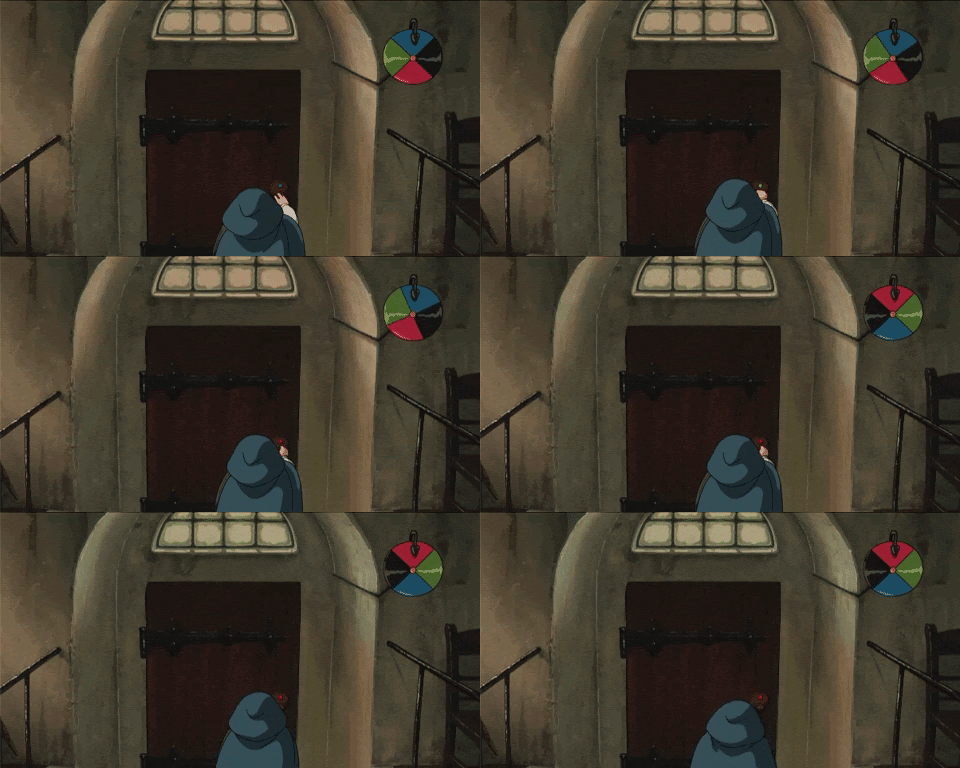
[10] Because the majority of Miyazaki’s films center around young characters and lack mature adult characters that many audience members may easily connect and identify with, a new obstacle announces itself: how are grown viewers supposed to continue to stay engaged with a narrative that hardly mirrors any aspect of their own personal life? Miyazaki’s ability to consistently create films that follow young characters and still involve an older audience has to do with the way in which he places his characters into certain liminal spaces that cannot easily be classified. Howl’s house, in Howl’s Moving Castle – whose door opens to multiple different locations (Figures 4, 5, 6), allowing the characters residing in the home that exists outside of time and space – exemplifies a more tangible liminal space Miyazaki’s characters inhabit. Other characters occupy the liminal space between childhood and adulthood, often within the context of perceived “freedom.” A situation such as being separated from family and having to take care of themselves, or having other characters be in their care, suddenly puts them in an undefined, transitory state in which they must make do and carry on. The feeling of a sudden growth of responsibility, and an unsettled phase of development, can easily be considered universal, making Miyazaki’s films more relatable to a much wider audience.
Figures 4, 5, 6, Door opening to multiple locations in Howl’s Moving Castle
[11] A final theme that rings common in many of Miyazaki’s films is an absence of parental figures. While a subject filled with childlike wonderment, fantasy, and imagination leaves very little room for concrete and fixed translations that come with a mature character, the absence or loss of parents seems to be intentional. Miyazaki’s films feature a multitude of different family structures and dynamics: the mother in My Neighbor Totoro, although alive, remains unseen, sick in a hospital, for a majority of the film; in Spirited Away, Chihiro’s main intention is to get her parents back and go back to the living world after they are turned into pigs and taken away. Princess Mononoke is adopted and raised by animals in the woods. Feminist film theorist E. Ann Kaplan might see this absence of parents, and of mothers in particular, as part of a system of patriarchal erasure. As Kaplan argues:
[12] The Mother as a complex person in her own right, with multiple roles to fill and conflicting needs and desires, is absent from patriarchal representations. Silenced by patriarchal structures that have no room for her, the Mother-figure, despite her actual psychological importance, has been allotted to the margins, put in a position limited to that of spectator. (Kaplan, 467)
[13] However, the lack of mother in the case of Miyazaki’s films does not always seem to be purely an extension of the patriarchal mentality and attitude that plagues the film world. Instead, these absenses offer the opportunity for other characters and elements to serve as a guiding hand. They also provide room for growth, especially between the human child and the non-human environment. What Miyazaki points to is the ultimate parentage of all living things, despite lineage, species, or power, is the landscape and the nature from which they all come. What fills the role of family and friend alike in his films are both human and non-human, exemplifying the interconnectedness, fragility, and dependence of relationships between all.
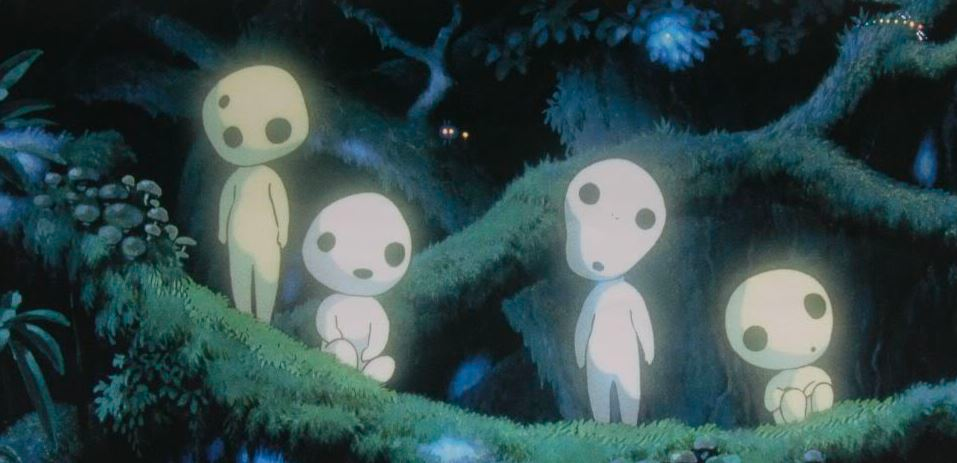
[14] In order to better understand the role that the non-human plays in Miyazaki’s films, it is useful to categorize the relationship between those characters and the human ones. Looking at My Neighbor Totoro, Spirited Away, Princess Mononoke, Howl’s Moving Castle, and Nausicaä of the Valley of the Wind, I found that the non-human entities in his films can be divided into three categories: (1) non-human as innocent, (2) non-human as friend/family/guardian, and (3) non-human as humanized or affected. The first category encompasses those that exist as natural and separate from characteristic human life. The susu-watari (“black soot”) from My Neighbor Totoro and the kodama (Figure 7) in Princess Mononoke exist as another dweller of the landscape without adding any particular plot to the film or profitability to the characters themselves. While these entities may not move the story forward, the audience can recognize that what the human characters do affects them: interfering with them and displacing them.
Figure 7, the kodama from Miyazaki’s Princess Mononoke
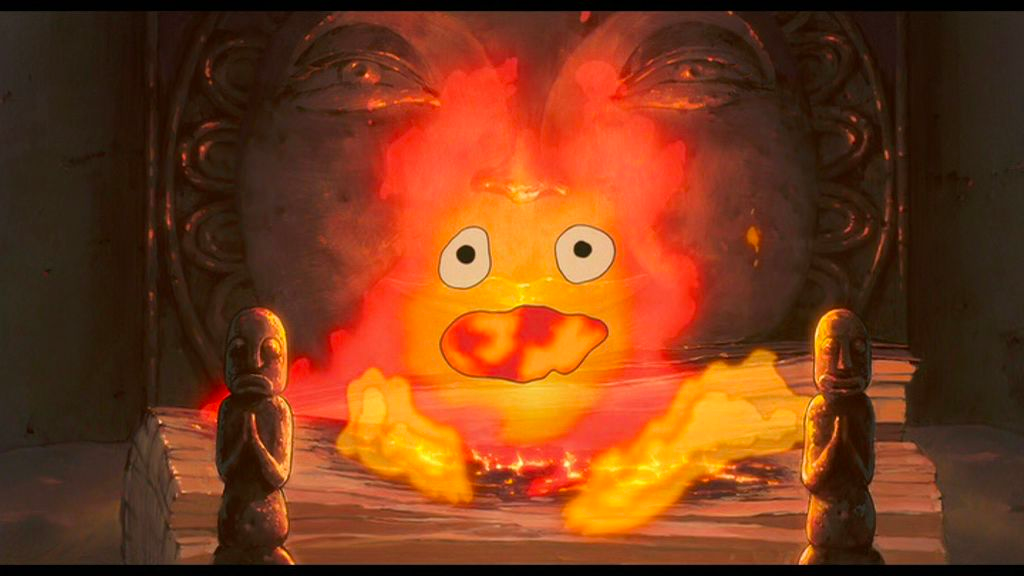
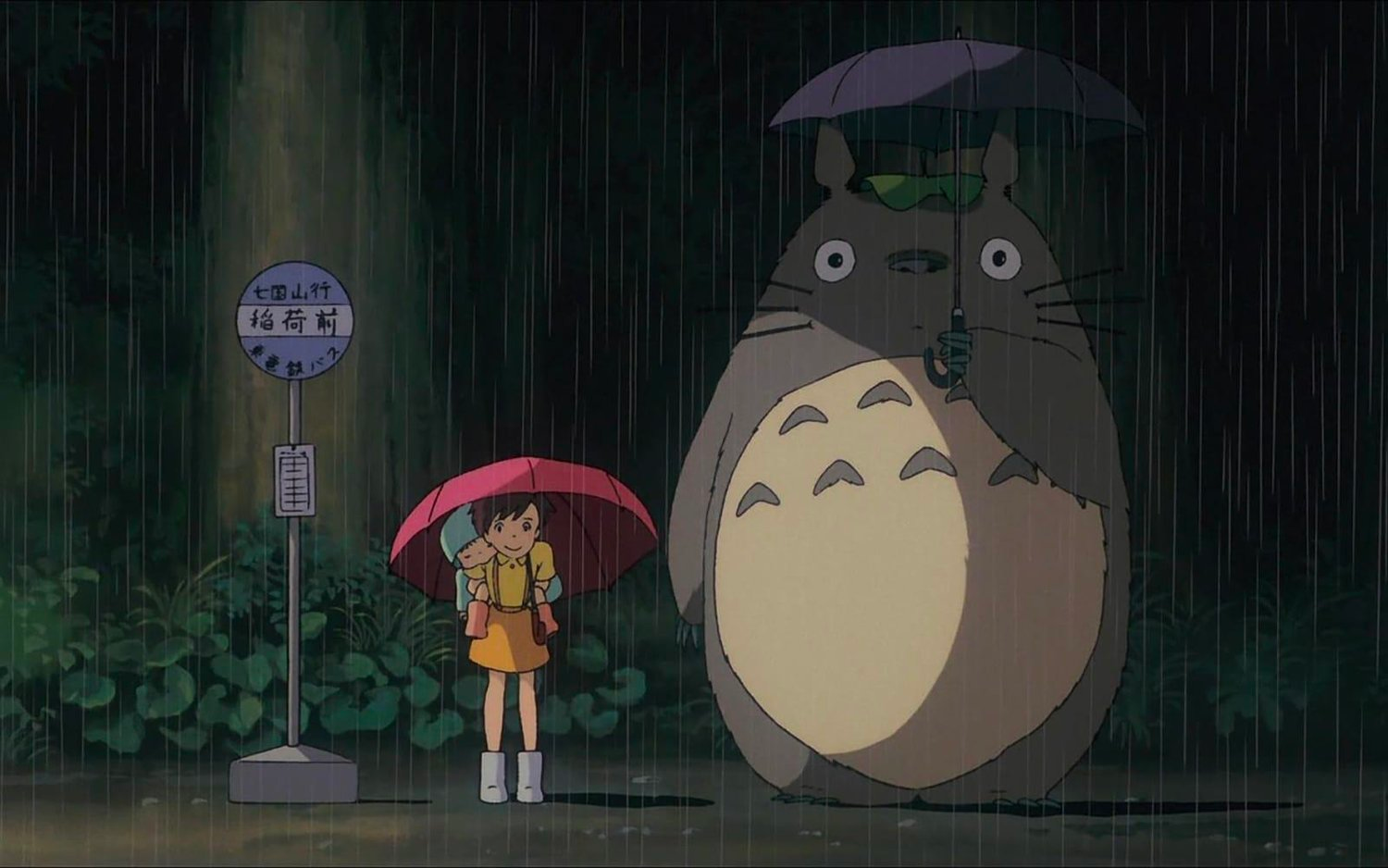
[15] The second category, which recognizes non-humans in relation to humans, includes a majority of “othered” characters in Miyazaki’s films: Moro, who serves as Monoke’s adoptive mother in Princess Mononoke; Totoro (plus friends) and the catbus in Totoro; Calcifer, Hin, and Turniphead in Howl’s Moving Castle, and the several animals in Nausicaä are just a few examples of non-human beings that explicitly associate with the human characters. They often fill a role: sometimes the missing parental role as previously mentioned, other times a more domestic role that seems to be more symbiotic or somewhat harmonious. Because they interact with the protagonist, the messages about human-to-nature relationships are less ambiguous: Calcifer (Howl’s Moving Castle, Figure 8) often protests his unbreakable linkage to Howl and his house, while he also protects them from harm and builds a positive relationship with the protagonist, Sophie. While other relationships like the one between Mei, Satsuki, and Totoro (Figure 9), is not outwardly criticized in the film (they are regarded as friends), there are plenty negotiated readings of each of Miyazaki’s films that finds a hidden judgment or warning about the dishonest, destructive, and damaging nature of human relationships with nature, along with the “bitter results of exploiting nature and the resulting landscapes” (Mumcu, 1).
Figure 8, Califer from Howl’s Moving Castle
Figure 9, Mei, Satsuki, and Totoro from My Neighbor Totoro
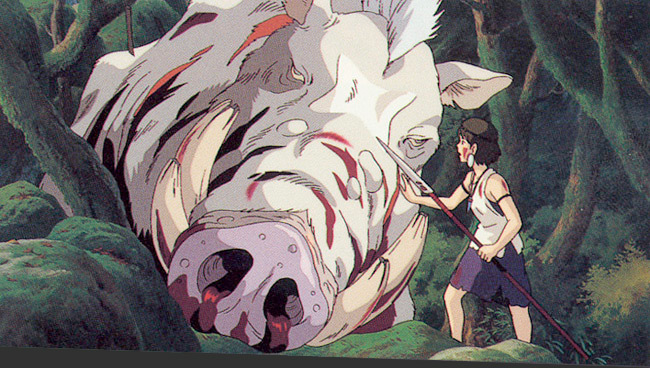
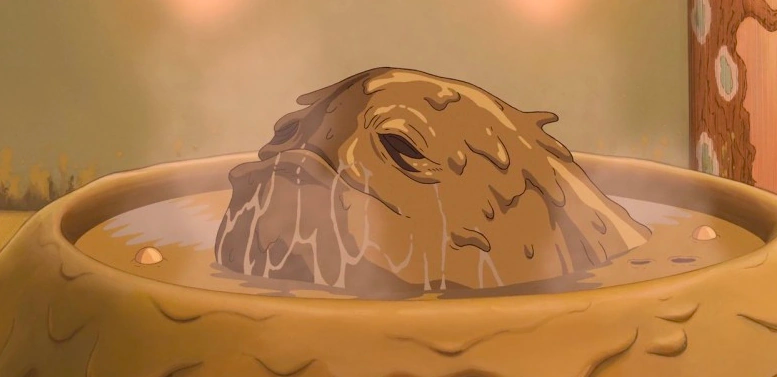
[16] The third and final category considers the non-human as humanized or affected. These would include Teto, a pet fox-squirrel in Nausicaä who dies of radiation poisoning, Okkoto (Figure 10), who becomes a demon as it falls prey to hatred in Princess Mononoke, and the Stink Spirit (Figure 11) from Spirited Away, whose wretched form is due only to the littering and extreme quantities of pollution in the river that he looks over. The reason I include “humanized” in this category is because other characters that take a human form but often shift into another; this transition is almost always an unfavorable human repercussion that affects them so. Through the separation of the non-human into these three categories, one is able to better understand how Miyazaki illustrates the many ways in which humans impact their environment, directly and indirectly.
Figure 10, Okkoto, who becomes a demon as it falls prey to hatred
Figure 11, The “Stink Spirit,” a River spirit corrupted by pollution in Spirited Away
[17] Many of Miyazaki’s "creatures" come from Japanese folklore, and thus prove to be more than simple secondary or tertiary characters; the ways in which human characters in the films interact with or influence these representations, and the consequences of these actions are correlated with not only Miyazaki’s but Japan’s spiritual beliefs and instincts. While a Western audience may not always be able to spot and recognize the embodiments of Japanese folk spirits–such as the previously-mentioned examples of Haku (Spirited Away) and kodama (Princess Mononoke)-- they still add another possible point of connection between his fantasyscapes and the spectator’s understanding of the real world.
[18] Moreover, while many of Miyzaki’s young characters face a multitude of difficult antagonists, none of these characters can simply be classified as villainous or evil. Every antagonist character in his films, such as Yubaba (Spirited Away), Madame Suliman (Howl’s Moving Castle), and Kushana (Nausicaa), are given somewhat gracious and compassionate backstories that explain their reasons for their actions. No character has truly malicious intentions; rather, human qualities like greed, grief, anger, and fear morph any moral individual into a “villian.” The way in which Miyazaki clearly shows these negative traits taking over these characters, instead of using a simple "creature/other = evil" stereotype offers the audience the chance to shift their subjective truths and interpretations. Miyazaki offers each of his characters a backstory and a perspective through which the audience can follow the reasoning behind bad or cruel actions. In addition, such as in Nausicaä, Miyazaki illustrates that “even supposedly good intentions… can be [a] catalyst for conflict and destruction” (Morgan, 78).
[19] Miyazaki’s newest film, The Boy and the Heron (2023) (literal Japanese title translates to How Do You Live?) serves as a great example of Miyazaki’s ability to create a compelling and intricate story without necessarily giving the audience a clear motivation or singular character to identify with. Because the film was intended to be his last film before his retirement, the integration of many of his other themes (and even characters) as a last “hoo-rah" seems understandable. This film surprisingly doesn’t appear to be as suitable for kids as a majority of his other films. Weapons, violence, and discussions of war and death, arise all throughout, and the plot itself fails to offer the same endearing and optimistic narrative that would draw in a young audience. Although this fantasyscape provides a fantastical imagery on par with his previous films, the on-edge and abstract nature of the film distinguished itself from his other works.
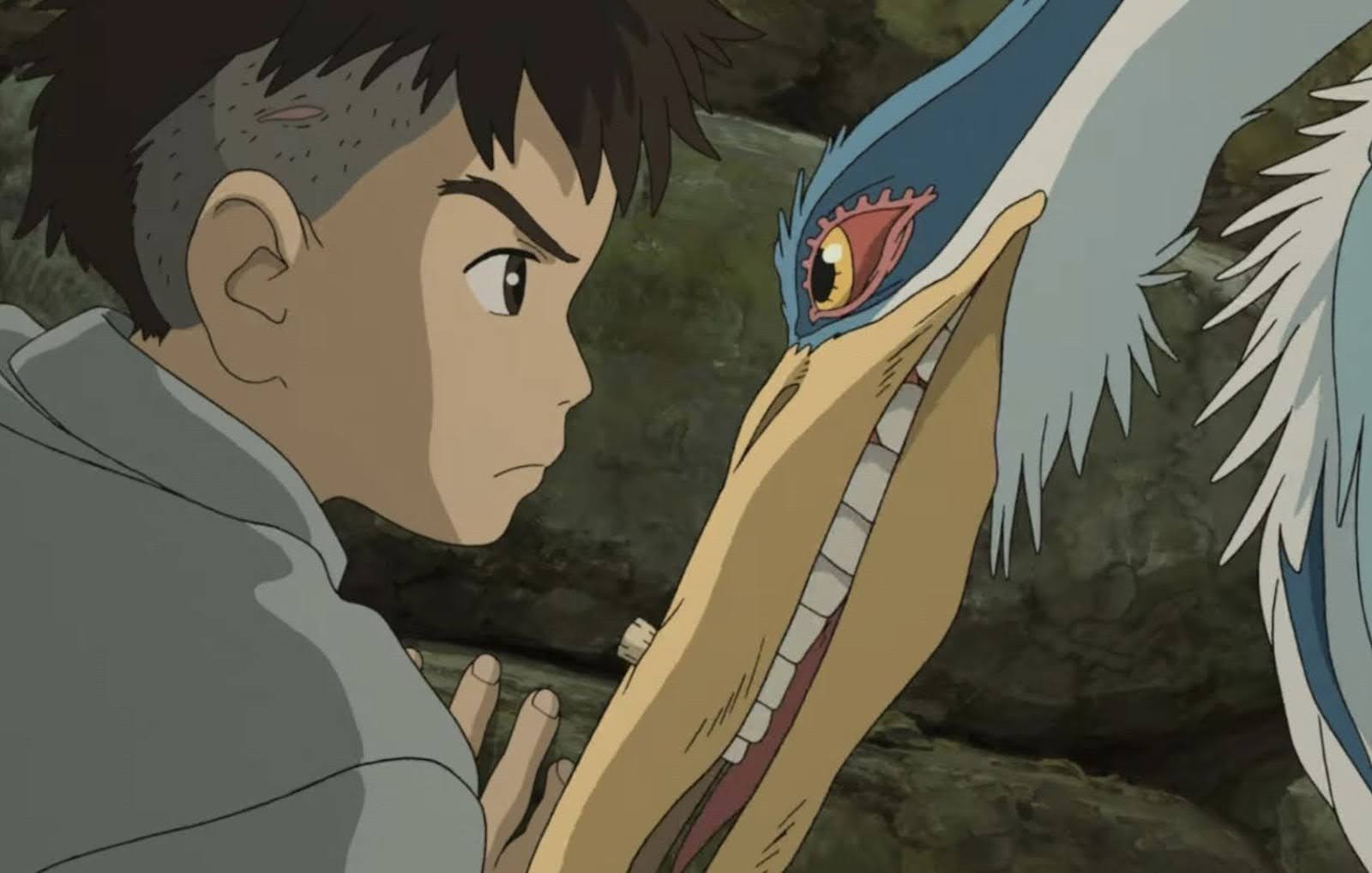
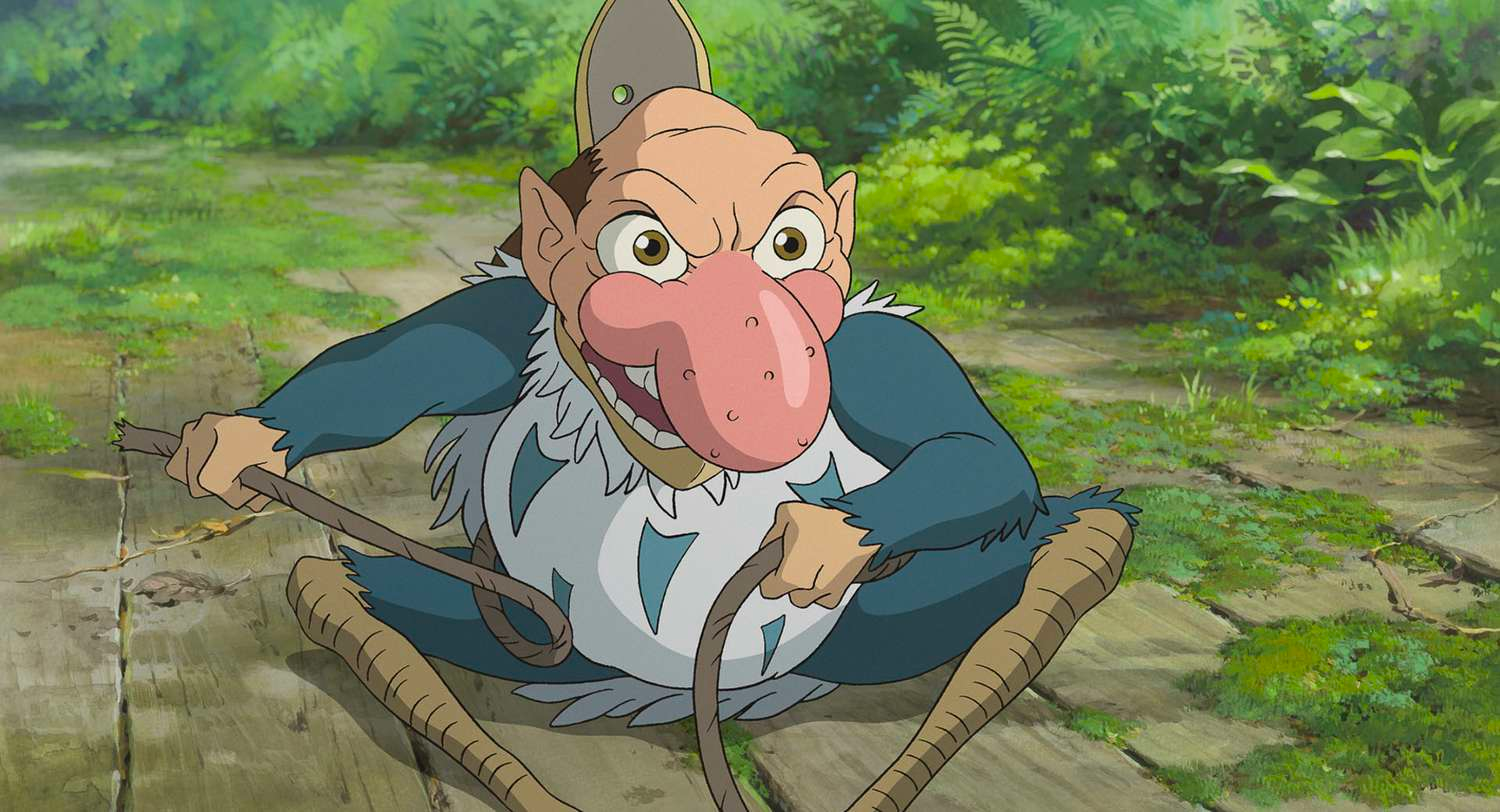
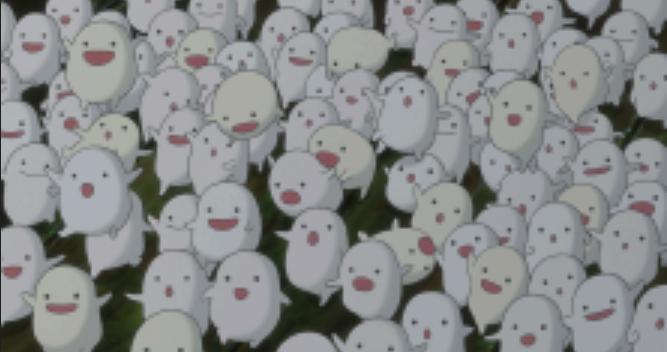
[20] Themes that have been explored throughout this paper, however, are once again evident in this film. The many dream-like scenes in which the concept of reality, even within the context of the film, creates a loop in which the audience is never sure what is “real,” Accepting the constant falling out of space and time becomes necessary in order to immerse instead of unintentionally ejecting oneself from the story. The landscape, which continually changes through different biomes and environments, creates a constant state of instability, and it is a relief to return home to a natural, less-manipulated reality at the end of the film. The use of non-human characters serves as a wonderful riddle to decipher: the protagonist, Mahito, depends on a gray heron (Figure 12), within which lives a man (Figure 13), and enters a world in which parakeets feed on humans. The relationship between predator (bird) and prey (human) in this reversed notion played an integral role in making the spectator question who or what to identify with. Even the pelicans that feed off of the most innocent characters, warawara (unborn human souls, Figure 14), are given the chance to explain their actions: they’ll starve without food. The reversal of these roles in which the “other” is still a personification of human influence, power, and consequence, creates a cycle of identification, where the viewer is unable to reside safely in the perspective of a single character. Miyazaki once again removes the child’s mother from the world, instead making her the mission of Mahito instead: after her death, Mahito follows the gray heron, who promises to bring him back to her.
Figure 12, Mahito and the gray heron
Figure 13, the little bird-man who lives inside the heron
Figure 14, Warawara (unborn souls) in The Boy and The Heron
[21] Throughout The Boy and the Heron, Miyazaki exemplifies what he has been able to do time and time again, and arguably more so in his “final”film: he is able to use the non-human to cross boundaries of reality and identification in order to force the spectator to question their own relationship with the “natural” world they inhabit. As a result of Miyazaki’s ability to blend such deep and complex subjects such as (1) Japan’s historically significant relationship with landscape/nature, (2) notions of reality and fiction through theories of spectatorship that employs the audience’s implicit frame of reference for understanding the world around them, and (3) the varying positions which parental figures occupy, his use of human and non-human characters makes his films more accessible, “transportable,” and adaptable for spectators both in and outside of Japan. Simultaneously, Miyazaki’s films demonstrate the need for Western film theory to be adapted in order to apply to non-Western film: in order to be capable to not only comprehend such pieces of international art, but to also be able to place some of its structures within the context of Western film academia, one must remodel the theories and lenses used to analyze such works, and better-acknowledge and address the cultural and historical contexts within which they were created.
References
Bryant, Nathaniel Heggins. 2015. “Neutering the Monster, Pruning the Green: The Ecological Evolutions of Nausicaä of the Valley of the Wind.” Resilience: A Journal of the Environmental Humanities 2 (3): 120–26.
Chen, Yuanyuan. 2017. “Animated Landscapes: History, Form and Function, edited by Chris Pallant.” Book Review. Alphaville: Journal of Film and Screen Media 13 (Summer 2017): 173–179.
Gossin, Pamela. 2015. “Animated Nature: Aesthetics, Ethics, and Empathy in Miyazaki Hayao’s Ecophilosophy.” Mechademia 10: 209–34.
Hall, Chris G. 2015. “Totoros, Boar Gods, and River Spirits: Nature Spirits as Intermediaries in the Animation of Hayao Miyazaki.” Resilience: A Journal of the Environmental Humanities, vol. 2, no. 3, pp. 158–65.
Lim, Tai Wei. 2013. “Spirited Away: Conceptualizing a Film-Based Case Study through Comparative Narratives of Japanese Ecological and Environmental Discourses.” Animation 8 (2): 149–62.
Meinig, D. W., and John Brinckerhoff Jackson. 1979. “The Beholding Eye: Ten Versions of the Same Scene.” The Interpretation of Ordinary Landscapes : Geographical Essays. New York: Oxford University Press.
Gwendolyn Morgan. 2015. “Creatures in Crisis: Apocalyptic Environmental Visions in Miyazaki’s Nausicaä of the Valley of the Wind and Princess Mononoke.” Resilience: A Journal of the Environmental Humanities, vol. 2, no. 3, pp. 172–83.
Sema Mumcu, and Serap Yılmaz. 2018. “Anime Landscapes as a Tool for Analyzing the Human-Environment Relationship: Hayao Miyazaki Films.” Arts 7 (2): 16.
Murphy, Amy. 2009. “Future Traditions of Nature.” Traditional Dwellings and Settlements Review, vol. 21, no. 1, pp. 7–20.
Napier, Susan J. 2005. “The Problem of Existence in Japanese Animation.” Proceedings of the American Philosophical Society 149 (1): 72–79.
Napier, Susan Jolliffe. 2006. “Matter out of Place: Carnival, Containment, and Cultural Recovery in Miyazaki’s Spirited Away.” The Journal of Japanese Studies 32 (2): 287–310.
Reider, Noriko T. 2005. “‘Spirited Away’: Film of the Fantastic and Evolving Japanese Folk Symbols.” Film Criticism, vol. 29, no. 3, 2005, pp. 4–27.
Rifa-Valls, Montserrat. 2011. “Postwar Princesses, Young Apprentices, and a Little Fish-Girl: Reading Subjectivities in Hayao Miyazaki’s Tales of Fantasy.” Visual Arts Research, vol. 37, no. 2, 2011, pp. 88–100.
Ruh, Brian. 2014. “Conceptualizing Anime and the Database Fantasyscape.” Mechademia 9: 164–75.