[0.1] Abstract - In The Harder They Fall (2021), director Jeymes Samuel expertly reclaims the Western genre, not for himself, but on behalf of previously underrepresented historical people of color who did exist in the Old West.
[0.2] Keywords - The Western, race and representation, Black cast, Black film, genre, whiteness
[0.3] Trailer
Swartz, Jacob. 2024. “Displacing the Whitewashed Western & Refocusing on the Exposition of Black Control,” Muhlenberg Visions. Volume 1, No. 2.
[1] Throughout the era of the late 19th century, the ever-expanding American frontier was riddled with standalone settlement towns, farmlands, Native American tribes, and of course, some good old cowboys. After the Civil War, cameras began capturing still images of people and landscapes from coast to coast. However, the innovation of moving pictures was about 30-40 years away from capturing exactly what these newly built Western settlements looked like and how the individuals acted. In all its gunslinger glory, the Western Genre only began to peak in the filmmaking industry in the 1930s. Film directors began to cite the real texts, stories, and pictures from this era to establish exactly how they would represent how the fictional American West was won.
[2] From the earliest days of the Western genre, the stories have been dominated by white characters and their experiences. However, this paper seeks to displace the whiteness of the Western genre while refocusing on the exposition of Black existence and control. Some of the most well-known films in this genre include A Fist Full of Dollars (1964, dir. Sergio Leone), The Searchers (1956, dir. John Ford), Shane (1953, dir. George Stevens), and The Magnificent Seven (1960, dir. John Sturges), to name a few. Although these four very talented directors do not represent all the creative experts of this genre, one powerful privilege they did have was being white men with extensive creative liberty during their time making films. I am not trying to diminish any of their skills or downplay the successes for which they worked throughout their careers; however, it is essential to note how their skin color affected the whitewashing that bleached the thousands of Western films.
[3] The Western began to lose its golden age status during the mid-1960s. In his thesis, “The Changing Face of the Western: An Analysis of Hollywood Western Films from Director John Ford and Others During the Years 1939 to 1964,” Jeffrey Spicer suggests that:
[4] Part of the reason for the overall decline of the Western’s popularity after 1964 might be that the mythology was no longer applicable… The Western continued to change and adapt, but after 1964, with the social revolutions and political upheaval of the mid-1960s, the traditional messages of the Western were no longer valued, and the Western either could not change quickly enough or had no way to alter itself further because of the limitations of the format. Part of the reason for the mythology becoming no longer applicable was the frontier myth, with conquering new land and establishing Anglo-Saxon dominance as a priority, became outmoded (Spicer 69).
[5] Despite this decline, the tropes of the gunslinging, villain-hunting, lone wolf, and community-saving good guy have persisted in various forms of production and media over the decades. These cowboy-like stories have stayed close to the surface, despite the Western’s falling off of popularity as a genre. However, one instance of this genre that snuck its way back into mainstream media was a reclamation of the West: Jeymes Samuel’s 2021 film, The Harder They Fall.
[6] The Harder They Fall, directed by Samuel and produced by Jay Z, is a modern twist on the classic Western and is cast almost entirely with people of color, particularly Black actors. These Black stars include Regina King, Jonathan Majors, Idris Elba, Zazie Beetz, and Delroy Lindo, who significantly defy the stereotypes of the Western characters they play within this genre. In an article for The Atlantic, How Hollywood Whitewashed the Old West, Leah Williams writes,
[7] The Old West and the iconic cowboys who populate it in movies were never solely white, to begin with. In recent years, filmmakers have grappled with this reality to varying degrees of success. Despite the admirable efforts of Westerns such as The Revenant and The Magnificent Seven, movies like Django Unchained, The Keeping Room, The Lone Ranger, and Bone Tomahawk all show how difficult it is to modernize the genre without continuing to peddle an inaccurate and exclusionary account of American history (Williams).
[8] Samuel, who had full creative control over this film, made the executive decision to produce a movie that imagined a forgotten version of the West that was, in fact, Black. The film follows a vengeful gunslinging outlaw, Nat Love, played by Majors, in his mission to take down his long-time enemy, Rufus Buck, played by Elba. This film takes a handful of forgotten historical figures and re-centers and re-presents them to reclaim their names and importance in the post-slavery West. It is pretty refreshing to see how the main characters in this film can acknowledge the Western frontier aesthetic of their white Hollywood predecessors yet mold a new narrative for people of color.
[9] The Harder They Fall effectively displaces the historically-curated whiteness of the Western. As 19th century Americans participated in the significant expansion West, where is the documentation of Black individuals, who surely must have been there? Some answers lie in the Time article, The Real Black Cowboys That Inspired Netflix's The Harder They Fall, by Andrew R. Chow. Chow explains the historical context of a number of the characters, including Bass Reeves (Delroy Lindo), Cherokee Bill (Lakeith Stanfield), Jim Beckwourth (RJ Cyler), and Stagecoach Mary (Zazie Beetz). The two I want to note are the main protagonist and antagonist within the film itself, Nat Love and Rufus Buck.
[10] Chow explains Love’s real persona stating,
[11] Much of what we know about the real Nat Love comes from his 1907 autobiography: The Life and Adventures of Nat Love, Better Known in the Cattle Country as “Deadwood Dick.” But it’s disputed how much of Love’s book is fact as opposed to self-mythology… In his autobiography, Love writes that he was born into slavery in 1854 in Tennessee, where he learned to break horses on his owner’s plantation. After the Homestead Act—which allowed formerly enslaved people to claim land in an expanding America—Love rode west and became a ranch hand in Kansas (Chow).
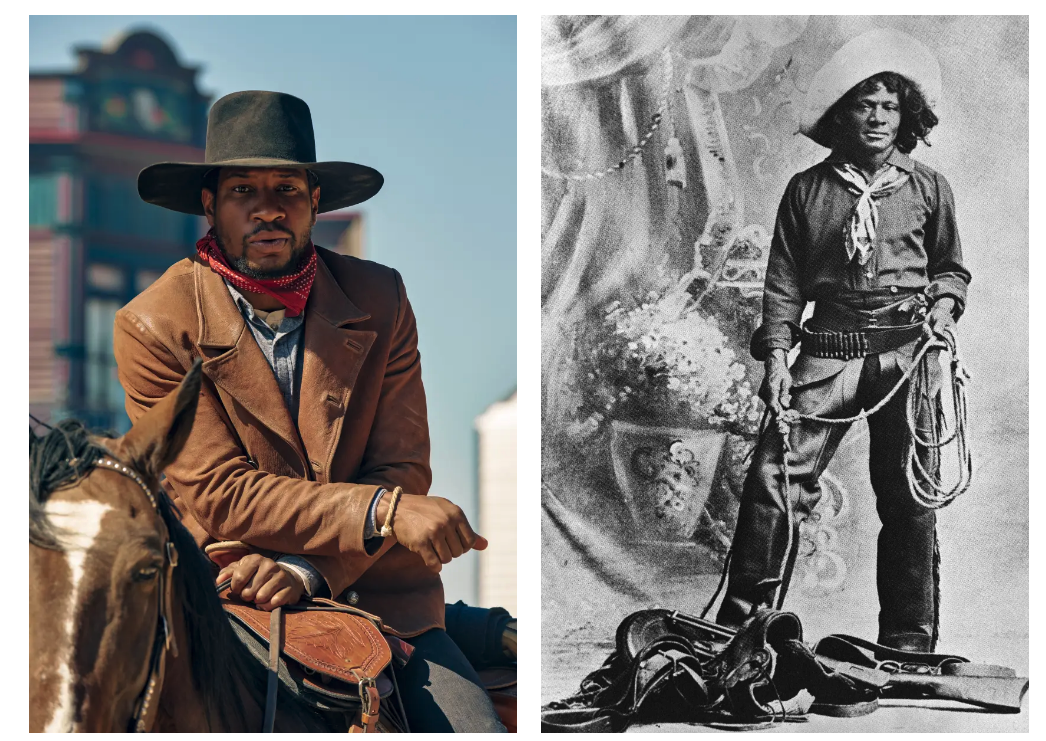
[12] From saddling, roping, and shooting, to riding 100 miles a day, the skills and relentlessness of Love’s character seems to live up to his Hollywood characterization. (Figure 1) Although Chow mentions that Love may have exaggerated his legacy, he still did exist along with countless other Black Cowboys of this era.
Figure 1: Nat Love as played by Jonathan Majors (photo by David Lee – Netflix) vs. the real Nat Love circa 1876 (Bettman Archive/Getty Images)
[13] According to Chow, Rufus Buck, on the other hand, though existing just as much as his enemy Love, had a much less fortunate life in the West. Chow states,
[14] In real life, Rufus Buck didn’t make it past 18. Buck was born in the late 1870s, the son of a Black mother and Creek Indian father. In the 1890s, Buck created a gang with other Black and Creek Indian teens and proceeded to rampage through Arkansas and Oklahoma, robbing stores, killing a U.S. deputy marshal, and allegedly violently beating and raping their victims (Chow).
[15] Buck’s life was refashioned to fit the context of Love’s evil counterpart in the film. Although the real Buck carried out his real acts of terror over such a short period, his place in the historical West is still worthy of note, regardless of its negative connotations.
[16] These historical people of color make up the foundation of the characters in The Harder They Fall. As presented in the film, their existence is completely juxtaposed with the idea of a white West as white figures and voices have disproportionately enveloped its representation. Director Jeymes Samuel stated in a GQ interview,
[17] Well, when I was a kid, westerns were always on TV. My mom and dad were always watching them. And so, I always loved Westerns, but they would always present a very narrow scope in those stories. They'd be very white male-centric. They wouldn't even show women with any power in those stories. So, although I loved the movies, the horses, the world, the environment, it’s just hard as hell (quoted in Tharpe).
[18] Samuel’s consistent exposure to cis white male characters in the Old West kindled his spirit to make his own history present in the genre. He aimed to reclaim the West and make a feature film that fit the standards of representation and style he had longed to see since childhood. The Black cowboys and outlaws were a part of the West just as much as white folks.
[19] The concepts of purity, rule-following, and order of the West stem from the ideals of the Anglo-American expansion across the frontier. But the power that the color white has concerning the control of both land and people is merely an imaginative concept. In his article, “White,” for Screen, Richard Dyer explains,
[20] The colourless multi-colouredness of whiteness secures white power by making it hard, especially for white people and their media, to 'see' whiteness. This, of course, also makes it hard to analyse. It is the way that black people are marked as black (are not just 'people') in representation that has made it relatively easy to analyse their representation, whereas white people - not there as a category and everywhere everything as a fact - are difficult, if not impossible, to analyse qua white. This property of whiteness, to be everything and nothing, is the source of its representational power. On the one hand…white domination is reproduced by the way that white people 'colonize the definition of normal (Dyer, Screen, 46).
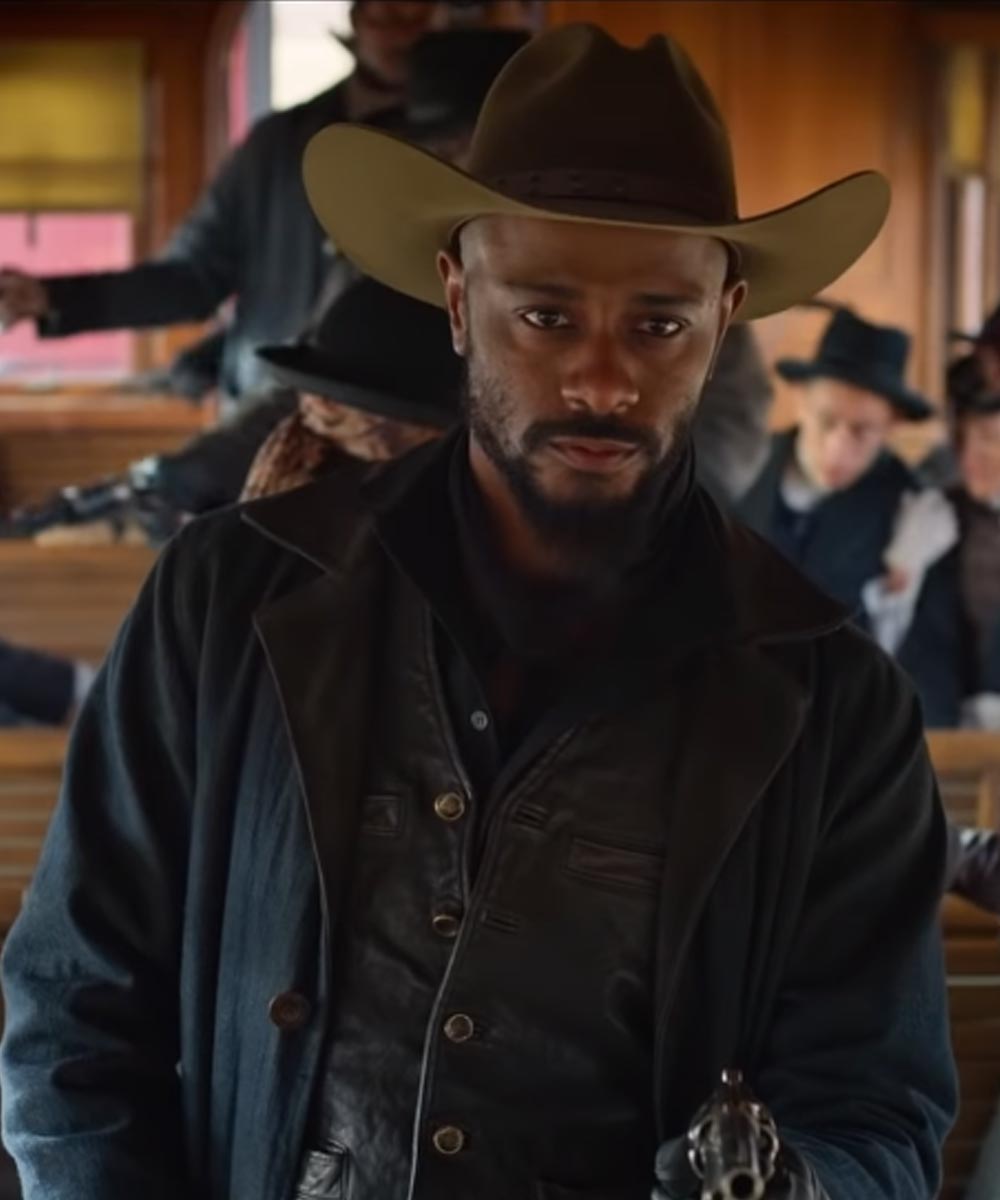
[21] This deep-rooted, racially biased way of thinking is a terrible excuse for almost an entire media genre to be fixated on whiteness. Western expansion occurred during the late 18th to mid-19th centuries, including 1865, when Congress passed the 13th Amendment. Although African Americans were free to exist amongst their fellow Americans, many struggled to emigrate to the newly acquired lands of the West. Author Jason E. Pierce states in his book, Making the White Man's West: Whiteness and the Creation of the American West, that:
[22] The low numbers of African Americans in the West when compared with the South were not merely a result of the echoes of slavery. Westerners themselves had long sought ways of preventing African Americans from settling in the region…Few blacks could afford to emigrate, and Westerners did little to welcome them (Pierce 124).
[23] Individuals of color were actively discouraged from coexisting in these territories. The depiction of a “pure” West was not simply a facade brought to light naturally through segregated films and television shows almost a century later, but rather a picture-perfect representation of how white America wanted their newly cultivated lands to be. The prevention of African Americans from moving to the West was not just a politically fueled idea but also a grass-roots racist disinterest in allowing many of the population to emigrate.
[24] The aspects of control and power present in the Western genre give it that lone ranger, hero vs. villain, smooth gunslinger, and town-saver flair. But whiteness has historically had a chokehold over these artistic representations of the West. A film like The Harder They Fall is a perfect example of how to reimagine the genre. The movie never tries to erase the idea or actions of racism and slavery or to deny what Black individuals were subjected to when slavery was not yet abolished. Instead, the audience is given a Western story told through the perspective of consequential, smooth-talking, and trustworthy Black characters played by actors of color. Remember that Samuel didn’t develop the film as a vehicle to portray a Black vs. white conflict. In this film, Black people play heroes and villains; he crafted a narrative conflict between two groups of Black people to tell a revenge-based story. The beginning shows Rufus Buck and his shiny gold revolvers killing the mother and father of a young Nat Love in cold blood. The rest of the story consists of Love and his crew tracking down Rufus Buck’s gang as they put everything they have on the line to secure Love’s long-awaited vengeance on Buck.
[25] The people in control throughout the film are all people of color, presented in many
ways. One example includes Cherokee Bill’s leadership and presence as he moves to hijack a train filled with posh white individuals. As shown in the picture below, Bill is pointing his revolver at a young white Union army soldier, out of frame, while the rest of his gang deliberately and aesthetically directs their weapons. (Figure 2) The soldier guards the door connected to the next train car, which holds Rufus Buck inside his cell. Although this may seem like a moment of racial tension due to the Black vs. white visuals, one can easily imagine a white cowboy and his gang pulling off the same heist.
Figure 2, Cherokee Bill hijacks a train in The Harder They Fall
[26] In his chapter, The White Man’s Muscles, Dyer discusses a white person’s power to darken and lighten his skin color to express multiple forms of identity. He states, “White male heroism is thus constructed as both unmistakably yet not particularistically white. The muscle hero is an everyman: his tan bespeaks his right to intervene anywhere” (Dyer, White, 163) If Cherokee Bill were white and had pointed his gun at a white soldier, it obviously wouldn’t justify his illegal actions in the scene; however, based on the norms created by this genre, my question is, would it be cinematically warranted? When a white hero is tanned by the Western sun, why does he not lose power or control? I don’t know the exact answer to this, although the effect of white power and privilege is a widely accentuated trope within the natural world and cinema.
[27] In his Screen article, Dyer asserts that,
[28] Power in contemporary society habitually passes itself off as embodied in the normal as opposed to the superior. This is common to all forms of power, but it works in a peculiarly seductive way with whiteness because it seems rooted in common-sense thought, in things other than ethnic difference (Dyer, Screen, 45).
[29] As explained above, the almost normalized way of perceiving influential figures is symbiotically connected to white identity. Dyer explains that the idea of whiteness is made to overwhelm ethnic differences to create a common sense “normal” from which Blackness deviates. The power that white bodies have held from European colonization to John Ford’s The Searchers, claim themselves as “normal” and must pull some weight in determining why films like Westerns are predominantly white.
[30] The Harder They Fall was the first time these characters were represented in a Black cinematic universe. Their purpose was not to diminish the power of the color white but instead introduce Black power into a whitewashed genre. Nat Love, the protagonist, is a cowboy trying to balance his quest for revenge with his love for Stagecoach Mary. The root of his character may seem to revolve around vengeance, but as I have argued, he is also a portrayal of Black excellence and mastery. From the moment the film begins, all fingers point to showcasing how the traumatized child, young Nat Love, will do everything possible to fulfill his destiny. Cowboys are commonly known to personify traits like the quickest hands in a standoff, exuding a sense of glorified independence, and of course, dishing out some intense hatred for the villains disrupting his or his community’s tranquility.
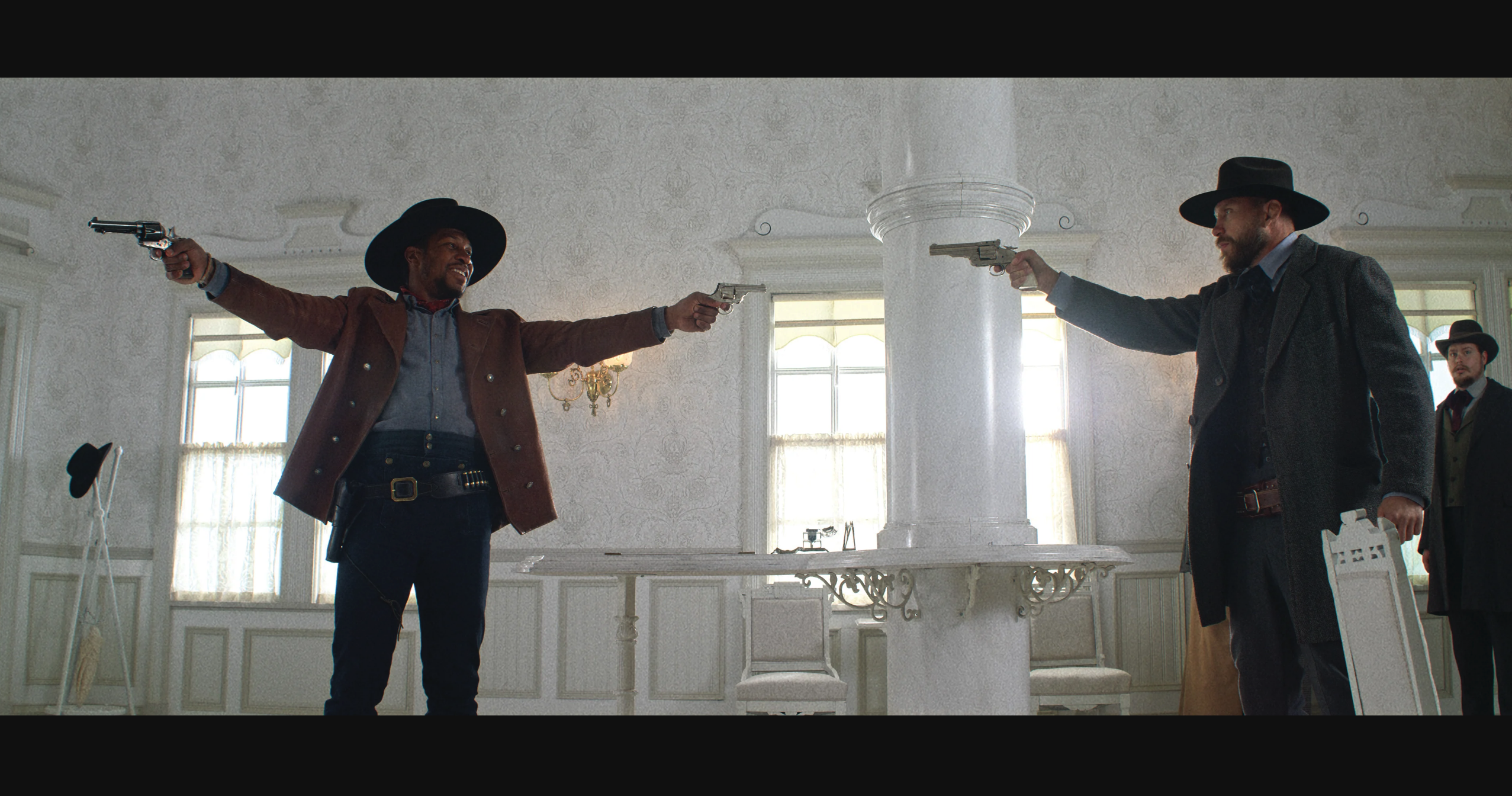
[31] Love embodies many of these ideals, which are essential to the Western genre. That said, his character reimagines the moral qualities of the white cowboy through his presence as a stoic and classy Black gunslinger. About an hour and thirty minutes into the film, Love and one of his gang members, Cuffee (Danielle Deadwyler), enter Maysville, labeled “It’s A White Town,” in which they are the only Black people among the population. Their goal is to rob the bank and get out scot-free. Spoiler alert, they did. But what makes this scene so formative is how the white folks perceive the only two Black characters as they make their way through the town. There’s a distinguishable tension in the air when Cuffee, dressed in her tailored red wool coat, asks to withdraw money from the bank teller. The skeptical white men are sporting puffed-out chests and high-class attire as the accompanying high-pitched, thriller-like strings fill the soundscape. The moment Cuffee pulls her weapon, various cowboy-cladded security guards appear, provoking Love to step in and dominate with smooth-talking cowboy flair. With his revolvers drawn and pointing at two of the guards, he looks at one and says, “Hey blue eyes. You scared? Your hand's shaking. You’ll miss. I won't." (Figure 3) And as the man begins to put his gun down, Love calmly directs him to, “Exhale.” As the man slides his revolver over to Love, Cuffee says to the teller, who had given her trouble, “I ain’t like my partner. He don’t wanna shoot nobody, but suddenly, I’m of a mind to.” The verbal juxtaposition of two gunslingers playing good cop and bad cop bit is a relevant trope, especially for situations like a bank robbery. But it’s Love’s demeanor that feels exciting and new. He starts the scene very much in the background, allowing Cuffee to do the dirty work at the beginning of the heist. But when things go south, Love steps in as the heroic outlaw who both acknowledges the whiteness of the man on the other side of the barrel but also spares his life to preserve the town's tranquility.
Figure 3, Nat Love smiles and keeps cool while robbing a white bank
[32] Love’s control of the situation in this scene shows how cowboys don’t have to be white to be moral. As Dyer explains in The White Man’s Muscles, “Extreme whiteness coexists with ordinary whiteness: it is exceptional, excessive, and marked. It is what whiteness aspires to and fears.” In this White Town, Samuel puts extreme whiteness on display and shows people of color in control, further disrupting the idea of the white man’s West.
[33] As a modern Western, The Harder They Fall gives its audience all the nostalgic concepts, landscapes, tropes, and gunslinger motifs one could ask for but cast in a very different light than its predecessors. By making this film, Samuel could present individuals who did exist in the era in which the film takes place but give them the necessary Hollywood aesthetics to be palatable for a contemporary audience. Black Westerns have popped up over the last few decades, including Blazing Saddles (1974) and Django Unchained (2012), although none had an entirely Black cast. But The Harder They Fall, in an incredibly cinematic way, gives viewers a very refreshing take on the previously whitewashed West. Samuel expertly reclaims the Western genre, not for himself, but on behalf of the previously underrepresented historical people of color who did exist in the Old West.
Bosley, Rachel. 2021. “Bad blood: The harder they fall.” American Cinematographer. December 3 . https://theasc.com/articles/harder-they-fall
Chow, A. R. 2021. The Real Black Cowboys that inspired “the harder they fall.” Time. November 3. https://time.com/6111612/the-harder-they-fall-true-story/
Dyer, Richard. 1988. “White.” Screen, Volume 29, Issue 4, Autumn, Pages 44–65.
Dyer, Richard. 1997. “The white man’s muscles.” White. London: Routledge.
Pierce, J. E. 2016. “The Politics Of Whiteness and Western Expansion, 1848-80.” In Making the White Man’s West: Whiteness and the Creation of the American West. University Press of Colorado, pp. 123–150. http://www.jstor.org/stable/j.ctt19jcg63.11
Sherman, Maria. 2022. How ‘The Harder They Fall’ director Jeymes Samuel Revolutionized the Western. Netflix, Tudum, November 2. https://www.netflix.com/tudum/articles/the-harder-they-fall-director-jeymes-samuel-spills-all
Spicer, Jeffrey A. 2012. "The Changing Face of the Western: an Analysis of Hollywood Western Films from Director John Ford and Others During the Years 1939 to 1964." ETD Archive 581. https://engagedscholarship.csuohio.edu/etdarchive/581 Tharpe, F. 2021. “The Harder They Fall director Jeymes Samuel on Black Cowboys, working with Jay-Z, and the audacity of Swag.”GQ. October 25. https://www.gq.com/story/the-harder-they-fall-netflix-jeymes-samuel-interview-jay-z-regina-king Williams, L. 2016. “How Hollywood whitewashed the Old West.” The Atlantic, October 5. https://www.theatlantic.com/entertainment/archive/2016/10/how-the-west-was-lost/502850/