[0.1] Abstract - This essay examines and analyzes the artistic choices Sanjay Leela Bhansali uses to explore the themes of home, community, equal rights, beauty, politics, and the desire for love in Gangubai Kathiawadi.
[0.2] Keywords - mirrors and mirroring, theatrical cinema, Bollywood, female agency, male gaze
[0.3] Trailer
Singh, Ruhani. 2024. “A Theatrical World of Gangubai Kathiawadi: Prison Becomes Home,” Muhlenberg Visions. Volume 1 , No. 2.
[1] Gangubai Kathiawadi is a 2022 Indian Hindi-language biographical crime drama film directed by Sanjay Leela Bhansali. The film is loosely based on the true story of Ganga Jagjivandas Kathiawadi, a poor girl from Kathiawad. With big dreams and naive aspirations, Ganga, who is nicknamed “Gangu” (maid or slave), wanted to become an actress, but little did she know that the man she thought was the love of her life would sell her for money to a brothel. The sad part about this story is that this was the story of most girls in this world. They were sold off to the world of prostitution against their own will or knowledge, only to be imprisoned there with no way to leave. A train brings them to the city and the brothel, but never takes them back. What does one do with no place to call their own home? With no way to go back to their family? The women of Kamathipura are driven to make a home for themselves, to form a community, to fight for respect and for their rights as prostitutes for their livelihood. Bhansali’s film is an epic tale of Gangubai, the true story of a girl from an affluent family sold into prostitution who became a so-called “mafia queen” of Mumbai, as well as a political leader who fought for the rights of prostituted women. This essay examines and analyzes the artistic choices Sanjay Leela Bhansali uses to explore the themes of home, community, equal rights, beauty, politics, and the desire for love in Gangubai Kathiawadi.
[2] In her book Cinematic Overtures, film professor Annette Insdorf argues that the opening scenes of films establish what a film intends for its audience to think and feel. She states that, “In addition to establishing the tone—whether tense, ironic, romantic, frightening, comic, nostalgic, or self-conscious—the opening [of a film] introduces meaningful motifs; these can include windows, circular images, or elemental imagery such as water and earth. The opening makes us aware of the point of view: who is telling the story” (Insdorf 1) . All of this then sets the tone of the film, setting us up to reflect on important themes, motifs, and symbols.
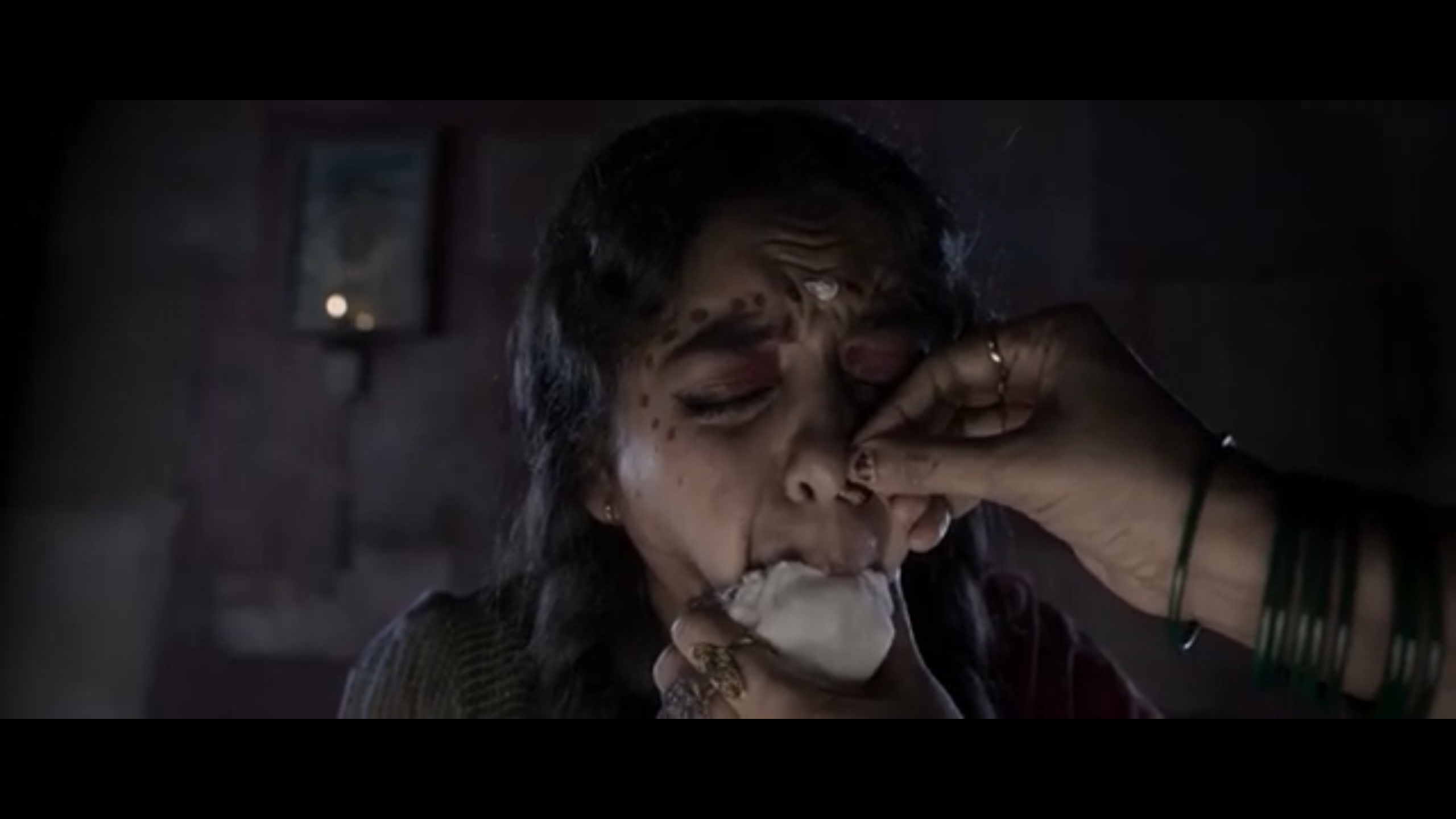
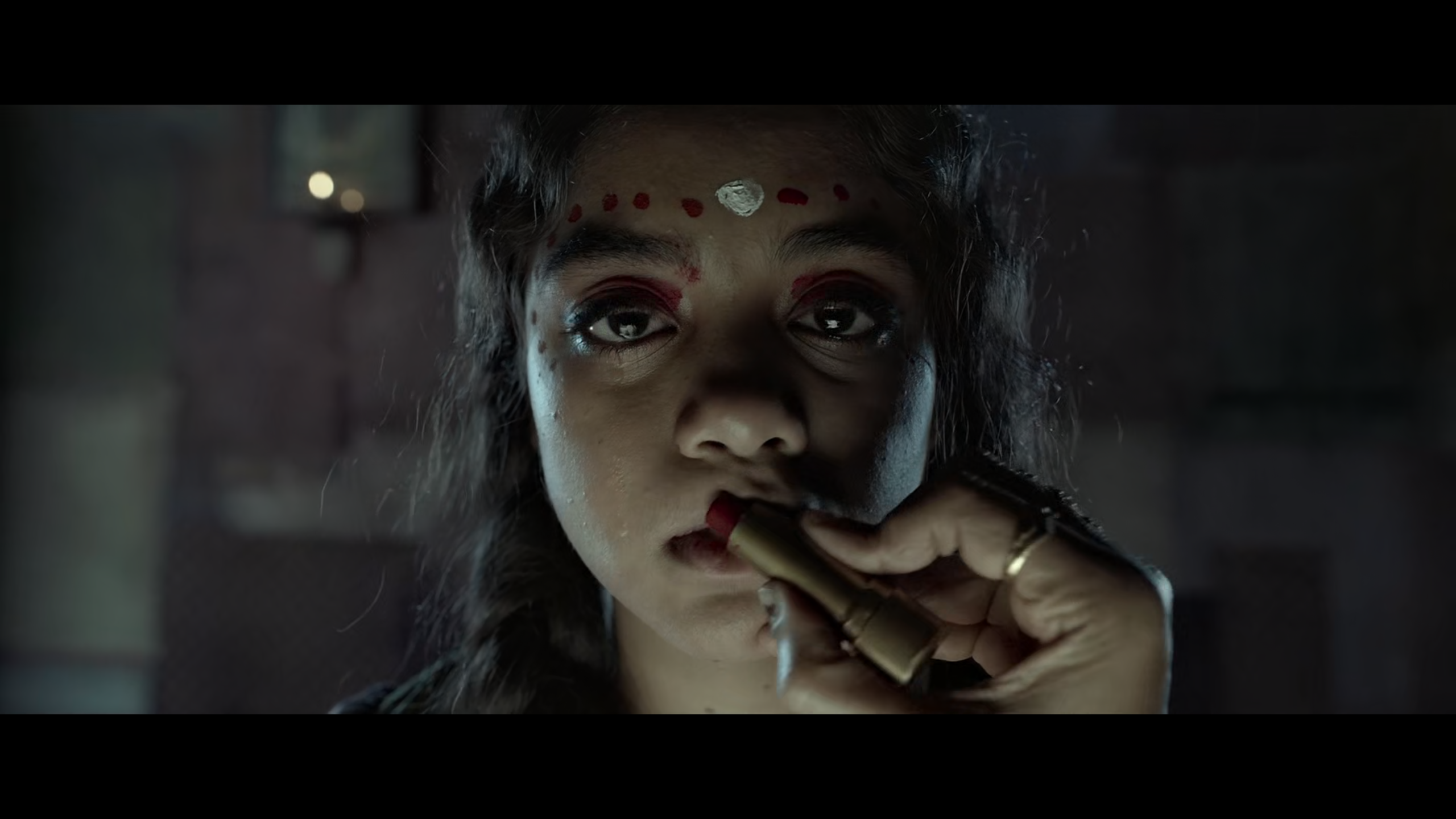
[3] The opening scene of Gangubai Kathiawadi is a highly significant one, crucial to establishing the meaning of the film. It shows a young girl staring directly at the camera in tight close up, and it seems that she is putting heavy, elaborate makeup on her face. (Figure 1) The first thing one sees is her eyes, and immediately one is drawn in, as you can see the pain and hurt being depicted in those eyes as tears roll down. The camera then pulls back to show more and more of her face. Soon we see hands appearing from the side of the frame, putting eyeshadow and lipstick on her, and we realize that this makeup is actually being forcefully put on her face, though we do not see that person’s face or know who they are. However, force is clearly visible through the hand’s movements and rough gestures. We then see the person stuff a gag into the girl's mouth and pierce her nose with their bare hands. The girl lets out a muffled scream, blood streaming down her nose. (Figure 2) This gesture marks the girl’s official entry into the shackles of this world, which she can enter into but not exit from. It is, literally, a rape: the unwanted penetration of her body with an object (the earring), and it results in blood like a deflowering. Bhansali uses a lot of images and symbolism such as this throughout the film to highlight the theme of the girls being forced into this world with no way to exit or leave.
Figure 1: A girl is forcefully “decked” up at a brothel
Figure 2: The girl’s nose is forcefully pierced by a bare hand as a welcome to the community
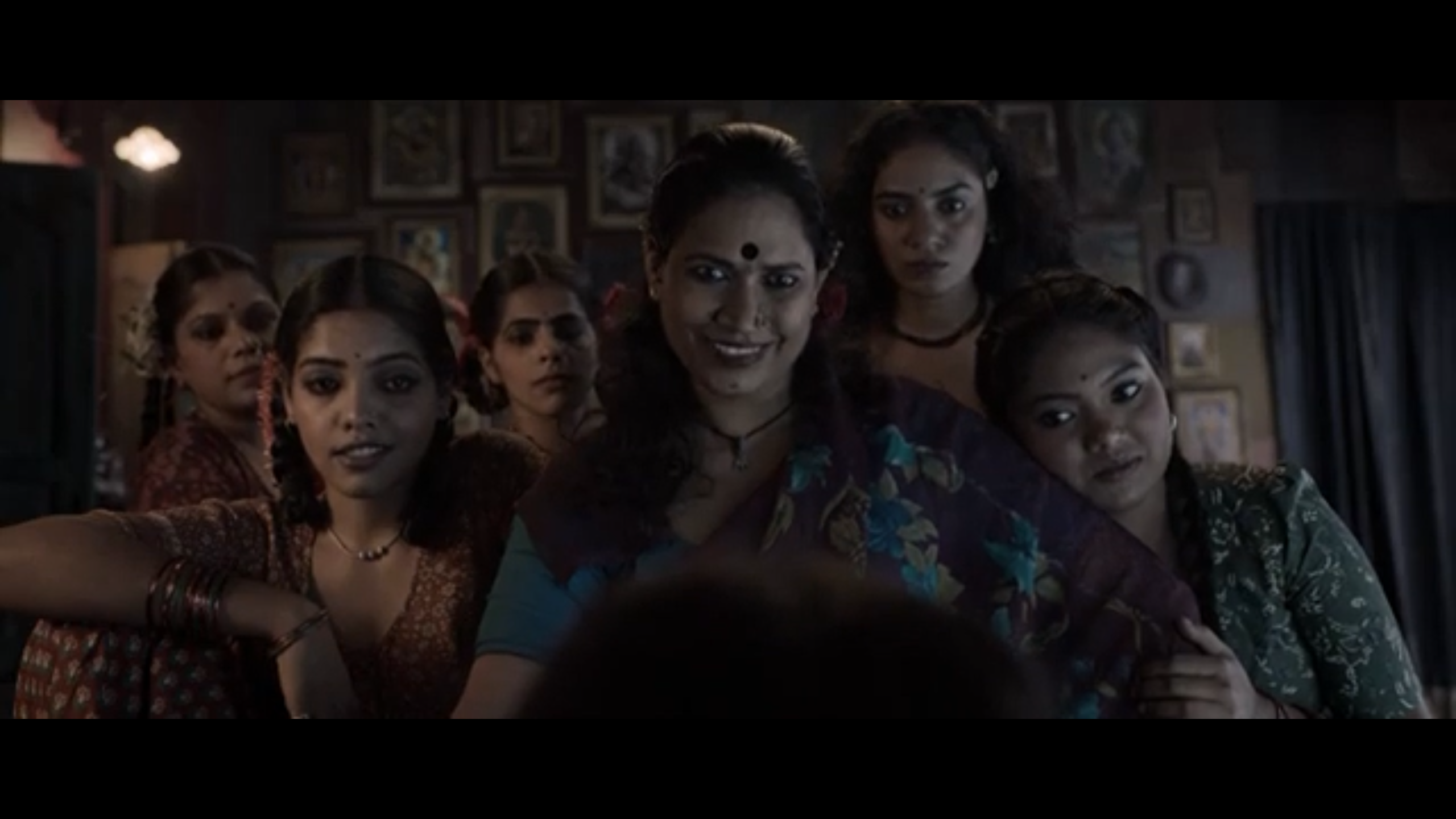
[4] It is a simple yet extremely powerful and intense shot (lasting more than a minute, from 3:10-4:15) where we see a young girl being forced to do something she clearly does not want to do, and all of that is established through the character’s facial expressions and the movement of the hands. She is also directly looking at the camera, unusually centered, looking into the camera as a mirror. All of this occurs in a single shot, and when we finally cut away to the next shot we immediately see a group of ladies in a very dimly lit room. They are staring at her in a frame where all their heads are aligned in such a way that they look like a photograph (Figure 3), but in fact they are the ones taking a metaphorical photograph of the young girl by objectifying her. This use of imagery and sense of a painting being created by the bodies is something that Bhansali repeats in the film.
Figure 3: The other side of the mirror: the women who are decking up the young girl to join them
[5] When the women instruct the young girl to keep her mouth shut and spread her legs, it is as if they are reliving their own past trauma of being on the other side of the frame. The use of shot-reverse-shot here makes the audience feel like the women are actually observing us (staring straight into the camera) and we become a part of the gaze, making us feel what the little girl might feel being so intently watched and objectified. The use of mirroring is quite complex. The ladies watching her almost see a mirror in front of them as they once were sitting in the same place as the little girl, while the direct eye contact with the camera also makes the audience aware of their positionality compared to that of the girl. We, too, become part of the gaze.
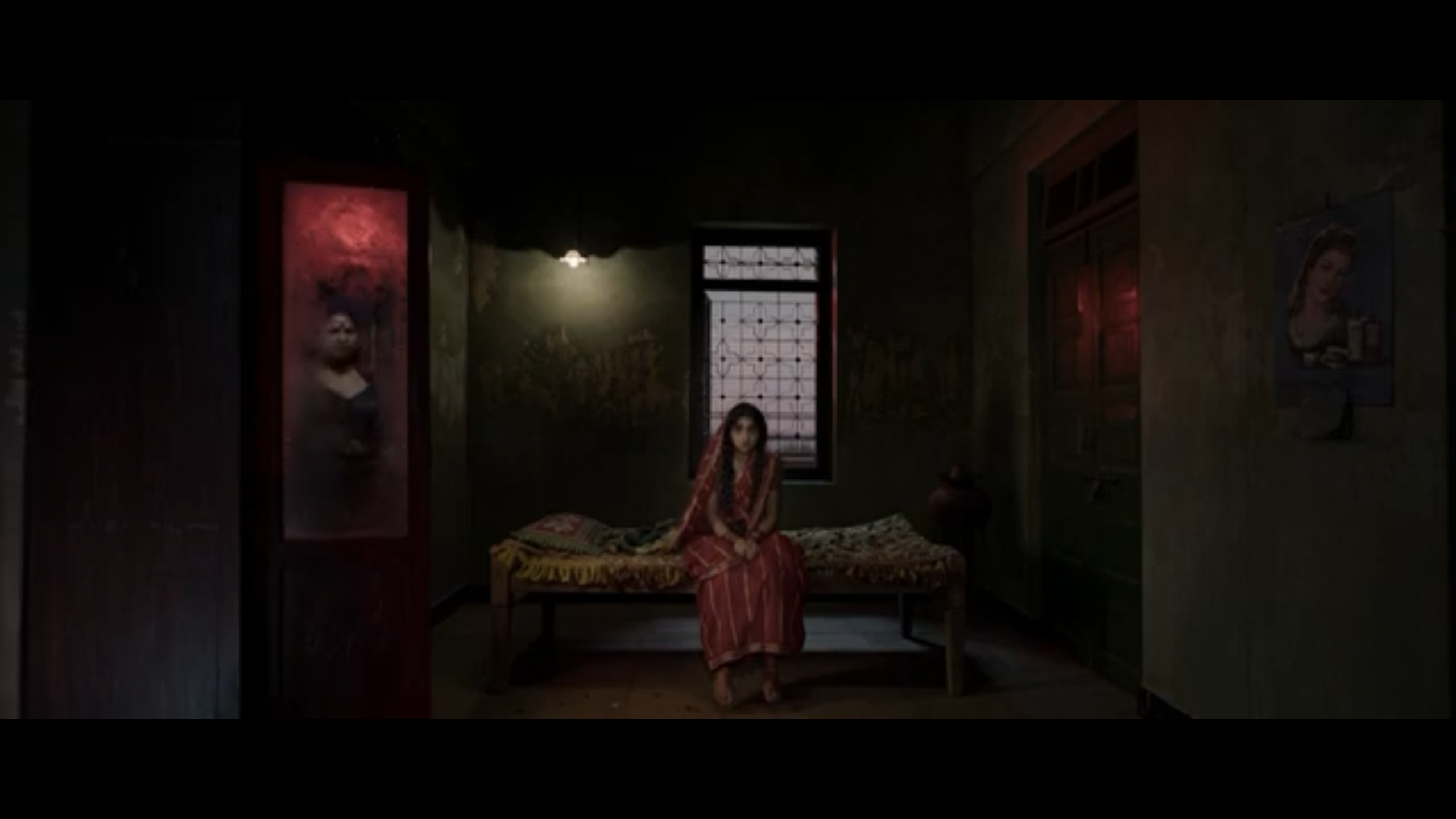
[6] The next shot is of the young girl sitting in a red traditional Indian bridal outfit on the bed in the center of an empty, dark, run-down room with the head lady entering and her reflection appearing on the mirror on the left. (Figure 4) The reflection almost symbolizes the past of the woman herself, who had once been in the same position as the child. The film is set up to be very theatrical, where instead of seeing the man enter himself, we see the lady enter, and only when she moves aside do we see the man enter, as if from the wings. As the man enters the room with a sadistic, almost predator-like expression, we see the little girl plead and beg to go back home. What is interesting in this shot is that, as the camera closes in on her face, we see and hear a train flash by through the window behind her. It is a reminder of how she has lost the train back to her house, quite literally and metaphorically. The train also feels like a phallic symbol, hinting at the forceful sex that will occur. The train does not stop, hinting at how this cruel act against the girl is also not about to be stopped by anyone. The lady then closes the door while intensely looking at her, sealing her off and blocking her way out as we hear the screams of the girl off-screen. These symbols are examples of what Insdorf talks about in opening scenes, and the tone they create for the entire film, letting the audience know what kind of a world they are about to enter into. This is not the story of our protagonist, Gangubai, except it is, because it is the story of all these women, and it repeats.
Figure 4: The brothel owner appears, literally and figuratively mirroring the girl
[7] Insdorf also questions the length of opening scenes: “The focus on beginning sequences leads to the inevitable question, when does the opening end?” (Insdorf 5). Insdorf claims that the amount of establishing time varies in every movie. In this analysis, I would argue that the opening continues to the next scene, where the street outside shows another aspect of what happens behind the closed doors of those houses: sex work and men objectifying women. We see a very theatrical set design of a street full of brothel houses. There are girls as prostitutes sitting outside the houses, calling men inside. The colors of the sky, the costumes, the vintage look, and extravagant set are all characteristic of Bhansali's work in most of his films. In his Bollywood films Padmaavat, Bajirao Mastani, and Ram-Leela, which are blockbusters, the sets, costumes, and editing are quite lavish and splendid. And even though this film is very visually bright and colorful, it is considered to be one of Bhansali’s less vivid and dazzling set designs. This might indicate the miserable lives of the women who inhabit this street.
[8] Yet, what is ironic in the film is that even though the situation of these sex-workers is quite horrible and they have to fight for even basic rights, these women have still managed to create their own community and sense of home and belonging amongst each other. As we see these women almost tease the men, and laugh about pretending they are happy, we hear very slow and sad music playing in the background. That music tells us what they are actually feeling inside. The women on the balcony, looking down from the window above, are posed as one would see them on a theatrical stage set. It is quite obvious that this is an everyday routine for them. The women are in an essentially theatrical profession which requires them to always look happy and inviting for the men outside. They are encouraged not to dwell on their pain and sorrow, even if they go through excruciating pain and torture selling their bodies.
[9] Thus we see that Insdorf’s analysis really opens up Gangubai Kathiawadi to close analysis, and the opening sequence really sets us up to understand the symbols, motifs and themes for the rest of the film. We now see that the opening shot prepares us for the theatricality of the piece; the make-up being forcefully put on the little girl resembles a scene of actors having to put make-up or a mask on to live their character. This young girl, too, was being commanded to live in the character of a prostitute. Even though we do not see the protagonist in the opening sequence, the young girl is the face of all those women around her, and symbolizes and prepares us for the story of the protagonist even though she has not yet appeared. Insdorf talks exactly about this in her essay, arguing that a filmmaker can use a simple but very intense opening sequence as a way to set the tone of an entire film, introducing the main themes and motifs–in this case, making the audience fully aware of the dark world they are about to enter.
[10] This opening sequence is so powerful that it immediately captivates the audience and incites them to be curious as to what is this world and what happens here. One is almost drawn to know more about this cruel and harsh society that is so beautifully staged in Bhansali’s film. We aren’t even introduced to the protagonist until a little later in the film where she enters, brought to the brothel by a limousine, swaggering in wearing a beautiful white saree with black shades and carrying a bottle of alcohol. The attitude and poise with which she enters almost immediately lets one know that she means serious business. Even the first glimpse of her–her shoes propped insouciantly against the window of her car as she reclines in the back seat–tells us about her personality before her entire body and face are shown. Unlike other films where females are sexualised, we don’t really see much skin of Gangu’s legs or look at her in a way that might objectify her body; rather, the camera is angled, making the legs an image and symbol of power and dominance. (Figure 5)
Figure 5: Our first introduction to Gangu, reclining in the back seat of a limo in style
[11] This is a different way of showing a leg, and one that contrasts with British feminist film theorist Laura Mulvey's argument that female characters are often reduced to a leg, a shape, and not a whole person with personality and more to them than just their body. As Mulvey says, “[C]onventional close-ups of legs...integrate into the narrative a different mode of eroticism. One part of a fragmented body destroys the Renaissance space, the illusion of depth demanded by the narrative; it gives flatness, the quality of a cut out or icon" (Mulvey 20). Most films show different parts of a woman's body before they show her face. In Gangubai, we see Gangu’s legs and feet first, yet it is not in a similar way. Mulvey talks about how females are often added to a film only for the purpose of being looked at: “In their traditional exhibitionist role women are simultaneously looked at and displayed, with their appearance coded for strong visual and erotic impact so that they can be said to connote to-be-looked-at-ness” (Mulvey 19). But in this film, even though most of the female sex-workers are beautiful, their purpose in the film is not solely their beauty. Despite being sex-workers, their bodies are not a source of “erotic impact” or visual pleasure for the audiences.
[12] And it is this technique of focusing on smaller, more important details that the director uses to bring out the character’s persona and identity without using many words. Something that is very intriguing and interesting in Gangubai is how the filmmaker creates this entire dark world of prostitution in Mumbai, yet does not treat the female characters as sex-workers and does not attach the usual objectification to their bodies for visual pleasure. It is ironic and almost fascinating how Bhansali has showcased this profession without much nudity, body exposure, or sexualising the female workers. Their bodies aren’t the spectacle, even though their lives and everything surrounding them is showcased in this big theatrical visual.
[13] Unlike most mainstream films, Gangubai Kathiawadi is not led by a male protagonist, but is based on this true story of a female prostitute who becomes a leader to fight for female sex-workers’ rights and comes to be known as the “mafia queen” of Mumbai. This is in contrast to Mulvey’s argument that male protagonists almost always lead the narrative, while the female characters are only there for the spectacle. Mulvey argues that:
[14] the split between spectacle and narrative supports the man's role as the active one of advancing the story, making things happen. The man controls the film fantasy and also emerges as the representative of power in a further sense: as the bearer of the look of the spectator, transferring it behind the screen to neutralize the extra-diegetic tendencies represented by women as spectacle (Mulvey 20).
[15] It is interesting to split the film into spectacle and narrative, where the main point of most mainstream films is the male leading the story as the protagonist, “making things happen” and performing actions, while the female is only there for the spectacle and to be viewed by the male characters as well as the audience. In Gangubai, even though the film is about female sex-workers they are not shown to the audience in the traditional modes of objectification. Mulvey says that “[t]he man controls the film fantasy” (Mulvey 20) and that usually the female is an object of fantasy in the eyes of the male in the narrative, but then also in the eyes of the audience. It is also interesting how Mulvey describes females as the bearer of spectacle and men as "bearer of the look of the spectator" (Mulvey 20), as if that, too, is a big responsibility. Whereas in contrast, in Gangubai, the female character has all the responsibility - Gangu is the bearer of the narrative, looking after the women in her brothel house, fighting for their equal housing rights, as well as education rights for the children of sex-workers. She is in this position of power, where despite being a prostitute herself, the film highlights her as a powerful woman going against the stereotypical negative connotations of looking down upon female sex-workers. Sakshi Sharda talks about the presence of male figures in her article for Feminism in India as well, noting:
[16] This is not the first Bollywood movie which has a female lead character or tells the story of a woman’s extraordinary achievements or her ordinary life. This is not Sanjay Leela Bhansali’s first woman-centric movie, though this is the first time in mass production of Bollywood that the story remains about the woman. Nowhere in the duration of the two hours does the focus of the storyline shift from the woman (Sharda).
[17] Sharda goes on to argue that even though the film has many active males, Gangu uses their patriarchal value system of protection and sacrifice to her advantage.
[18] Another irony in this film is that aside from the one male figure whom Gangu makes her brother–Lala Rahim, the mafia king in the neighborhood–there aren’t a lot of strong or powerful male authorities trying to dominate the sex-workers. It is almost as if the female sex-workers have power and authority, providing men pleasure and contentment outside of their personal lives. There is almost sympathy created for the men in the film, where none are shown in horrible light even though most are married men coming to these brothels to get pleasure outside of their homes. There is a famous line that Gangu says towards the end of the film while giving a speech fighting for the rights of sex workers: “It is your men from your households that come to us, yet why are our homes the ones that are disrespected and dishonored?” It is almost as if all these men are let off the hook, and not much blame is thrown on them. There are only two exceptions to this case. One is Gangu’s childhood boyfriend, who comes to the brothel to sell her off–yet even he is not shown to be an angry, dominating character but rather is portrayed as timid and cute. The other exception is that of a horrible man who visits their brothel and takes pleasure out of physically assaulting Gangu. Even though Gangu is the powerful character in the film, she gets a helping hand from a man, Lala Rahim. Lala, a gang leader who is known for his loyalty and trust in doing his work honestly and respectfully, helps Gangu get more resources and gain more leadership in her area, Kamathipura. In one scene, contractors declare their desire to abolish the brothels in Kamathipura, really so that they can create bigger, modern buildings there, but with the excuse that the nearby school authorities object to the business of sex-work. Lala replies to them by saying, “Lala like to make homes, not break them.”
[19] Besides the obvious objectification of the sex-workers in their own profession, the film does not sexualise any of the females. However, Gangu’s lover-boy, Afshan, who comes a little later in the film, is objectified almost as a commodity: the film loves to look at him and isn’t much interested in what he wants or has to say. While Afshan and Gangu love each other immensely, and while it is personally important to Gangu that she finally receives the love she desired and wanted, Gangu also uses her romantic love tactically, even politically. She sacrifices her love for the larger good, using him to show the world that marriages can in fact take place in a prostitution house. To prevent one of the younger daughters in her house from being forced into the world of sex work, she marries her off to her own lover, Afshan; she is also motivated by the desire to win the election to lead Kamathipura. Even though he did not want to, Afshan ends up accepting the marriage that Gangu has arranged for him, and the audience feels sympathy for him. He is shown as the cute, romantic lover who is “sold off” into this marriage as a commodity–similar to the ways other girls were sold off to the brothel house.
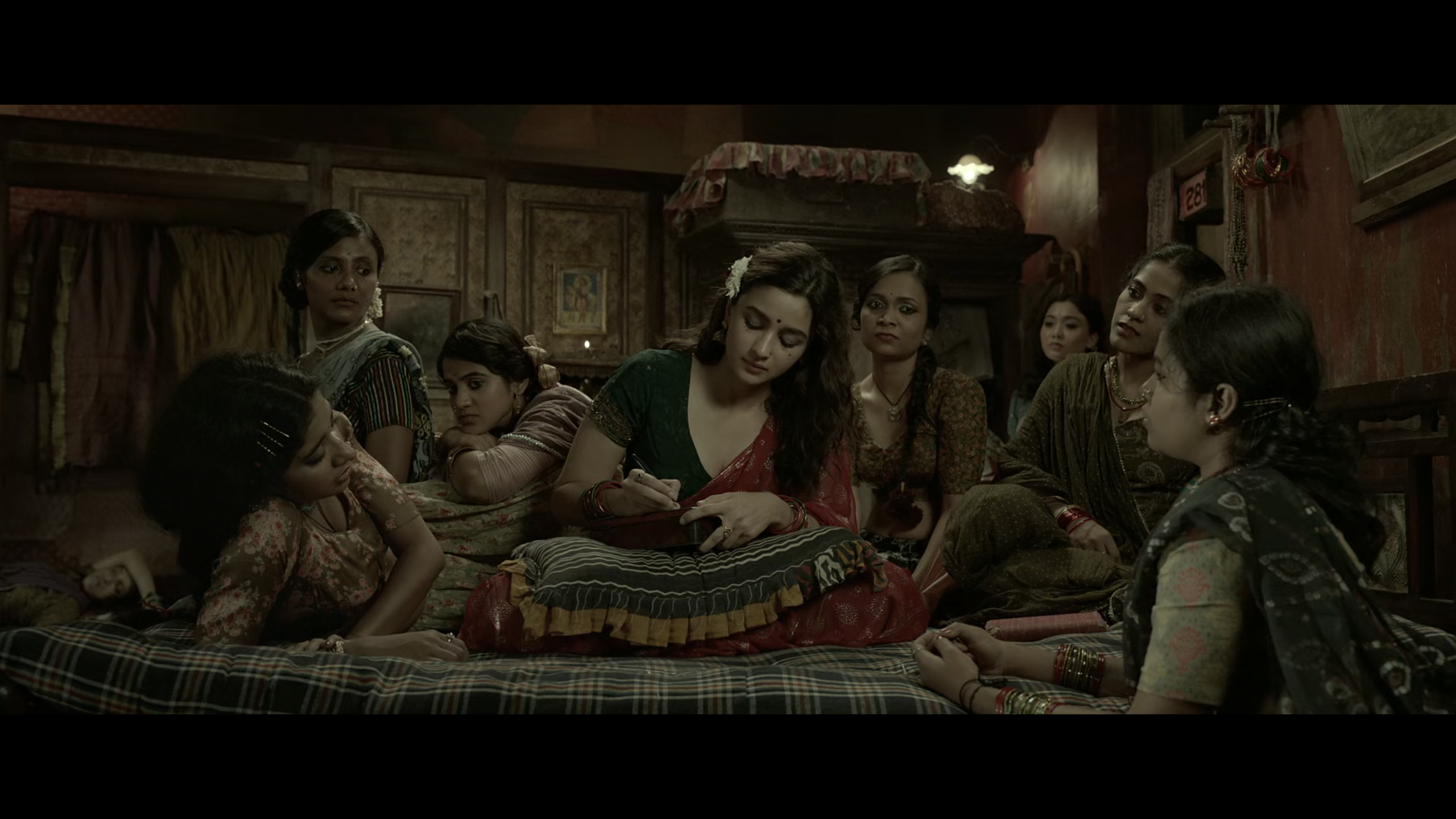
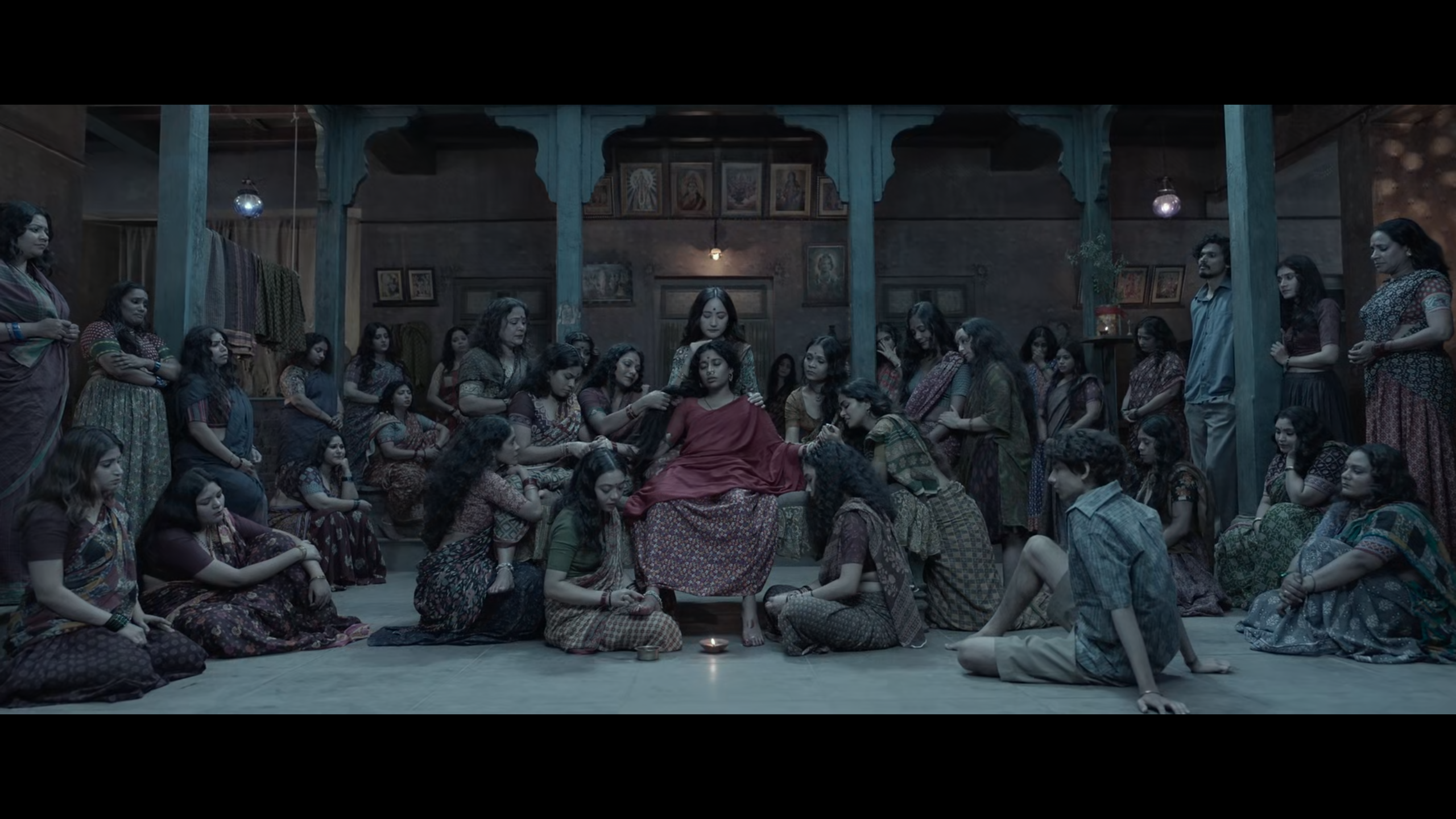
[20] Given false hopes of a fairytale lifestyle in the bustling city of Mumbai, hoping to make it to Bollywood as an actress, a lot of women from smaller towns are conned and sold off to the brutal red-light district of Mumbai and locked away inside four walls. They have nowhere to go anymore, with their dreams shattered and the metaphorical train in their lives long gone. “Once you enter Kamathipura, there is no going back,” says Gangu to the young girl we see in the opening scene. What is beautiful in this film is that Bhansali is able to capture the sense of sisterhood and family created by these female sex-workers away from their home. They enter this place captured as if stuck in a prison, only to find a family and home amongst each other. This is the reason Gangu fights so dedicatedly for their rights and respect. The movie engages in conversations of consent, female intimacy, feminine unity and the strength of sisterhood. Sharda describes how Bhansali “successfully employs the beauty of intimacy among women. There are remarkable scenes of sisterhood in the movie, be it in the preparation of death, or in the sheer number of women enjoying a movie” (Sharda). They create this sense of community, of belonging, doing everything together: dressing up, going out to watch a film, writing letters to share some of their pain, celebrating festivals as they would if with their actual families, fighting for each other, and taking care of each other to the point that, when one of them dies, they dress her up as a newlywed bride.
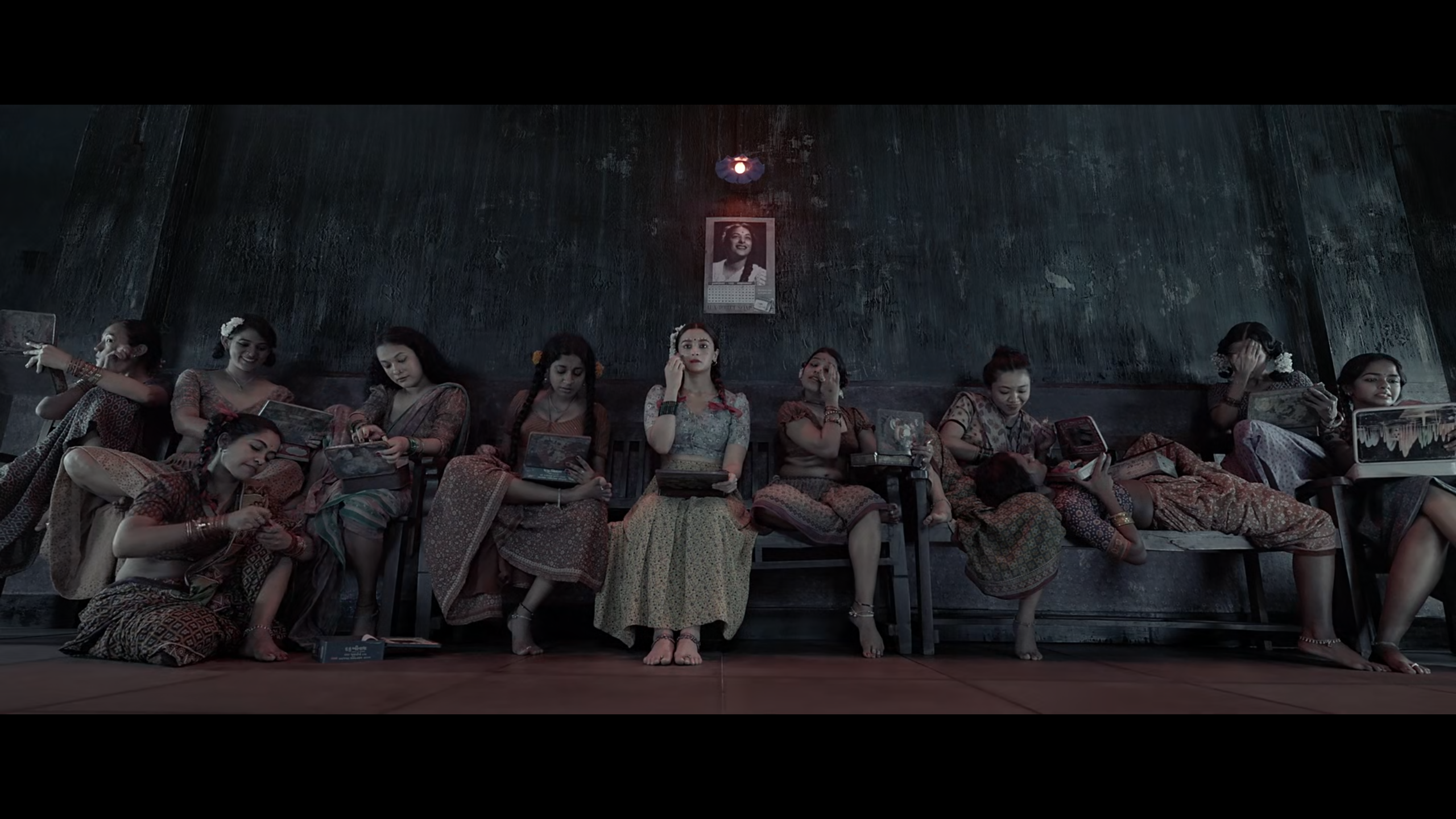
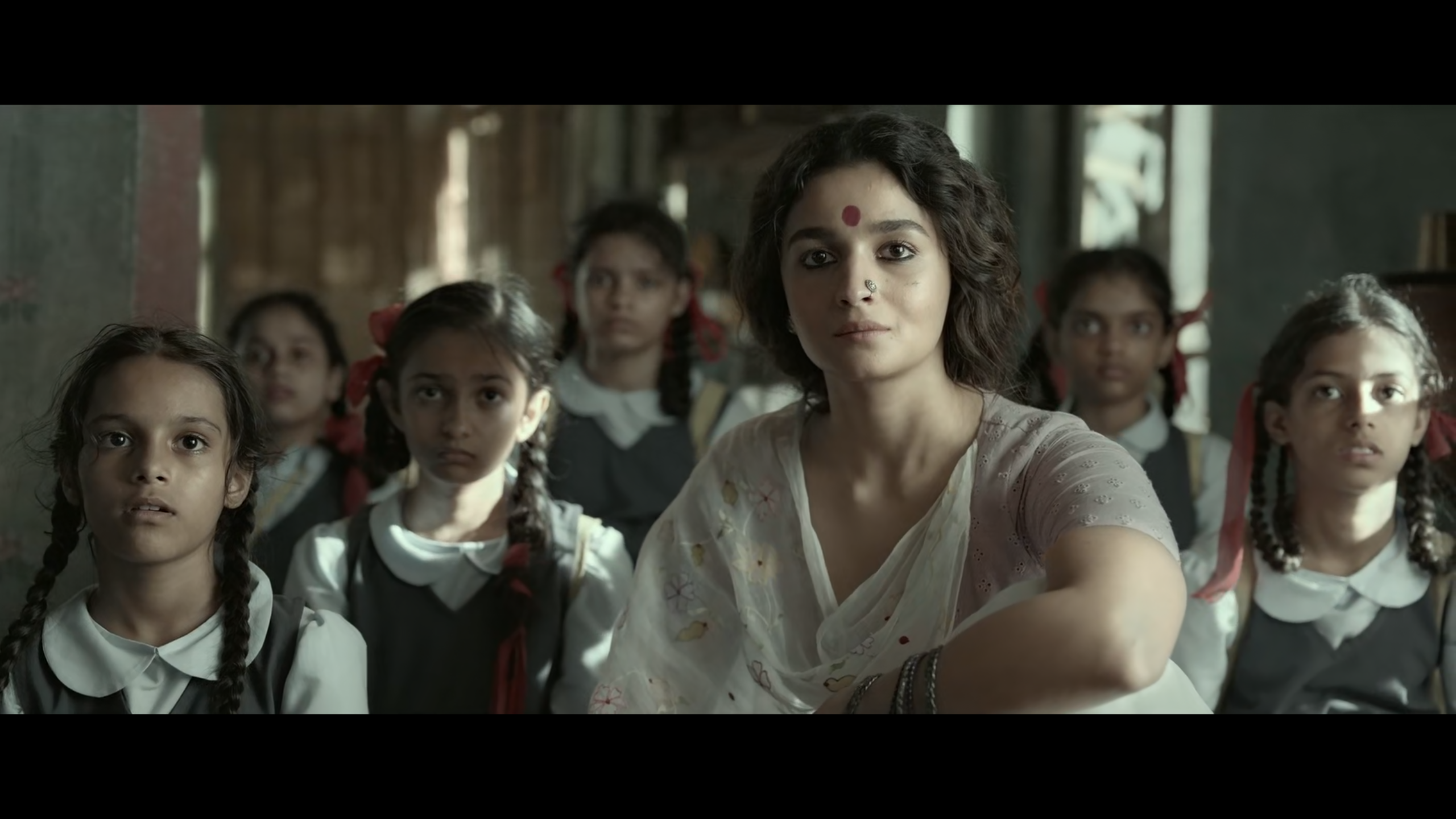
[21] Director Sanjay Leela Bhansali uses visual storytelling, metaphorical imagery, extravagant sets and composition to bring out the theme of sisterhood in this film. (Figures 6 - 9)
Figure 6: The women in the brothel get ready with their makeup for the day
Figure 7: The women write letters together to their families in far away villages/towns
Figure 8: The women respectfully honor the body of a dead sister
Figure 9: Gangu fights for the children of sex workers to receive equal education and be able to attend school
[22] The images created by Bhansali reflect the simultaneity that critic Zander Brietzke claims is more typically characteristic of the theatre (Brietzke 4). Even though the camera lens restricts us as audience members only to view what the director would like us to see, Gangubai also uses theatrical composition in such a way that lets us view a lot happening in the scene that is not in focus. In his chapter “Dramatic Projections,” Brietzke talks about the simultaneity of theatre vs. sequence in film, describing how in film
[23] [an] audience sees what someone else has already seen and appreciates everything that has been placed in the frame on its behalf. The responsibility of the audience to see for itself in the theater requires the viewer to scan the stage and pick up on everything that he or she sees. Such liberty creates the possibility for an aesthetic experience very different from that offered by the mediated arts (Brietzke 24).
[24] Even in the images above, the composition created with the female sex-workers not only gives a captivating visual but also shows a beautiful portrayal of their bond with each other. These scenes could be described as both theatrical and simultaneous because of the wide shots and camera angles, the shots are almost set as if staged on a theatre stage, allowing the audience to view multiple elements at the same time. The director shows what the viewers should focus on, yet gives us the liberty to view the people and objects on the side, which makes the whole scene come alive, almost as if on a theatre stage. The sets, the lighting, the roads, and the buildings outside are made to be very theatrical and big, almost as if on a big production stage. Another very big and extravagant scene is the ending, with Gangu literally made to stand on a pedestal moving through the neighborhood while everyone around cheers for her, and celebrates her. The way all the main characters in her life come out to their balconies to show respect and clap for her is also something very much possible on a theatre stage, yet there were elements of close-ups and wide-shots that would only be possible through the magic of the camera.
[25] Even though Gangubai Kathiawadi has fewer Bollywood dance songs than most mainstream films, the two main dance numbers play a hugely important role. Both songs are traditional dances performed during the festival of Navratri, yet they are distinctly different in nature and significance. The first one happens when Ganga is at home celebrating with her family and friends, completely oblivious to what her future is going to look like, and the harsh circumstances and obstacles she will have to face. She is in bright red, traditional ‘garba’ clothes, enjoying her time until her boyfriend comes to get her and take her to Mumbai as promised to fulfill “her dreams.” The second dance song takes place in the middle of the film when Ganga has become ‘Gangubai’ and is now known for her famous white saree. She brings the festival of Navratri to Kamathipura for the first time so that the sex-workers, the children and everyone around can have something to celebrate together and a way to remember their own homes in this home they have created. It is a celebration of womanhood, community and togetherness. This second song begins with everyone dancing together, yet somewhere in the middle it only has Gangu in the center taking these large circles rotating in the middle. It is almost as if some memories have triggered her and she is using this dance to let out some of the pain. This shot is done in a single take: we see everyone around in colorful clothes while Ganga rotates in the center in her white saree throwing color powder and petals from the plates that the girls are holding. This song, unlike the first song that was more of a celebration, is also an outlet of pain and hurt for Gangu and allows her to express herself. Another key element of Gangu’s character is the symbol of white: after she gains the status of the female leader in Kamathipura, all the women of her house want her to only wear white just like a politician, and to leave sex-work and only be responsible for taking care of them. The symbolism of her traditional white saree displays not only power but also purity. What is ironic is that even though her outfit might be considered a symbol of purity, her profession was definitely the opposite, considered impure by most in the outside world. This symbol of ‘white’ is also seen in the last scene, where not only does Gangu appear in white and red, but the entire neighborhood is wearing white as a way of celebrating her, her achievements, and all that she has done for them.
[26] This essay only focuses on some of the cinematic techniques and theatrical influences used by Sanjay Leela Bhansali to create this beautiful, thought-provoking and impactful film about Mumbai’s “Mafia Queen'', Gangubai. He uses a male gaze, yet not in the stereotypical way of sexualizing female characters; he deploys theatricality and simultaneity in his imagery and composition; and he creates a mode of spectatorship that encourages us to think about what it means for the audience to look at these women. These techniques allow him to bring out very important themes of womanhood, community, togetherness, home, and belonging. In a review in Times of India, Ronak Kotecha says, “Like every other Bhansali film, this one, too, is a visual delight. While the camera captures the dark alleys of Mumbai’s red-light area, it does so with extravagance and ample gloss.” (Kotecha)
[27] However, something also very important to be noted here is that even though the film might be visually very appealing and captivating to the masses, and might help amplify the larger message to a bigger audience, the extravagance shown in the film is far from the actual harsh truth of of the lives of female sex-workers in this red-light district. Sharda talks about this tension in her article and asks important questions.
[28] Kamathipura is portrayed as a space dominated by feminine power in Bhansali’s movie but are red light areas truly like that? Merely showing multiple women sleeping in one room cannot be the sole symbol of poverty and poor livelihood conditions. Even as we state that Gangubai Kathiawadi is a feminist movie done right, we cannot not emphasise [sic] on how it misses the politics of sexual health, material resource distribution and the politics of pimps, which make for important conversations in the politics of a red light area (Sharda).
[28] This powerful and poignant film about a strong female fighter leaves the audience with a lot to think about, but we must also recognize that the actual reality of those facing these hardships everyday is not as pretty and beautified as in Bhansali’s film. The real Gangubai Kathiawadi was recognized for a lot of her work, her courage and strength, and all of this is beautifully showcased in Bhansali’s film. As Sharda notes, Gangu “becomes a businesswoman the day she speaks of buying her kotha [the brothel or whorehouse where she lives], she becomes powerful the day she seeks justice from the Lala, she becomes a partner and mafia queen the day she becomes a local liquor baron” (Sharda). But she becomes well-known after a film highlights her life and her work reaching out to the masses.
Brietzke, Zander. 2007. American Drama in the Age of Film. Tuscaloosa: The University of Alabama Press.
Insdorf, Annette. 2017. “The Crafted Frame: (Saul Bass, Talk to Her, Knife in the Water, Camouflage).” In Cinematic Overtures: How to Read Opening Scenes, 1–13. Columbia University Press.
Kotecha, Ronak. 2022. ‘Gangubai Kathiawadi Movie Review : A Visual Treat, but There’s a Lot about Gangu’s Story Left to Be Told’. The Times of India. 13 May. Accessed 17 December 2022. https://timesofindia.indiatimes.com/entertainment/hindi/movie-reviews/gangubai-kathiawadi/movie-review/89811379.cms.
Mulvey, Laura. 1989. “Visual Pleasure and Narrative Cinema,” in Visual and Other Pleasures. Bloomington: Indiana University Press.
Sharda, Sakshi. 2022. “Film Review: Sanjay Leela Bhansali’s ‘Gangubai Kathiawadi’ — A Powerful Narrative On Sisterhood,” Feminism in India, 13 March. https://feminisminindia.com/2022/03/14/alia-bhatt-gangubai-kathiawadi-review/.