[0.1] Abstract - The most voraciously-spectated being throughout the history of film is the woman. We devour the female body in every form of visual media, yet we feel ourselves offended by it at the same time. Jordan Peele’s 2022 film Nope illustrates what happens when the viewer is put in mortal danger by the object of their gaze, presenting us with a case where the spectators’ fascination drives them to risk their lives just for the chance to witness something spectacular.
[0.2] Keywords - gaze, horror, spectatorship, commodification of the image, feminist film theory, queer film theory, cinema of attractions
[0.3] Trailer
Hager, Brooke A. 2024. “Gaze Carefully: The Function of Spectacle and the Horror of Femininity in Jordan Peele’s Nope,” Muhlenberg Visions. Volume 1, No. 2.
[1] “A portrait may become fatal, a revealer of the unconscious or a stolen double, a story of possession and dispossession of what one holds the most precious: his/her own image.” -Maria Klonaris & Katerina Thomadaki, Film Portraits of Women by Women
[2] As modern viewers, we are more than accustomed to mindlessly consuming spectacular media at any moment of the day. What we fail to consider is the question of what can be considered spectacle when everything has the potential to be turned into one with a single TikTok post: in our age, the family dog can become an internet spectacle just as easily as a Victoria’s Secret supermodel. To spectate in today’s world is to view unashamedly and with insatiable thirst, which only renders true spectacle that much more difficult to come by. That which dazzles, stands out from the noise, and pulls people out in droves to witness its brilliance, for better or for worse. The staying power of film lies in its ability to do precisely that by bringing intense action, graphic violence, and the endless nude bodies of the world’s most coveted stars–all things that would get you instantly banned if you posted them on the more respectable corners of the internet. Film gives us an excuse to look at these things with the assurance that the spectacle is necessary for the greater plot, rendering us all temporarily innocent perpetrators of the gaze when we occupy the theatre seat (or our living room sofa). As we learn from film theorists like Laura Mulvey, Carol J. Clover, and Barbara Creed, the most voraciously-spectated being throughout the history of film is the woman. We devour the female body in nearly every film, yet we feel ourselves offended by it at the same time. Jordan Peele’s 2022 film Nope illustrates what happens when the viewer is put in mortal danger by the object of their gaze, presenting us with a case where the spectators’ fascination drives them to risk their lives just for the chance to witness something spectacular. Most importantly, Nope addresses the concern of spectatorship through the lens of an abstract female “alien” form in an attempt to discuss our relentless consumption of femininity and our simultaneous horror at its existence when it does not serve us as we are used to. By placing what Creed calls the “monstrous-feminine” in a position of being gazed upon and commodified like a real woman, Peele reveals that the true horror lies in our relentless insistence on the exploitation of womanhood in the hopes that it will perform for us, even when its bloody jaws are wide open.
[3] Nope (2022) follows the Haywood family, the owners of a horse ranch in Southern California who specialize in the training of horses for film shoots. Siblings OJ and Emerald must take over the ranch when their father is killed in a freak accident, but their business is halted when they discover a mysterious UFO-like being loitering in the clouds above the ranch and causing lethal disruptions to their property. Some inhabitants of the area are already aware of this being’s presence, however: local burnt-out child television star Ricky ‘Jupe’ Park owns and operates Jupiter’s Claim, an amusement park based entirely around the exploitation of the alien being. Searching for answers and hoping for proof, OJ gets in contact with Jupe in an attempt to learn about the creature. The debacle quickly turns into a race to get photographic evidence of the creature (whom OJ dubs “Jean Jacket”), and the Haywood siblings join Jupe in the quest to extort the alien presence for all her worth. The beauty of watching a Jordan Peele film is that he tells the viewer right away what the film is about at its core, and Nope is no exception. The opening card of the film features a Bible verse (as we also see less explicitly in Us [2019] and Get Out [2017]), this time from Nahum 3:6, “And I will cast abominable filth upon thee, and make thee vile, and will set thee as a spectacle.” This verse essentially operates as the film’s thesis–we are told from the jump what Nope is about so we can consciously revere the spectacle herself throughout the entire film. The verse’s text is a reminder that to be made a spectacle is nothing more than a punishment, a form of torture for the spectated party who has not given (or cannot give) their consent to be viewed. This status applies to multiple entities in the film: the Haywood horse at the beginning of the film who rebels on the set of a commercial, the trained chimpanzee who killed and maimed nearly the entire cast of Jupe’s childhood sitcom live on air, and the subject of our focus, the alien being herself.
[4] To discuss spectacle without exploring its connection to gaze would be a disservice to film theorists everywhere, so let us land there for a moment. In one of film theory’s most notable essays, Visual Pleasure and Narrative Cinema, Laura Mulvey illustrates precisely what it is about the feminine image that our culture is so averse to on a psychological level. She notes that film “reflects, reveals and even plays on the straight, socially established interpretation of sexual difference which controls images, erotic ways of looking and spectacle” (Mulvey 14). What I would like to highlight here is, of course, “spectacle.” Even in this brief summary of her work, Mulvey tells us that film is a spectacle all its own. For a film as meta as Nope in its references to the act of filmmaking, Mulvey’s argument is crucial information for operating on the same playing field as the director. By watching the watchers watch, we are participating in the consumption of spectacle on an even grander scale than the one we are critiquing. Mulvey goes on to explain just how this “sexual difference” matters when a man gazes at a woman in a film. According to her analysis, in conjunction with Freud’s, the male gazer is initially horrified. Mulvey tells us that this horror exists as a result of the “castration anxiety” (Mulvey 21) that is invoked in male viewers by the presence of femininity in film. This notion that viewing anything that lacks male anatomy (both literal and figurative) is inherently off-putting to the male spectator is precisely what makes Nope’s alien creature so effective and frightening.
[5] Mulvey notes that “the male unconscious has two avenues of escape from this castration anxiety…investigating the woman, demystifying her mystery… or else complete disavowal of castration by the substitution of a fetish object or turning the represented figure itself into a fetish so that it becomes reassuring rather than dangerous” (Mulvey 21). The second option she presents, which she refers to as “fetishistic scopophilia,” is the avenue taken by Jean Jacket’s victims in Nope. They are terrified of her not only because of her threat to their existence on a mortal level, but also because her horrifically feminine form operates in line with this Freudian natural instinct to be repulsed by the physically feminine—except unlike with a human woman, there is no hope of mentally backtracking and later finding pleasure in viewing her as Mulvey suggests occurs in the sexualization of female stars by men. Instead, Jean Jacket’s viewers are left with that feeling of abject horror that only deepens their inclination to turn her into a fetish object in an attempt to find comfort from their fear.
[6] The film’s prime example of this phenomenon is the storyline of Ricky ‘Jupe’ Park. Jupe’s peculiar placement within the film frames him as Peele’s representation of the worst version of the male spectator. He survived the aforementioned chimpanzee attack due to an alleged moment of “connection” with the chimp that saved him from being harmed. Later in life, Jupe took this to mean that he was capable of taming even the most ferocious force of nature, so when that opportunity presented itself once again, he had no hesitation in doing so. This assumed right to gaze at that which fascinates regardless of the object’s approval is one which feminist film theorists everywhere are all too familiar with, and which Mulvey highlights in her essay:
[7] In a world ordered by sexual imbalance, pleasure in looking has been split between active/male and passive/female. The determining male gaze projects its fantasy onto the female figure, which is styled accordingly. In their traditional exhibitionist role women are simultaneously looked at and displayed, with their appearance coded for strong visual and erotic impact so that they can be said to connote To-be-looked-at-ness (Mulvey 19).
[8] This “active/male and passive/female” dynamic is key to understanding the root of Nope’s warning for the mindless spectator. We learn early on in the film that to physically look up at Jean Jacket is a death sentence; this is how OJ’s father met his demise, as well as an entire audience of spectators at Jupe’s final presentation. This scene in particular is one in which we get a clear sense of how gaze functions for Peele. The gaze, no matter how innocently directed, inherently places the gazer in a position of power. To elaborate on the implications of this idea, Peele provides us with the opposite dynamic, in which that power is mirrored back onto the gazed-upon object instead. Suddenly, the object of the gaze is the “monster” in the narrative for acting against her own nonconsensual perception.
[9] Even more interestingly, Jupe refers to the stereotypical aliens which he mistakes Jean Jacket for as “The Viewers”. This implies that he believes they are watching him right back, and it creates an even more complex relationship between Jupe as the “active/male” and Jean Jacket as the “passive/female” (Mulvey 19). Jupe knows that the aliens are actively watching him, and this heightens his discomfort even further. This explains his character’s framing as the one who has dedicated his whole life to their exploitation and fetishization–he hates that he is the only one being watched, so his instinct is to bring in as many people as he can to strengthen the power of the oppositional gaze and potentially gain some of that power back for himself. This is his definition of “taming” the object of his gaze, despite the irony that Jean Jacket has remained in control since the beginning and appears to be toying with him for her own amusement.
[10] With this context in mind, let us revisit our central point of focus: the fact that Jean Jacket is undeniably female, and as a result she is full of feminine rage. Throughout the film we watch as she sucks her victims up through what can only be described as a reverse birth canal, showers the Haywood home with blood that is expelled through that same canal, and, toward the end of the film, sheds her UFO shape to expand into a final form that looks straight out of a Georgia O’Keefe painting. We may as well concede to adding Jean Jacket to the list of vengeful women commodified by Hollywood for their mysterious and threatening beauty.
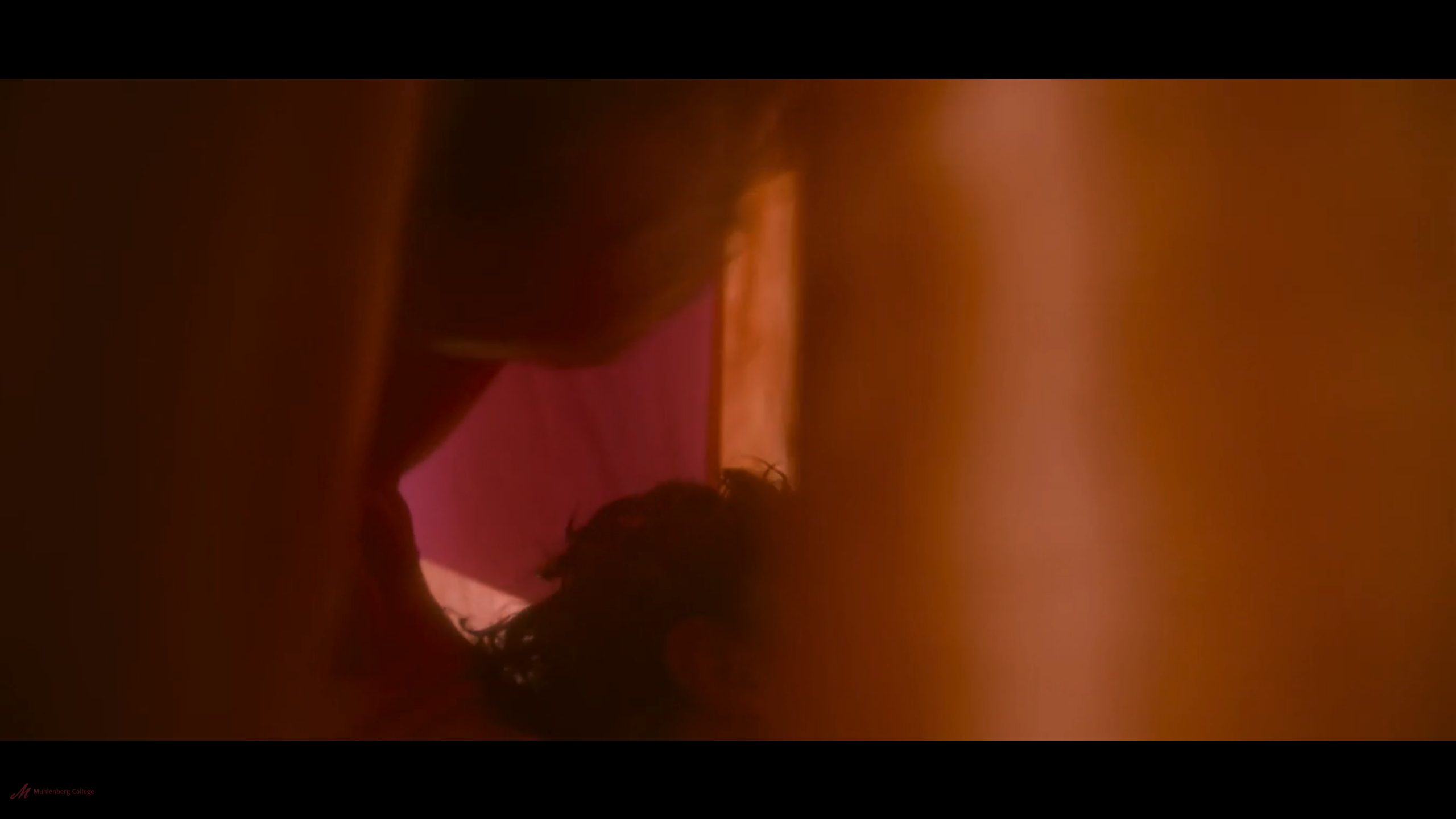
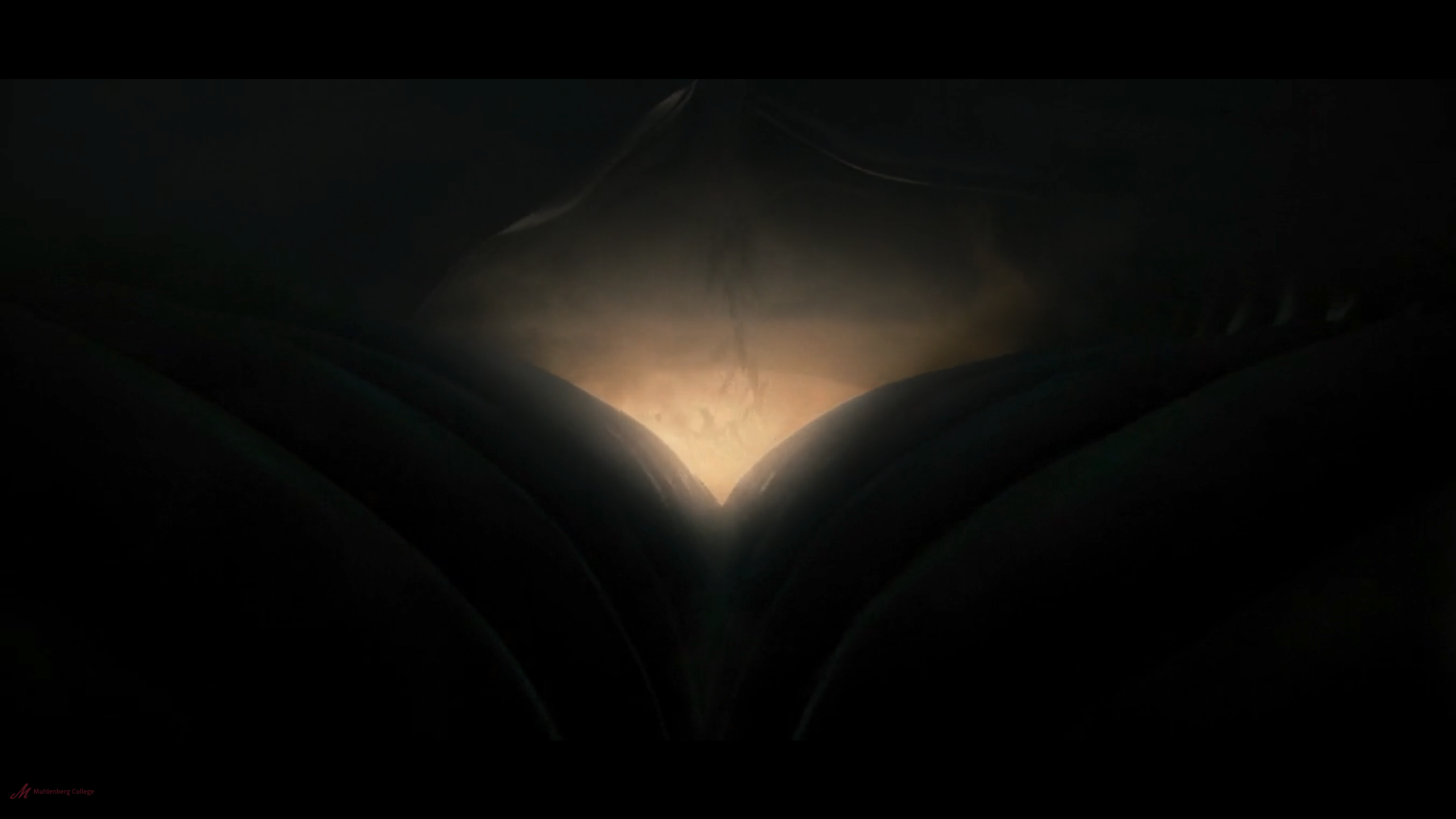
[11] Throughout Nope, we are presented with overtly vaginal imagery each time Jean Jacket seeks her revenge. The first of these images that I would like to explore is that of the reverse birth canal. (Figure 1) In the scene directly following Jupe’s last speech, he and his meager audience are devoured by Jean Jacket in a manner reminiscent of the stereotypical “cow being beamed up by a UFO” image. They are sucked up into Jean Jacket’s cavernous hole in the bottom of her body, and we watch as they are squeezed through a tight bloody tunnel that reminds us of the vagina. The camera places the viewer in the point of view of one of these victims, in a dark frame backlit only by what we can assume to be the sun coming through her skin (Figure 2). This throws us into the illusion of being pulled up higher and higher alongside Jupe’s audience, a claustrophobic nightmare that feels like birth. The key issue here, of course, is that her victims are going in and never coming out. It is here that we can employ Barbara Creed’s book The Monstrous-Feminine: Film, Feminism, and Psychoanalysis. In her fourth chapter, Creed points out the phenomenon that “[i]n the horror film the ancient connection drawn between woman, womb and the monstrous is frequently invoked” (Creed 170-1). Nope is clearly no exception to this, as the reverse birthing scene so deftly illustrates. Creed’s argument supports the idea that Jean Jacket’s threat to humanity is due to her status as the “anti-womb”, but her argument is centered around the trope in horror of the woman birthing something “other”: a computer, an alien, or a monster (Creed 171-7). While these examples still have to do with birth of “monstrous offspring” (Creed 178) rather than the inversion of birth entirely, Creed sets up the idea that we will always find the female womb horrifying, regardless of what it is producing (or in Jean Jacket’s case, consuming). Creed posits that a woman's “ability to give birth links her directly to the animal world and to the great cycle of birth, decay and death. Awareness of his link to nature reminds man of his mortality and of the fragility of the symbolic order (Creed 184). By this line of thinking, it could be argued that Jean Jacket’s taking of life rather than her giving of birth should be a welcome differentiation from the maternal cycle. However, Jean Jacket simply presents an equally-horrifying reminder of nature’s cycle by skipping past the birth and decay and heading straight for death. Despite the fact that she is not performing her traditional role as a perpetuator of the birthing cycle, Jean Jacket poses an even greater threat to man because of her ability to expedite the natural cycle of life.
Figure 1, Vaginal imagery in Nope; Figure 2, The reverse birth canal
[12] In her ninth chapter, Creed argues that “woman transforms into a monster when she is sexually and emotionally unfulfilled. She seeks revenge on society, particularly the heterosexual nuclear family, because of her lack, her symbolic castration” (Creed 445-6). By this argument, we could take Jean Jacket’s revenge as a personal one instigated by her own lack of fulfillment, as she can only ever consume and never produce in the way a human woman can. Her potential disdain for the nuclear family would also be supported by her bleeding all over the Haywood house: if the house is a symbol of family, we can read that scene as an act of revenge on the perfect domestic life she will never get to lead. However, I would like to propose that Jean Jacket defies Creed’s original definition of the female monster in that she does not appear to feel castrated at all. Her acts against the nuclear family are not a result of her sexual or emotional dissatisfaction, but rather a means of asserting her power over traditional images of the woman as birther or the home as a symbol of reproduction. She is not suffering from a lack of anything, and she is quite literally above it all; she can destroy it at a moment’s notice, securing her hyper-vaginal image as a winning competitor for symbolic power over the phallus entirely.
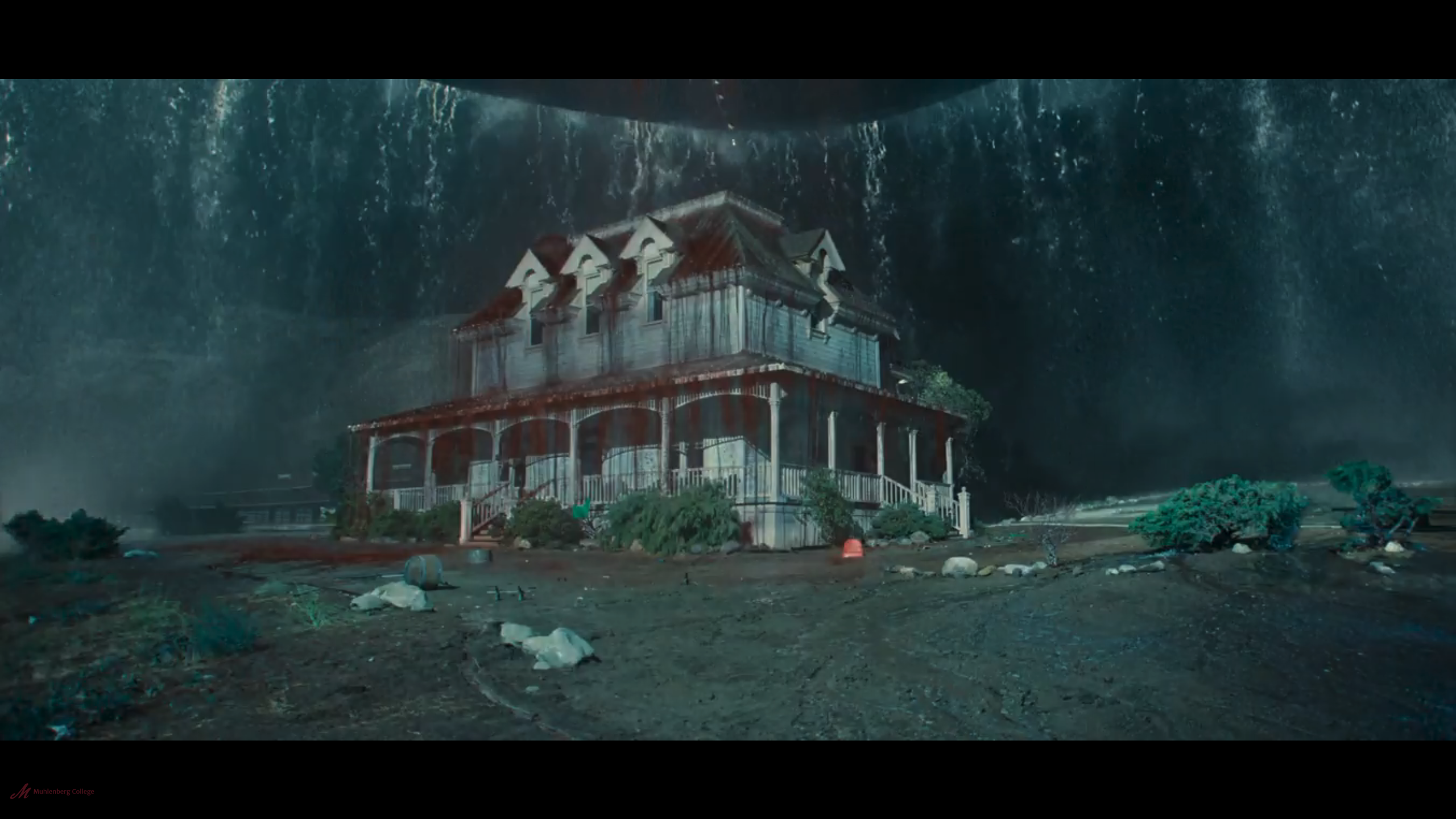
[13] The second image of Jean Jacket’s monstrous femininity that I would like to dissect is the aforementioned scene in which she bleeds over top of the Haywood ranch house as its inhabitants cower inside of it in fear. (Figure 3) While I’ve noted that Jean Jacket’s weaponization of the feminine grotesque acts as a rebellion against the spectacle that is made of her against her will, it cannot be ignored that this act of bleeding is particularly spectacular in its own right. Since we don’t know her biological needs in terms of feeding, it could be argued that her consumption of people is entirely survival-based—but her choice to hover over the Haywood house in particular to shed her body’s rejected fare amidst gallons of blood feels extremely deliberate. Jean Jacket chooses this spectacle for herself, and the scene’s structure makes sure we are aware of that fact: its shots highlight the blood dripping down the windows and the dramatic thudding of coins and plastic decorations onto the ground, and it ends with the intensely sinister shot of Jean Jacket above the house, raining blood down from on high. Laura Mulvey tells us that “[w]oman's desire is subjugated to her image as bearer of the bleeding wound; she can exist only in relation to castration and cannot transcend it” (Mulvey 14). If this is true, the argument I presented previously about Jean Jacket’s overpowering of the phallus is completely moot. However, I argue that the transcending of castration is possible if the woman’s desire is able to overcome said “image as bearer of the bleeding wound.” Here, Jean Jacket is not only addressing this image head-on, but she is once again turning it into a tool of terrorism against those she assumes to have placed it onto her. In this same vein, Barbara Creed says that “[t]he womb represents the utmost in abjection for it contains a new life form which will pass from inside to outside bringing with it traces of its contamination – blood, afterbirth, faeces” (Creed 191). We can think of this scene not just as Jean Jacket’s recognition of woman as the entity who bleeds, but as her own “afterbirth” (afterdeath?). These products of her body that we have learned must come out of her one way or another are symbolic of her simultaneous connection and variance from the functions of the female body. Her body evidently cannot hold anything that is not solid organic matter, and she spews out the rejected material with great purpose as a sign of her ultimate womanhood. She likely chooses the Haywood home as her dumping grounds because she is aware by this point in the film that they are watching her, and she is taking control of exactly what they see of her.
Figure 3, Jean Jacket bleeds over the house.
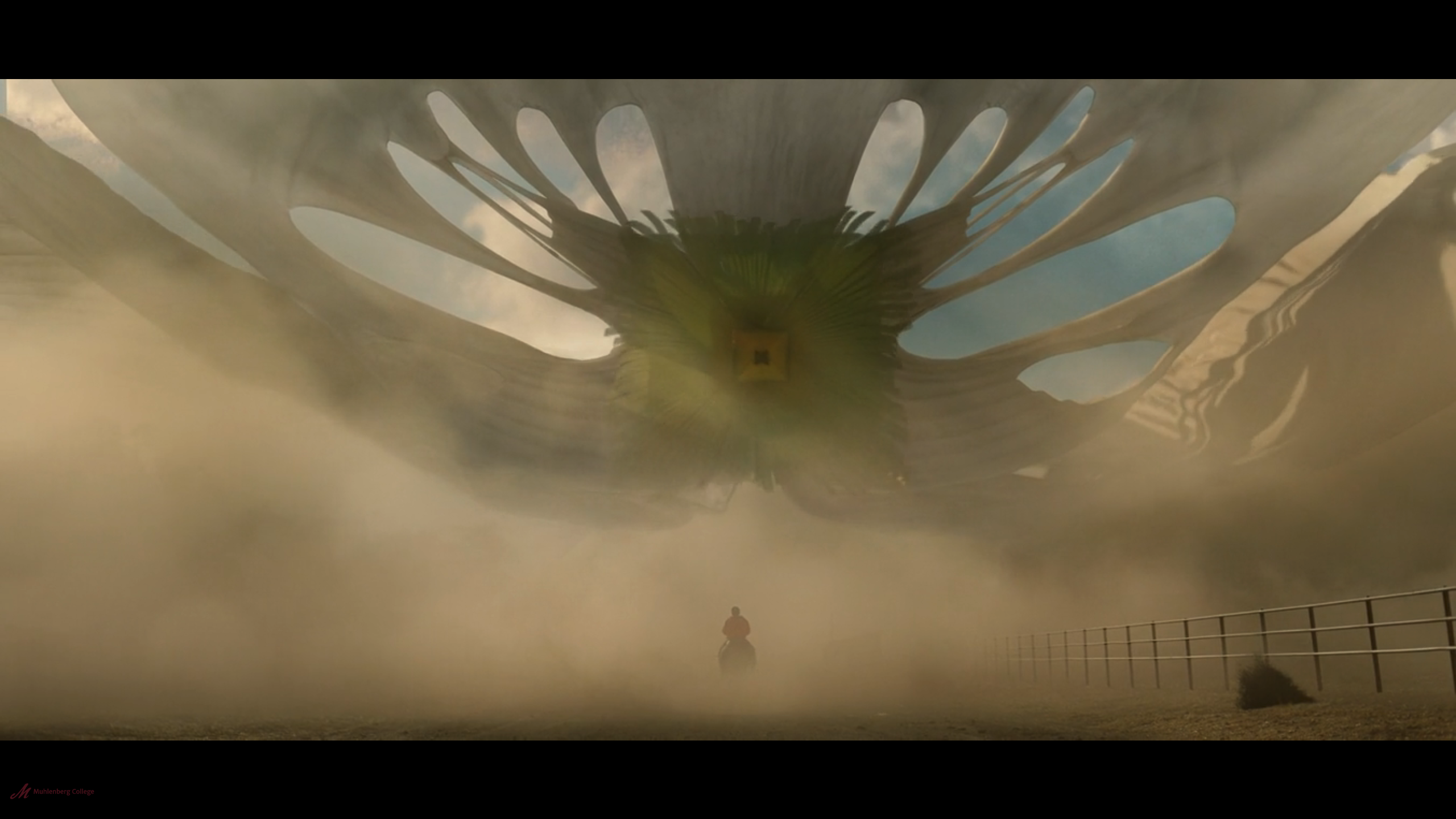
[14] The third and final image of Jean Jacket that I would like to draw attention to is the image of her “opening” into the last state we see her in, where she transitions from the flying saucer-like shape into a Biblical-looking, flowing organism that resembles an orchid, or more importantly, a vulva. (Figure 4) While Jean Jacket’s “final form” is not frightening in theory—there is no gore, no blood, no rubbery birth canals pulling people through its length—it poses the greatest visual threat of the three images we have discussed, both for the audience and for the Haywood siblings. It helps that she gets closer than ever before to the ground at this moment so that we may fully understand the intimidating scale of her body, but her size is not the primarily frightening aspect of this form. It feels redundant at this point to rehash why the vulva-esque shape of Jean Jacket’s final form poses a psychological threat to the audience; we feel the same way about the vulva as we do the womb and what comes out of it. I would, however, like to shift us to the less obvious reason why we are so intimidated by this version of her body: its symmetry.
Figure 4, Jean Jacket opens into her final form.
[15] In his article “Symmetry—the Forbidden Fruit of Picture Composition in Film”, Louis Thonsgaard argues that “[t]he visual power of symmetry is so great that filmmakers often avoid or are advised against using symmetrical picture compositions,” and that subsequently, “filmmakers who master the art of symmetry wield a powerful visual aid capable of communicating complex meanings that cannot otherwise be conveyed visually” (Thonsgaard). By Thonsgaard’s definition, Jean Jacket fits what is called “axial symmetry”: “The axial symmetric picture consists of two mirroring parts which start out by counterbalancing each other compositionally, thus often creating compositions that are statically in balance” (Thonsgaard). It would be easy to assume that this kind of symmetry, since it is pleasing to the eye, would create a sense of visual comfort despite Jean Jacket’s looming wrath. However, this kind of symmetry is so underused in cinematography that we are not used to seeing it on screen, and are thus subconsciously put off by its presence. Simply put, Peele has harnessed that “visual power” that so many filmmakers avoid due to its uneasy nature in order to do just that: make us uneasy.
[16] It is doubly worth noting that the green centerpiece that juts out of Jean Jacket’s center resembles a square camera lens: it is protruding, complexly layered, and has an aperture in the middle that opens and closes as the greater length of it extends out or retreats inward. In this image, we get the sense that she is watching us more closely than ever before, and she gives us the clear impression that she is rebelling directly against the cameras used to capture her image throughout the end of the film by Antlers, Angel, and the TMZ reporter. Even if we don’t look at this appendage and think “that looks like a camera,” Peele is still accomplishing his goal by subjecting the audience to the camera-oriented exploitation that spectacles like Jean Jacket must face, and guiding them into the headspace of the “looked at” party, however subconsciously. This moment is Jean Jacket “mirroring” the situation she has been put in by the humans around her, thus creating another less-visual type of symmetry.
[17] Beyond Jean Jacket’s ripping apart and reconfiguration of gender expectations, Peele presents us with another, equally peculiar, subject position in the film: that of the lesbian spectator. Since the penis is meant to be the ultimate symbol of pleasure in Freudian analysis, Mulvey tells us that the male spectator is wary of the female object because of “her lack of a penis, implying a threat of castration and hence unpleasure” (Mulvey 21). If we follow Freud’s and Mulvey’s ideology, we are left with a huge question mark regarding the presence of the lesbian spectator: is she afraid, and if so, how does her fear differ from that of her male counterparts? Peele explores this through the character of Emerald Haywood, the sister of OJ and the only person who is able to outsmart Jean Jacket and successfully capture an image of her (while simultaneously leading Jean Jacket to her demise). Not only is Emerald Haywood a lesbian, but she is also the only main female character (other than our big white starlet in the sky). Her status as female is what places her a step ahead of everyone else in terms of coming to grips with Jean Jacket’s motivations—women are perhaps more sensitive to the idea of their own commodification because many of them have experienced it their entire lives. Yet Emerald is an active participant in her own self-commodification: she advertises her ability to act, sing, and ride motorcycles to anyone who will listen. If anything, she and Jean Jacket are dramatic foils. As Jean Jacket attempts to deflect and reroute her own exploitation, Emerald tries desperately to be seen in whatever ways she can manage and seeks out opportunities to make a spectacle of herself. Ultimately, Emerald realizes that Jean Jacket is her ticket to fame, and her focus shifts away from her search for superstardom and toward getting the “money shot” of Jean Jacket to help save the Haywood ranch (and get her name on television). However, I argue that despite the fact that Emerald is one of the biggest proponents of Jean Jacket’s exploitation, her status as the lesbian puts her in a unique position of reverence for Jean Jacket’s taboo femininity, providing her with the respect required to see how Jean Jacket truly operates—something her male counterparts cannot quite grasp. We can understand how Emerald’s feminine gaze functions by referencing the collection “Film Portraits of Women by Women” by Maria Klonaris, Katerina Thomadaki, and Dot Tuer. In her section of the collection, Tuer marks, “Suppose I like it down here, down among the women. Suppose I have seen it, their phallus, and do not want it” (Tuer 18). This quote not only aligns Tuer with Emerald’s modus operandi as a lesbian, but it also encapsulates what we have discussed about Jean Jacket’s own existence outside of male consideration: she is female in a way that overpowers the typical gendered power dynamics we refer to time and again with Mulvey, Freud, and Creed. Like Tuer and the filmmakers she associates with, Jean Jacket exists not to counteract masculinity, but to overshadow it entirely with herself. This intersection of operation is how we begin to find the connections between Emerald and Jean Jacket that allow Emerald the privilege of being the sole capturer of Jean Jacket’s image. Tuer writes that, in artistic spaces where women are operating without the influence or consideration of male spectatorship, “the evocation of the body will threaten the mastery of cultural prescription” (Tuer 18). Once more, we see how the act of taking masculinity out of the equation entirely informs a worldview that centers the woman as the sole spectator. In our case, Jean Jacket’s body threatens the cultural prescription of fear in a way that Emerald can connect with as a woman purposefully out of contact with the male psyche and body. Like filmmakers Maria Klonaris and Katerina Thomadaki, Emerald captures a female body with deep understanding of what it means to be a woman capturing womanhood, even in its most frightening, raw form.
[18] Another piece of Emerald’s character that sets her apart from both the norms of Nope and of horror more broadly is her status as a Black and queer Final Girl. While Nope is not a slasher film, it operates like one by having a Final Girl, which Carol J. Clover defines in her article, “Her Body, Himself: Gender in the Slasher Film” as “the one who encounters the mutilated bodies of her friends and perceives the full extent of the preceding horror and of her own peril; who is chased, cornered, wounded; whom we see scream, stagger, fall, rise, and scream again. She is abject terror personified” (Clover 201). While Emerald fits this definition unfailingly, she does not function as the typical final girl in that she is not the virginal, bookish girl who uses her purity of mind to outwit her opponent in ways that her counterparts are too clouded by their own sin to come up with. Despite this, she manages to fit the mold in a roundabout way. Clover notes that “[t]he Final Girl is boyish, in a word. Just as the killer is not fully masculine, she is not fully feminine—not, in any case, feminine in the ways of her friends” (Clover 204). Nope creates a unique set of circumstances because Emerald is up against a killer who is not masculine at all, and Clover’s analysis may lead us to believe that this should throw off the Final Girl/killer dynamic. That being said, I argue that Emerald’s status as lesbian replaces the dynamic of emasculated male killer and tomboyish female survivor with something even more equally-matched, the hyper-feminine versus the worshiper of the hyper-feminine.
[19] Just as she is a lesbian Final Girl, Emerald is also a Black Final Girl, which places her amongst a miniscule pool of contemporaries in the horror genre. Her race is equally important in the equation of what makes her successful–Blackness and the gaze have long been intertwined in filmic discourse and discussions of spectacle, and Nope acknowledges this immediately at its beginning with the lesson on the Haywood ancestor who was in one of the first motion pictures ever, but who was never given credit because he was Black. In her book, Black Looks: Race and Representation, bell hooks tells us that “[t]he "gaze" has been and is a site of resistance for colonized black people globally” (hooks 116). It is no mistake that Peele, famous for his works about race and the Black experience, has his Black Final Girl stand off and win against a giant white entity. Jean Jacket may be undeniably female, but she is also undeniably white, and this creates yet another layer in Emerald’s relationship to her that heightens the importance of Emerald being the one to defeat her. In hooks’ words, it is an act of resistance on Peele’s part to set up this rare, subversive dynamic for his killer and his Final Girl. In short, both Emerald’s queer understanding of womanhood and her sense of racial justice drive her to work with Jean Jacket in order to work against her. There is a mutuality between Emerald and Jean Jacket as two beings desperate to be understood and seen in the right ways, even if those modes of seeing contrast with one another. The only way Nope could have ended is for the destroyer of the white female spectacle to be a Black lesbian, because she is the only person who understands the true power of the layered gaze fully enough to do so.
[20] Following Barbara Creed, we can theorize that Jean Jacket is a monster because she is a vengeful woman. Her monstrously feminine physique coupled with her incessant rage is her greatest asset in terms of solidifying her horrific presence, but it elevates her far beyond the woman in a typical revenge plot. Rather than solely attempting to bring down those who have wronged her by objectifying them, she seeks to create a world in which she is the only being capable of causing that level of distress. We learn from her that in order to bypass the violence of the male gaze, we must obliterate the male presence entirely. Peele structures Nope in a manner that slowly exposes the viewer to each new layer of the film’s commentary on spectacle through the progression of Jean Jacket’s form as the anti-womb, the bleeding wound, and the symmetrical giant. We gain insight through each of these images about how femininity and visibility function in horror individually, especially in a film that centers itself around the horror of being made into a spectacle. He finally joins together the ideas presented by these images as Emerald captures her photo at the wishing well–both her and Jean Jacket’s final moments of occupying the roles of looker and looked-at, respectively. For Peele, gender and the total deconstruction of it is a spectacle all its own, but he makes a spectacle of it in order to prove this exact point rather than to showcase it and beg us to bear witness to its wonder for our own entertainment. By delivering a story of the machinations of spectacle through the avenue of horror, Peele avoids the pitfall of falling victim to his own message. The inherent culture of horror allows him to be both ironic and deeply serious about the topic he presents because it forces the audience to experience the horror of spectacle first hand. Horror is a genre of showing, not telling; we can discuss how the simultaneous downfall and perpetuation of the white male gaze can only be successfully facilitated by a Black lesbian, but it would never pack the same punch if we could not view the inner workings of that dynamic ourselves.
[21] Jordan Peele’s Nope reminds us that the industry of spectacle will never fully dissolve. Rather, it will simply continue to take on new forms as we repeatedly convince ourselves that we have demystified and decolonized the gaze time and time again. Yet with this reminder Peele provides a peek at a hopeful outcome: if we can continue to conquer it in small ways, even as we are complicit and thus also contributing to its survival while in doing so, we can at the very least begin to recognize when we are in danger of making an unwilling spectacle out of ourselves or others. When we can learn to keep ourselves from facing the same fate as Jean Jacket or Emerald or Jupe, we can begin the work toward discovering what the ethical consumption of spectacle looks like outside of our TikTok feed. That is, of course, if we can overcome the nagging hunger we have for that endless loop of looking.
Clover, Carol J. 1987. “Her Body, Himself: Gender in the Slasher Film,” Representations, No. 20, Special Issue: Misogyny, Misandry, and Misanthropy, University of California Press, pp. 187-228.
Creed, Barbara. 1993. The Monstrous-Feminine: Film, Feminism, and Psychoanalysis. Routledge.
hooks, bell. 1992. “The Oppositional Gaze,” Black Looks: Race and Representation. Boston: South End Press, pp. 115-31.
Klonaris, Maria, Katerina Thomadaki, and Dot Tuer. 1986. Film Portraits of Women by Women, The Canada Council.
Mulvey, Laura. 1989. “Visual Pleasure and Narrative Cinema,” Visual and Other Pleasures. Indiana University Press, pp. 14-26.
Peele, Jordan, director. 2022. Nope. Universal Pictures.
Thonsgaard, Louis, trans. Susanne Stranddorf. 2003. “Symmetry - the Forbidden Fruit of Picture Composition in Film”, P.O.V., No. 15. https://pov.imv.au.dk/Issue_15/section_5/artc1A.html