[0.1] Abstract - Despite being a family film, E.T The Extra Terrestrial also belongs to two of what film theorist Linda Williams calls, “body genres,” which are genres of film that produced bodily sensations in the spectator, mainly terror (horror) or weeping (melodrama). In this essay I argue that E.T. combines elements of horror and melodrama to become a body genre film for kids.
[0.2] Keywords - body genres, horror, melodrama, child spectators, mirroring emotion, blockbuster films, E.T.
[0.3] Trailer
Sodl, Alec. 2024. “‘Elliott Feels His Feelings’: E.T. and Body Genre,” Muhlenberg Visions. Volume 1, No. 1.
[1] The original trailer for Steven Spielberg’s beloved classic E.T. The Extra Terrestrial (1982) is not representative of the entire film. The film follows Elliott, a young boy living with his older brother, younger sister, and mother in American suburbia. After befriending the Earth-stranded alien E.T., Elliott helps him call his home planet so he can return. However, Elliott isn’t the only one who knows about E.T., and he must get E.T. back home before the government finds him. The film can best be described as both an adventure and a coming-of-age story. However the trailer would lead one to believe that the film is strictly horror. Throughout the trailer we hear one of the more menacing pieces of music from the soundtrack, and only clips from the scary scenes are shown. The trailer’s voiceover emphasizes the film’s depictions of such elements as “the search,” “the desertion,” “the fear,” “the warning,” “the mystery,” and “the danger.” (Video 1) In addition to these aspects of horror, E.T. also contains aspects of a traditional melodrama. The trailer’s narration does mention friendship and love, but the visuals and music do not support this. Much of E.T.’s story involves familial melodrama. The film is just as much about fears of the unknown and of entrapment as it is about the sadder emotions of friendship, such as loss and goodbyes. In her influential essay, “Film Bodies: Gender, Genre, and Excess,” Linda Williams defines a series of what she calls body genres, which are based on what she names as the three main bodily sensations a film can produce: sensations of arousal (as in pornography), sensations of violence and terror (as in horror), and sensations of “weeping” (strong emotion, as in melodrama) (Williams 4). These three categories - pornography, horror, and melodrama - make up the three body genres. Unlike most films of a body genre, which deal with a single sensation, E.T. evokes sensations of both terror and strong emotion. Despite being a family film, E.T. is still able to belong to two body genres. Its horror comes from moments of suspense that make you jump, and its melodrama is understandable and digestible to kids and adults alike. E.T. combines elements of horror and melodrama to become a body genre film for kids.
Video 1, The original trailer of E.T. The Extra-Terrestrial
[2] E.T. is considered to be a blockbuster film. In Charles R. Acland’s “Senses of Success and the Rise of the Blockbuster,” he says blockbuster movies refer to movies that are huge in every sense of the word: “outsized production budgets, elaborate promotional campaigns, and significant box-office results” (Acland 11). Today the term is generally used to describe a big-budget film with a star-studded cast that produces enormous box office revenue. The term was borrowed from military slang; in World War II, a “blockbuster” described a four-thousand pound bomb that could be dropped on enemy cities and literally destroy whole city blocks (Acland 11). In the film industry, a film can be a blockbuster for “smashing” box office records. It could also be a film with a wide enough appeal that it essentially “busted” ticket sales for other films due to its popularity.
[3] To achieve blockbuster status, ideally a film would appeal to the widest possible audience. In “E.T. The Extra-Terrestrial: Turn on Your Love Light,” Nigel Morris takes a comprehensive look at the film’s critical success and its relation to fantasy and mythology. He notes that E.T. was low-budget in comparison to other blockbusters of the time, used modest special effects, and contained no known stars (Morris 85). Despite this, it achieves its blockbuster status because of its wide appeal. But I would argue that it is also a blockbuster for a different reason. E.T.’s transcendence among and across genres allows it to “bust” the blocks that are genre. It is a film that relies just as much on horror as it does melodrama. It is worth noting E.T.’s status as a blockbuster film because while it is undeniably a box office and critical success, it also offers multiple sensations by occupying space in multiple body genres. It is a film with something for everybody.
[4] While E.T. crosses the boundaries of two body genres, it does so in a way that is appropriate for families. In general, bodily sensations in film are defined by their excess: excessive sex, violence, or emotion (Williams 3). E.T. is not as excessive as modern horror films, which are very representative of horror as a body genre. This is not to say that the film is not scary– it is just not as excessive as typical horror films. However, in regards to melodrama– a genre marked by its strong emotional excess and which is traditionally seen as being made for women– E.T. does exemplify the stereotypical strong emotions of happiness and sadness. The most qualified measure of a film’s status as a body genre is how much and how strongly a viewer identifies with the emotions of the characters. As Williams puts it, a mark of a body genre film is if “the spectator is caught up in an almost involuntary mimicry of the emotion or sensation of the body on the screen” (Williams 4). E.T.’s displays of horror and melodrama can produce screams, fright, sadness, and overwhelming joy for a child audience. The viewer’s identification – whether the viewer is a parent, teen, or child – lies with Elliott. But the film is effectively a kid’s body genre film in the way that the audience is made to mirror the emotions of Elliott. Kids can not only relate to Elliott, but they also will have the same type of bond as E.T. and Elliott have, feeling Elliot’s feelings just as Elliott feels E.T.’s feelings in the world of the film.
[5] The film’s opening scene introduces the audience to E.T. before immediately plunging us into horror. As we fade from the opening credits to a starry sky over a forest, gentle music plays, invoking a sense of serenity. The spaceship on which E.T. arrives is revealed sitting in the forest. Nature from the surrounding wildlife and the exotic out-of-this-world plants on the ship constantly fill the frame. Along with this, fog occupies much of the ship’s interior and surrounding exterior as the aliens collect plants outside. At this point the film has not established a protagonist, and therefore there is no emotion for the audience to mimic. The fog, the unknown alien creatures, and their ability to glow red from the chest in unison may be unsettling, but the calming score makes this scene peaceful. The soundtrack throughout is crucial in setting the mood (as it would be for any film), but it also works to build the bodily sensations that a scene produces.
[6] The film starts to become horror once E.T. is left behind. The camera singles him out from the other aliens as he wanders the forest alone. An ultra-wide shot shows his isolation; he is far away from his shipmates. Once the government men pull up in their trucks, their bright headlights disrupting the serenity of the forest, the audience finds itself identifying with E.T. instead of the agents. This is the first instance of what Linda Williams calls the “too early.” According to Williams, the “too early” is a temporality attached to bodily sensations featuring violence and horror (Williams 9); it evokes the anxiety of being surprised, or not being ready. Fear is evoked in an audience because they are sharing the emotions of the unprepared E.T. The government agents came too early, providing horror for E.T. since now he has insufficient time to reach the ship before taking off.
[7] Viewer identification has firmly shifted to E.T. by this point. Keys, the head of the agents so named for the jingling keys on his belt, leads his crew in a search of the forest. In “The Look Back in ‘E.T.,’” Ilsa J. Bick relates his jingling keys to superior power and intelligence (Bick 29). This supports the idea of a hunter-prey relationship between Keys and E.T. Being an alien allows E.T. to fill different roles throughout the film. In this instance, E.T. is like a small animal, doing nothing but innocently roaming the forest. As he runs for his life from Keys and his crew, the audience as a whole sees the suspense, but children are more likely to share E.T.’s fright. E.T. is the prey and Keys is the hunter. Furthermore, the camera shows E.T. running from his point of view. Seeing the world from E.T.’s short height is similar to watching from a child’s perspective.
[8] Although children may have identified with E.T. in the first scene, he temporarily becomes a figure of horror for Elliott and his siblings before they befriend him. The next scene is in Elliott’s kitchen. He tries to join his older brother Michael’s Dungeons & Dragons-style game to no avail. Michael and his friends treat him like all he is good for is bringing their pizza delivery in. Elliott’s introduction shows how he doesn’t fit in. Kids who have experienced being excluded by their own older siblings will feel a strong connection to Elliott here, which will set them up to experience his emotions in the coming moments.
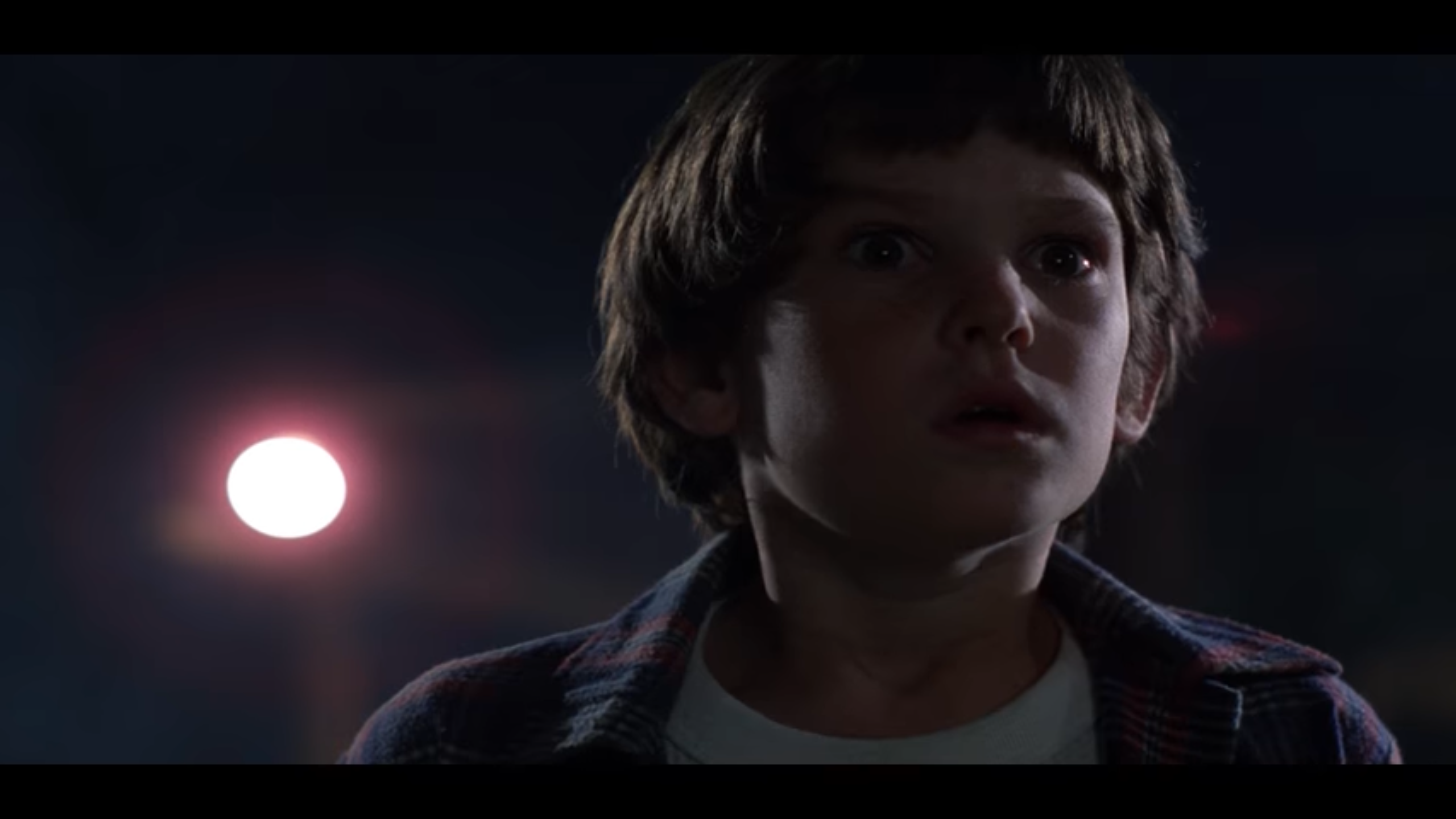
[9] As Elliott walks the pizza back into the house, he hears a sound coming from the backyard shed, which is lit up. He lobs a baseball into the shed and is shocked when someone throws it back. Elliott’s shock is on full display in a close-up shot. (Figure 1) This scene reads more as horror for kids than any other demographic. Elliott’s display of shock signals to kids (especially those who have felt a personal identification with him prior to this) that there is something frightening about the shed: “If this kid has reason to be scared, then so do I.”
Figure 1, Elliot’s display of shock can be seen as horror for kids
[10] When Elliott runs inside to warn his family about the tool shed, his mother, Michael, and Michael’s friends go investigate. They find nothing out of the ordinary and speculate that the unknown entity in the shed is a coyote. After they all go back in the house, E.T.’s heavy breathing is heard as his long alien fingers grab the side of the shed. Our initial identification with E.T. is briefly forgotten since we feel closer to Elliott at this point. As a small animal being hunted, E.T. gains our sympathy. But once he becomes unsettling to Elliott, he is a monster. Being an alien allows E.T. to shift roles. Elliot thinks he saw a monster but no one believes him, which is a relatable childhood experience. Elliott never saw E.T. as prey and so is afraid. Children in the audience would likely shift in how they perceive E.T. It is interesting to note that immediately following the shot of E.T.’s fingers is a shot that includes Elliott's dog, as if to suggest a future connection between aliens and pets.
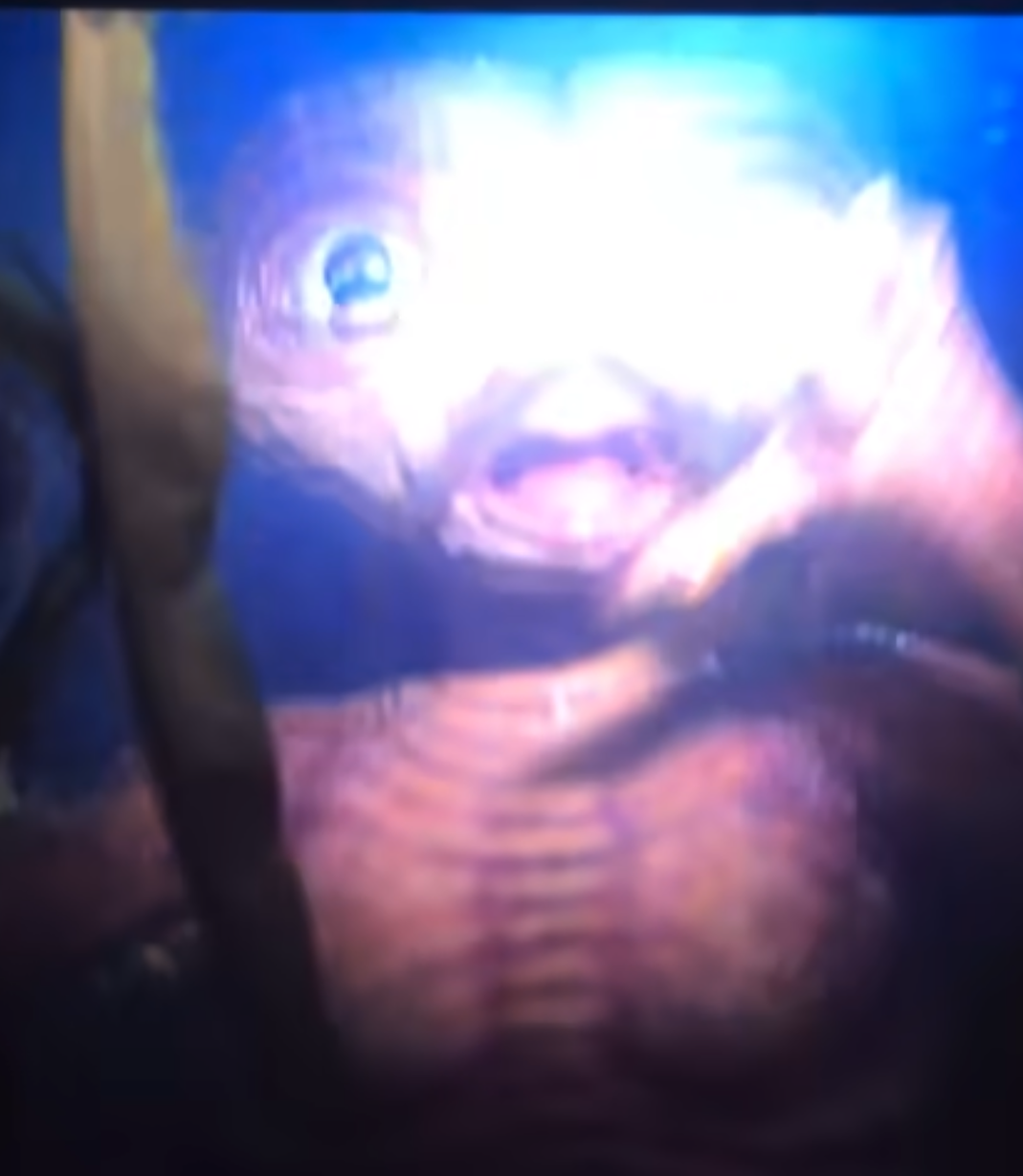
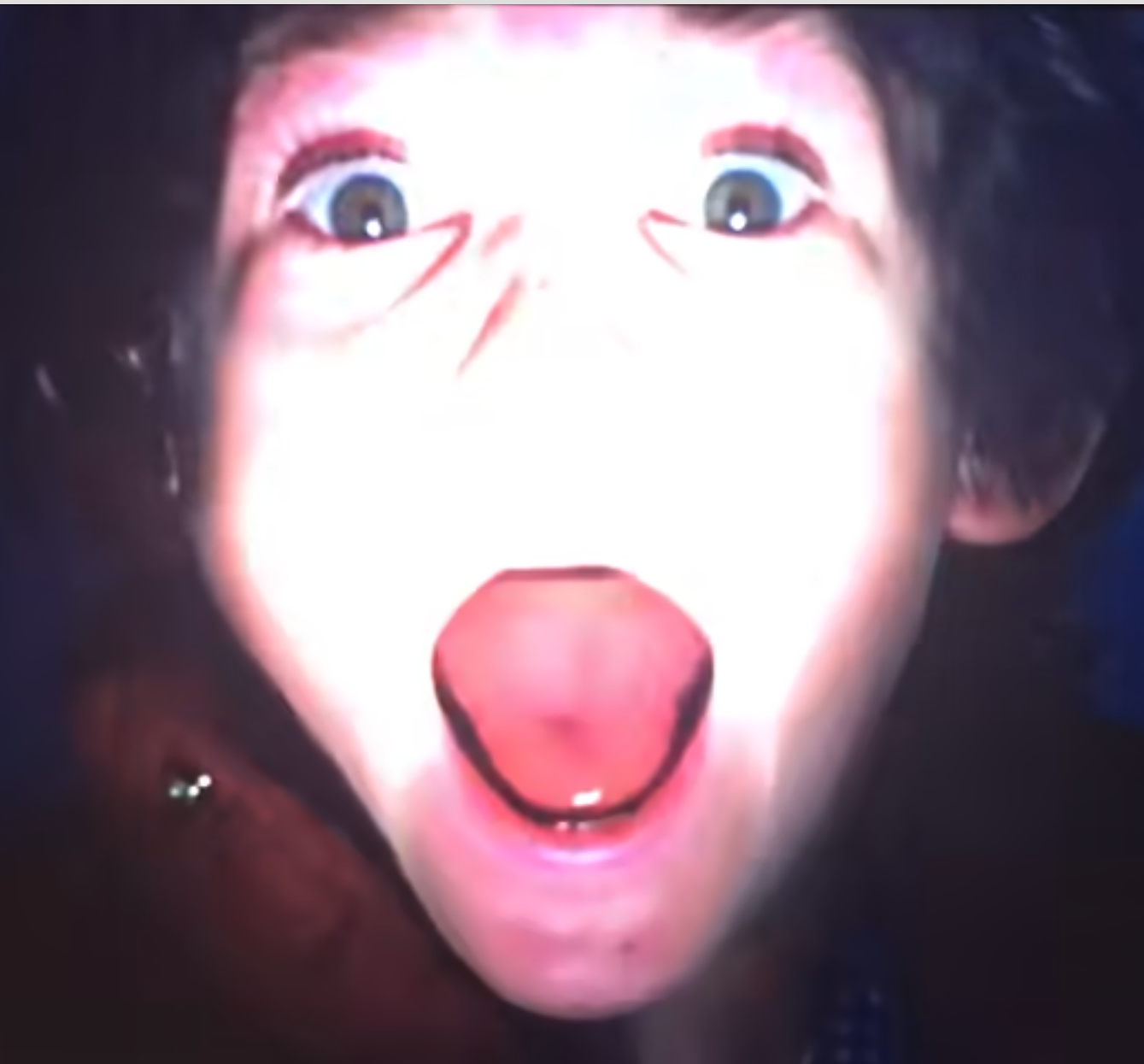
[11] Elliott embodies childlike wonder in the next scene when he decides to go out and look for the shed monster one more time that night. He sits awake in bed, distracted by the sounds he hears outside. There are alien tracks behind his house that lead him straight to E.T., who screams in fear, even before Elliott does. The two are shown screaming in reverse close-ups. (Figures 2 and 3) Elliott is actually mirroring E.T., since E.T. screams and runs away first. Elliot’s flashlight, reminiscent of Keys’ flashlight, is blinding him, and he runs away from Elliott. Both were too early for each other: E.T. was not ready to meet someone on the other end of a flashlight, fearing the worst, and Elliott was not ready to meet the source of his fear from earlier. Meanwhile, the children in the audience are likely mirroring Elliott as they too have just come face to face with the shed-monster.
Figures 2 & 3, E.T. and Elliot mirror each other’s terror at encountering each other
[12] Elliott and E.T.’s relationship at this point is like that of a child with an overactive imagination who claims to have seen a monster. His mother and brother do not believe him, but the monster is very real to him. Despite being scared of E.T., it is now Elliott’s goal to prove his existence. Elliott goes to the forest to leave a trail of Reese’s Pieces, hoping to lure E.T. back to his house. While there, Elliot hides from Keys, who is searching the forest up ahead. At this point in the film, Keys’ face has not been revealed. In his article, Morris presents a chart of binary oppositions that exist in E.T., and one of these is children vs. adults. (Morris 93). Keys remains a mysterious figure until the second half of the film, either shot from the waist down or from a far distance with his back turned to the camera. So far all adults are either on the hunt for E.T. or they don’t believe he exists. This theme of “adults just don’t understand” would be most relatable to children and adolescents. Also at this point the children in the audience have been given chances to identify with both E.T. and Elliott, and they have mirrored both of their reactions of shock and fright.
[13] Initially terrified of E.T., Elliott is the first human who takes steps towards showing kindness to him. At the dinner table, Elliott expresses that he would prefer the “goblin,” as Michael calls it, not be caught because “they’ll [the catchers] give it a lobotomy or do experiments on it.” He has an understanding of E.T.’s life that all the adults so far are missing. That night, Elliott waits out in his backyard to see if E.T. will come back. He starts to doze off as E.T. approaches. This is the last time E.T. is too early for Elliott–that is, a figure of horror. As E.T. sporadically stops and moves closer, making strange sounds, the music becomes menacing. His features hidden, he is just the silhouette of the monster Elliott encountered that night with a flashlight. The audience shares Elliott’s shock as he sits still, paralyzed with fear. Again, for most adults this may not be so horrific, but to a kid this scene is likely to produce the same fear that Elliott experiences. Elliott sitting in darkness is further reminiscent of a child watching the movie in a dark theater. Not only is their fear mirroring his at this point, but their surroundings are too.
[14] After being a hunter’s prey and a monster, E.T. now takes on the role of a child’s imaginary friend. For the first half of the film, only Elliott and his siblings believe in E.T.’s existence, first thinking of him as a monster before becoming friends. As Elliott lures E.T. into his bedroom with candy, the music becomes light and playful, similar to the tone of he opening scene. E.T. mimics Elliott as he scratches his nose and touches his mouth. The two have become comfortable with each other and E.T. is no longer a threat to Elliott. If children make it this far into the film without being too frightened, they will learn along with Elliott that E.T. is friendly. When E.T. is introduced to Michael and their younger sister Gertie, both experience the same initial shock Elliott did. The two siblings’ reactions mirror Elliott’s: Michael stands there and stares, awestruck, and Gertie screams. Believing E.T. exists serves as a test for Michael. If he denies Elliott “absolute power” then he won’t get to see E.T. and will be more in-line with the adults. But he grants his brother absolute power and thus positions himself on the child side of the childr-adult binary. Elliott explains to Gertie that she cannot tell their mother about E.T. because adults can’t see him. E.T. is now their collective imaginary friend that adults refuse to understand or believe in. E.T. also functions as a pet that Elliott brought home and is scared of being told he cannot keep. While adults may be able to relate this situation back to times from their childhood, a child watching E.T. would have a more intense experience feeling Elliott’s emotions, perhaps wishing they could have the imaginary friend/pet from space that he does.
[15] Scenes involving the three siblings and E.T. are often followed by a glimpse of Keys on the hunt. The first time this happens is immediately after Elliott befriends E.T.; the film cuts to Keys and his crew searching the forest, where he finds Reese's Pieces. These instances are there to serve as reminders of who Elliott should be scared of now. This exemplifies the E.T.-Keys binary that lasts until around the second half of the film (Morris 93). Children want to help E.T. phone home, while Keys wants to catch him in the name of science.
[16] The last major horror of the film is the government takeover of Elliott’s house. Both E.T. and Elliott are at this point deathly ill and lying on the bathroom floor. Since the two share each other’s feelings, they also share each other’s state of wellbeing. Michael calls their mother up to the bathroom because they can no longer keep their new pet a secret. Elliott speaks on behalf of both himself and his alien friend when he tells his mother, “We’re sick. I think we’re dying.” The mother, terrified to find out that the “goblin” from the shed is real, screams once she realizes that there is actually a monster (from her point of view) in her house. Unlike her children, she does not befriend E.T.; rather, she rushes her family out of the room. Meanwhile, the government agents, with their identities concealed by hazmat suits, storm the house. The music shifts to a menacing score like the ones heard when Keys is on screen. No matter which way the family goes, they are met with agents cornering them. The men enter from the front door, hallways, and even through the window in their hazmat suits, looking like astronauts. The astronauts are “too early,” providing no more chances for Elliott and his family to hide E.T. or abandon the situation that was bound to get the government involved. Although Elliott is too sick to be frightened, lying in his mother’s arms, children watching can feel his feelings for him– they are terrified that their alien pet will be captured for experiments. This scene is the last instance of the “too early” temporality: the horror temporality.
[17] Looking back at E.T.’s opening scene, while it is primarily operating in the mode of horror, it is also giving us our first glimpse of melodrama and the temporality of the “too late.” Similar to the “too early,” the “too late” temporality involves melodrama and the bodily feeling of excessive emotion (Williams 9). The audience shares the strong emotions, typically great sadness, of the protagonist as they learn that there is no more that can be done to solve their issues; they are grieved that they are “too late” to make things better. However, in E.T., strong joyful emotions follow the strong emotions of hopelessness. These emotions are also produced by the “too late” because had the “too late” not been resolved, these emotions would not exist.
[18] It is easier to remember that Elliott was abandoned by his father since there is dialogue to reaffirm it. Actually, E.T. was the first character the audience sees experience abandonment by their family, as he was left behind on Earth. The parallels between the two characters continue with their names: all of the letters in E.T. are in “(E)lliot(T)” and the two names sound similar. The opening scene is both “too early” and “too late,” since E.T. was not prepared to be hunted and also did not make it back to the ship in time.
[19] The next instance of too late happens once Elliott has gone missing. The night before, Elliott uses trick or treating as an excuse to take E.T. into the forest. There, E.T. can test out his invention to communicate with his home planet. The two of them stay out all night. While in the forest, Elliott has a moment of crisis. He sees E.T. focused on contacting his planet and realizes that if E.T. went home then this would mean losing him forever. At this point it is not too late to save E.T., and Elliott tries to convince him to stay: “You could be happy here. I could take care of you. I wouldn’t let anybody hurt you.” Elliott wakes up the next morning alone in the forest next to the communicator device. The film then cuts to his kitchen, where his mother is reporting him missing to a police officer. His mother and siblings experience the brief “too late” that is Elliott not coming home. Moments after this conversation with the officer, Elliott is revealed to have been standing out of view behind a refrigerator door. While we see Elliot’s mother’s relief and joy upon seeing her son, it is Elliott’s worry that children in the audience share. They knew that Elliot was okay– they just saw him wake up in the forest. But E.T. is still missing.
[20] Elliott’s first words to Michael once reunited are “Is he here?” Ideally, if children in the audience share Elliott’s feelings, then they are concerned about the whereabouts and condition of E.T. just as much as Elliott is. Michael goes searching for E.T. and finds him by a sewer drain. He now has a chalky white, sickly appearance. Although Elliott is not there when his missing alien pet is found, children in the audience can feel his feelings for him. They feel the uneasiness Elliott would have felt if he was present.
[21] Elliott and E.T.’s emotional connection is put into words by Michael. After their house has been commandeered by the government, Elliott and E.T. lie side by side on makeshift hospital beds. Scientists and doctors are asking the family questions. One doctor, trying to understand the unique link between Elliott and E.T., clarifies “Elliott thinks its thoughts.” Michael corrects him: “No, Elliott feels his feelings.” Their exchange is a perfect summation of the children-adults binary. Children, like Michael, refer to E.T. as a “he,” treating him like a person, whereas the adult scientist calls E.T. “it,” showing a lack of empathy for him as a living individual. One kid’s friend is another scientist’s experiment, it would seem.
[22] Prior to the government takeover and his house being enveloped in a plastic bubble to contain the hazard that E.T. represents, Michael expressed concern to Elliott over E.T. looking sick. Elliott insists that “we’re fine” when the topic is brought up. Again, Elliott speaks for the both of them, even when just talking about one of them. It is another attempt of Elliott’s to stall the temporality of the “too late.” By denying any illness, he is ignoring the problem altogether.
[23] Keys’s face is finally revealed to the audience shortly before Elliott and E.T. receive medical help. He suits up in a hazmat suit with a large clear visor allowing his face to be seen for the first time. While a face makes him less sinister, Keys is still dressed like the other scientists. For this reason he remains aligned with the science side of another of Morris’ binaries: fantasy-science (93). Keys asks Elliott what the machine (the communicator) in the forest is doing, to which Elliott replies: “I really shouldn’t tell. He came to me.” Even in his weakened state, Elliott will not volunteer information that could jeopardize E.T.’s return home.
[24] In a situation that looks too late, science and adults clearly have control. But this does not stop Elliott’s childlike wonder from allowing him to cling to fantasy. It is safe to say that the kids watching would side with Elliott, giving all their hope to E.T. escaping from the man formerly hunting him. However, Keys reveals that he does not want E.T. to die, and only then does Elliott tell him E.T. is calling his planet to come get him. Keys says he’s been waiting for this moment since he was ten years old, and he thinks E.T. coming to Earth is a miracle. Keys reveals his inner child, and for the first time an adult shows compassion for E.T. By relating to Elliott, Keys up-ends the E.T.-Keys binary, and ushers in another of Morris’s binaries, Keys vs ”authorities” (93). Keys praises Elliott for taking care of E.T.: “You did the best that anybody could do. I’m glad E.T. met you first.” The next shot shows that Keys was holding Elliott’s hand throughout the scene. These words coming from Keys are like Elliott receiving fatherly praise. What Keys is really telling Elliott is that not all adults want to use E.T. for science, as Elliot feared. After relating to Elliot, Keys moves onto the fantasy side of the fantasy-science binary. Similarly, Keys comes to represent the adults watching the film who were made to feel like kids again through feeling Elliott’s feelings.
[25] I would argue the highest point of melodrama in the film is E.T.’s death and resurrection. Before explaining this scene’s relevance to mirroring Elliott’s emotions, it is important to note an earlier instance of the fantasy-science binary which precedes E.T.’s resurrection. In this scene, Gertie’s mother is reading her Peter Pan in bed. As she reads, Elliott and E.T. watch from the inside of the closet. Elliott cuts himself on a buzzsaw blade he gathered along with other parts to help E.T. make his communicator and E.T. extends his glowing finger to the wound. As if he, too, is affected by the cut, E.T. says “ouch” as he touches his finger to Elliott’s. Heard in the background is the mother reading a part about Tinkerbell. Right after Elliott’s finger is magically healed, his mother reads that Tinkerbell “thinks she can get well again if children believe in fairies.” She asks Gertie if she believes in fairies,and asks her to clap her hands to prove her belief. Gertie replies “I do!” Children in the audience are mirroring Elliott’s actions: they are watching him through the screen as he watches his sister from the closet. When the mother says to clap your hands if you believe in fairies, it is as if she is addressing children beyond the screen, testing their belief in E.T. As if Elliott needed any more reason to believe in E.T., he is firmly rooted in the fantasy-camp after this experience: he believes, and E.T. heals his injured finger. Similarly, kids can believe in E.T. as much as Elliott does and as much as any other fairy tale.
[26] E.T.’s death is the only time Elliott truly experiences the sensation of “too late.” E.T. lies in bed being attended to by doctors. The uplifting score toys with our emotions because of the tragedy about to take place. Michael is shown falling asleep in E.T.’s makeshift bed in the closet with a flower pot to his side. Earlier, E.T. magically made these flowers grow. However, the film cuts to morning and the flowers are dying. The soundtrack changes in a matter of seconds to become depressing. We then watch Elliott cry as the paramedics fail to save E.T.’s life. Keys requests everyone leave the room so that Elliott can have some time to say goodbye. Elliott pays his respects to his friend by staring through the glass window on E.T.’s metal coffin. This is reminiscent of the classic melodrama Stella Dallas (1937) where Stella watches her daughter get married from afar through an apartment window. Like Stella, Elliott is separated from the person he loves by glass, allowing him to observe but not interact with what is on the other side. He tells E.T.’s body: “You must be dead, because I don’t know how to feel. I can’t feel anything anymore.” He looks through the glass, mirroring the audience who is watching these events unfold through the screen, and sheds a tear. Processing grief is not easy, especially for children in the audience. Elliott’s utter sadness is like that of children who have just experienced watching a beloved pet die. The death of E.T. has proven to be the ultimate “too late.” If a dog is man’s best friend, then an alien was Elliott’s best friend– and vicariously the audience’s too. As Elliott is leaving the room, the flowers in the flowerpot (which Michael has brought to the makeshift hospital room) suddenly come back to life. Upon seeing this, Elliot rushes back to E.T.’s coffin and pries it open to see E.T.’s glowing red chest. He unzips the body bag and E.T. excitedly says: “E.T. phone home!” Kids have just experienced Elliott’s loss and can just as quickly rejoice with him. Like Tinkerbell was healed through Gertie’s belief, E.T. was seemingly brought back to life through the audience’s belief in him. This scene exemplifies the film’s ability to produce melodramatic bodily sensations of happiness just as effectively as it can sadness, and in both cases, these scenarios are likely to provoke tears in the audience. Moreover, we see fantasy triumphing over science, giving children the metaphorical victory over adults in the film's universe.
[27] E.T.’s revival is followed by a chase to the forest. Elliott evades the government agents to deliver E.T. to the forest, with the prior scene’s joy giving the audience a new, optimistic outlook. If E.T. could come back to life through the power of belief, then there should be nothing stopping him now. Elliot and Michael steal the truck containing E.T. and stop at a park to meet up with Michael’s friends, who will provide backup on their escort mission. When Michael’s friends first meet E.T., they find him standing in the back of the truck, red chest glowing, surrounded by mist. He evokes imagery of Jesus Christ, someone else who came back from the dead. Elliott explains the mission. One friend asks why E.T. cannot “just beam up” to his ship. Elliott replies, “This is reality, Greg.” “Beaming up” is from Star Trek, which is just a story, but Elliott’s fantasy has now become reality and his response makes perfect sense to an audience who has experienced everything alongside Elliott.
[28] To evade the police, E.T. uses his powers to make the group escorting him fly. The first time he made Elliott fly, it was at night with the moon illuminating their silhouettes. This time, it is with the sunset backlighting the kids. Following Morris, I propose my own binary opposition that relates directly to body genres: the moon-sun binary. The moon is surrounded by the darkness of night, and is shown while there is still uncertainty surrounding E.T.’s mission of going home. Here the moon is representative of horror bodily sensations. The sun represents melodramatic bodily sensations. It comes at the end as Elliott quite literally rides off into the sunset. After that image is presented on screen, there is no doubt in the audience’s mind that E.T. will succeed.
[29] Once in the forest, children mirror Elliott one last time during his bittersweet goodbye. Elliott tears up as he stands across from E.T. Using the words he learned, E.T. points to his chest and says “ouch,” which Elliott mirrors back. This is another instance of a triple mirroring that extends beyond the fourth wall. Elliott mirrors E.T.’s heartbreak, which is also mirroring the audience’s heartbreak. E.T. points to Elliott’s head and says, “I will be right there.” This mirrors what Elliott had said to him while lying next to him in the hospital beds. Feeling Elliott’s emotions throughout the horror and heartbreak has made this an equally emotional goodbye. As Ilsa Bick points out in her article, “The Look Back in E.T.,” just as E.T. returns to his family on the “mother” ship, Elliott returns to his mother and family (Bick 26). Likewise, the children watching this, presumably in a dark theater or room, are like Elliott in the dark forest. Just as Elliott and E.T. return to their families, kids will likely return to theirs as the film ends and the lights turn back on. If children relate to Elliott by experiencing the narrative with him, then they are also saying goodbye to E.T. themselves.
[30] What makes E.T. a body genre film for kids is its combination of horror and melodramatic bodily sensations. Kids watching become Elliott through experiencing his terror, loss, and friendship. Since Elliott feels E.T.’s emotions as well, kids also become E.T. by the same association. Just as E.T. was kept alive in the film-world by Elliott’s belief in him, children’s belief in him seemingly guides the film to its happy ending. E.T. is a family film that allows two bodily sensations to carry it through its most memorable moments. Although kids may find the film too scary or overpoweringly emotional, the fact that both sensations are present allows E.T. to be a film that provides more to enjoy than a single traditional body genre film could. Conversely, some children may find these sensations too stimulating. Especially due to the scary scenes, the film may become a feat to conquer. If children are not able to watch the whole film in the present, they can try watching it again when they are older. While this is a body genre film for kids, this does not mean adults cannot identify with Elliott and his emotions. While the identification with Elliott is closer for children, adults watching may feel the same connection. In this way E.T. brings out the child in everyone.
Acland, Charles R. 2013. “Senses of Success and the Rise of the Blockbuster.” Film History, vol. 25, no. 1-2, pp. 11–18. JSTOR, www.jstor.org/stable/10.2979/filmhistory.25.1-2.11. Accessed 11 December 2020.
Bick, Ilsa J. 1992. “The Look Back in ‘E.T.".” Cinema Journal, vol. 31, no. 4, pp. 25–41. JSTOR, www.jstor.org/stable/1225169. Accessed 11 December 2020.
“E-T the Extra Terrestrial Original Trailer 1982.” 2011. YouTube, uploaded by Nineteen Eighties, https://www.youtube.com/watch?v=_7-2PB4jj2o.
Morris, Nigel. 2007. “E.T. The Extra-Terrestrial: Turn on Your Love Light.” The Cinema of Steven Spielberg: Empire of Light. New York: Columbia University Press, pp. 84–94. JSTOR, www.jstor.org/stable/10.7312/morr476489.11. Accessed 11 December 2020.
Williams, Linda. 1991. “Film Bodies: Gender, Genre, and Excess.” Film Quarterly, vol. 44, no. 4, pp. 2-13.