
[0.1] Abstract - Despite its reputation as a feminist comedy, Miss Congeniality (2000) is an unhealthy portrayal of male/female relationships and further perpetuates the unhealthy ideals of femininity and masculinity through the male gaze.
[0.2] Keywords - feminism, male gaze, romcom, chick flick, makeover movie, spectatorship, audience studies, feminist film theory
[0.3] Trailer
Panzak, Mia. 2024. “Representations of Gender and Power Dynamics in Miss Congeniality,” Muhlenberg Visions. Volume 1, No 1.
[1.1] Miss Congeniality (2000, directed by Donald Petrie) perpetuates stereotypes of masculinity and femininity and normalizes misogyny. Gracie’s transition from an aggressive FBI agent into a polished pageant contestant is disjointed and imperfect. She struggles to express herself as fully “masculine” or fully “feminine” because she is forced to define herself through the expectations constructed by the male gaze. Her physical strength is treated as insignificant compared to her potential for attaining ultimate beauty as a pageant contestant. Gracie attempts to defy gender expectations but falls prey to the desires of her male coworkers. Her defiance is performative because she has already relinquished her control to the patriarchy. In order to qualify as a legitimate pageant contestant, she must undergo a complete makeover in which she emerges as the epitome of male desire. Throughout the film, the men act as her puppeteers. She is surveyed and controlled as a device for male pleasure, serving as an example of desirability. Miss Congeniality is an unhealthy portrayal of male/female relationships and further perpetuates the unhealthy ideals of femininity and masculinity through the male gaze.
[2.1] In film, the purpose of a woman’s body is to please the male viewer. Women in film are often objectified through the male gaze and have little power in reclaiming their bodies onscreen because they are given little bodily autonomy. In her essay “Visual Pleasure and Narrative Cinema,” Laura Mulvey explains that this gendered gaze is grounded in psychoanalytic theory: “Women in representation can signify castration, and activate voyeuristic or fetishistic mechanisms to circumvent this threat” (Mulvey 25). This psychoanalysis suggests that men view women as people who lack the qualifications of manhood. Men fear this castration, this “lack,” and confront this threat by objectifying the woman’s body onscreen. Mulvey argues that these gendered structures have shaped pleasure for men and taken control from women. Pleasure is exclusively reserved for male audiences because they are the dominant power.
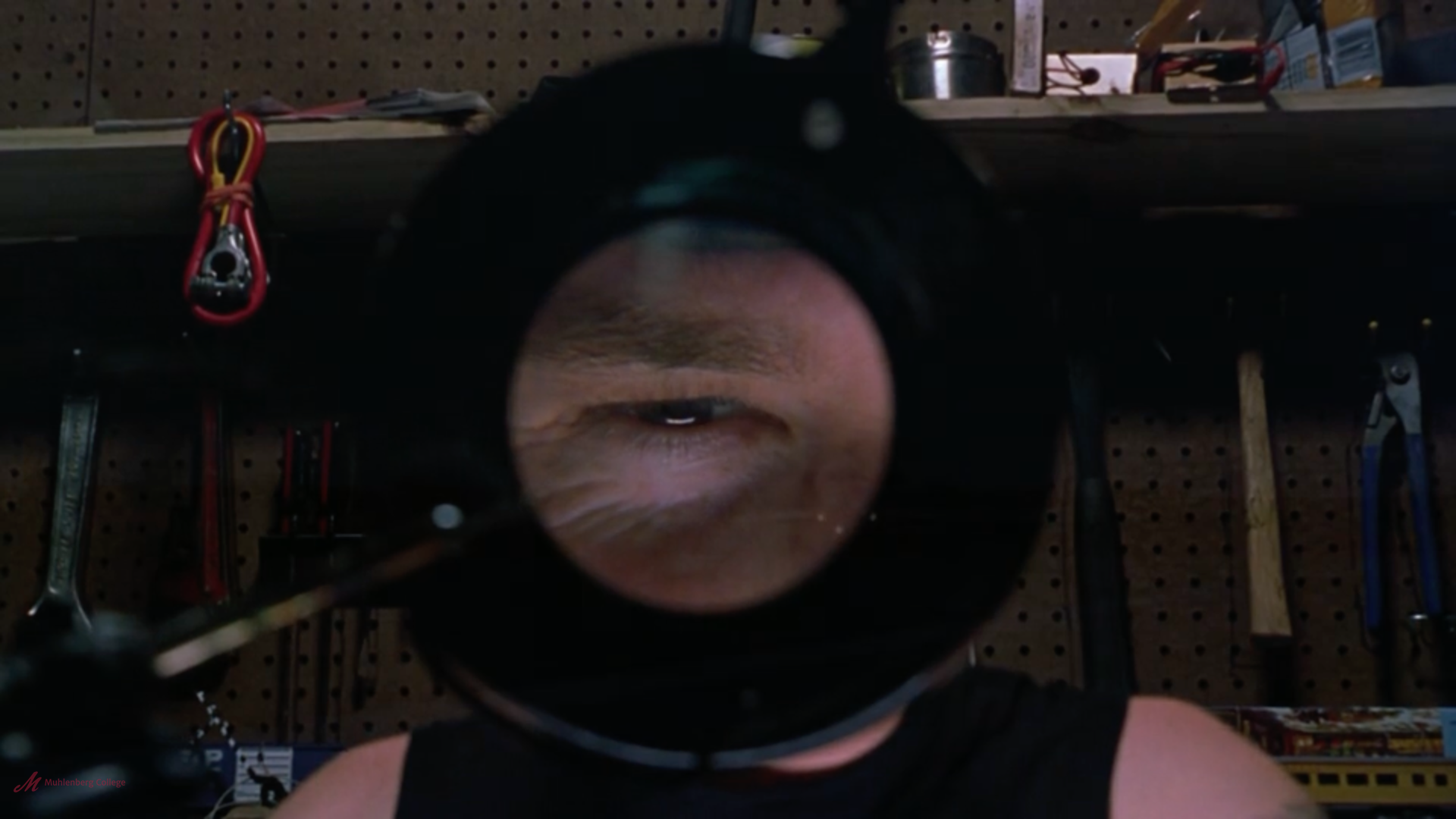
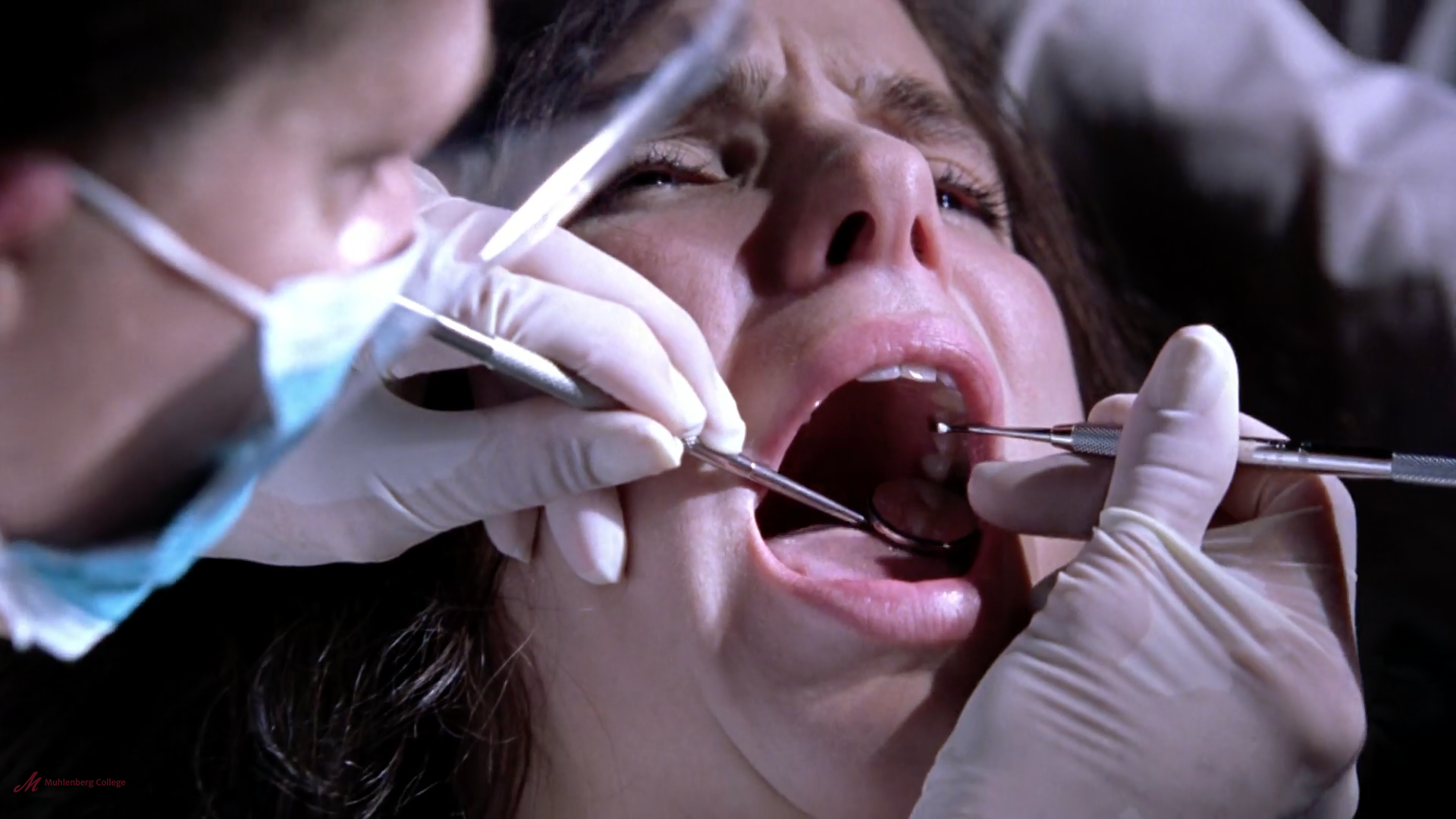
[2.2] In Miss Congeniality, Gracie must endure a complete makeover, led by pageant wash-up Victor Melling, before she is considered an acceptable contestant. She must have the “beer stains and steak residue” removed from her teeth, a thorough hair brushing, and her body fully waxed of hair. (Figures 1 and 2) When she finally reveals herself, she has changed out of her agent clothes and now struts down the runway like a model. Gracie exemplifies the ultimate body of male pleasure, her physical pain deliberately inflicted to reach her full beauty potential. It does not matter that she is in pain. She acts only as an object to be manipulated. In a backhanded compliment, agent Eric Matthews praises Victor: “You also said you couldn’t make her beautiful in two days and look at her now. Look at how gorgeous she is, I mean, compared to the car wreck she was before.” He determines Gracie’s beauty, in accordance with his own desires. Gracie only becomes a site of pleasure and desirability once she fulfills the demands of the male gaze.
Figures 1 and 2, Makeover as torture in Miss Congeniality
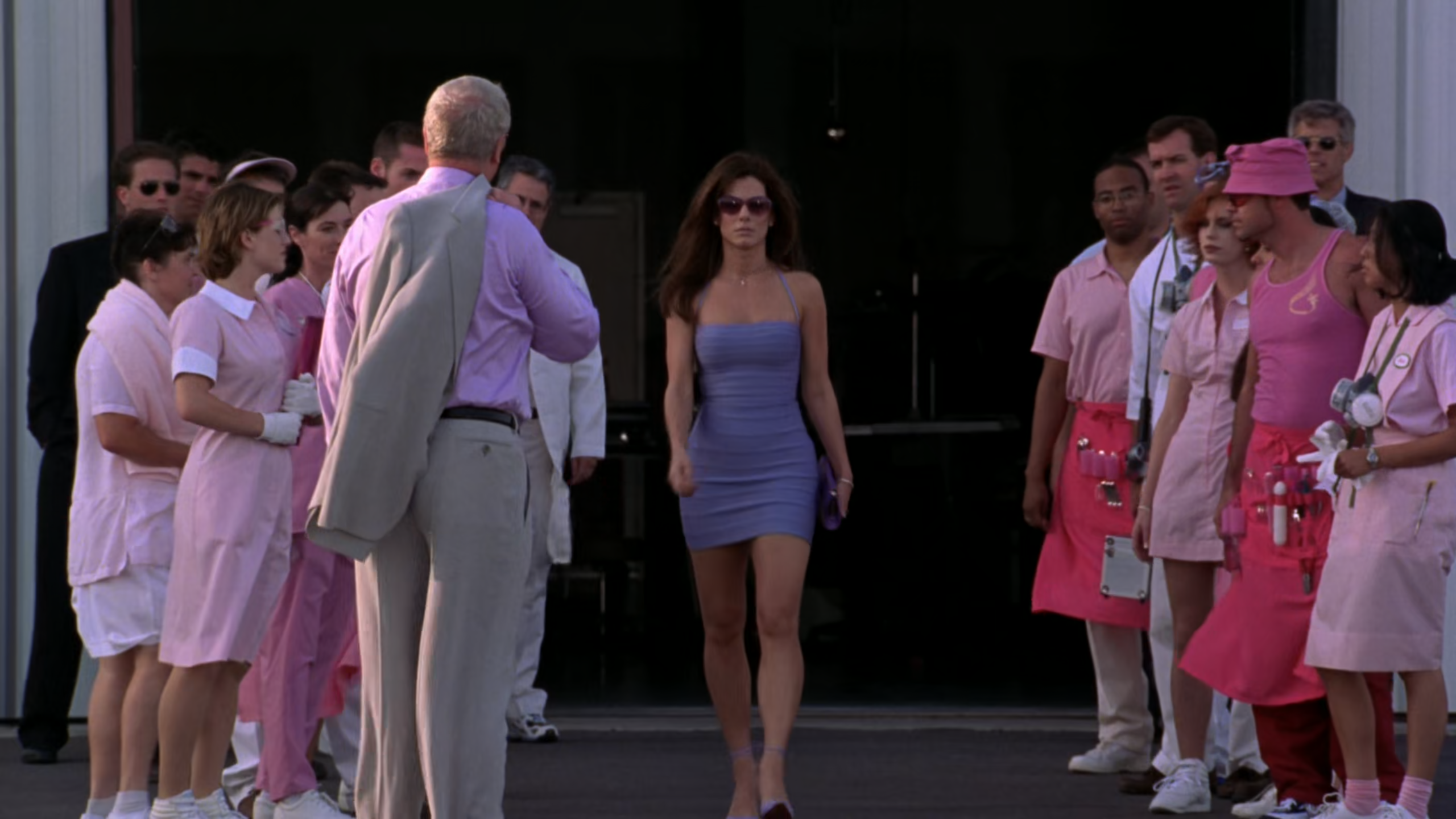
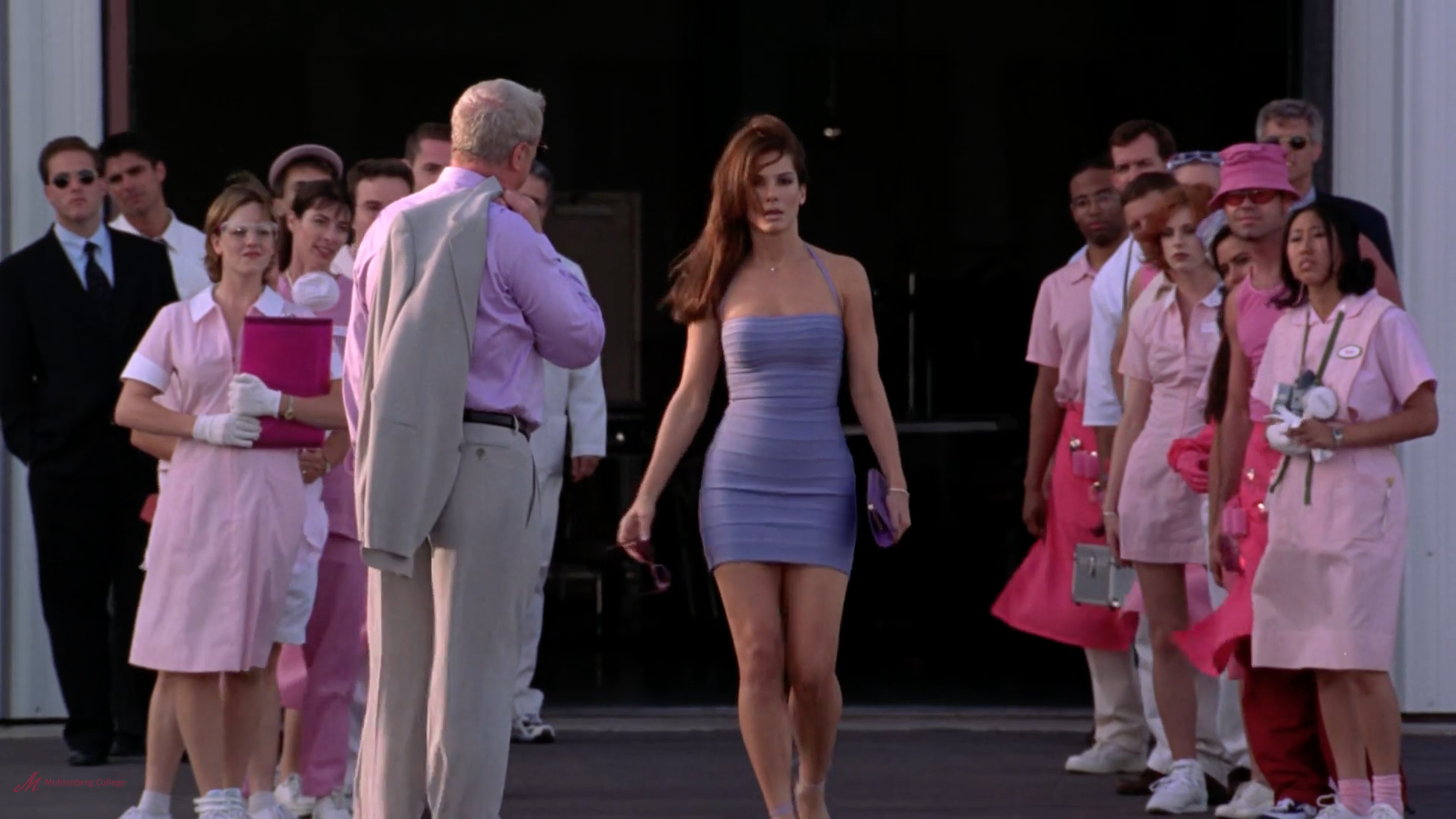
[3.1] After Gracie’s makeover, she is revealed to the audience and to her male coworkers through a dramatic unveiling. She struts down the “runway,” hidden at first by the men and women that transformed her. They part as she walks in slow motion to the song “Mustang Sally” by The Commitments. Gracie is dressed in a tight dress, her hair has been untangled, and she is visibly wearing makeup. This new look, juxtaposed with her FBI agent look, is startling to her coworkers. As Gracie is walking, she takes her sunglasses off and flips her hair. This moment should not go unnoticed. (Figures 3 and 4) Taking off her glasses is representative of a physical and symbolic transformation to spectacle.
Figures 3 and 4, As Gracie struts down the runway, she flips off her sunglasses
[3.2] In “Cinema and the Masquerade,” Mary Ann Doane explains moments like this one: “The woman with glasses signifies simultaneously intellectuality and undesirability; but the moment she removes her glasses (a moment, which, it seems, must always be shown and which is itself linked with a certain sensual quality), she is transformed into spectacle, the very picture of desire” (Doane 82-83). In Miss Congeniality, Gracie uses both prescription glasses and sunglasses. In this scene, she uses the sunglasses to further emphasize her transformation into spectacle. Taking the sunglasses off, as opposed to leaving them on or putting them on, is deliberate in both the literal and symbolic sense. Shirley Welton explains, in “Nobody’s Perfect: Queer Gender Performance in Some Like it Hot and Miss Congeniality,” that “Gracie is revealed behind a team of specialists as she walks out the warehouse; as she walks, she takes off her glasses, signifying her status as a feminine woman and an object of the male gaze” (Welton 22). With the sunglasses on, the audience can not see Gracie’s face clearly. However, when she takes her sunglasses off, the audience sees her in full view. Gracie’s new appearance is now less threatening to her male coworkers than her masculine, unkempt appearance from before her makeover.
[4.1] Tania Modleski writes in “On the Existence of Women: A Brief History of Relations Between Women’s Studies and Film Studies, “ that “[B]ecause the sight of women's genitals is so traumatic to men, women in cinema are fetishized-glamorized and made into two-dimensional icons, cut up into body parts (legs, breasts, etc…)” (Modleski 19). She argues that, for men, women are body parts with no significance or substance.
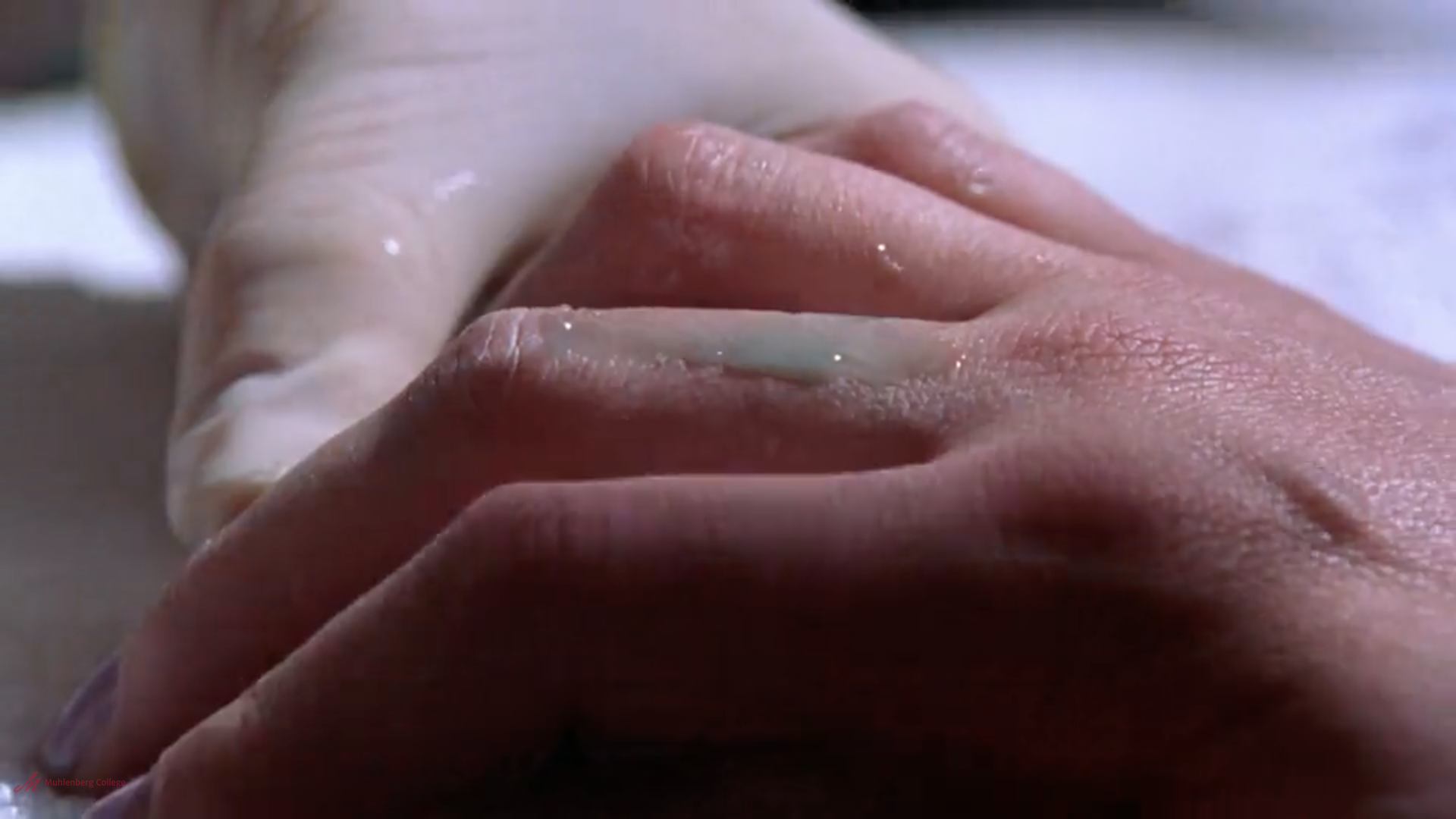
[4.2] In the makeover montage, Gracie’s body is broken up into “parts” as she is manicured by hair stylists and makeup artists. (Figures 5 and 6) The scene is led by the male gaze, showing women what they ought to do to become a site of pleasure. Gracie's hands, legs and face represent fragments of an altered whole. As a female pageant contestant, Gracie’s body is designed to be desired. At first, Gracie expresses her refusal to be in the pageant, “I’m not gonna parade around in a swimsuit like some airhead bimbo that goes by the name of what? Gracie Lou Freebush, and all she wants is world peace?” Even once she agrees to take the job, she continues to voice her criticism: “It’s like feminism never even happened, you know? I think any woman to do this is catering to some misogynistic Neanderthal mentality.” We identify with her ignorance, as feminists, while simultaneously asserting our own sexist opinions about women who participate in pageants. The original intention and design of pageants was intended to judge women based solely on their appearance. They were created by men to judge women, this structural practice ingrained in its existence. Since Gracie ultimately agrees to participate in this mission despite her initial resistance, she becomes a two-dimensional icon of pleasure and subjects herself to the objectification of her male coworkers.
Figures 5 and 6, Gracie’s body is broken up into parts
[4.3] As she is undergoing her makeover, agent Matthews introduces the pin camera. It is a microscopic camera disguised as an American flag pin which Gracie must wear at all times.
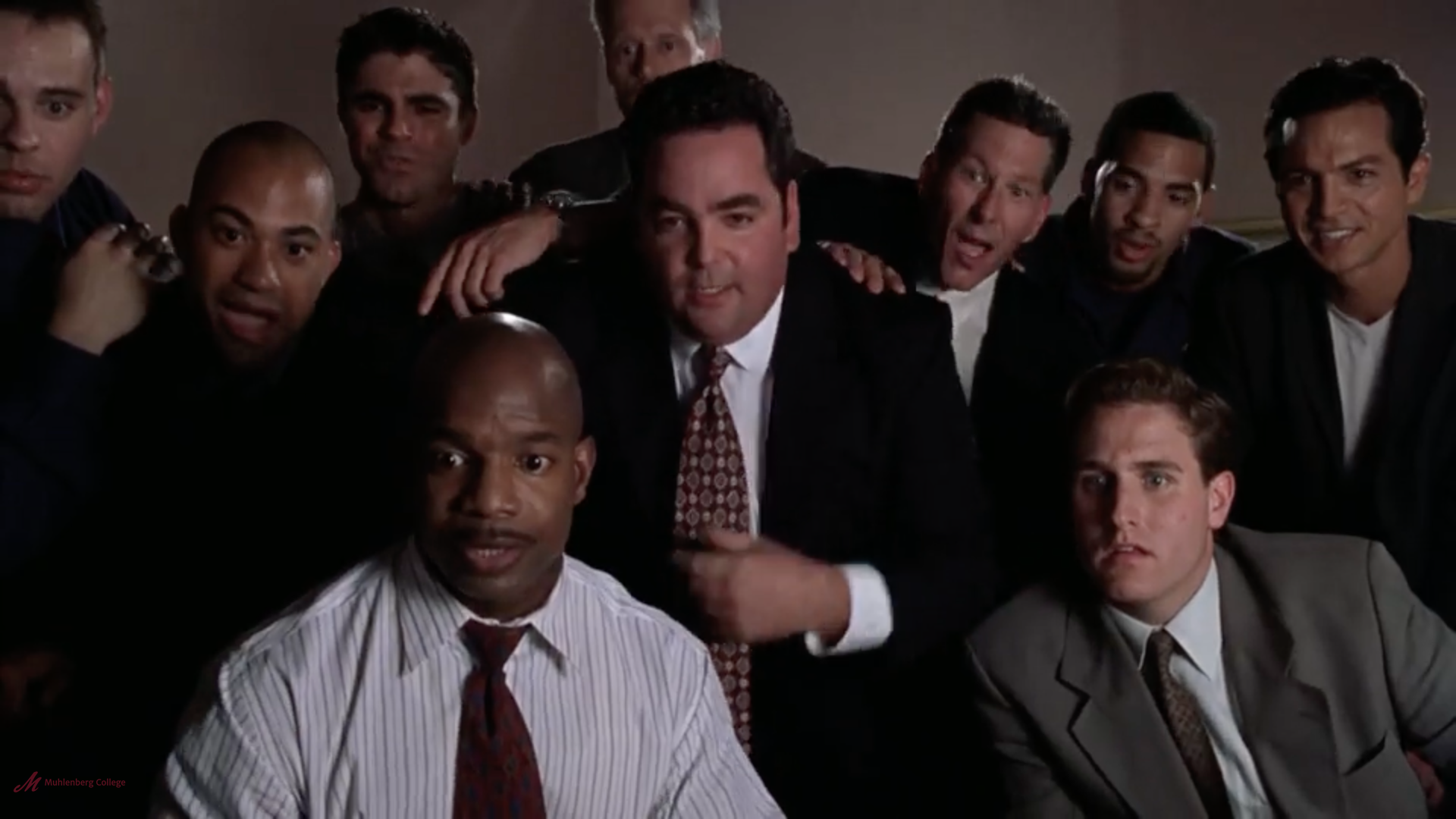
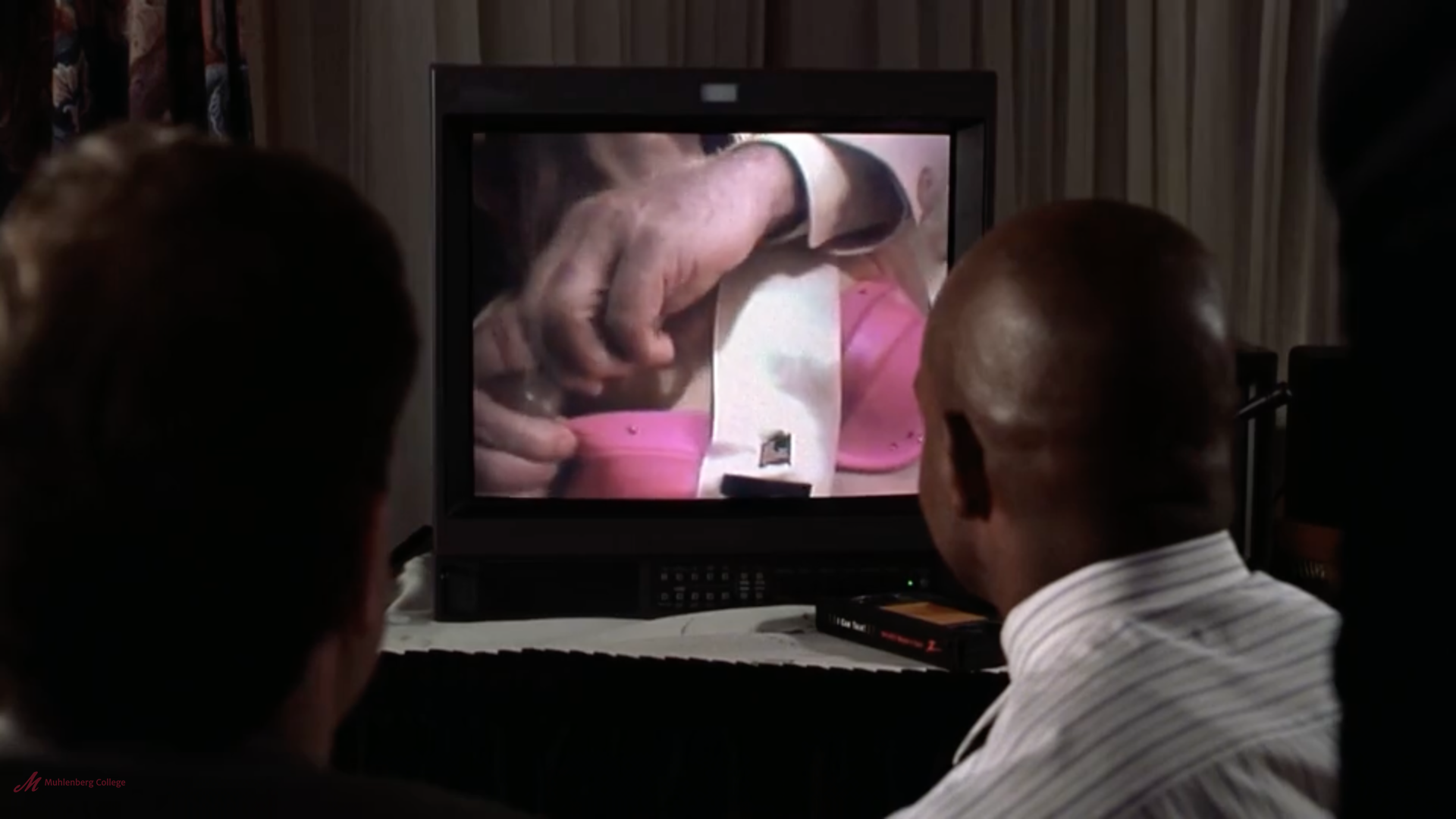
The camera connects back to a hotel room where the other male agents will be watching. The first time Gracie walks into the banquet hall of the pageant, the agents make suggestive remarks like, “Oh, I love my job,” “It’s not a bad view, huh?” and “Look at all the hoochie mama.” Throughout the film, they make commentary on the women they see through the pin camera. In the hotel room, the agents gather around the monitor as they watch Victor put push-up gels into Gracie’s bikini top (Figures 7 and 8). Gracie does not explicitly agree to being watched because her consent is assumed. She is expected to want to be desired and objectified by her male coworkers, which would be considered an accomplishment. The line is only crossed once agent Matthews becomes intimately involved with Gracie. He allows the men to gaze upon Gracie, but only at his discretion. The main reason he wants to show Gracie off now is because she is the epitome of male desire. The male agents are not reprimanded for spying on Gracie because it is their job. Their behavior is acceptable because they have created a situation that favors their desires and excuses themselves from feeling guilty about their voyeurism.
Figures 7 and 8, FBI agents spy on Gracie through a microscopic camera
[5.1] White male bodies are privileged onscreen as symbols of power. Their bodies are often seen more than their non-white counterparts because of their positioning as “dominant” figures in society. In film, the white male is the subject whereas the females are the objects. The white men choose where to guide and engage the viewer throughout the film. Frank Tobin is the son of Kathy Morningside, the director of the Miss USA pageant. He creates the bomb that will be set off at the final ceremony. Victor Melling used to work as a pageant trainer but has been ostracized by the pageant world because of a failure from years back. In Miss Congeniality, both Frank and Victor “do not have” bodies themselves because they are gazers (Figures 9 and 10).
Figures 9 and 10, The males, gazing
[5.2] Frank creates a bomb that will completely obliterate the pageant contestants, his hostility intended to bring the women harm. Under Victor’s direction, Gracie’s entire persona is completely redefined. She is transformed into an unrecognizable, awkward version of herself. Victor appears to be helping Gracie rather than hindering her growth, but despite his intentions, his actions are still sexist.
[5.3] Agent Matthews attempts to disrupt this privilege as a non-white man but is unsuccessful. He is simultaneously a subject and an object. (Figure 11) As a male, he has power over women as an objectifier but his racial privilege is non-existent. Frank and Victor claim their power through judgment and objectification of women without showing their body. Their privilege comes from both their gender (male) and race (whiteness). They are directors of the male gaze and manipulators of the female body.
Figure 11, Agent Matthews
[6.1] Shirley Welton considers the fluidity of gender and sexuality in Miss Congeniality, explaining that: “Gracie makes a vital mistake, which causes her colleague to get shot; as a punitive assignment, Gracie is later forced to go undercover at the pageant, entering as Miss New Jersey in order to regain respect at work” (Welton 19). The relationship between Gracie and her coworkers is transactional, she is actively working to gain approval and reputability as a woman in the agency. She must take additional steps to prove herself to the male agents because her femininity works against her. Welton references Judith Butler’s “styles of the flesh”: “This is because there is no natural gender; rather all gender is simply sets of speech acts, bodily gestures, and ‘styles of the flesh,’ which are always already performative” (Welton 20).
[6.2] However, the social construction of gender only exists through the perpetuation of these acts or gestures which further maintain the male/female binary. Miss Congeniality argues that there is a “natural gender” which men and women must conform to through gendered behavior. Welton continues, “Due to [her] tomboy identity, Gracie is considered an oddity, on the outside of the gender binary that serves to define social actors. She is then given a makeover in order to make her fit into this binary, but this makeover nevertheless makes a queer reading of the film possible” (Welton 21). Welton is arguing that Gracie’s participation as a pageant contestant is unnatural because she is a tomboy masquerading as a female, which makes a queer identification with the character possible. (Figure 12) Still, the film presents Gracie’s masculine qualities as disqualifying her from being a “real” or natural female.
Figure 12, Gracie struggles to correctly perform gender
[7.1] In Love and Microphones: Romantic Comedy Heroines as Public Speakers, Eleanor Hersey analyzes the final public speeches in four Hollywood blockbusters. Hersey references Steve Neale and Frank Krutnik’s text Popular Film and Television Comedy, explaining that, “Although their tone indicates an appreciation for these films, they conclude that the woman usually converts to the values of the man, so that the final union signifies ‘an acceptance of the authority of the male and a rejection of the woman’s economic independence’” (Hersey 150). Hersey attempts to disprove their analysis in her exploration of Never Been Kissed (1999), The Princess Diaries (2001), Legally Blonde (2001) and Miss Congeniality (2000). Hersey argues,
[7.2] “Because these films are popular comedies with beautiful actresses and bouncy soundtracks, it might be difficult to see their progressive elements. However, my experience watching Legally Blonde for inspiration before enduring my MLA job interviews suggests that Josie, Gracie, Mia, and Elle are good role models for women in the twenty-first century” (Hersey 158).
However, I think Neale and Krutnik’s analysis more accurately describes the formulaic and targeted structure of the romantic comedy than Hersey’s.
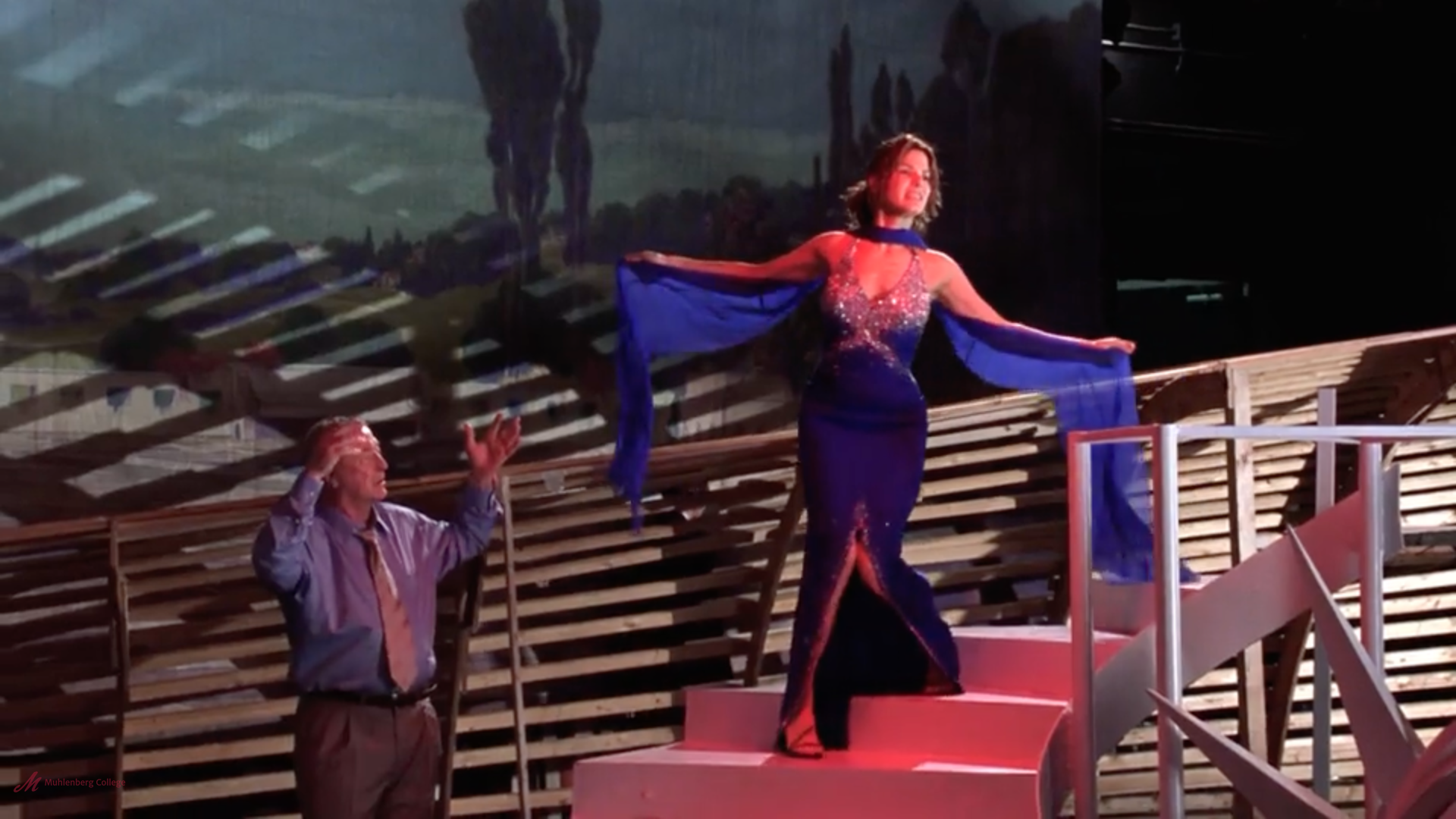
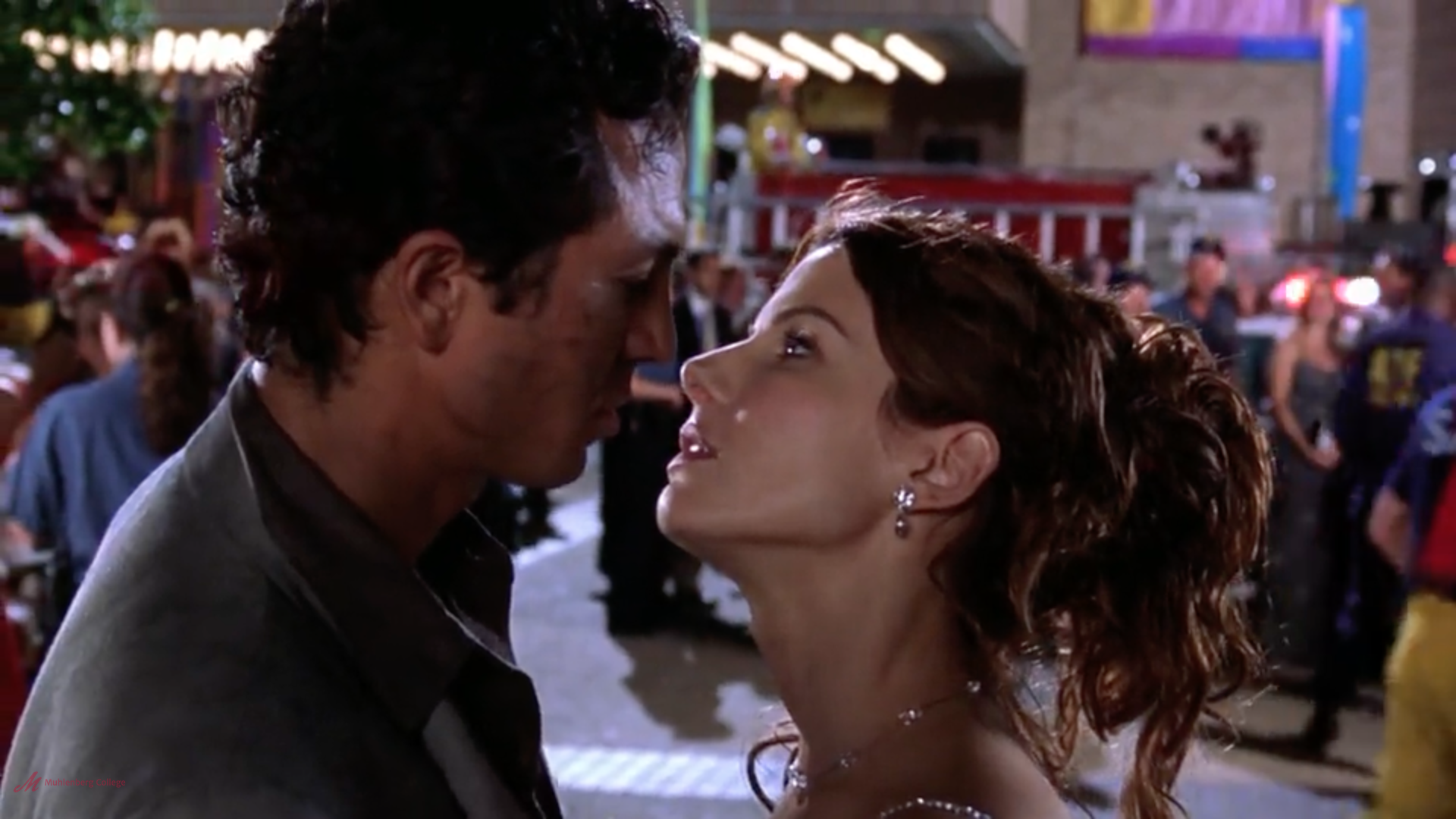
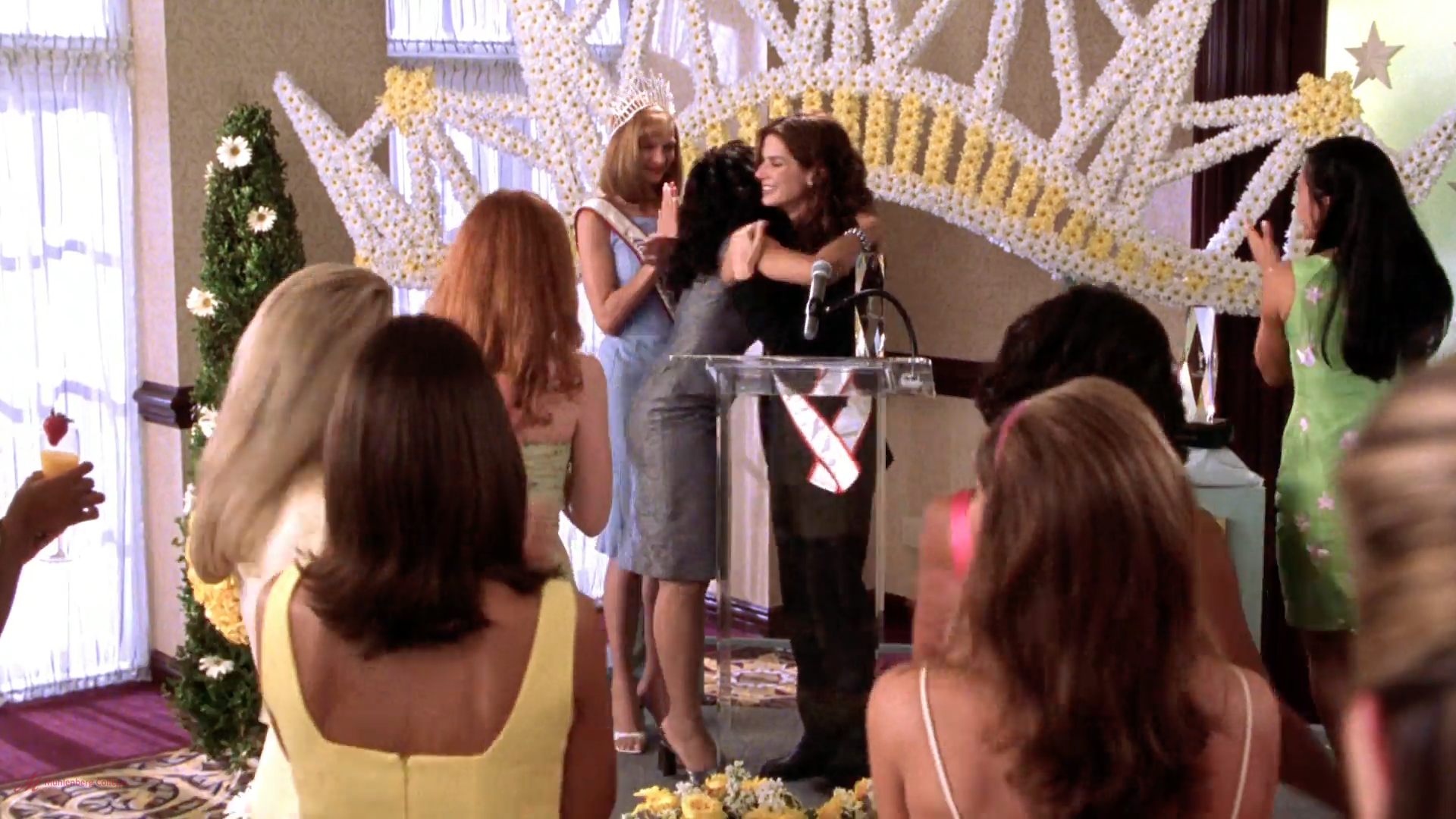
[7.3] At the end of Miss Congeniality, Gracie and agent Matthews finally give in to the sexual tension that has been building since Gracie’s transformation. (Figure 13) This “final union” is an example of how Gracie buys into the sexist hierarchy of male/female relationships by renouncing her independence and fully internalizing her own oppression. Hersey continues, “Neale claims that romantic comedies center around a learning process that is often linked to plot elements of ‘disguise, deception, and adopted or mistaken identity’ that lead to ‘the revelation of a character’s true identity’” (Hersey 151). Gracie’s masquerade as fully feminine ends with romance once she is able to win the approval of agent Matthews by undergoing a serious makeover. When he expresses interest in Gracie, her reciprocation is expected because his desirability is inherent whereas Gracie must earn hers. Gracie’s “public speech” at the end of Miss Congeniality is forced upon her. Victor convinces her to come by telling a lie: “I knew I’d never get you here, unless you had a chance to shoot someone.” (After reluctantly stepping onstage, Gracie gives her speech accepting the award for Miss Congeniality. She begins by cracking jokes, but eventually collects herself for her final statement: “I’m very honored… and moved... and truly touched… and I really do want world peace.” This speech is a serious presentation of the speech that Gracie had originally mocked on the plane to the pageant. She now completely embodies the “pageant” persona. This lackluster, weak speech does not inspire and is not aligned with any traditional feminist movement. While Hersey argues that Gracie being surrounded by the pageant women at the end of the film contradicts the formulaic structure of the “romantic comedy,” (Figure 14) this final scene does the opposite, by completing her full transformation from FBI agent to pageant contestant.
Figures 13 and 14: Gracie’s final unions - with Matthews and with the pageants
[8.1] While Miss Congeniality perpetuates unhealthy stereotypes of masculinity and femininity, it can not be denied that the film evokes excitement through spectacle. Despite its counterproductive social messages, the film appeals to audiences looking to be entertained by
pageantry antics. Tania Modleski considers the agency of audience members, arguing that, , “[E]specially with respect to Hollywood film, we are involved in contradiction - even when we recognize it as retrograde, film moves us; it works on us; it manipulates us, and we need to recognize how this happens” (Modleski 22). Understanding how audiences understand films is an important part of the interpretive process. She continues, “Furthermore, as real women we bring our own desires to a film and these desires affect the way we see it: interpretation, even for untutored filmgoers, is almost always more than interpellation” (Modleski 22). Even though Miss Congeniality is sexist and misogynistic, it can simultaneously be enjoyed. Audiences can acknowledge this oppression and choose to participate by either watching or protesting. As film scholars or regular viewers, these meanings or interpretations do not go unrecognized and are considered by each audience member. Bringing meaning to Miss Congeniality is inevitable because each viewer has their own understanding. Audience agency comes into play when viewers choose to either engage or disengage with the film despite its antiquated ideology. .
[9.1] Miss Congeniality attempts to deny the existence of gender stereotypes but ultimately perpetuates the role of the male gaze and objectification/desire of the female body. After Gracie undergoes her makeover, she fully exemplifies the expectations of the male gaze. She becomes more desirable to her male coworkers when she changes her appearance. However, her transformation is not fluid. She struggles to fully embody her pageant contestant persona because she does not identify with their projections of femininity. Her male coworkers survey her behavior at the pageant by watching through a pin camera that she must wear at all times. They make suggestive and sexual comments about the women as they watch them through their monitor. While the movie attempts to clearly define the boundaries of masculinity and femininity, it fails to recognize the similarity between each space. In each position, agent and contestant, there is policing of gender. As an FBI agent, Gracie is undesirable and hassled because she is a woman. However, as a pageant contestant, she is considered too masculine because she is physically adept. She can be violent and “unladylike” which disqualifies her from expressing femininity correctly or accurately. In each space, the people around her dictate her desirability or undesirability, something which is completely out of her control. Gracie ultimately fails to make any statement as an agent or contestant because she has no bodily autonomy. She is controlled as a site of male pleasure, a malleable object cast around for manipulation. Miss Congeniality is antiquated and degrading, further perpetuating unhealthy ideals of femininity and masculinity.
Doane, Mary Ann. 1982. “Film and the Masquerade: Theorising the Female Spectator,” Screen, Volume 23, Issue 3-4, Sep/Oct, p. 74–88.
Hersey, Eleanor. n.d. “Love and Microphones: Romantic Comedy Heroines as Public Speakers.” Journal of Popular Film and Television 34 (4): 146–59.
Modleski, Tania. 2002. “On the Existence of Women.” Women’s Studies Quarterly 30 (1/2): 15-24.
Mulvey, Laura. 1989. “Visual Pleasure and Narrative Cinema,” Visual and Other Pleasures. Indiana Univ. Press, pp. 14-26.
Neale, Stephen, and Frank Krutnik. 1990. Popular Film and Television Comedy. Popular Fictions Series. London: Routledge.
Welton, Shirley. 2012. “Nobody’s Perfect: Queer Gender Performance in Some Like It Hot and Miss Congeniality.” Film Matters 2 (4): 18–23.