[0.1] Abstract - Situating Gene Kelly’s career in terms of the masculinity crisis both before and after World War Two helps us to understand why Kelly used Black dance forms. In the video portion of this essay, we will take a closer look at how Kelly used dance to embody Black masculinity through association and “Blackbodying,” which Pamela Grenelle Krayenbuhl describes as “a post-blackface practice” in which white bodies function “...as structured absences of blackness, possessing bodies that could access screen spaces and perform black dance.”
[0.2] Keywords - the musical on film, dance, tap, Blackbodying, masculinity, male gaze, gender, race, whiteness, appropriation, screen credit, unconscious guilt, oppositional gaze
[0.3] Trailer
Gordon-Sandweiss, Zachary. 2024. “Gene Kelly: Muscles, Masculinity, and the Oppositional Gaze,”Visions. Volume 1, No. 1.
[1] In her 1995 essay Dancin’ In The Rain, film scholar Carol Clover argued that the 1952 classic, Singin’ in the Rain, ironically fails to do exactly what the plot of the film says is morally right – to give credit where credit is due. Singin’ in the Rain is a story about a young actress hired to be the “voice” of a famous silent movie star whose real voice isn't fit for the talkies, but Clover posits that “its real subject is not white women's singing voices, but Black men's dancing bodies” (Clover 737). That’s because the true soul of the film lies in its spectacular dance numbers, in which Gene Kelly taps his way across the screen. But Clover also contends that there are elements within the film, tangential to the plot, that reveal a level of anxiety or guilt regarding this cultural appropriation, suggesting that there was at least some level of awareness of the failure to give credit where credit is due. While Clover presents this argument in her piece, she doesn't really delve into the reasoning behind why Kelly was using Black dance forms (note 1). If we situate Kelly’s career in terms of the masculinity crisis both before and after World War Two, it helps us to understand this question. We will examine his upbringing and his time in the military, and then we will examine what Black dance, specifically tap dance, is, and why it is considered to be masculine. From there we will move onto the video portion of this essay, where we will take a closer look at how Kelly used dance to embody Black masculinity through association and “Blackbodying,” which Pamela Grenelle Krayenbuhl in her dissertation, “Dancing Race and Masculinity Across Midcentury Screens: The Nicholas Brothers, Gene Kelly, and Elvis Presley on American Film and TV,” describes as “a post-blackface practice” in which white bodies function “...as structured absences of blackness, possessing bodies that could access screen spaces and perform black dance” (Krayenbuhl 3).
[2] Eugene Kelly was born in 1912 to an Irish-American family. Although raised in a middle-class environment, living in Pittsburgh, Pennsylvania exposed the young Kelly to the hard way of life for the working class, and it stuck with him throughout his entire career. As a child, he was frequently attacked and ostracized by the neighborhood boys over the fact that he was enrolled in dance classes (Krayenbuhl 126). At this time in America, participating in European styles of dancing, such as ballet, was seen as something that only a “sissy” would dare to do. It was only suitable in the presence of a woman, because “dancing for fun — dancing for any reason other than courtship of a woman — was perceived as a feminine undertaking; to put one’s body on display as spectacle and for the sake of visual pleasure was to join the ranks of ballerinas and showgirls, not one’s fellow men” (Krayenbuhl 19). Kelly had inside him “oppositional images of male physicality,” as he was pulled between the traditionally masculine working class environment he was surrounded by, and the elegant fluidity of the dance floor, which clashed with the “...normative ways of moving the male body”(Krayenbuhl 127). All of these contradictory forces that Kelly faced instilled within him what Stephan Prock described as an “...obsession with evading the ‘stigma of effeminacy’” (Prock 313). In 1956, during a TV special he created called Dancing: A Man’s Game, Kelly stated:
[3] Any man who looks sissy while dancing is just a lousy dancer. A good dancer simply takes the physical movements of sport, exaggerates them, extends them and distorts them in order to show what he wants to say more clearly and more strongly. There's very little difference between a footballer warming up for the game and a modern dancer going through his paces before the show. It's only a matter of intention. (quoted in Prock, 313)
[4] When the Great Depression hit in 1929, the Kelly family struggled to earn a living. However in the early 1930s, they took over a dance school that was on the verge of collapse (Krayenbuhl 127). Eventually renamed the Gene Kelly Studio of the Dance, the school had a mission statement that sought to promote dance as a physical exercise, further highlighting Kelly’s obsession with dance as a masculine activity like sports. After working at the school throughout the 1930s, Kelly eventually made his way to New York City, where he found success upon the Broadway stage. Starring in the titular role in Pal Joey helped advance his career, and by the early 1940s, Gene Kelly was working in Hollywood.
[5] He quickly wowed the world with his dancing abilities by appearing in, among others, For Me and My Gal in 1942, Thousands Cheer in 1943, Cover Girl in 1944, and Anchors Aweigh in 1945. But with World War Two raging on, Kelly wanted to do more than play a soldier on the silver screen, he wanted to be the real thing. After begging the studio for months to grant him a leave of absence, and having just wrapped shooting for Anchors Aweigh in late ‘44, Kelly joined the Navy (Brideson and Brideson 158 - 161). Despite wanting to be on the front lines, he was assigned to a photographic unit and spent the next three years in Washington D.C. creating training films and other short documentaries. But even with his lack of battle action, Kelly’s association with the military reinforced his real-life image as a masculine, athletic soldier, like the characters he portrayed on screen Cover Girl and Anchors Aweigh. Both these films also saw Kelly beginning to strongly utilize the Black dance forms that I will discuss in this paper.
[6] But when Kelly returned to Hollywood in 1946 after his multi-year hiatus, a lot had changed in the world. With the end of the Second World War and the beginnings of the Cold War, a new masculinity crisis began to sweep across the nation. Prior to the turn of the 20th century, white male masculinity was defined by the idea of “manliness,” with a focus on strong character and morals, as well as communal and familial relations. But with the rise of the assembly line and mass production, what defined masculinity in the eyes of the American white male shifted at the turn of the century. Men had to make themselves distinct, to avoid becoming homogenized. “Manliness'' became more about proving one's masculinity through physical strength and aggression, and because of this, athletics exploded in popularity. Ultimately, bodily fitness became, in Krayenbuhl’s words, “...rhetorically linked to mental, spiritual fitness and together the two defined a desirable, powerful white masculinity” (Krayenbuhl 17).
[7] Men in the Pacific and European theaters had become heroes, fighting to save the world from destruction, and now they had to return home to their normal lives and their day jobs. Amy Weintraub argues, in her thesis on screen dance, that compared to what they had just been doing, nothing could top military service in terms of masculine energy (Weintraub 62). Returning home and being forced to conform back into mass society, especially one that was becoming more and more consumer focused, made men feel as if their rugged individualism, as manifested by their physical strength and aggression, had been ripped away from them. As K.A. Cuordileone argues in his article, “Politics in an Age of Anxiety: Cold War Political Culture and the Crisis in American Masculinity, 1949-1960,” people of the time feared that:
[8] American males had become the victims of a smothering, overpowering, suspiciously collectivist mass society - a society that had smashed the once-autonomous male self, elevated women to a position of power in the home, and doomed men to a slavish conformity not wholly unlike that experienced by men living under Communist rule (Cuordileone 522-523).
[9] The pervasive fear of communism, known as the Red Scare, was also spreading rapidly around the United States as the Cold War began after the end of World War Two. The Cold War dichotomy presumed that “...one is 'soft' if one insists that the danger from domestic communists is small," while one is "hard" if one holds that "no distinction can be made between international and domestic communism" (Courdileone 515). Essentially, how much one hated communism determined how masculine they were, and of course, this was connected to the growing fear of homosexuality. Senator Joseph McCarthy, the man who spearheaded the government’s effort to rid the U.S. of communists, once said, "If you want to be against McCarthy, boys, you've got to be either a Communist or a cocksucker" (Courdileone 521).
[10] It can only be assumed that Kelly felt the pressures of this new masculinity crisis, especially as in the late 1940s, both he and his wife Betty were investigated by the government for possible ties to communism (Brideson and Brideson 198). Combined with his pre-existing fears over his masculinity, as someone who was active in a field closely linked to effeminacy, as a man having just been released from the military and back into mass society, and especially as a member of the U.S. Navy, with its historical association with homosexuality, Kelly’s anxiety must have been at an all time high (note 2). But this period after the war – the late 1940s through the mid 1950s – was also Kelly’s most successful, and Krayenbuhl argues that, interestingly enough, it was also the period which saw his “...most explicit use of blackbodying to bolster his masculinity…” as well as to bridge the gap between his love of dance and his strong desire to represent the working man (Krayenbuhl 31).
[11] At this point it is worth asking: what prompted Kelly to appropriate Black forms of artistic expression – specifically tap dance – to create his own white masculinity? It must first be established that tap dancing has a long history and its form has been molded over centuries by a great number and variety of influences, ranging from West African and British dance traditions, to the Atlantic Passage, to plantations in the U.S. South, to minstrel shows and vaudeville. As Krayenbuhl explains. “Even outside of dance studies, it is widely known that jazz dance originated as an African-American vernacular dance and that tap dance represents the merging of Irish-American and African-American rhythmic forms….” (Krayenbuhl 11).
[12] But the tap dancing that we know today really began to form at the turn of the 20th century, around the same time as the first shift in the perception of masculinity, when it was, in Constance Hill’s history of the form, “...resurrected from its nineteenth-century minstrel origins to a modern twentieth-century art form” (Hill). With the invention of jazz, specifically ragtime, as well as other syncopated rhythms, jazz and tap slowly began to fuse, creating the specific form that Kelly would go on to dance: jazz tap (note 3). Jazz tap was distinguished by a few specific features, such as a “...low center of gravity, asymmetrical diagonality, angularity and momentum-driven ‘flow’” (note 4) (Krayenbuhl 35). In addition to that, jazz tap was characterized by “‘...polycentrism/polyrhythm,’ such as the feet moving to one rhythm and the arms moving to another…’ephebism,’ generally defined by looseness, speed, vitality, and intensity…” as well as “‘...the aesthetic of the cool,’ an all-encompassing attitude that ties together the previous items under a mask of effortlessness or calculated carelessness….” (Krayenbuhl 14).
[13] Now that it has been established as to what the Black dance that Kelly appropriated was, the question of why it was considered more masculine can be addressed. The answer is multifaceted, but, in part, because of “Europeanist standards,” the fluidity and the accentuation of body parts in jazz tap caused Black dancing bodies to be seen as “...vulgar, comic, uncontrolled, undisciplined, and, most of all, promiscuous” (Krayenbuhl 14-15). Along with the accentuation of body parts in jazz tap, this air of promiscuity was further charged by white audiences and their racist stereotypes about Black men that painted them as “...dangerous, oversexed, hypermasculine bucks….” (Krayenbuhl 21). Krayenbuhl quotes Black dancer and choreographer Bill T. Jones describing his own personal experiences in the first half of the 20th century:
[14] There is something about the spectators saying, in effect ‘Perform for us. Show us your body.’ So it made me extremely aggressive, and maybe that was my desire to impose masculine control – I also assume it was racial....It was a cruel and ironic way that I saw myself. You know: you’re a black man – take off your shirt. You’re allowed to wiggle your hips in public. You know that they’re all thinking, ‘Oh, I bet you have a dick down to your knees.’ (Krayenbuhl 21)
[15] The Nicholas Brothers, Harold and Fayard, were part of a very limited group of Black dancers who were able to find relatively consistent work performing for live white audiences, as well as in Hollywood, throughout the 1930s. In part, due to the fact that they had begun performing and become famous as young children, the brothers were able to remain sexually nonthreatening. But by the mid 1940s, the brothers were no longer able to pass as childlike, as they were now twenty-two and twenty-eight, tall, mustached, and “...unabashedly sexy” (Krayenbuhl 77). Subsequently, Twentieth Century-Fox, who owned their contract, began to avoid putting their “...potentially ‘dangerous’ black masculinity…” on screen (Krayenbuhl 77).
[16] Looking further back, though, we find that the origins of jazz tap and the methods used to perfect it were also vehemently masculine. In places like the Hoofers Club on Lennox Avenue in Harlem, Black men would gather in a small, back room to dance, challenge, and compete with each other, almost like an underground fight club. But tap dancers didn't only learn their moves in clubs, as many tap dancers learned in the “school of the street.” In her essay, Clover quotes author Rusty Frank regarding Black dancers:
[17] Dancing on street corners was an integral part of many a dancer's schooling, and it was not, by any means, casual. There a dancer had to demonstrate bonafide skill to 'survive.' If a dancer could not 'cut it,' there was just no staying on that particular corner. Corners were ranked, and a dancer's goal was to move up to the top corner (Clover 738 n28).
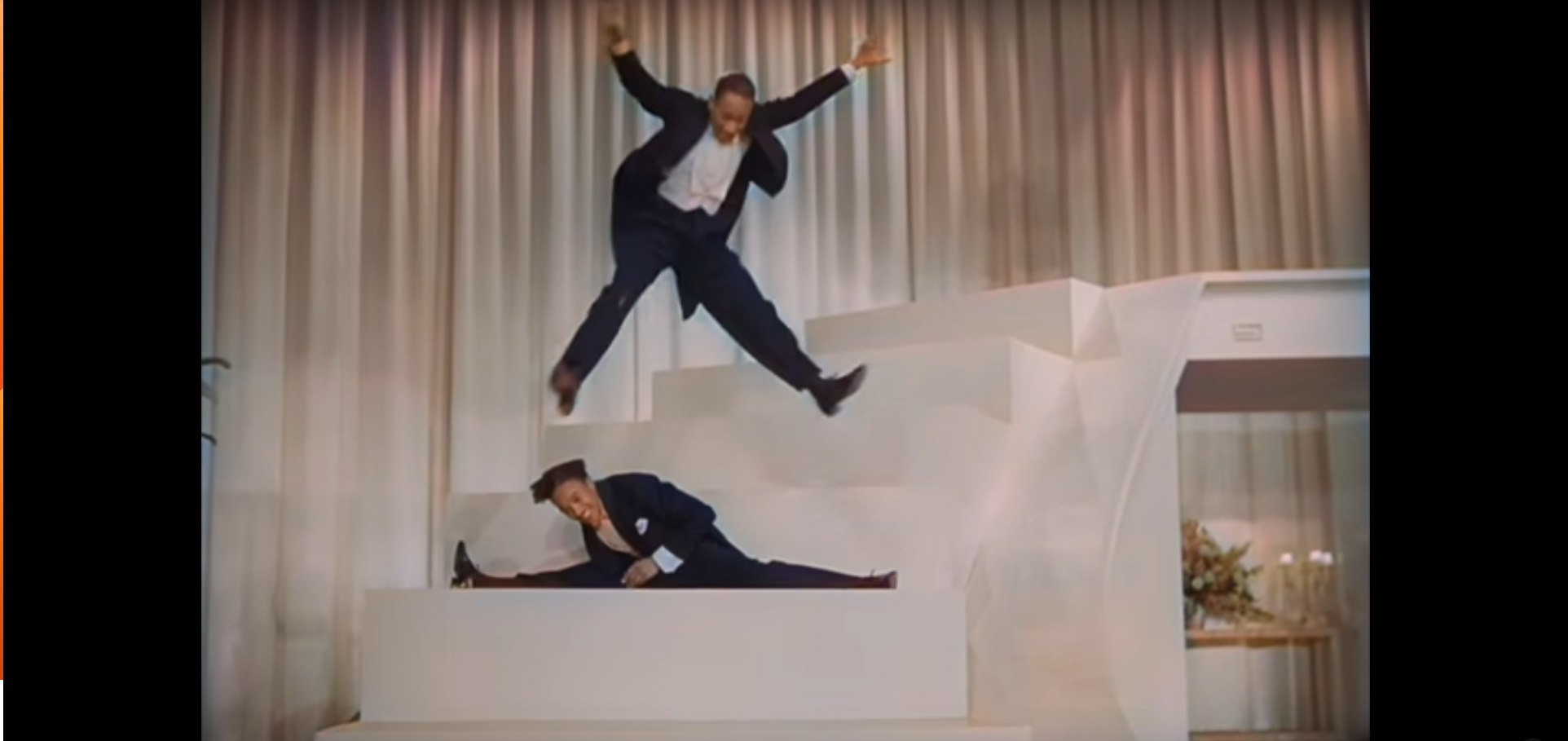
[18] The origins of jazz tap, both in clubs and on the streets, harkens back to notions of masculinity in the early 20th century, which, while linked mostly to whiteness, centered around physical fitness and making oneself distinct from others. But Jazz tap was also exceptionally athletic, further relating back to these concepts about white male masculinity. Not only was fast-paced and intricate footwork required, but there were different styles of jazz tap – in this case specifically the “flash” style – which featured acrobatic stunts like flips, splits, and other gymnastic feats (Krayenbuhl 34). All of these moves required intense skill, precision, and hard work to master, but dancers like the Nicholas Brothers were able to do it and impress the audience with their moves and athletic ability (note 5). The still shown below is taken from one of the Nicholas Brothers’ most famous scenes, and features one of their iconic, and exceptionally athletic moves (Figure 1).
Figure 1, The Nicholas Brothers performing one of their signature
acrobatic moves in the film Stormy Weather (1943)
[19] In addition to the sexual connotations that surrounded Black men and their
bodies during this time, along with the masculine origins of jazz tap and the incredible athletic prowess needed to perform many of its acrobatic stunts, jazz tap also had an aura of class that was unmistakable. The tradition of “class act” dancing, “...like ballet, challenged its partners to execute the highest degree of controlled precision while moving together with smooth effortlessness” (Krayenbuhl 36). The Nicholas Brothers, in addition to being known for their acrobatic skills, were some of the most prominent dancers in the realm of “class act” tap. Having been born into a relatively wealthy family, the brothers were able to master their dancing skills in the classroom rather than on the street or in back rooms, giving their style a much more polished look. Despite the degree of intricacy and pure speed with which their feet and bodies moved, the level of skill, expertise, and training allowed them to sweep gracefully and effortlessly across the stage. In addition to the fluid manner in which they moved, the brothers almost always performed in clean-cut, matching tuxedos, which added an extra level of professionalism, sophistication, and class to their routines (Krayenbuhl 44).
[20] Between the masculine and competitive origins of jazz tap in clubs and on the streets, the exceptional athletic skill it required and conveyed, and the classiness associated with some of the most visible Black dancers at the time, jazz tap in the 1930s and 1940s exemplified the idea of a “virile Black manhood” that so terrified white Americans all around the country (Krayenbuhl 86).
[21] But that “virile Black manhood” is also exactly what Gene Kelly wanted to take advantage of, and in this next section, a video, I will examine how Kelly appropriated aspects of Black dance in order to create the masculinity that he portrays on screen and in real life.
Video Essay
Notes
1. I use this quote from Pamela Krayenbuhl, as it perfectly captures my intent when using the phrase “Black dance.”
As a non-black scholar, I do not presume to define this term but I do wish to honor these debates. While I recognize that “black dance” can describe a broad range of movement practices located throughout the African diaspora, I use “black dance” here...with a particular focus on the United States. I focus on tracking performances of what Johnson describes as “the social dance forms that are indigenous to this country which include tap and jazz dance” (Krayenbuhl 12-13).
2. For more on homosexuality in the U.S. Navy, see: https://movies2.nytimes.com/books/first/l/loughery-silence.html
3. For more on the history of tap dance see: https://www.loc.gov/item/ihas.200217630/
4. Krayenbuhl goes on to quote Constance Valis Hill from her book Brotherhood in Rhythm: The Jazz Tap Dancing of the Nicholas Brothers:
“Jazz tap dance was a form of expressive production that led to a specifically African American modernism. The speedy, swinging, rhythmic propulsion of this modern drum dancing—dissonant in the clatter of its taps, yet exciting in its offbeat, rhythms—defined the new Jazz Age twenties and sounded out a new breed of artists who would finally “shed the costume of the shuffling darky” for the more formal elements of rhythmic expression: its essential abstractness, form (angularity and asymmetry), succession and repetition (visual andaural), and the play of weightedness against weightlessness.” (Hill quoted in Krayenbuhl, 35).
5. For an example of the acrobatic style of Flash dancing see:
https://www.youtube.com/watch?v=IoMbeDhG9fU
Brideson, Cynthia, and Brideson, Sara. 2017. He's Got Rhythm : The Life and Career of Gene Kelly. Lexington: University Press of Kentucky, 2017.
Clover, Carol J. 1995. "Dancin' In The Rain". Critical Inquiry 21 (4): 729-738.
Cuordileone, K. A. 2000. ""Politics in an Age of Anxiety": Cold War Political Culture and the Crisis in American Masculinity, 1949-1960." The Journal of American History 87, no. 2.
Dyer, Richard. 1997. “The White Man’s Muscles.” White. London: Routledge.
Gene Kelly - IMDB. 2020.
Hill, Constance Valis. 2020. "Tap Dance In America: A Short History". The Library Of Congress.
hooks, bell. 2015. “The Oppositional Gaze.” Black Looks : Race and Representation. New York: Routledge.
Krayenbuhl, Pamela. 2017. "Dancing Race And Masculinity Across Midcentury Screens: The Nicholas Brothers, Gene Kelly, And Elvis Presley On American Film And TV". Ph.D, Northwestern University.
Prock, Stephan. 2000. "Music, Gender And The Politics Of Performance In Singin' In The Rain". Colby Quarterly 36 (4). https://digitalcommons.colby.edu/cq/vol36/iss4/6.
Stormy Weather. Stormy Weather in Color - The Nicholas Brothers and Cab Calloway | Colorized with DeOldify, 20th Century Fox, 1943. www.youtube.com/watch?v=IoMbeDhG9fU.
Weintraub, Amy. 2012. "Reel Men Do Dance: Choreography, Masculinity, and the American Film Musical.” Senior Capstone Projects.