[0.1] Abstract - Frans Masereel’s The Idea and Passionate Journey, Lynd Ward’s Wild Pilgrimage, and Richard McGuire’s Here show the evolution of picture stories from wordless novels to graphic novels. As the form evolved, authors found inspiration from contemporary mediums of the time, adding elements, such as temporal markings and dialogue, that allowed for a nonlinear story structure. The incorporation of elements from new forms of media allowed authors of picture stories to blur barriers between low and high art.
[0.2] Keywords - picture stories, woodcut novels, graphic novel, nonlinear
Ali, Muntasir. 2024. “Where Did Linearity Go? Exploring Time and Structure in Picture Stories,” Wings Of Fire. Volume 1, No. 1.
[1] In 1918, the Belgian artist Frans Masereel released Die Passion Eines Menschen (The Passion of a Man), pioneering a new and revolutionary style of storytelling through the medium of books. During numerous progressive artistic movements (Modernism, Expressionism, and Dadaism), Masereel sought to connect literature to art by creating a “wordless novel” that relayed a sequential narrative via textless black-and-white woodcuts. Other artists such as Lynd Ward and Otto Nückel followed suit in this experimental literary genre, and the wordless novel eventually evolved into the modern graphic novel in the 1970s. The obvious differences between early wordless novels and graphic works are the addition of text and multiple panels within a page, but another development was the shift from linear storytelling to more nonlinear and abstract narratives in graphic novels. Although the works of Masereel and Ward are limited in expressing complex sequential narratives compared to modern text-and-image graphic novels such as Richard McGuire’s Here (2014), all these works were inspired by their contemporary mediums and desired to push their perceived “low-art” form into “high-art” that literary critics should seriously consider.
[2] After the success of The Passion of a Man, Masereel followed up with a longer and more ambitious wordless novel: Passionate Journey (1919). This book, containing 163 woodcuts, follows a nameless male protagonist moving into a new industrial city and explores his life through various situations. Throughout the novel, he takes part in both mundane activities like ice skating and farming and more vulgar, adventurous pursuits, such as sleeping with prostitutes and traveling around the world. With a nameless plain-looking main character and no dialogue, Masereel’s novel focuses on actions over characters. This makes Passionate Journey a universal tale that readers of any demographic can relate to. Lasse B. Antonsen, in his 2004 retrospective look at Passionate Journey, finds that, “extraordinarily sophisticated in style, each woodcut is easily accessible yet lends itself to prolonged contemplation. It is indeed surprising how fresh and rich any individual print remains, no matter how many times one returns to it” (Antonsen 155). Stefan Zweig likened the book to an encyclopedia: “If everything were to perish, all the books, monuments, photographs and memoirs, and only the woodcuts that [Masereel] has executed in ten years were spared, our whole present day world could be reconstructed from them” (qtd. in “Wordless Novels in Woodcuts” 65). Indeed, Passionate Journey is a unique time capsule that effectively captures the experiences of an early 20th century European man more than any text could ever broadcast.
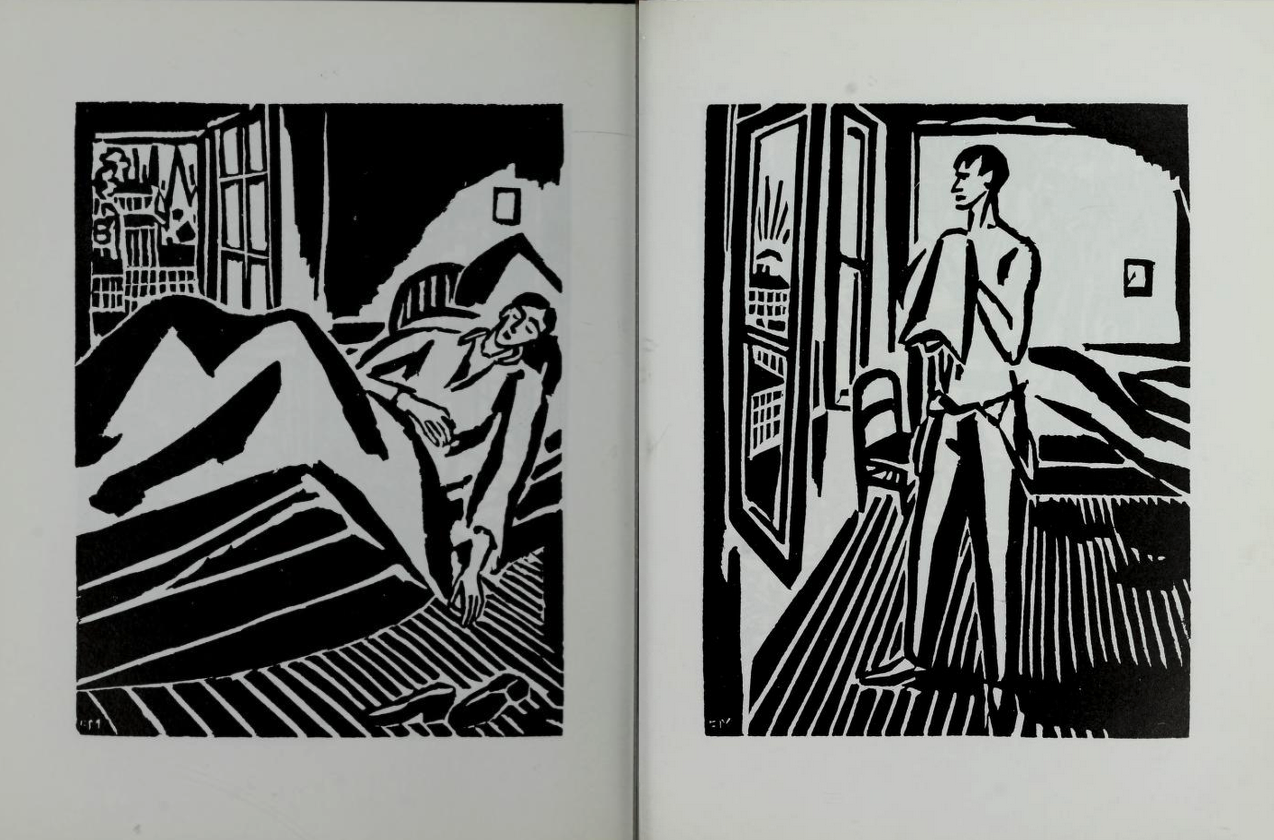
[3] The broad approach to Passionate Journey can be attributed to its linear storyline in which each proceeding image follows a straight temporal sequence. Despite this, reading the novel does not become tedious due to the amount of time that passes between pages varying throughout the book, even being ambiguous at times. The two images represented in Figure 1, for example, can be inferred to take place over a matter of minutes or hours, as it depicts the protagonist sleeping in a bed, followed by his awakening in the same setting.
Figure 1, Passionate Journey by Franz Mazereel, p. 42-43.
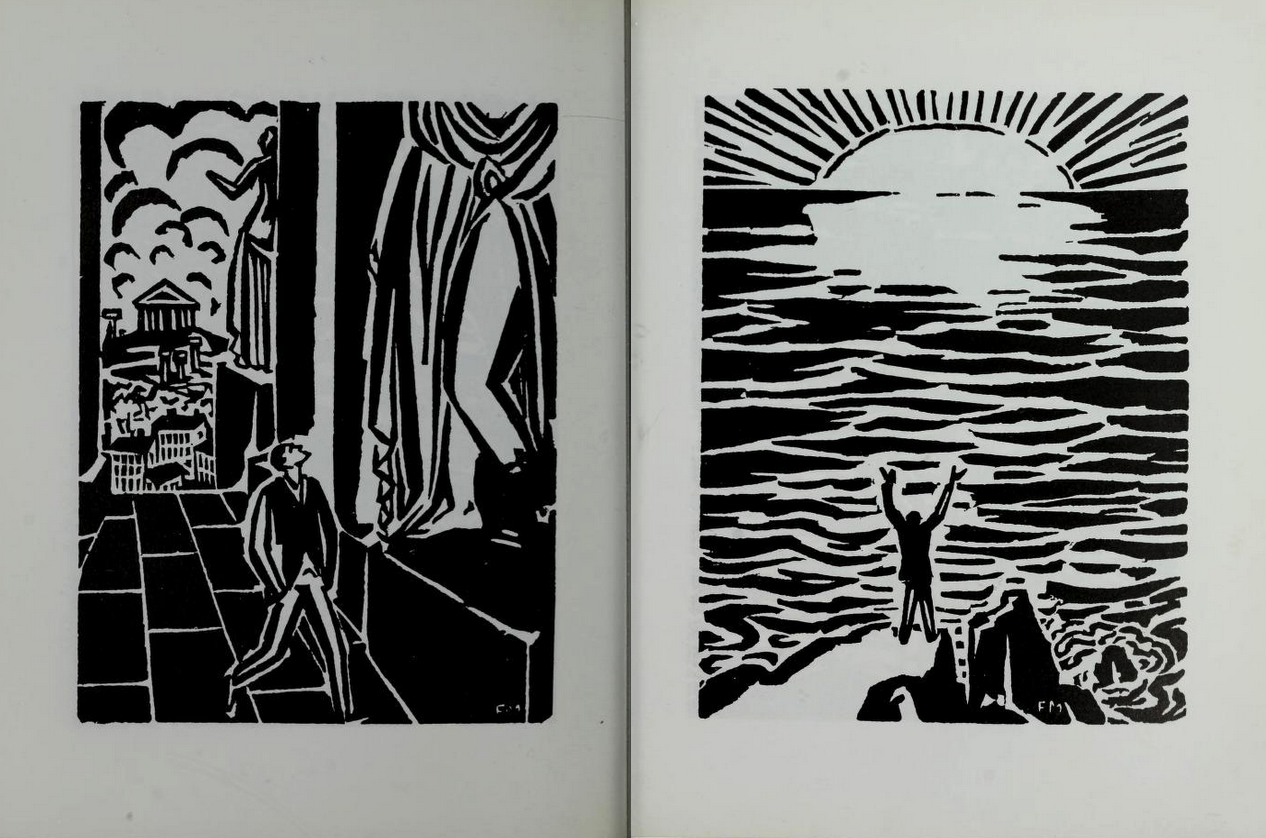
[4] It’s more difficult, however, to determine how much time has passed between the pages represented in Figure 2 where the protagonist is walking down the streets of Greece only to stand on the cliff of a remote location.
Figure 2, Passionate Journey, p. 94-95
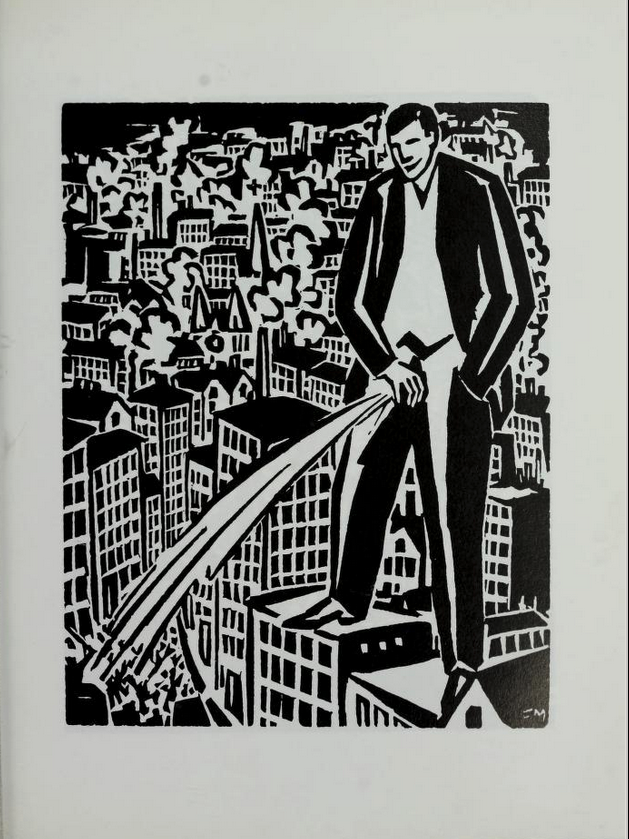
[5] Figure 3, possibly the most controversial woodcut of the novel, takes a jarring turn from the otherwise realistic narrative and depicts the protagonist, now an enlarged figure, urinating on the city. This bizarre cut into a dream-like image is the only explicit instance of Masereel breaking the linear structure of Passionate Journey, but Masereel does not elaborate on this outlier further. Like time itself, he simply moves on to the next action.
Figure 3, Passionate Journey, p. 149
[6] Masereel continued this linear style for his other wordless novels, but what compelled him to do so? The most practical possibility is the lack of text to develop complex characters and plot details. The simplistic design of Masereel’s woodcuts helped to bring literature to the illiterate working class that was dominating the rising urban cities throughout Europe. Beronä describes Masereel’s woodcut novels as a combination of “a more democratic medium of display—the book” and “the most primitive mode of pictorial communication—the woodcut” (“Wordless Novels in Woodcuts” 63). Beronä’s political diction refers to Masereel’s pro-working class socialist ideology that is brazenly decorated throughout his works, but the increasing accessibility came with the cost of making Passionate Journey a relatively uncomplicated narrative. Furthermore, images evoke the audience to focus more on the spatiality of its illustrations rather than the temporal array that texts concentrate more towards, as noted by Gotthold Ephraim Lessing who argues that “bodies [spatial sequence] are the peculiar subjects of painting,” while “actions [temporal sequence] are the peculiar subjects of poetry” (Lessing 101). Passionate Journey, while revolutionary in breaking the strict barriers between art and literature that Lessing articulates, was still limited in the type of narrative it could display, but this does not mean that Masereel was unable to convey deep, important themes and motifs within the novel.
[7] Other media forms emerging around Masereel’s time may also have affected the development of the wordless novel. Silent film, for instance, was a new form of popular entertainment for consumers across the United States with blockbuster releases such as Ben-Hur: A Tale of the Christ (1925) and the problematic The Birth of a Nation (1915). While cinema was becoming a massive commercial sensation among casual audiences, critics dismissed these movies as cheap and having low artistic value. In the 1920s, the silent film craze influenced European filmmakers, with some wanting to tackle a more experimental side of cinema to transform it into “high art.” This led to such films as The Cabinet of Dr. Caligari (1920) and Nosferatu (1922), early European works that combined popular American media with surrealist aesthetics and plots from the German Expressionist movement to push the latter beyond the high art world. Speaking on this trend, Paul Grainge, Mark Jancovich, and Sharon Monteith write in Film Histories: An Introduction and Reader:
[8] Throughout the 1920s, German cinema was agreed by critics to sit at the apex… Such films were screened as avant-garde ‘classics’ in art-house cinemas by the end of the 1920s. In this way, film culture derived from intellectual movements that worked outside, or pitted themselves against, the norm of Hollywood classical cinema of cinema art… (Grainge et al. 171)
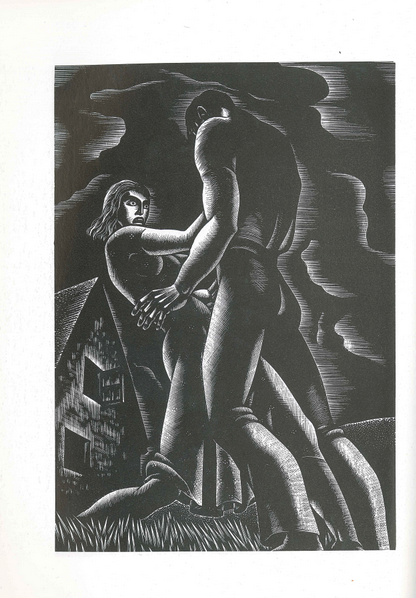
[9] These German filmmakers’ mindsets ran concurrently with Masereel and Nückel who were competing with traditional pictorial stories that were simple kids’ books to elevate the genre into something more sophisticated.
[10] German silent films, then, inspired wordless novels both in style and in spirit. Regarding this relationship, Natalie op de Beeck notices that “both silent cinema and pictorial literature deal in immediacy, montage, and early twentieth-century narrative forms, suggesting what fascinated popular audiences of the early twentieth century” (op de Beeck 142). One key difference between the two that op De Beeck did not mention, however, is that silent films still contain text through intertitles, so even without sound, words are still projected to the audience to tailor complicated—and sometimes nonlinear—stories that Masereel’s woodcut novels couldn’t quite achieve. Dr. Caligari, for example, begins with Francis, the protagonist, sitting on a bench with another man as a woman passes by them. Francis remarks to the older man, “What she and I have experienced is yet more remarkable than the story you have told me. I will tell you” (Mayer and Janowitz). This scene transitions into a flashback within which the bulk of the film takes place. The audience, of course, does not hear Francis speak this, but the addition of text is a practical necessity for the audience to understand the story’s time shift.
[11] While Passionate Journey has been characterized as “a kind of movie which… needs no other words, captions, or sub-titles to explain it” (Mann 13), another Masereel wordless novel, The Idea (1920), uncovers his acknowledgment and praise of film. This book—another linear tale—details a nude female protagonist that personifies an artist’s “idea” by taking a life on its own. Throughout her adventure, The Idea runs across numerous forms of media, including newspapers and film reels (The Idea 49, 60, 68). Masereel’s association of more traditional forms of communication such as newspapers with newer forms like cinema and radio is his attempt to legitimize the latter to literary critics. In turn, he is trying to empower picture novels as not just innocuous children's stories, but as serious works of art about mature topics that deserve close analysis.
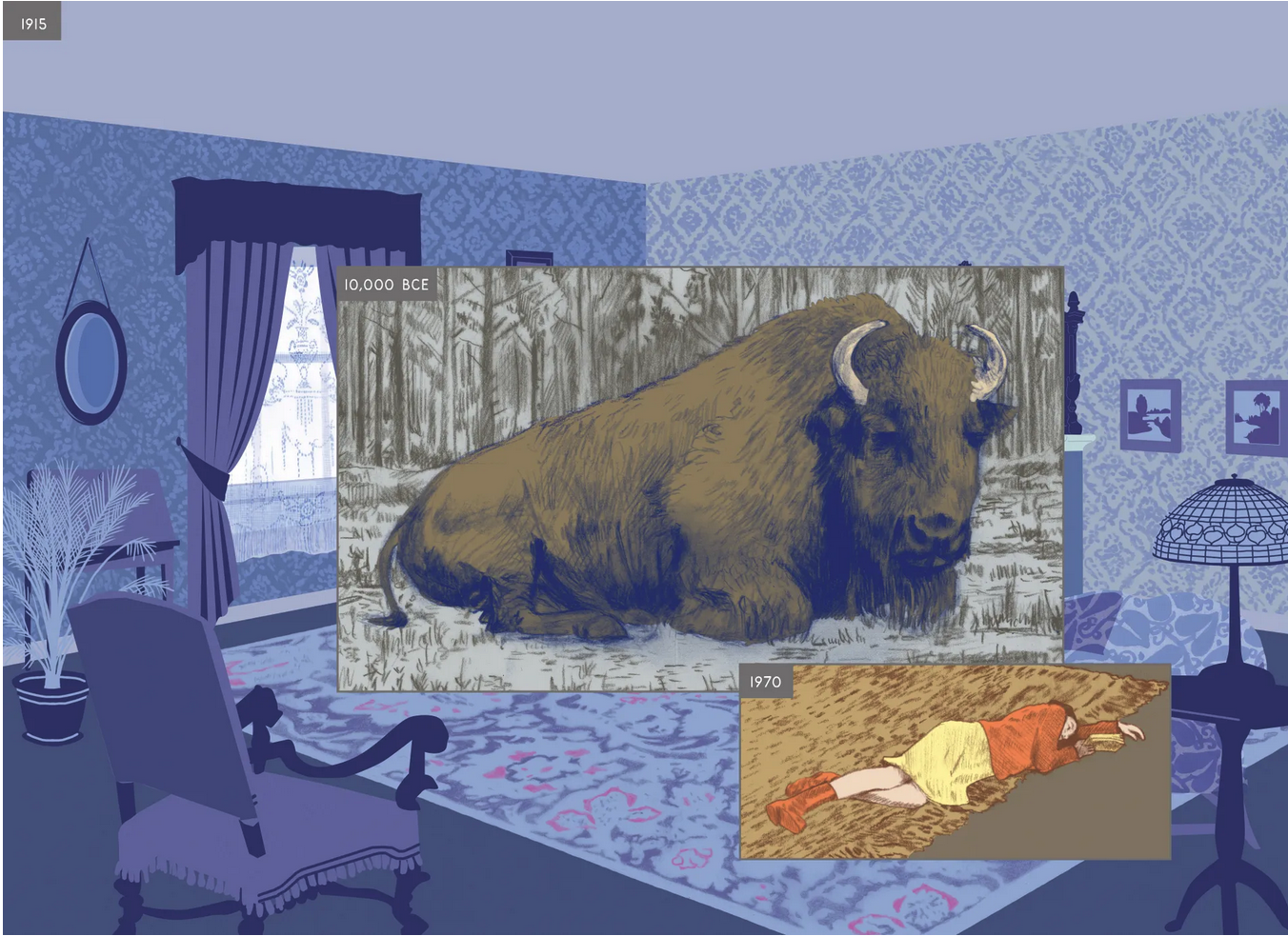
[12] The transatlantic exchange of silent films also occurred for wordless novels when Lynd Ward, an American artist inspired by Masereel’s works, released his own woodcut narratives throughout the 1930s. His debut picture novel Gods’ Man (1929) was a commercial success to his domestic audience, but critics disliked his follow up Madman’s Drum (1930) because of its more complex storyline that featured a larger cast of characters. Despite the negative feedback, Ward continued to evolve the wordless novel with his third book Wild Pilgrimage (1932). This book returns to form with a single protagonist, and while the story remains fairly linear, Ward adds a “dream dimension” that is separate from the main narrative. To distinguish between these two realms, Ward uses a red/orange tint to mark certain sequences, interjecting them within the normal black-and-white woodcuts.
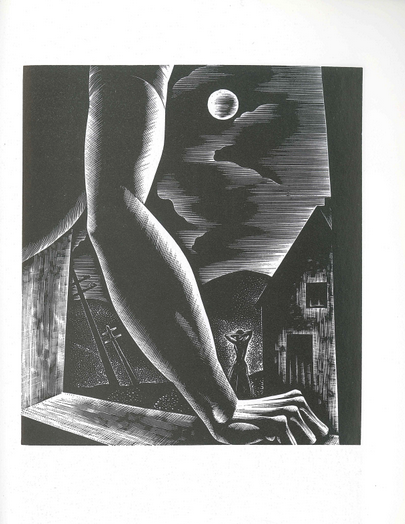
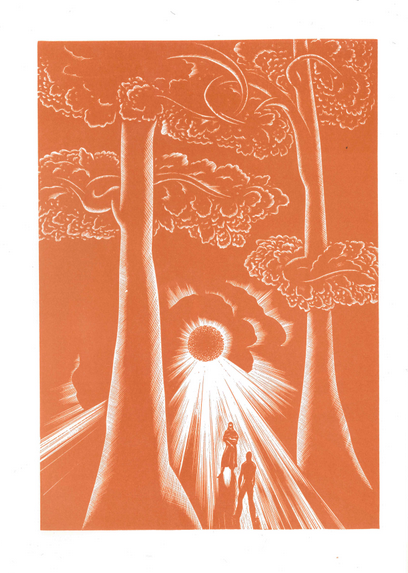
[13] For instance, Figure 4 (black-and-white) depicts the protagonist at night looking at a woman through a window. The following page, now in this dark red coloring, jumps to the protagonist approaching the same woman in a forest, with the blackened sun beaming right over them at an impractical distance (Figure 5).
Figure 4 (left, p. 29) and Figure 5 (right, p. 30), Passionate Journey
[14] A romantic sequence ensues between the two as they roam together with the stars out, and in a later image, the woman, now completely nude, faces the reader as the shirtless protagonist gazes onto her; the next page depicts them passionately kissing. An abrupt shift occurs in Figure 6, however, as the black-and-white coloring returns to the woman with an exaggerated shocking expression (another transfer from German Expressionist art and film) as she pushes herself away from the protagonist, suggesting that the protagonist embraced her in a non-consensual manner. While the distinct colors suggest a nonlinear shift in the plot, there is still some continuity between the pages as the characters are in a similar, albeit mirrored, position. Without the red tint indicating a different state of mind for the reader, this sequence would feel out of place as the “established rule” of wordless novels initiated by Masereel implies a linear temporal sequence within a singular reality. Ward breaks this convention in Wild Pilgrimage by drifting between the objective and subjective worlds.
Figure 6, Passionate Journey, p. 36
[15] Ruminating on the true meaning of the red sequences, Grant F. Scott writes, “the ambiguity of their ontological status further deepens Ward’s investigation as these red engravings operate on varying levels of consciousness—from fantasy, waking dream and traumatic memory to premeditated action and political commitment” (Scott 100). Indeed, each of the red sequences slightly differ from each other in terms of the subject matter and relation to the protagonist’s experiences, but it is all ultimately within the psyche of the protagonist. For example, a string of red woodcuts (p. 41-44) shows the protagonist running from a group of white farmers, ending up in a deep forest where he sees a group of lynched Black men before finding himself underneath an empty noose. This is a callback to an earlier black-and-white scene in which the protagonist witnesses the lynching of a Black man and does not intervene. This speaks to a collective white guilt for atrocities committed against Black Americans from the slave age to the Jim Crow era (Ward 17, 18). Throughout the red sequences, Ward evidently explores a variety of issues, some which are universal like in Passionate Journey, but others which are more topical.
[16] Circling back to Ward’s awareness of Black oppression, Beronä ascribes Wild Pilgrimage and Ward’s other wordless novels as “commercially successful examples of prints published in book format that displayed themes of social injustice” (Review of Printmaking of the Left 88). Although Masereel displayed contemporary social and political themes in his wordless novels—primarily capitalist oppression of the working class—Ward expands on the pioneering elements by directly commenting on race relations in Wild Pilgrimage, something more pertinent to the U.S. than to Europe. Ward reflects on his innovative approach to the woodcut novel, saying how the color switch “resulted in an expansion of the narrative capabilities of a series of images, and if the reader ultimately receives a greater sense of involvement in what is going on, then the experiment will have proved worthwhile” (Ward 796). Of course, Ward’s departure from Masereel’s unilateral structuring is impressive and significant, but his shift is ultimately just a minor step up in that it goes from a singular linear plot to a binary narrative that still operates on one protagonist in a straight temporal progression. How can picture stories move further from here?
[17] The advent of graphic novels and long-form comics in the 1970s sought to remedy this limitation of wordless novels. The addition of text alongside images allowed for comic artists to express themselves in more abstract and autobiographical ways, from the intense avant-garde style of Martin Vaughn-James’s The Cage (1975) to the unconventional thematic grouping of Alison Bechdel’s personal memoir Fun Home (2006). However, the most interesting use of time-bending to an extremely nonlinear form is Richard McGuire’s graphic novel Here (2014). In this book, each two-page spread is the same wide single panel of a living space, showcasing different snapshots throughout time as it jumps into the past, present, and future. The different time periods constantly overlap with each other through layered palimpsests of “windows” from vastly different years which McGuire labels on the top left of every panel. (See Figure 7.)
Figure 7, Image from Richard McGuire’s Here
[18] A stark contrast from the linear woodcuts of Masereel and Ward, McGuire plays with chronological sequencing and completely rearranges the temporal to devise his own thematic structuring on what the space—and the events that hold within that space—means to himself and the world around him. Philip Smith argues that “the relationship between panels on a given page is not chronological, then, but neither is it random—the selection of images on a given page have been curated in order to emphasize the correspondence between discrete historical instances” (Smith 40). Although text is sparse compared to other graphic novels, Here effectively conveys its intentions behind its nonlinear arrangement via sparse dialogue peppered throughout the novel that speaks not only on historical connections, but other important themes and symbols regarding the universality of the human experience. One typical sequence (McGuire 69-73) brings out this central idea. A small panel labeled 1960 illustrates a concerned woman asking, “Did you lose something?” followed by a series of dialogue from a variety of years that all relate to that question: “I lost my wallet;” “I think I’m losing my mind;” “I lost my self control;” “I can’t see a thing without my reading glasses.” McGuire, by stringing together vignettes of people all speaking on the same concept in the same space under vastly different contexts, reveals unexpected relations throughout time which expands the reader’s limited perspective on life.
[19] Furthermore, McGuire’s use of dialogue is also a means to tie in separate passages of Here that are otherwise completely different in time and aesthetics. For instance, early in the novel, a 1959 panel shows spouses conversing: “Do you have your keys? Watch? Wallet?” “Check” (McGuire 33). These items are later reinforced with panels in 1958 and 1959 (McGuire 41) with similar dialogue, “Watch, wallet, keys?” “Check.” While these panels do connect with the passage of loss, a more explicit correlation is with a sequence near the end of Here that takes place in 2213. A tour guide reconstructs the house through different eras (as shown throughout the novel) to the audience, and, as part of her history lesson, she displays three “essential items” of the twentieth century: a watch, a wallet, and keys. With this, McGuire is using time to frame how significance in objects changes beyond our perception. The people of the future—or more accurately, McGuire’s constructed future—are in absolute awe of household objects that we think of as mundane, creating a dramatic irony for the reader.
[20] McGuire, however, also carefully uses the past to restructure this relationship so that the reader can comprehend this relative to their own experiences. One sequence takes place in 1986 with an older woman interacting with a man from an archeological society (McGuire 47-55). They discuss how the house may have been an important historical site for Native Americans, and the woman is in disbelief, crying out, “Burial sites?! Oh, my dear lord” (McGuire 55). Throughout this section, McGuire draws panels of Native Americans occupying the space in the early 17th century, again evoking dramatic irony with the woman shocked at something that the reader knows to be true. This mirrors the way the people in the future cannot comprehend the existence of watches, wallets, and keys, yet the novel shows that they occupied the very space that they stood on centuries ago. A wordless version of Here would be insufficient in relaying these themes as images are limited in giving information to an audience. Without these texts, the reader would be lost in the barrage of loosely connected images, so text is a crucial component to delivering complex, nonlinear visual narratives.
[21] In elaborating the layering of disparate periods of time over each other, Michael North remarks:
[22] The structure of Here implies that this has turned the present into a vast screen onto which the past and the future are projected, not in sequences, by and large, but rather in bursts and fits of reverie. The whole of time is always available, always present, and equally present, since we don’t have to go through the intervening years to get to any particular point in time. (North 176)
[23] North’s mention of “a vast screen” and “projecting” connects Here to film, akin to Masereel and Ward being influenced by German Expressionist silent cinema of their time. Indeed, McGuire was also inspired by films and new age media of his time. Modern films, now complete with sound and color, also evolved in delivering convoluted nonlinear narratives. Christopher Nolan’s Memento (2000) and Inception (2010) are great examples of this progression in film, and unlike the experimental German films of the 1920s, they were both commercial and critical successes, indicating a blur between “high-art” and “low-art” within film. McGuire’s transplanting of these films’ complicated plots into a suburban setting for Here makes these themes more digestible, and thus, more accessible to a broader audience while maintaining its sophistication. Therefore, McGuire is also bridging the gap between the two forms of art with Here by creating a picture story that highlights mature subjects such as existentialism, albeit in a hopeful and optimistic tone. This association between high and low art is further supported by Here becoming an art installation at the Museum Angewandte Kunst in 2016 and later a VR short film in 2020.
[24] While North mentions other modern technologies that have allowed McGuire to experiment with graphic literature in the 21st century, such as the completely rearranged e-book edition of Here, what he fails to bring up is the rise of remix/sampling culture. Initially a musical technique, sampling directly takes elements from older songs, television shows, films, etc. and reshapes them into short, looped soundbites that, when combined with other elements, creates a whole new body of work. McGuire, then, uses a form of “autonomic” sampling in Here by constructing original visuals and texts and then reworking them into literary “soundbites” that create the artistic effect of contrasting times speaking to one another. This is referenced in the novel in a 1775 scene of Ben Franklin telling his grandson, “life has a flair of rhyming events” (McGuire 63). The choice of the word “rhyming” also relates to the idea of poetry as a disparate art from paintings, as outlined by Lessing, so McGuire’s inclusion of this line also serves as a pushback against this argument, similar to what Masereel did with his breakout woodcut stories.
[25] Despite the wide differences in aesthetics, structure, and narrative, the wordless novelists of the early-to-mid 20th century and the modern-age graphic novelists carry out similar objectives in their works. Masereel and Ward, artists who sought to legitimize their form in the literary sphere, meticulously labored on hundreds of woodcuts to craft stunning visual stories that created a democratic form of reading that textual books could not achieve. But these limitations meant that a linear temporal structure was necessary for readers to comprehend the plot, and even when Ward experimented and expanded on the direction of wordless novels, simplicity in format had to be kept to avoid widespread criticism. Graphic novels, by combining text and image, were not confined like wordless novels and thus were able to experiment more in both its temporal and spatial structure. McGuire used this advantage for Here by breaking comic conventions, turning to single panel pages (similar to Masereel and Ward) that were extensively layered by smaller panels within the same setting. With the multifaceted nature of these literary works, it is no surprise, then, that they are products of the communicative and technological advancements that surrounded them. For the woodcut novelists, these were silent films and radio. For McGuire, it was virtual reality and remix culture that have dominated the post-Gutenberg era of printed media dominance. Instead of fearing new forms of media that seem like a threat to traditional writers, creators of picture stories embrace and incorporate them to add onto the legacy of printed books rather than demarcating elitist barriers between high-art and low-art.
Antonsen, Lasse B. 2004. “Frans Masereel: Passionate Journey.” Harvard Review, no. 27, pp. 154–155. JSTOR, https://www.jstor.org/stable/27568954. Accessed 12 Dec. 2022.
Beronä, David A. 2003. “Wordless Novels in Woodcuts.” Print Quarterly, vol. 20, no. 1, Mar, pp. 61–73. JSTOR, http://www.jstor.com/stable/41826477. Accessed 12 Dec. 2022.
Beronä, David A. 2005. Review: Printmaking of the Left in 1930s New York, by Helen Langa.” Print Quarterly, vol. 22, no. 1, Mar., pp. 86–89. JSTOR, https://www.jstor.org/stable/41826346.
op de Beeck, Nathalie. 2010. “Now Playing: Silent Cinema and Picture-Book Montage.” Telling Children's Stories Narrative Theory and Children's Literature, University of Nebraska Press, Lincoln, pp. 140–162. JSTOR, https://www.jstor.org/stable/j.ctt1dfnsch.13. Accessed 12 Dec. 2022.
Grainge, Paul, et al. 2007. “Realism, Nationalism and 'Film Culture'.” Film Histories: An Introduction and Reader, Edinburgh University Press, Edinburgh, pp. 165–186. JSTOR, https://www.jstor.org/stable/10.3366/j.ctt1r28dt.11. Accessed 12 Dec. 2022.
Lessing, Gotthold Ephraim. 1853. Laocoon: An Essay upon the Limits of Painting and Poetry. Translated by E. C. Beasley, Longman.
Mann, Thomas. 2004. “Introduction to Frans Masereel, Passionate Journey: A Novel Told in 165 Woodcuts.” Arguing Comics: Literary Masters on a Popular Medium, edited by Jeet Heer and Worcester Kent, University Press of Mississippi, pp. 13–21.
Masereel, Frans. 2007. Passionate Journey: A Vision in Woodcuts. Dover.
Masereel, Frans. 2009. The Sun, The Idea & Story without Words: Three Graphic Novels. Dover Publications, Inc., 2009.
Mayer, Carl, and Hans Janowitz. 1919. The Cabinet of Dr. Caligari. Decla-Bioscop.
McGuire, Richard. 2014. Here. Hamish Hamilton, 2014.
North, Michael. 2018. “Conclusion: Here and Now.” What Is the Present?, Princeton University Press, Princeton, NJ, pp. 167–177.
Scott, Grant F. 2022. “Lynching, Labor and Homoeroticism in Wild Pilgrimage (1932).” Lynd Ward's Wordless Novels, 1929-1937: Visual Narrative, Cultural Politics, Homoeroticism, NY: Routledge, Taylor & Francis Group, pp. 99–123.
Smith, Philip. 2018. “Rhyming Events: Contested Narratives and ‘Cli-Fi’ in Richard McGuire's Here.” Inks: The Journal of the Comics Studies Society, vol. 2, no. 1, pp. 38–48., https://doi.org/10.1353/ink.2018.0003.
Ward, Lynd. 2010. Gods' Man; Madman's Drum; Wild Pilgrimage. Edited by Art Spiegelman, Library of America.