[0.1] Abstract - The literary form of the bildungsroman (stories that deal with one’s formative years and show a protagonist developing morally and psychologically) helps readers trace a thread through the evolution of graphic novels and allows us to examine how this structure frames childhood.
[0.2] Keywords - bildungsroman, childhood, woodcut novels, graphic novels
Zipper, Rebecca. 2024. “How the Bildungsroman Interacts with the Child” Wings of Fire. Volume 1, No. 1.
[1] Graphic novels are always trying to “ditch the troublesome word ‘comics’” (Hatfield, 100) and find deeper meaning within this medium. Frank Serafini defines graphic novels as visually rendered narratives, which tell stories through sequential drawings (Serafini 24). These visual novels often are bildungsroman, stories that deal with one’s formative years and show a protagonist developing morally and psychologically. As many graphic novels deal with a character’s formative years, a connection can be made about how the idea of childhood has evolved alongside the medium itself.
[2] Woodcut novels often allow for the simplest of stories to be told. David A. Beronä writes that woodcuts are a “more democratic medium of display — the book — in combination with the most primitive mode of pictorial communication – the woodcut – to reach a wide audience of readers without regard for language or literacy” (Beronä 63). The content of these books are most of the time inappropriate for children. However, the stories still grasp the journeys of growing up. This makes for a universal reading experience allowing people from all walks of life, especially the lower classes, to bring their own experiences into reading. The stories of these books might be deemed simplistic, but craft-wise, everything is deliberate. Both woodcut novelists that will be discussed in this paper learned this craft later in life, allowing for new ways to reflect on their past and present from a strictly adult lens.
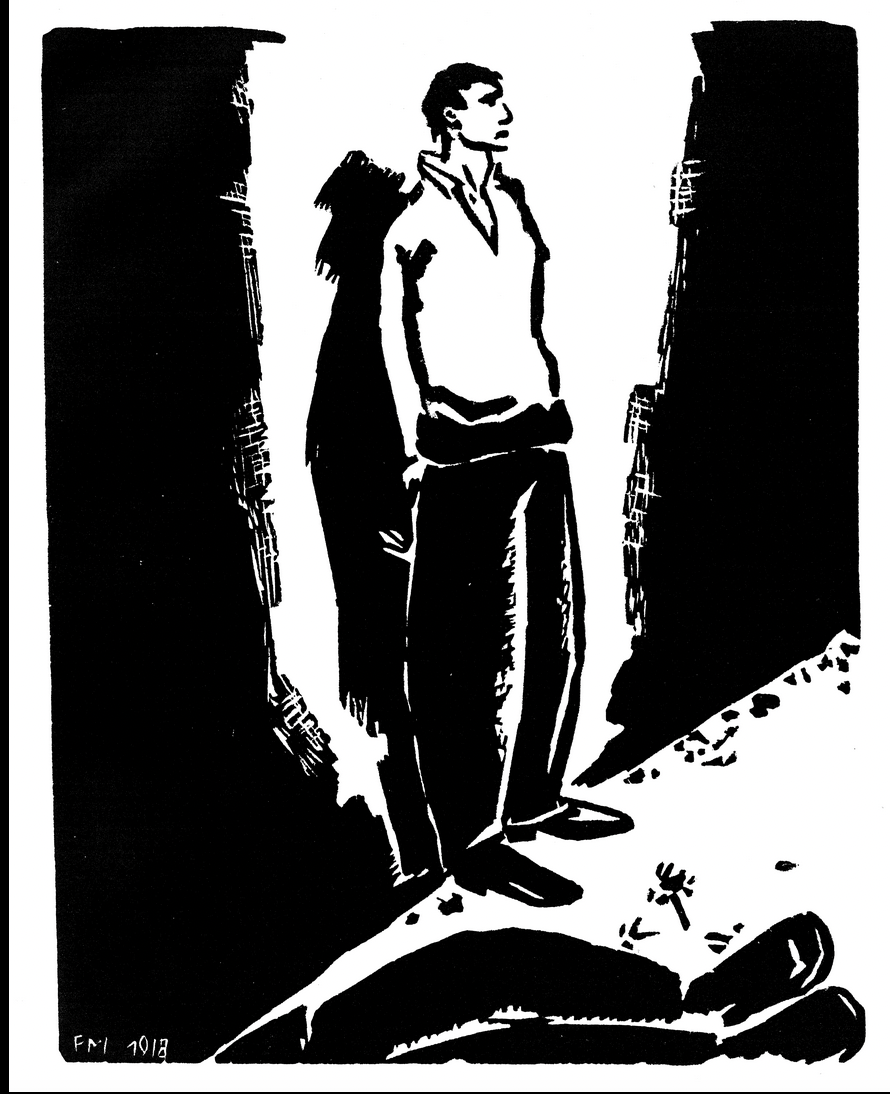
[3] In his book chapter entitled “The Cutting Edge of German Expressionism: The Woodcut Novel of Frans Masereel and Its Influences,” Perry Willet says that “The irony at the center of these narratives lies on their exploration, entirely without words, of the power of language and the language of power” (Willet 112). Frans Masereel started the revolution of woodcut novels. Masereel’s first novel Die Passion Eines Menschen (The Passion of Men) acts as a struggle with destiny and fate (Antonsen 154). The book follows a young boy as he grows up orphaned and in poverty. His life is governed by his socio-economic status and he later turns to revolution in order to try to make a better life for himself. Lasse Antonsen argues that Masereel, and woodcut novels in general, often follow the themes of a bildungsroman in that they journey through life looking for meaning, or perhaps a better life free from societal hardships. In the foreword to Masereel’s second novel Passionate Journey, Romain Rolland writes that Masereel can “testify to the suffering through which the soul of the poet was passing” (Antonsen 154), and Willet argues that woodcut novels work so well for this form of narrative because “We only view the characters’ actions without hearing their thoughts, making the action seem inevitable and tragic,” (Willett 114).
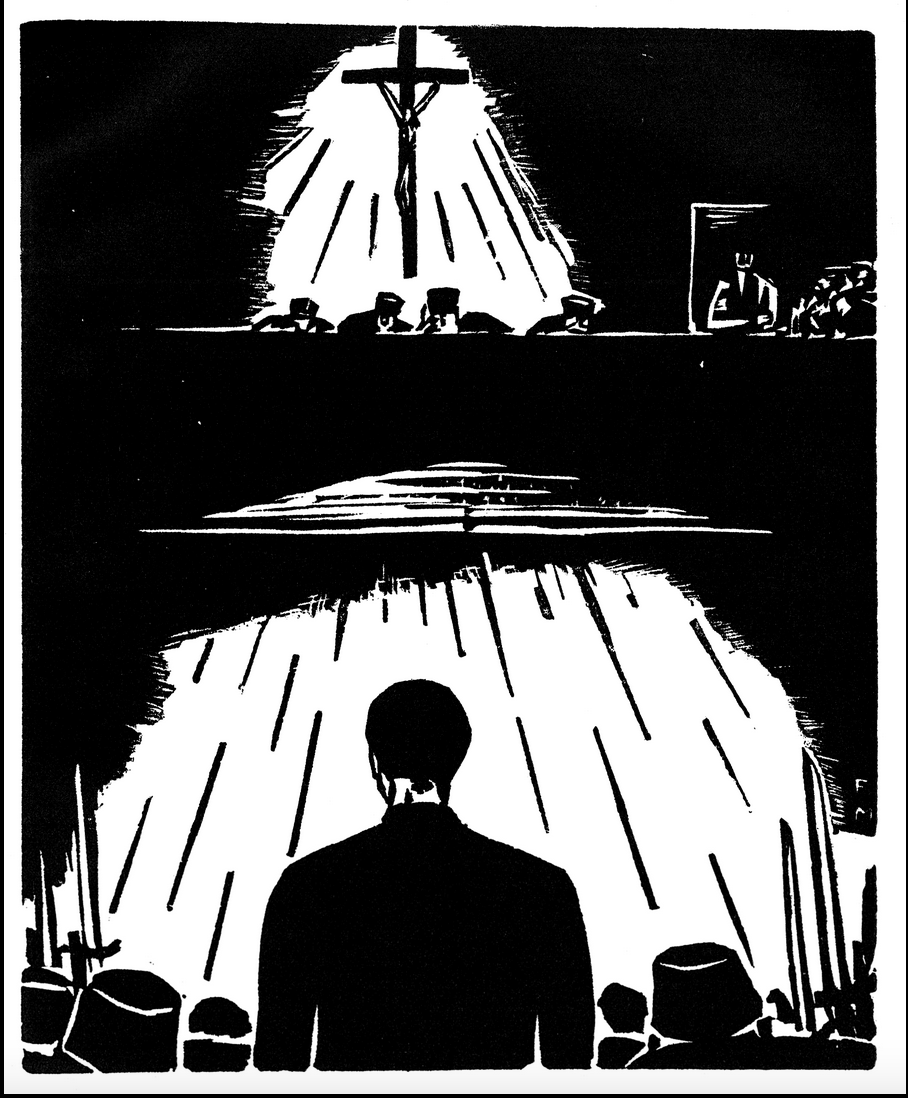
[4] Although the bildungsroman often ends on a positive note, the actions to get there might still be seen as tragic. For example, in Die Passion Eines Menschen, when the protagonist becomes an adult, he is focused not on himself but on making a less capitalistic society (Willett 114). He is acting more for society than himself. The act of becoming a martyr and facing execution for the hope of a better life is contrasted by the feeble child he once was. As a child, the protagonist is stuck trying to make money for himself. This is visible on pages five and six, which show the children of higher society playing around the riverbank of the city while the protagonist is stuck doing hard labor. On the next page, he gets kicked out of his job while a woman chases her dog in the background, showing that within the capitalistic climate, the protagonist is as good as a wild animal, untrained and replaceable (7). As soon as he is out of the capitalistic binds, in what might be an allusion to Les Misérables, the protagonist, like Jean Valjean, is forced to steal a loaf of bread in order to survive, which causes punishment. Not only is he psychologically different by the end, but in the eyes of God he is saved, and yet is still a martyr. Willett writes, “In a key illustration, during his trial, a figure of Christ on the cross shines beams of redemption on him” (Willett, 114). (Figure 1) In the next panel, he is executed.
Figure 1, The Protagonist of Die Passion Eines Menschen in a redemptive light
[5] This ending may leave the readers in a fit of melancholia. Masereel often shows the protagonist alone, othering him from society even if he is similar to the people in it. In one image, he reads a book, looking for an answer to help him get through the fight (19). The lights of the smokestack reflect the choice he needs to make: whether to keep fighting or not. The struggle the character feels and his quick loss of innocence follows the narrative structure of the bildungsroman. On the next page, we see the protagonist get married but soon after he goes back to fight for his cause. He chooses the societal conflict over the woman, further propelling him into a lonely life. It seems that, to the protagonist, everything else other than his mission are just superficial milestones, as if he knows he is going to die fighting for his cause. He gets with the woman, he has moments of solitude, he repents for what he has done, but he knows he cannot live in this society. Looking at the last panel (Figure 2) and how the light hits the man forces us to see that he is not guilty like society judges him to be. The way Masereel sculpts his shadow shows the juxtaposition between who he thinks he is versus who society thinks he is.
Figure 2, The Protagonist at his execution
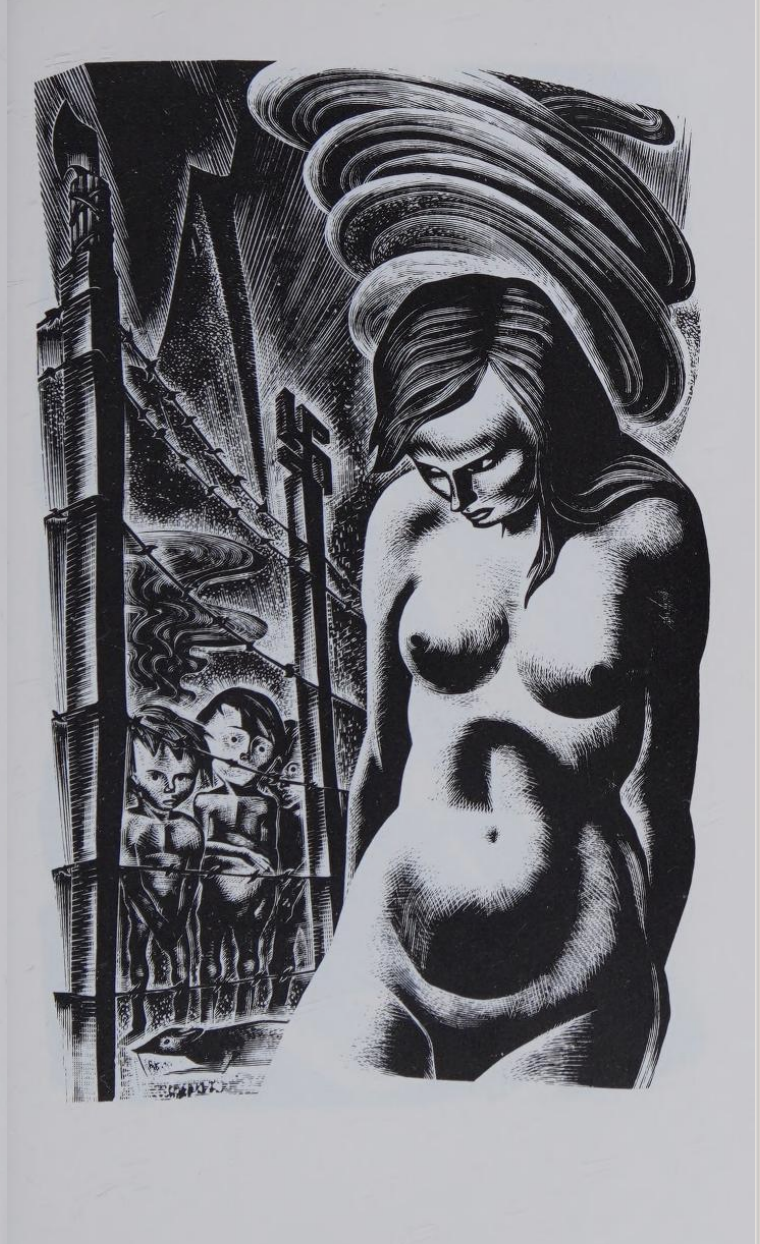
[6] The protagonist of Die Passion Eines Menschen was never allowed freedom during his lifetime. Instead, Masereel depicts the protagonist forced into a life of crime and revolt in order to show how deeply crippling capitalistic society is to the hardworking people that are stuck in the system. Similarly, Lynd Ward’s novel Song Without Words (1936) also features a protagonist held in the binds of a tough decision in the midst of a horrid political landscape. Ward was another woodcut novelist who after college moved to Leipzig to study at the National Academy for Graphic Arts and Book Design. It was in Leipzig that he came into contact with Masereel’s novels which inspired his own woodcut journey (Herb 11). Ward was the author that brought woodcuts to the United States, popularizing them as a distinct medium. Helen Painter writes that Ward is “concerned with facts, many of which come from what he knows and what his background has been” (Painter 663). This is definitely true in Song Without Words. This book focuses on a woman’s choice on whether or not to have a baby during the lead-up to World War II. This is clearly shown in panel eleven, which depicts children behind a fence with a swastika on the top. (Figure 3) In this time of alienation and war, the woman tries to free herself, not only from making a choice but also from the society she was born into.
Figure 3, Children imprisoned in Song without Words
[7] Song Without Words fits nicely into the bildungsroman. While it doesn’t necessarily comment on the woman’s formative years, her contemplation of whether to raise a child in this climate as well as the depiction of a clear psychological journey makes it clear that Ward is playing with the form. The book starts and ends with her outside the capitalist city, in a “safe” space away from the war. In panel four, her penetration is not shown by the man she awakes next to but divinity itself, as if she was chosen to bear this child. This reflects her role in society, that she is forced to contemplate motherhood, even if it is not good for her or her child. This not only acts as the start to her journey but is a physical loss of innocence. The journey forces her into the city in order to care for her child, as she will need the money that the capitalist regime will give her. The reader watches her go through this journey alone, shown by the myriad of panels where she is walking or running through the city trying to run away from both capitalism and her impending decision. On panel fourteen, the readers see what happens to the children: society captures them and then, once grown, trains them for war efforts with the mother left waiting, never knowing if her baby is still alive. It is one of the only panels without the protagonist in it, allowing the readers to get more acquainted with the pressures of the world within which she lives.
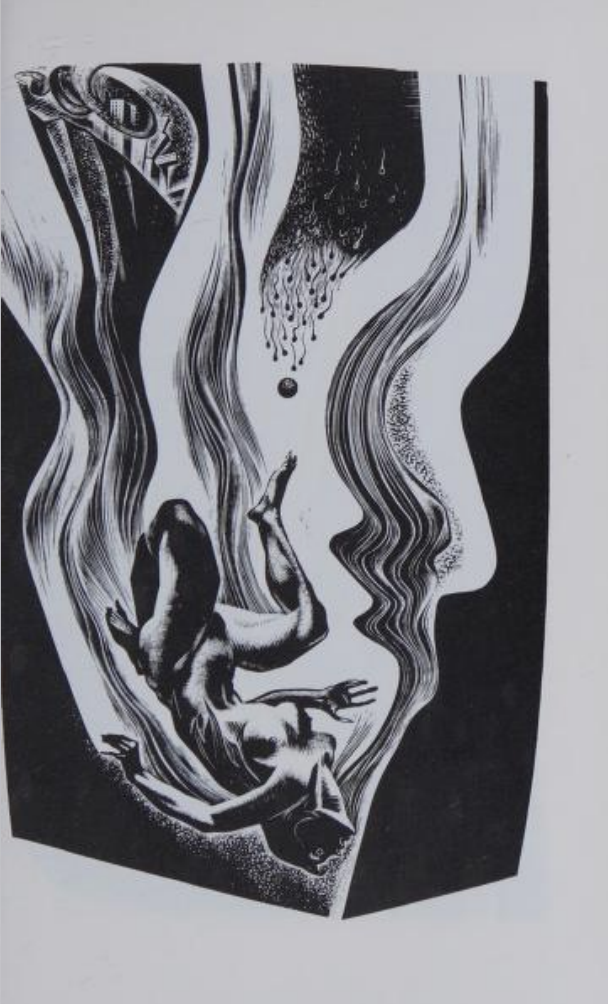
[8] Song Without Words is one of the few woodcut novels that features a woman protagonist. Ball states in his article, “Lynd Ward's Modernist ‘Novels in Woodcuts’: Graphic Narratives Lost Between Art History and Literature,” that “Ward’s graphic narratives are replete with motifs of heroic, masculine artists singularly confronting an uncaring urban-landscape…” (Ball 139). Within Song Without Words, the protagonist has both masculine and feminine energy. Although she is always naked, therefore reminding readers that she is a woman due to her breasts, Ward often highlights her thighs and taut stomach to show her “masculine” strength. (Figure 4) Although she is dealing with the traditionally feminine conflict of motherhood, Ward makes sure that she holds up against his male protagonists. Unlike Ward’s other male protagonists, the urban landscape haunts her. Skulls and a man with a top hat follow her, as if to make sure she knows the risks she is taking. On panel eighteen, the man is in the eyes of the skull equating them as one horrible entity. The characterization of the city forces the woman to see the many crimes of war and capitalism. Through witnessing these atrocities, she is depicted as stronger than her male counterparts; by way of contrast, in Ward’s earlier novel Gods’ Man, the male protagonist is given all he has ever wanted (money, parties, woman, etc) when he enters the city.
Figure 4, Ward emphasizes the strength of the Woman’s body
[9] Song Without Words is stylistically very different from Die Passion Eines Menschen. The latter was very clear cut, all the panels are the same dimensions and the style between all the panels is consistent. From woodcut to woodcut, Masereel’s main object of affection is playing with shadows. Meanwhile, Ward has taken a different approach. Each of his novels is styled a little bit differently, bringing in new techniques to push the medium forward. In Song Without Words, Ward steals from the style of German expressionism, adding harsh and bold lines to his piece, and yet, the woman’s turmoil is shown through curvy lines and spirals. Painter argues this is because “an artist is putting emotions across to a reader for that individual’s own evolvement” (Painter 666). Ward is trying to get the reader into the story, to feel what the woman is feeling. Not only that, but the frames of the panels aren’t straight either. While they are uniform in size and orientation, Ward’s panels make you feel the action. In Figure 4 above, it feels like the woman’s head is going to fall off the panel, spiraling about whether to raise her child or not.
.
[10] Scott McCloud’s notion of closure, “the governing, participatory role given the reader of comics to fill in the associative and narrative gaps between what is pictured in individual comics panels,” (Ball 130) is evident in Ward’s novels. By having one panel on every page, similar to Masereel, Ward lets the reader sit in each panel before moving forward, allowing for a prediction of what is going to happen next. Ward is “squaring his symbolic, even melodramatic visual vocabulary with the semantic slippage of those very symbols” (Ball 130), meaning that there is dissonance between how the reader fills in the vague story with the symbols provided, or lack thereof in Masereel’s work. Ward always continued to develop woodcuts and challenged what they could be, especially when allowing a woman protagonist to fight against society just like a male protagonist would.
[11] Moving to another work with a female protagonist, Fun Home by Alison Bechdel is a graphic memoir about her relationship with her sexuality and her father. This 2006 novel fits perfectly into the themes of the bildungsroman due to the way it tackles reflection on Alison’s childhood. This book took seven years to make as Bechdel found, took, and drew pictures to create what Ann Cvetkovich calls Bechdel’s archive of “postmemory” (113). Marianne Hirsch, author of The Generation of Postmemory: Writing and Visual Culture After the Holocaust, defines postmemory as “the relationship that the ‘generation after’ bears to the personal, collective, and cultural trauma of those who came before — to experiences they ‘remember’ only by means of the stories, images, and behaviors among which they grew up” (Hirsch 5). This building of the archive started after Bechdel looked into her father’s criminal record at the police station. She started to collect information and soon enough her mother was giving her letters from her father. All of this culminated into a huge pile of information to redraw and format into the book and she found that this caused her to have “posthumous bond with my father… like we were comrades” (Bechdel 1006).
[12] Bechdel’s bildungsroman is built on acceptance, trying to understand her younger self and her father as her adult self. She is grappling with the authority to represent her story (Lemberg 120) as she realizes she doesn’t know everything about her father, most pointedly whether he killed himself or if his death was an accident. Her journey is a bit harder to trace considering Fun Home does not move linearly like the woodcut novels do, allowing the readers to see clear character progressions and snapshots of childhood, college-aged, and present-day Bechdel.
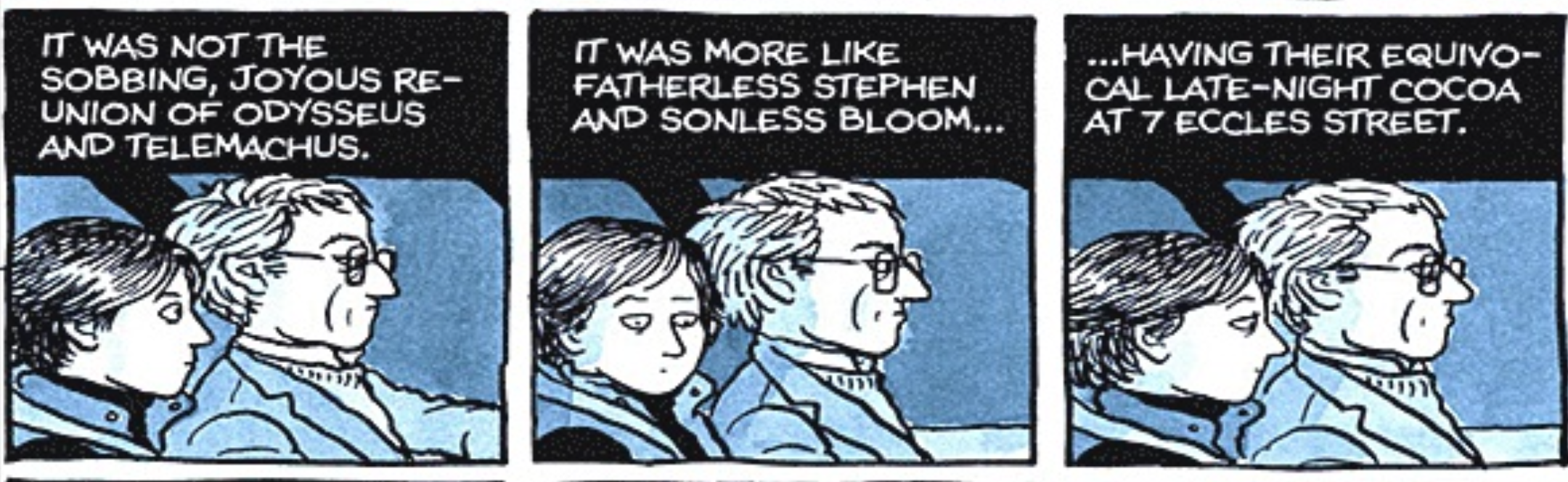
[13] Throughout Bechdel’s childhood, she is basically screaming for attention and acceptance from her father, though he mostly uses her to aid him in his own goals. In the beginning of the book, it is very clear that Bruce, her father, hates when there is a lack of control. He causes Alison to fall after only a few seconds of playing airplane with her, then forces her to go back to work in his carefully constructed house. His lack of love and support as well as the almost constant stream of competition and chores leads Bechdel to fill the book with literary allusions, showing that all his “hard work” to prepare her into an academic paid off. Annette Fantasia explains in her article, “The Paterian Bildungsroman Reenvisioned: ‘Brain-Building’ In Alison Bechdel's Fun Home: A Family Tragicomic” that Alison despises the things that her father loves, which includes his house, feminine things, and maybe even herself (Fantasia 87). The only way Alison finds herself connecting with her father is through literature. However her father is always smarter than her. While they can have a conversation, he always makes sure that she is put in her place. When she goes to college, she realizes she is gay. This revelation leads her to write a letter to her parents to tell them. While her mother is less than thrilled, her father gives her a book to read, ignoring her but also telling her that it is okay. After this turn, Alison looks for outright acceptance from her father and a concrete answer about his sexuality. Late in the book, readers see a moment where they do connect, but it is not a thrilling conclusion to this arc. There is no emotional crisis, just a conversation between father and daughter (220-221). (Figure 5)
Figure 5, Alison and her father talk in the car in Fun Home
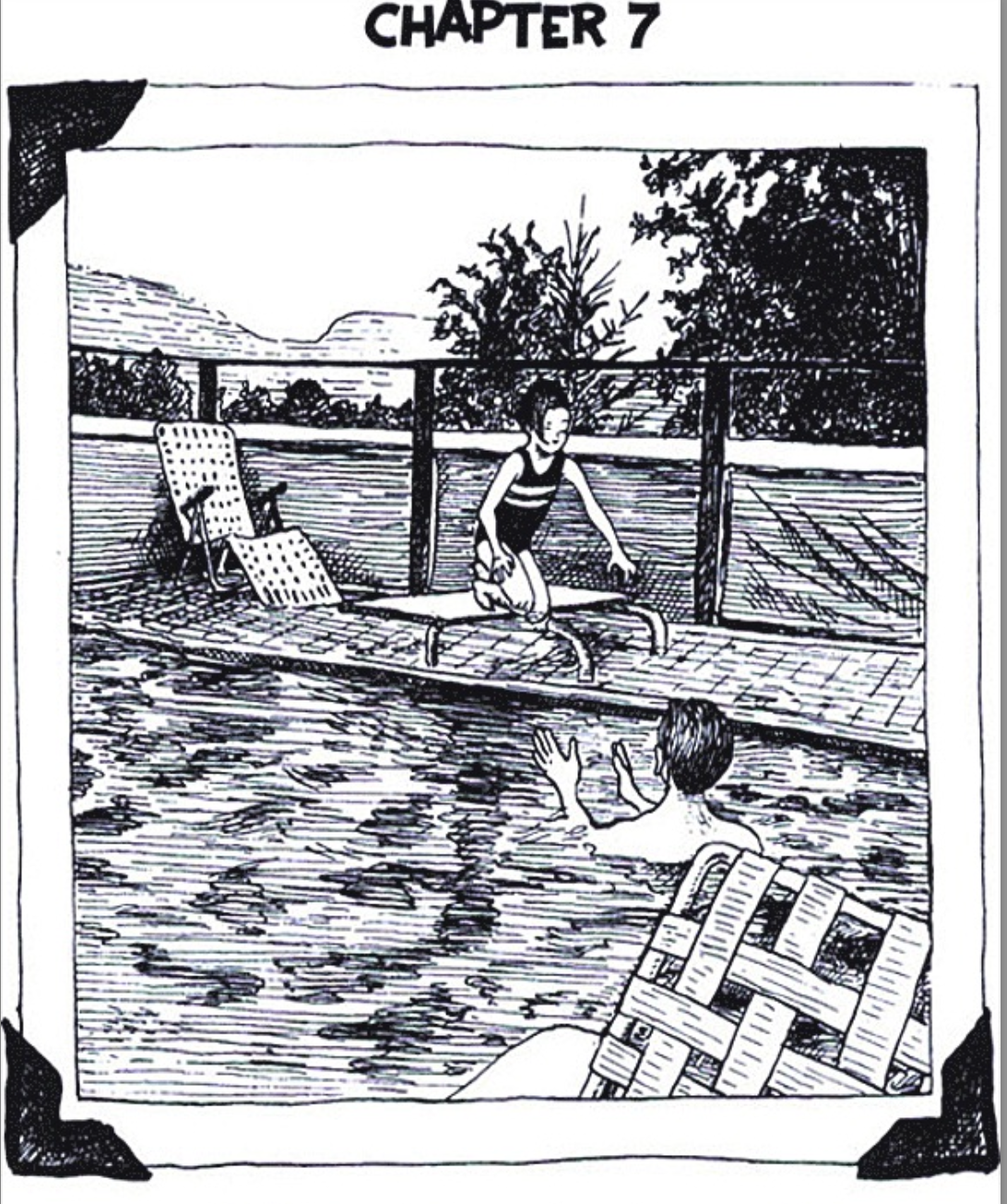
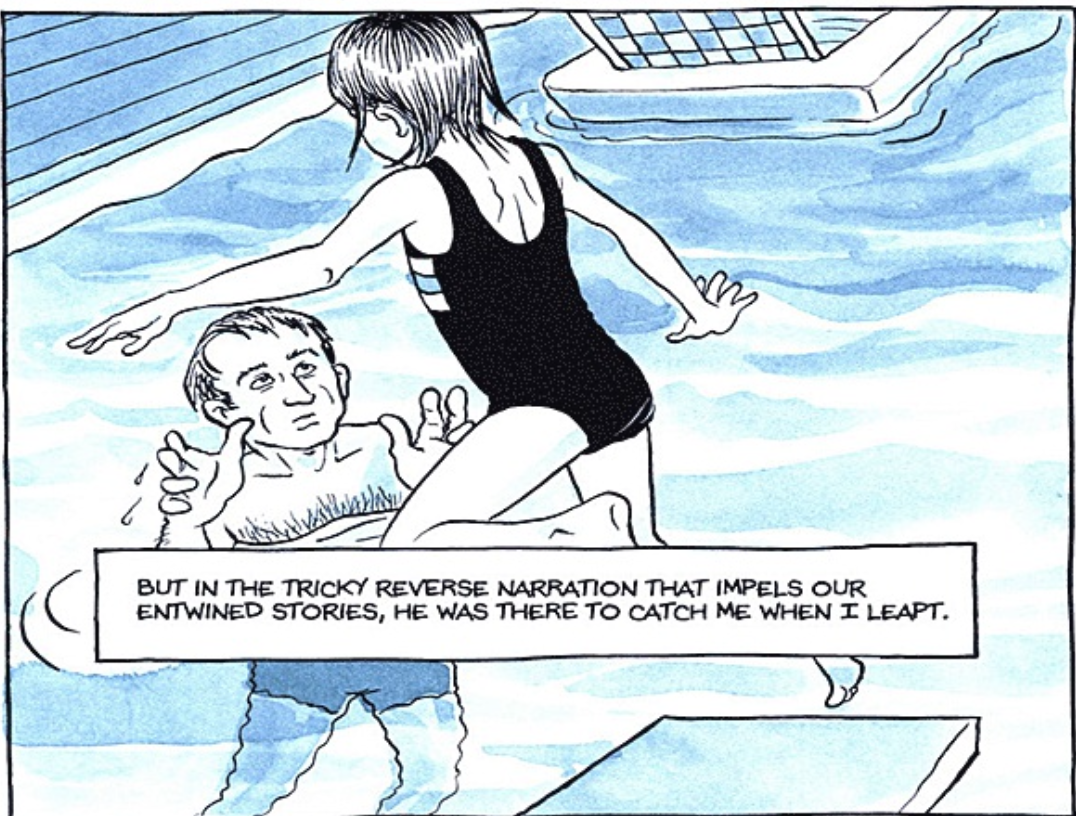
[14] Jennifer Lemberg hypothesizes that a reason Bechdel might have written this book was “proving her father ‘really was there’” (Lemberg 131), and that by going through these old photos of her childhood, she would be able to find a different outcome in how he treated her. There are moments in the book where she does change how events happened. For example, at the beginning of the last chapter, we see a photo of Alison jumping into her father’s arms, and in the last panel, the scene is shown from a different perspective. (Figures 6 & 7) Bechdel argues that even though her father was less than perfect, he was there for her when she needed his support. Even though he was complex, he still raised her and was still her father.
Figure 6 (L) Realistic snapshot of pool scene; Figure 7 (R) that scene from another angle.
[15] The photographs that frame the beginning of the chapters, and also pages 100 and 101, are styled very differently from the rest of the book. These photos are hyper-realistic and drawn in a crosshatch style. These photos are a link between “public appearance and private reality” (Cvetkovich 118). A sexy photo taken by Bruce of the babysitter Roy complicates the picture of Bruce as a loving father on vacation with his family (100-101). Lemberg quotes, “McCloud contends in Understanding Comics that more ‘realistic’ drawings of people convey a sense of absolute ‘otherness’” (Lemberg 135). By putting these pictures at each chapter heading and within the middle of the book, Alison is both closer and further away from her father. Within this narrative, Alison does not allow herself to hide like her father and all this hiding from him makes her feel more alone. These photographs perhaps bring her closer to her father though he would probably approve more of her realistic drawing style than her cartoon style. Bechdel says that “These are photos that feel particularly mythic to me, that carry a lot of meaning” (Bechdel 1009). To Bechdel these photos act as an anchor and a reminder that this happened to her family, that this is real life.
[16] Throughout this story, Alison’s formative years are on display, and we learn how her father’s death has affected her. The fight with her father over literature is perhaps one of the reasons why the book is so packed with material. She wants to prove to her father how well-read she is, and further spites her father by choosing to use color in her drawings (Bechdel 1012). Throughout these packed pages, Bechdel manages to still have a clear and connected artistic vision. The colors are consistent, the spreads normally only spread over one page, and the font is the same. She leaves little space between the panels. Comics usually have spaces in order to “allow the reader to create meaning and cohesion out of the panel…” (Fantasia 94). Bechdel instead opts to pack things in, not allowing a reader to settle in, and instead bombards the reader with literary allusions that Bruce might’ve sprung on his daughter. Bechdel fights her father posthumously, longing for a childhood filled with light instead of neuroses.
[17] Both Alison Bechdel and Linda Barry burden their readers with information. Linda Barry’s What It Is (2008) also deals with childhood trauma, specifically with her mother equating her to a medusa-like creature. Barry finds solace in Grimm fairy tales and the television. Like Bechdel, she longs to control her narrative, but instead of a calculated neat illustration, Barry decides to go back to her messy childhood. This crazy exploration of questions alongside the narrative of Barry’s childhood feels like an explosion. Barry uses collage to form beautiful scenes, putting newspaper clippings over cut-out and hand-drawn monsters and creatures, all on yellow legal paper. Later, her book evolves into a guide on writing exercises, seemingly abandoning the overarching story. This is because she is showing how her childhood has influenced what she does now. She allows the readers to learn from her, not just about her. Unlike Fun Home, a child could pick up What It Is and think it’s just another picture book. Similarly, both Barry and Bechdel layer text upon text. Barry and Bechdel fight the stylistically plain woodcut novels, showing the evolution of these novels and how graphic novels could look.
[18] The bildungsroman helps readers trace a thread through the evolution of graphic novels and allows us to examine how this structure frames childhood. All of these visual books deal with trauma in and around children or childhood. As time went on, pictures and text also became more complicated. From Masereel and Ward’s emphasis on revolution to Bechdel and Barry’s emphasis on acceptance and growth, we can see themes of empowerment running through the timelines, showing that whether it be a world war or a war with yourself, growing up is rather difficult. We can see in this evolution of the graphic novel an evolving depiction of the complexities of childhood.
Antonsen, Lasse B. 2004. “Frans Masereel: Passionate Journey.” Harvard Review, no. 27, pp.
154–55. JSTOR, http://www.jstor.org/stable/27568954. Accessed 4 Dec. 2022.
Ayres, Jackson. 2016. “Introduction: Comics and Modernism.” Journal of Modern Literature, vol. 39, no. 2, pp. 111–14. JSTOR, https://doi.org/10.2979/jmodelite.39.2.08. Accessed 4 Dec. 2022.
Ball, David M. 2016. “Lynd Ward’s Modernist ‘Novels in Woodcuts’: Graphic Narratives Lost Between Art History and Literature.” Journal of Modern Literature, vol. 39, no. 2, pp. 126–43.= JSTOR, https://doi.org/10.2979/jmodelite.39.2.10. Accessed 4 Dec. 2022.
Bechdel, Alison. 2006. Fun Home: A Family Tragicomic. Boston and New York, Houghton Mifflin Harcourt.
Bechdel, Alison, and Hillary Chute. 2006. “AN INTERVIEW WITH ALISON BECHDEL.” Modern Fiction Studies, vol. 52, no. 4, pp. 1004–13. JSTOR, http://www.jstor.org/stable/26286681. Accessed 4 Dec. 2022.
Beronä, David A. 2003. “Wordless Novels in Woodcuts.” Print Quarterly, vol. 20, no. 1, pp. 61–73. JSTOR, http://www.jstor.org/stable/41826477. Accessed 4 Dec. 2022.
Cvetkovich, Ann. 2008. “Drawing the Archive in Alison Bechdel’s ‘Fun Home.’” Women’s Studies Quarterly, vol. 36, no. 1/2, pp. 111–28. JSTOR, http://www.jstor.org/stable/27649738. Accessed 4 Dec. 2022.
Fantasia, Annette. 2011. “The Paterian Bildungsroman Reenvisioned: ‘Brain-Building’ In Alison Bechdel’s Fun Home: A Family Tragicomic.” Criticism, vol. 53, no. 1, pp. 83–97. JSTOR, http://www.jstor.org/stable/23131556. Accessed 4 Dec. 2022.
Hatfield, Charles. 2011. “Graphic Novel.” Keywords for Children's Literature, edited by Philip Nel and Lissa Paul, NYU Press, pp. 100–05. JSTOR, http://www.jstor.org/stable/j.ctt9qg46g.25. Accessed 4 Dec. 2022.
Herb, Steven L. 2013. “The Graphic World Of Lynd Ward.” Archives of American Art Journal, vol. 52, no. 3/4, 2013, pp. 10–15. JSTOR, http://www.jstor.org/stable/43155512. Accessed 4 Dec. 2022.
Hirsch, Marianne. 2012. The Generation of Postmemory: Writing and Visual Culture After the Holocaust. Columbia University Press. JSTOR, http://www.jstor.org/stable/10.7312/hirs15652. Accessed 3 Dec. 2022.
Lemberg, Jennifer. 2008. “Closing the Gap in Alison Bechdel’s ‘Fun Home.’” Women’s Studies Quarterly, vol. 36, no. 1/2, pp. 129–40. JSTOR, http://www.jstor.org/stable/27649739. Accessed 4 Dec. 2022.
Masereel, Frans, and Beronä David A. 2009. “The Idea.” The Sun ; the Idea ; &, Story without Words: Three Graphic Novels, Dover Publications, Inc., Mineola, NY, NY.
Painter, Helen W. 1962. “Lynd Ward: Artist, Writer, and Scholar.” Elementary English, vol. 39, no. 7, pp. 663–71. JSTOR, http://www.jstor.org/stable/41385356. Accessed 4 Dec. 2022.
Serafini, Frank. 2014. “Exploring Wordless Picture Books.” The Reading Teacher, vol. 68, no. 1, pp. 24–26. JSTOR, http://www.jstor.org/stable/24573665. Accessed 4 Dec. 2022.
Ward, Lynd, and David A Beronä. 2010. Prelude to a Million Years & Song Without Words : Two Graphic Novels. Dover ed. Mineola, New York: Dover Publications.
Willett, Perry. 2005. “The Cutting Edge of German Expressionism: The Woodcut Novel of Frans Masereel and Its Influences.” A Companion to the Literature of German Expressionism, edited by Neil H. Donahue, NED-New edition, Boydell & Brewer, pp. 111–34. JSTOR, http://www.jstor.org/stable/10.7722/j.ctt169wfmh.10. Accessed 4 Dec. 2022.