[0.1] Abstract - The Idea (1920) by Flemish artist Frans Masereel, Song Without Words (1936) by American artist Lynd Ward, and Fun Home by American artist Alison Bechdel, build off of one another chronologically but also retain tactics characteristic of of the graphic narrative, while handling these themes of politics, ideology, and the sexuality of the female body, connecting these themes into an idea of how life is brought into the world.
[0.2] Keywords - picture stories, graphic novel, woodcut novel, female body
Suarez, Desire. 2024. “The Female Body as a Vessel for Social Commentary and Sexuality,” Wings Of Fire. Volume 1, No. 1.
[1] As wordless novels evolve into graphic novels, the addition of words to the images creates an extremely different experience. This can clarify a narrative structure set up by the author, as seen in works like Fun Home: A Family Tragicomic (2006) by Alison Bechdel, or clarify the themes the author is communicating, as in Lynda Barry’s What It Is (2008). On the other hand, the omission of words, as seen in earlier forms, can contribute to a wider interpretation of not only narrative but thematic elements, as in works like Passionate Journey (1919), and Wild Pilgrimage (1932), by Frans Masereel and Lynd Ward, respectively. But what stands out in the history of these picture books is the prevalence of certain themes, no matter their ambiguity within the work or role in the narrative, across the time periods of the 1920’s through the early 2000’s. There have been ventures by Ward, Masereel, and Bechdel alike into the themes of sexuality, gender, and how they relate to politics, and also the relationship of these things to capitalism as it buds through the eras of European and American society alike. The Idea (1920) by Flemish artist Frans Masereel, Song Without Words (1936) by American artist Lynd Ward, and Fun Home by American artist Alison Bechdel, build off of one another chronologically but also retain tactics characteristic of of the graphic narrative, while handling these themes of politics, ideology, and the sexuality of the female body, connecting these themes into an idea of how life is brought into the world. Barbara Postema refers to both Masereel’s and Ward’s work as “socially engaged art” (64), bringing it into a plane of dialogue with the context of societal structures around it. These works raise the idea of the female body as representing a home and simultaneously an open cavity, and ask how that contributes to the perception of family building if that lineage begins with womanhood.
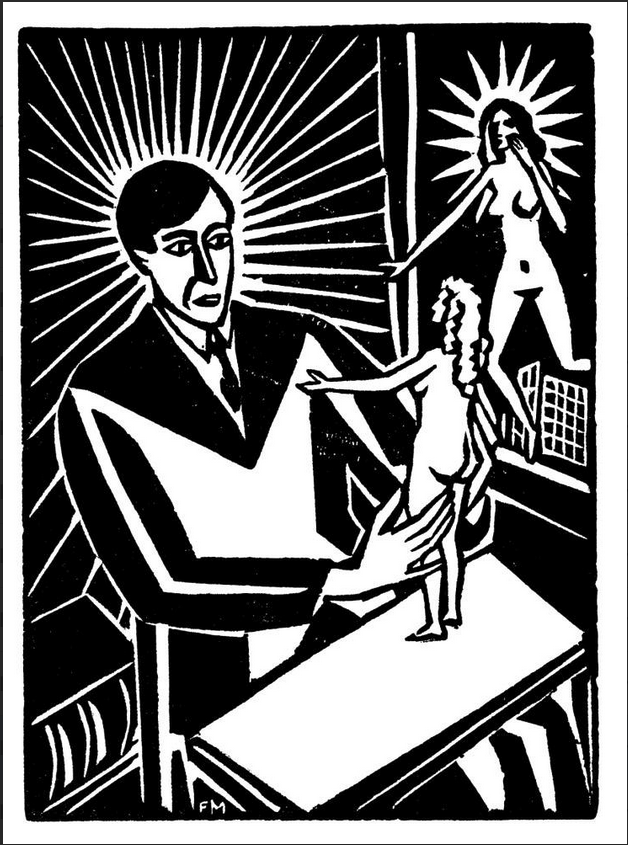
[2] This history of the graphic novel can be said to begin with Masereel’s 1920 novel The Idea. Frans Masereel was born in Belgium in the year 1889, and studied art in Paris before being exiled to Switzerland during World War I. His “drawings and woodcuts… made an ‘accusation against those in power,’ as Roger Avermaete writes, indicting the politicians, businessmen and arms manufacturers who profited from the war (18)” (Scott 26). Masereel’s black and white style critiqued the politics of the party systems, and the political climate thus impacted his work. In The Idea, he critiques the dominant male figures through the spectacle of the objectified female body. The Idea follows a creator and his idea, which materializes into physical reality from his head as a female bodied naked figure, with long dark hair (Figure 1).
Figure 1, the Idea springs from the artist’s head in The Idea
[3] He proceeds to nurture and hug her, going on to kiss her, but she stops him, and steps away onto the desk in front of him, waving a finger at him, indicating a refusal of this affection. The following images show him sending her off (tearfully) in an envelope, and the story becomes about his journey of longing to find her and her desire to get away, and the thwarting of the attention of other men in the pursuit. This story begins with a man materializing an idealized female body, slender, small, and able to be manipulated, and this theme is recurrent throughout the story. David A.Verona denotes Masereel’s style of socially related commerce commentary as “the continuing industrialization of society after the end of the war” (qtd. in Postema 62-63), and this can be seen as the female body becomes a commodity to be had in the story. This lack of autonomy is a form of trauma and one which The Idea relives throughout the story. This trauma is palpable to the audience, as she continually attempts to claim any sense of agency she can. Time after time she fails, as she is used (Masereel 28), hunted (61), trapped (52, 60), reproduced (55), and abused (14, 15). She also does gain agency in some cases, only to have it again stripped away. Hillary L. Chute discusses this repetition of trauma in her introduction to Graphic Women, stating that many graphic novelists “return to events to literally re-view them, and in doing so, they productively point to the female subject as both an object of looking and a creator of looking and sight” (2).
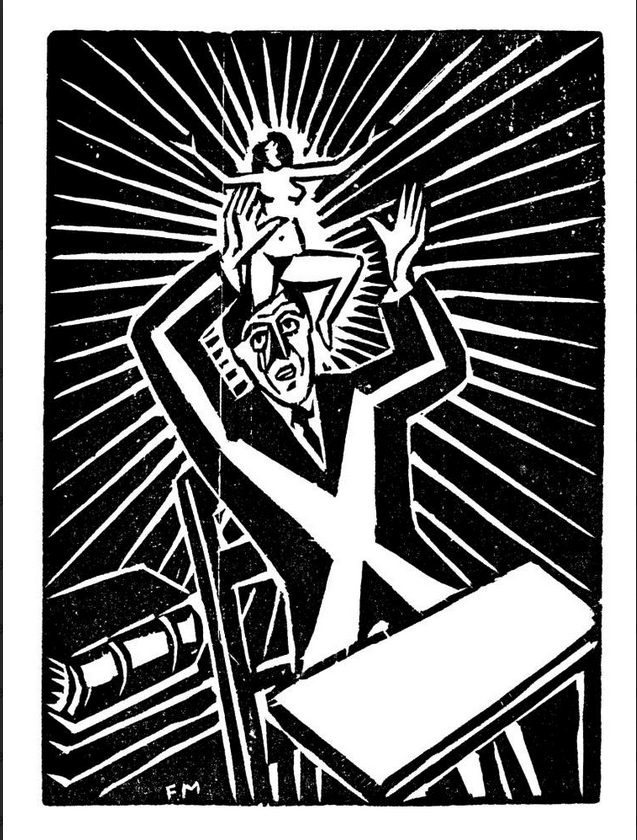
[4] To understand the female body and character as an object whose purpose is to be viewed and to be the highest example of what it means to view, means the woman must be adept in her powers of observation and of silent attentiveness. This is an ideal challenged not only by Masereel’s objectified women, but of Alison Bechdel in her work Fun Home, which upends the agency of the female body and female voice, as Bechdel’s main character is not a completely gender-conforming woman. Masereel also draws our attention to gender in The Idea, contrasting the dominant male figures in his images with the actions being carried out by The Idea and using their cartooned and satirical expressions (50) to communicate the irony and absurdity of the events of the story. However, it is not enough to comment on the commodified body of The Idea; we must also inquire into how it is passed down. The Idea’s plights seem to repeat when the artist has a new Idea, her trauma reiterated in a new version, the only difference between the old version and the new version being the new Idea’s blonde, curly hair (82). (See Figure 2)
Figure 2, The Idea sees the Artist and his New Idea
[5] This implies that these traumatic experiences don’t end and instead are passed down, creating a link between the two Ideas and their representation of the entirety of women. Their bodies are allegorical to free real estate. They are sold, bought, and claimed by the hands of men. Grant Scott argues that the female body is used as an aesthetic, depicted in a simplistic way to become an easily imprinted upon artifact. In his book Lynd Ward’s Wordless Novels, 1929-1937, Scott describes the “female figure that stands for the author’s thought” as “subject to multiple forms of harassment and control as various male authorities…restrain, subdue, cover, clothe, domesticate, capture, imprison and police her” (185). The Idea is literally birthed by thought of the stand-in-for-Masereel protagonist of The Idea.
[6] Lynd Ward builds on Masereel’s social commentary on capitalism and the commodification of life, i.e the female body as an object to be consumed, but the reiteration of the process is explicitly questioned as Ward’s protagonist’s plotline unravels. Ward was born in 1905 in Chicago, Illinois, and his father was a prominent professor and Communist. Political dealings were a large part of his life from the very start, even though he never publicly declared absolute sympathy with, or an objection to, his father’s views. He, however, doesn’t shy away from the political in his work, and eventually developed the idea of the “evils” of prostitution, “representing it as a byproduct of the urban environment that dehumanizes the factory worker” (Scott 24). In this, Ward draws from German expressionism in theory as well as form, similar to Masereel. We can connect the female nudity in Ward’s Song Without Words (1937) back to The Idea, as The Idea’s body is subject to a sort of prostitution as it is used, and handled against her will, for profit and for the satisfactions of her creator.
[7] Grant Scott compares Ward’s novel Song Without Words to Masereel’s work: “Masereel’s heroine is naked as a function of the male artist’s original idea, Song figures nakedness as a fundamental existential state” (Scott 160). Ward’s first image of the characters shows the female character cupping her breasts, already establishing a certain control and connection she has to her own body, as her male counterpart snoozes in the background. She also is bigger than him, shown strongly upright in the foreground of the image, viewing her own body as she holds it. Ward’s images also diverge from the structure of Masereel’s work, in the art style and the framing of the wood engravings. The figures are more realistic, with shadows and crosshatching revealing textured skin, and the framings appear off-kilter, with unequal and not-quite-parallel borders, making rounded images, stripping the strictly boxed pictures typically seen in earlier works. While Masereel’s commentary of capitalist structures through the depiction of supply and demand use only The Idea as an object of commerce, Ward again travels along the avenue of offspring, and children.
[8] Before getting into the question of lineage, one must look at the contrasts of nudity between The Idea and Song. Santiago García has distinguished the “rounded simplicity of Masereel and the sophisticated lines of Ward,” and Beronä writes that Ward was “less explicit in his portrayal of sex than Masereel” (Fraser 56). We will see a stark difference when jumping into Bechdel’s work with Fun Home, however the nudity in The Idea and Song play different roles in the narrative. The former aims to connect a sense of control to the viewing of her body. Whether or not The Idea wears clothes or is allowed to choose if she may or may not wear clothes, or who touches her, where they touch her, and how many hands are on her, are all aspects to be observed. As mentioned, her body's universality as an object becomes a large theme here. Yet, with Song, the naked body is not for the consumption or control of other characters or figures in the story, it is only a house for the feminine and maternal figure being represented. She is seen dealing with inner turmoil, and while there is violence, it is inflicted upon other beings in the story: for example the baby impaled on a sword (15), or the implied violence against the children in the concentration camp (11). She is seen in anguish, hands to her temple, face twisted in agony, due to a different, invisible pain. She is dealing with something larger than physical trauma, which is not to subdue the matter, but to communicate the scale of generational trauma. Her body is feeling in a human way that readers can relate to, unlike The Idea, who endures violence meant to represent a commentary of industrial affairs, and not her personal plights. It is clear there is a quality of suffering that is complicated by the time period and world events, as Masereel is commenting on how the World War I era influences the power dynamics of the West while Ward utilizes the Holocaust as a more specific cause of personal tribulations.
[9] Coming back to lineage, The Idea’s reiterations and reproductions repeat her trauma, and the protagonist of Song Without Words experiences visions that express fear of bringing another life into the world, through images that show children in concentration camps, calling back to the eleventh image, that features the insignia of a swastika next to barbed wire. This brings in this historical moment and raises the question of how to bring a child into a world of such violence and horror? How do you allow a life to begin, knowing what it will encounter in the future? The children in the image look to her with wide eyes, and our protagonist is seen, chin downward, hands behind her back, clearly troubled and seething with an intensity that transcends her body. It attaches to her a purpose, and motive in the narrative, that is disconnected from her relationship to man as a singular facet of physical relationships. It brings about a larger call to humanity, and the female body as a witness to violence and not only a victim to it.
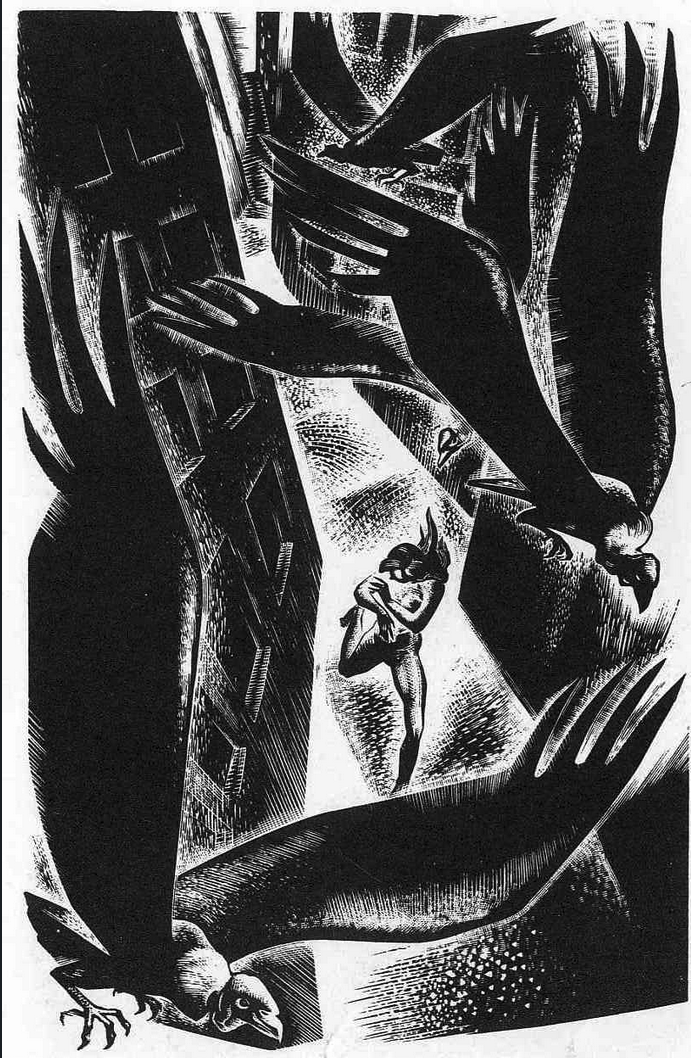
[10] Scott also sees Ward’s female protagonist as having agency (see Figure 3):
[11] Ward resists portraying his heroine as nude, as a sexualized or aestheticized…Instead, he nearly always depicts her in action, whether walking, running, or even thrusting her fist in the air, movements of body that defy the stasis of the conventionally represented female form and define her as an independent agent (Scott 160).
Figure 3, the active woman in Ward’s Song Without Words
[12] This female agency blooms in Song and continues to grow in Alison Bechdel’s work as “the world was ready to accept a comic as a book, and a queer story as a human story” (Bechdel qtd. in Hall 299). Alison Bechdel’s 2006 tragicomic Fun Home marks another monumental moment in the development of graphic narrative. While Bechdel was not the first and certainly isn’t the last woman author, she marks an important milestone of queer stories in a heteronormative world. This queer conception changes the foundation for the narrative as a genre and the use of the female body is inexplicably changed because it was drawn by the hands of a woman and not a man. As Valeria Rohy outlines in her essay “In the Queer Archive: Fun Home” she recalls Bechdel’s work as tracing “a queer genealogy” (Rohy 341), transforming the meaning of the body, and the meaning of agency, by taking control of how the story of trauma is told, how the female body is portrayed and what that means thematically for the story. Bechdel’s depiction of the naked female body grows throughout the novel and our first glimpse of a naked protagonist is on page 22, where a child Alison is shown being bathed by her father. Her belly is rounded and with short hair, she looks more androgynous in these panels, as prepubescent bodies do not have any markers above the waist differentiating their gender. The next naked body we see is the first cadaver Alison sees, an older man, and in this image we see his penis. The bodies to this point are not sexualized, and the nudity is meant to communicate the experience of humanity as an “existential state” (Scott 160). But as the first sex scene appears, we see a new side of the female experience as pleasure is introduced. Alison is seen at college age with her girlfriend, Joan, as they discover not only each other’s bodies, but theorize about the link between pleasure and literary freedom (80-81). They find agency in their own bodies, and Bechdel’s depiction of the sexual is not drawn for the visual pleasure of audiences. This framing of the female queer body allows a deeper analysis into the portrayal of female nudity.
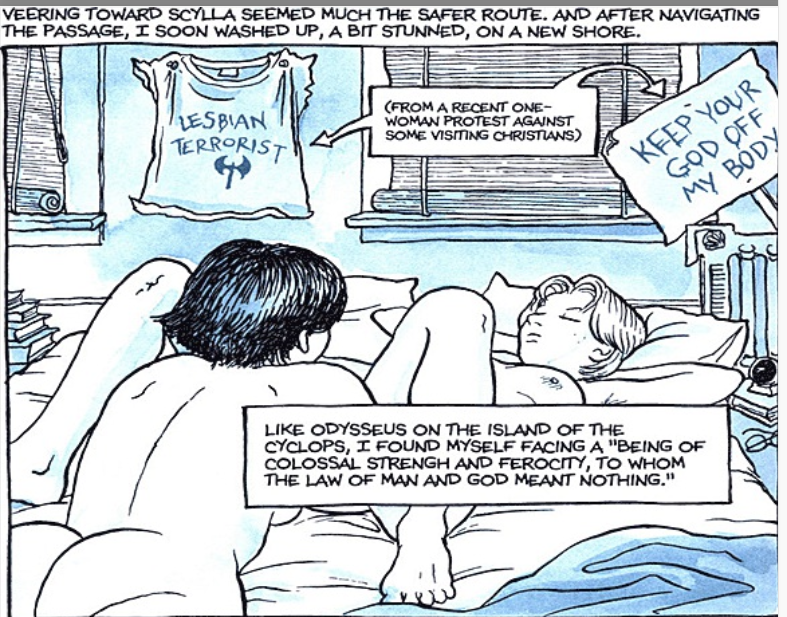
[13] Laura Doan and Sarah Waters suggest that “retrospection is a condition of homosexual agency” (qtd. in Rohy 343). So again we revisit the subject of female sexuality and nudity in the graphic novel. On page 214, Alison and Joan are again engaged in sexual activity, but the bedroom is decorated with a sign and t-shirt in the background that are designated as belonging to Joan from a “recent one-woman protest” (214) that say “Keep Your God Off My Body” and “Lesbian Terrorist.” The caption says, “Like Odysseus on the island of the cyclops, I found myself facing a ‘being of colossal strength and ferocity, to whom the law of man and god meant nothing.’” (Figure 4)
Figure 4, Lesbian reverie in Fun Home
[14] At the bottom left, we get a panel of Alison looking at Joan’s vagina before proceeding in carrying out giving oral sex, and the text now says, “In heroic fashion, I moved toward the thing I feared,” and as she is peering at Joan’s vagina, it is implied what exactly she fears. The female body now becomes a “colossal strength” that transcends law and god, as Bechdel raises lesbianism to a status it doesn’t often get: reverie. Bechdel builds upon her predecessors by evolving her mind and not only intertwining the ideas of faith, law, and familial structures, but she “also exemplifies feminism’s third-wave goal of including the LGBTQ community, in contrast with earlier critiques that second-wave feminist movement held something of a myopic heterosexism” (Kirtley 278). Bechdel’s exploration into female sexuality doesn’t commodify the woman, and instead depicts the naked body as not inherently sexual but as Ward does, as an “existential state” (Scott) of existing. Her use of the female body as an image isn’t defined by its literal form or by definitions specific to male ideologies. Bechdel utilized the graphic narrative form to enhance her story, and “adroitly used the complexity of the graphic-novel medium in ways that parallel the queerness of the subject matter” (Hall 299). Bechdel leaves room for more philosophical queries into the feminine and expresses a theorizing of sexuality into pleasure and finding agency in the body.
[15] To wrap up the findings in this particular study, graphic narratives have evolved in form and content as they expand to reflect the growing representation of bodies and sexualities in a modernized world. Peter Kuper has written that the lack of words in wordless novels requires “the reader to decipher what has taken place, then connect the dots from one image to the next. Though these stories can be quickly scanned and comprehended, what they offer grows with repeated viewing” (qtd. in Fraser 57). What Bechdel has built weaves this treasuresque picture style with prose text that coalesces a novel within a graphic narrative. The expansion of this form is not only technical, but we can see the metamorphosis of the female body as an independent agent through Masereel’s Idea, through Ward’s mother figure, and into Bechdel’s own rendering of herself and Joan. Another aspect of agency can be seen in the naming, specifically of the characters of Alison and Joan. The female body as a product to be produced and sold relies on its generic rendering, and the more specificity a character has, the less generic it becomes. This individuality situates the woman's voice and body in time, making space in history as an entire being and entity, and not only through association with men. The female body is more than sexuality, and more than a maternal being, and as the artform progresses, so does the construction of female characters and their stories, making room for more women authors to come, and countering the centuries of male depiction and control of female stories.
Fraser, Benjamin. 2020. “The Passions of Everyday Urban Life.” Visible Cities, Global Comics: Urban Images and Spatial Form, University Press of Mississippi, Jackson, pp. 51–95.
Hall, Justin. 2018. “The Secret Origins of LBGTQ Graphic Novels.” The Cambridge History of the Graphic Novel, edited by Jan Baetens et al., Cambridge University Press, Cambridge,, pp. 286–302.
Kirtley, Susan. 2018. “‘A Word to You Feminist Women’: The Parallel Legacies of Feminism and Underground Comics.” The Cambridge History of the Graphic Novel, edited by Jan Baetens et al., Cambridge University Press, Cambridge, pp. 269–285.
Postema, Barbara. 2018. “Long-Length Wordless Books: Frans Masereel, Milt Gross, Lynd Ward, and Beyond.” The Cambridge History of the Graphic Novel, edited by Jan Baetens et al., Cambridge University Press, Cambridge, pp. 59–74.
Rohy, Valerie. 2010. "In the Queer Archive: Fun Home." GLQ: A Journal of Lesbian and Gay Studies, vol. 16 no. 3, p. iv-361. Project MUSE muse.jhu.edu/article/382220.
Scott, Grant F. 2022. Lynd Ward's Wordless Novels, 1929-1937: Visual Narrative, Cultural Politics, Homoeroticism, Routledge, Taylor & Francis Group, New York.