[0.1] Abstract - The nude female body is a common thread throughout the picture stories Passionate Journey (1919) by Frans Masereel, Song Without Words (1936) by Lynd Ward, and Fun Home (2006) by Alison Bechdel. This collection of graphic stories not only represents how the picture story itself has evolved, but also shows how the depiction of the naked female form has evolved with them.
[0.2] Keywords - picture stories, graphic novel, woodcut novel, female body
Sloan, Peyton. 2024. “Legacy of the Naked Female Body: An Analysis of Masereel’s Passionate Journey, Ward’s Song Without Words, and Bechdel’s Fun Home,” Wings of Fire. Volume 1, No. 1.
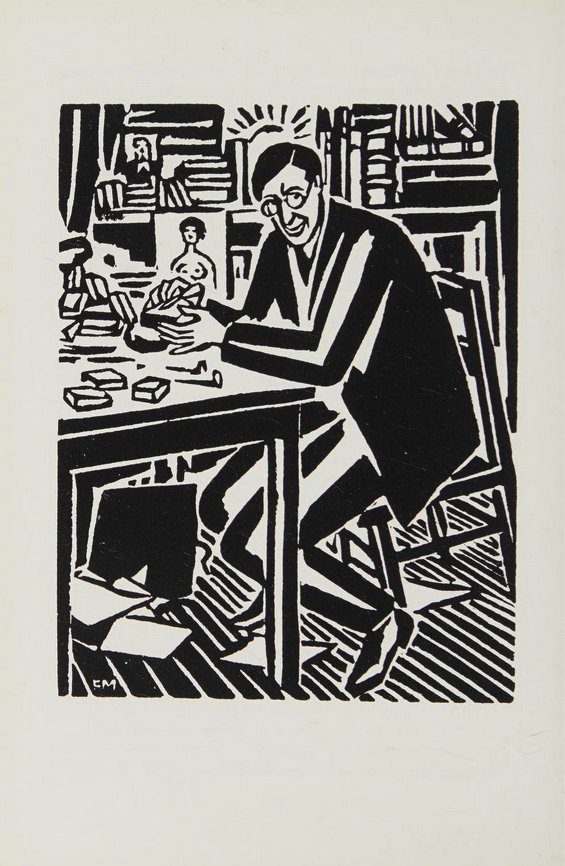
[1] The female body has always been a subject of interest in art. It has remained a common thread throughout the picture stories Passionate Journey (1919) by Frans Masereel, Song Without Words (1936) by Lynd Ward, and Fun Home (2006) by Alison Bechdel despite the varying subjects and forms in which these stories take shape. This collection of graphic stories not only represents how the picture story itself has evolved, but also how the depiction of the naked female form has evolved with them. Frans Masereel, as the creator of the first woodcut novel, set the tone for naked women in picture stories. His numerous graphic, and often shocking, depictions of naked women in his picture stories are a defining characteristic of his work, as demonstrated through his inclusion of a topless woman in the autobiographical carving of himself at his work bench in the beginning of Passionate Journey. (Figure 1) Lynd Ward shared a similar fascination in depicting naked women, but his use of nudity is differentiated from Masereel’s not only in the fewer instances of nudity across his work, but in the clear power he imbues into the naked female form in Song Without Words. Masereel and Ward can be more fairly compared with one another as both of their works take shape in wordless novels and were published in the early twentieth century, but it is still of importance to analyze how their legacies have influenced more modern picture stories like Alison Bechdel’s graphic memoir, Fun Home: A Family Tragicomic (2006). Despite almost a century between the publication years of the wordless novels and the graphic memoir, all of these works are united as they feature some depiction of female nudity. Although they all feature nude content, the physical medium of their picture story, their positioning of nude female bodies, and the narrative purpose of including such nudity differentiate these picture stories and produce different effects. As the picture story shifts from the male-authored woodcut wordless novel to the female authored ink and paper graphic memoir, the naked female body is grounded in reality and becomes demystified.
Figure 1, The image of a topless woman is visible in Frans Masereel’s self portrait
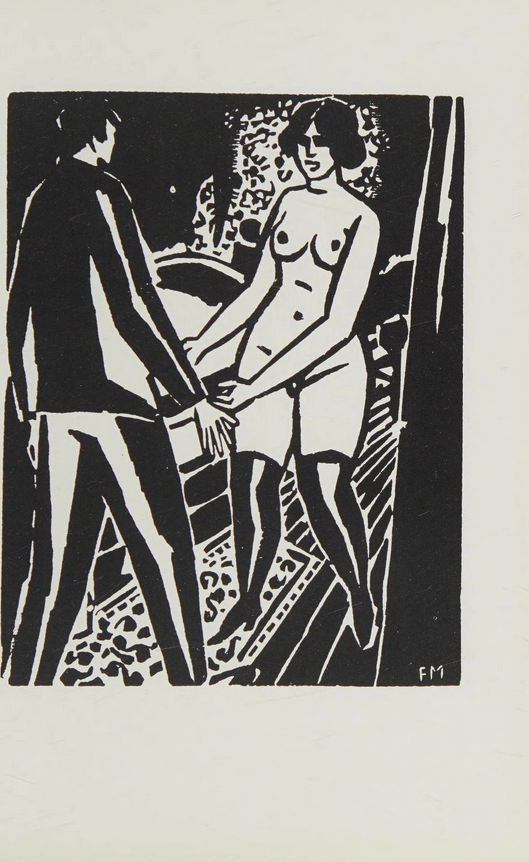
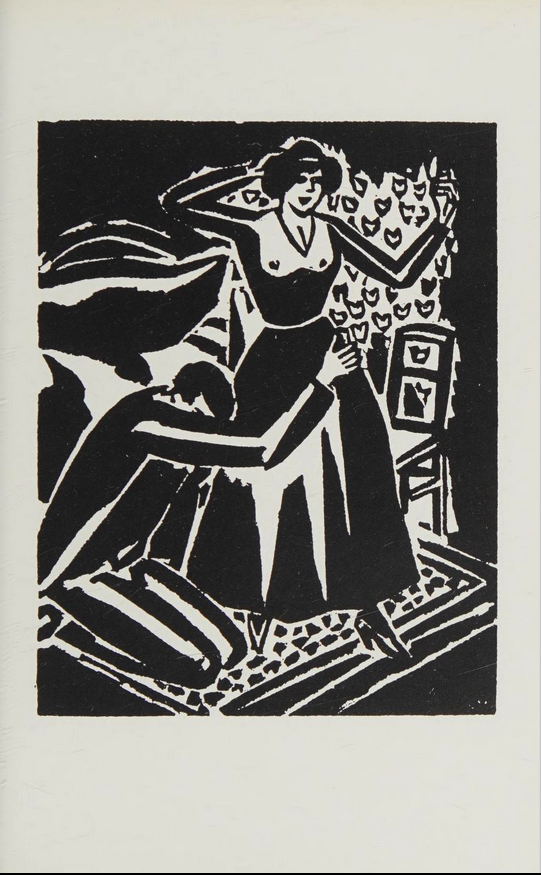
[2] As previously stated, Frans Masereel is the father of the woodcut novel and laid the groundwork for future depictions of female nudity in visual stories. His most famous work, Passionate Journey, was published in 1919 and follows the male protagonist’s journey as he goes through the pleasures and woes of life. During his story, there are several instances of him having sexual relations with women, many of whom are shown topless or with a focus on their chests, their nipples showing through their clothing. (Figures 1 and 2) The depictions of female frontal nudity are quite striking, which is in part due to Masereel’s sharp woodcut medium. Thomas Mann wrote in a preface to the first popular German edition of the novel, “Look at these powerful black-and-white figures, their features etched in light and shadow. You will be captivated from beginning to end” (Willett 116). This artistic style of sharp light and shadow carves the frontal female nudity of Masereel’s work, eliciting a sharp, attention-grabbing design of the female form.
Figure 1, Depiction of a nude woman (l); Figure 2, Clothed woman with nipples indicated (r)
[3] Like the topless woman in his self-portrait that prefaces Passionate Journey, most of these women are carved with sharp black dots for nipples to clearly contrast the whiteness of their breasts. Such hard cuts and features “captivate” the audience’s attention and create a focus on the body, more specifically the chests, of Masereel’s frontally naked female characters in the scope of Passionate Journey.
[4] Not all nudity is created with sexual intent, but it can still be perceived with a sexual gaze. Published in the Journal of Sex Research, a 2013 study by James K. Beggan, Jennifer A. Vencill, and Sheila Garos analyzes the presentation of male and female nude models in Viva and Playboy, 1970s magazines that focused on publishing frontal male and female nudity respectively to be consumed by female and male audiences respectively. Beggan, Vencill, and Garos investigated the male and female gaze in pornography, specifically in the gaze of the nude models. They found that “[w]hen their pubic area was exposed, male models in Viva avoided direct gaze, whereas Playboy Playmates were especially likely to gaze directly at the camera. Playmates also displayed a strong tendency to make eye contact when they were topless” (Beggan et. al). Overall, they noted that nearly all Playboy Playmate female models looked directly into the camera while most nude male Viva models averted their gaze, which indicates that the heterosexual pornographic male gaze seems to include eye contact with the female model while the female pornographic gaze involves gaze aversion with the male model. The effects of this gaze’s directness and avoidance are debatable since such posing can elicit varying degrees of dominance, submissiveness, sexual interest and availability from the model (Beggan et. al.). I include these findings not to suggest that all female nudity in picture stories is represented with pornographic intent or effect, but to better understand how the sexual male and female gaze allows for an analysis of such nudity and the possible sexual context or perception of its inclusion.
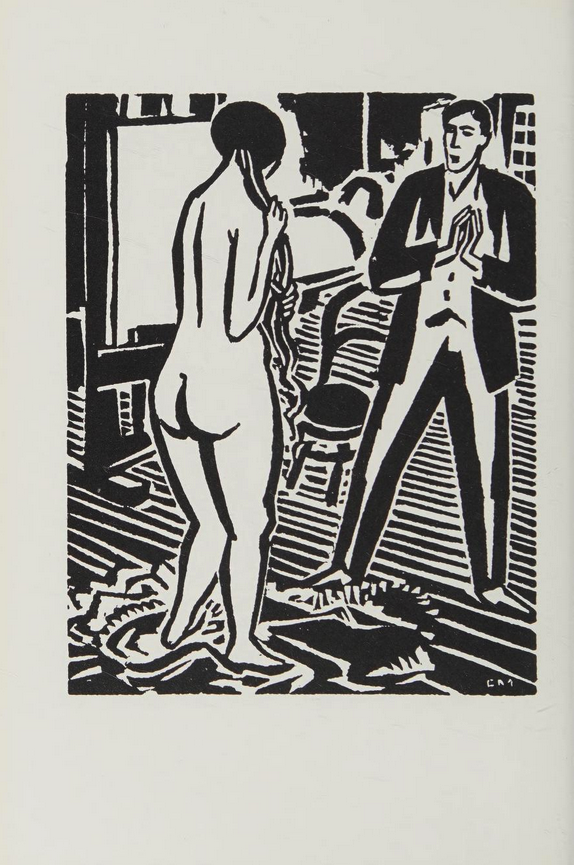
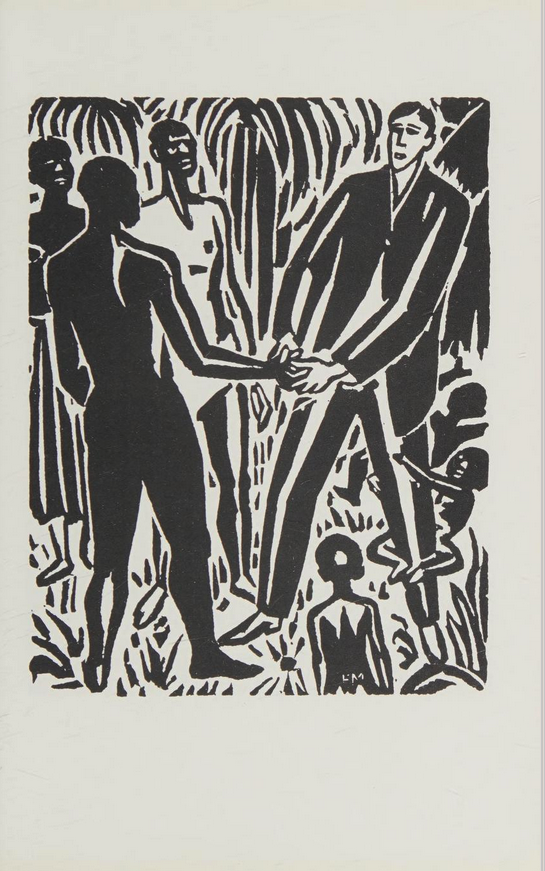
[5] It is uncertain if Masereel carved his strikingly nude women for pornographic purposes or with any explicit knowledge of the sexual male gaze, but some of Beggan, Vencill, and Garos’s findings appear to be reflected in his posing of the women. While the naked women of Passionate Journey do not look directly at the reader, they are still forward facing or posed in such a way that their frontal nudity is visible. The sexual nature of this female nudity is only interrupted by the inclusion of the young girl who grows up into the long-haired woman who bares herself to the protagonist, but not the audience (Masereel 87). (Figure 4) Masereel overall does not illustrate the protagonist and the long-haired woman’s relationship as overtly sexual, but as more genuinely loving. A part of the non-sexual nature of this relationship is thus illustrated in Masereel’s breaking of the male pornographic gaze by having the long-haired woman’s back turned to the reader to completely break any eye contact.
Figure 4, Nude woman with her back to the reader
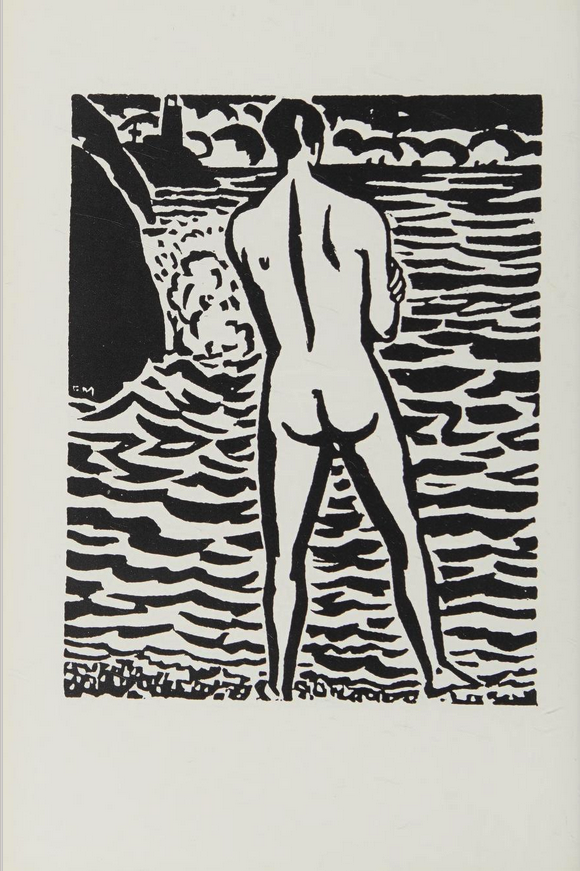
[6] The attention that Masereel calls to the women’s frontal nudity is expanded by his effective censoring of the few instances of male nudity in the novel. In one panel, the protagonist stands naked and facing the ocean to leave only his rear nudity visible to the reader (Masereel 99). Masereel also strategically poses a tribe of naked men to cover their frontal nudity and utilizes shadows to hide their rear nudity (Masereel 112). (Figures 5 and 6) While these nude male characters are posed with gaze aversion, they still do not fully fit into the female pornographic gaze since their frontal nudity is covered and therefore can be interpreted as being posed without any sexual context. Through this posing as well as the evaluation of the male pornographic gaze, it can be argued that the exposed front-facing women of Passionate Journey are meant to be seen in a sexual or pleasurable context.
Figures 5 and 6, Frontal nudity is obfuscated in Passionate Journey
[7] Masereel draws attention to the bodies of his nude front-facing women through a multitude of factors in his artwork. His woodcut medium, his striking art style that highlights the light and darkness of their nude form, his front-facing posing of women which appeals to the male pornographic gaze, and his unequal censoring of male nudity which fails to appeal to the female pornographic gaze all combine to draw attention to the female form rather than to the women themselves. In a 2022 study published in the American Journal of Cultural Sociology, Michaël Berghman, Thomas Calkins, Koen van Eijck and Yu-Chin Her investigated the public reception of male and female nude photography in heterosexual male and female audiences. These researchers found that “[f]emale nudity is liked better at any level of sexual conservativeness” and that “[b]oth men and women express a preference for female nudity, but this is far more pronounced among men” (Berghman et. al. 438). As with the Journal of Sex Research study, I am not claiming that Masereel was aware of these ideas, but his work was still probably influenced by these sociological factors, since female nudity catered to heterosexual male tastes appeals to the widest possible audience. Due to these factors, Masereel’s depiction of female nudity overall places heavy emphasis and arguably objectifying focus on the female body itself, which was likely meant to grab the attention and interest of a male heterosexual audience.
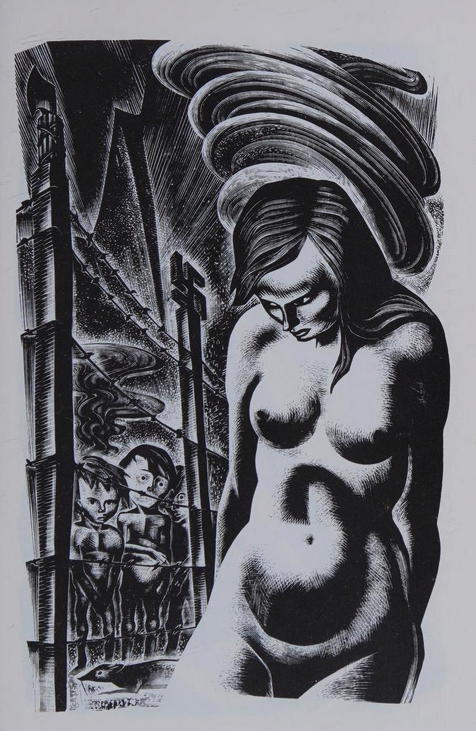
[8] Lynd Ward was influenced by Masereel’s work as he developed his own wordless novels, but his female nudity is distinguished from his predecessor. Ward did not rely on depicting female nudity in his stories like Masereel did. His work Song Without Words contains the most female nudity, as it follows a naked female protagonist as she journeys through the horrific world of a fascist regime and contemplates having a baby in such an unjust world. The first clear distinction from Masereel is in Ward’s shadowy, cross-hatched art style. Despite both artists carving woodblocks, Ward utilizes shadow to soften and complicate his depiction of the female form compared to Masereel’s more simple and striking black and white carvings. The protagonist’s naked front is illustrated the most clearly and explicitly to the reader as she stands outside a concentration camp of naked children (Ward 11). (Figure 7) Shadows curve around the muscles of her arm, stomach, breasts, and sex which give her body dimension and blend her breasts and sex into the rest of her body so her bare intimate parts do not draw the same attention as Masereel’s black nipple dots. Ward does not carve in such a striking manner, which consequently does not draw the same attention to the bare intimate parts of the female form like Masereel.
Figure 7, Ward’s female protagonist in Song Without Words
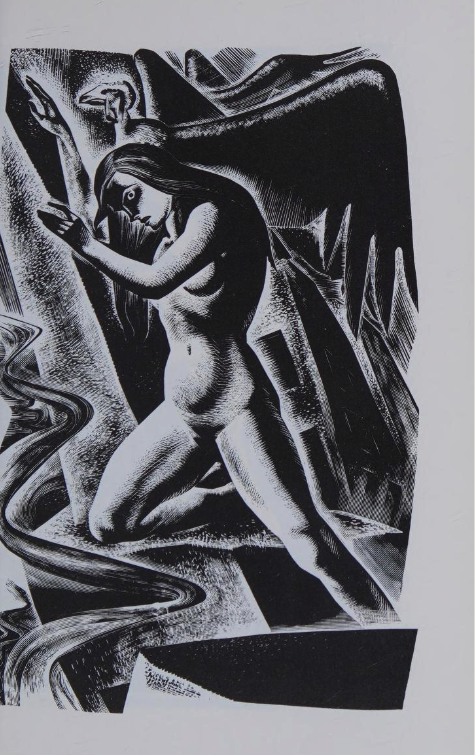
[9] In Figure 7, Ward’s female protagonist is facing the reader and so is most similar to Masereel’s front-facing posing. Elsewhere in the novel, Ward poses her more dynamically. Her arms and legs cover her as she runs through the city and weeps, her shadowy back is often turned to the reader, and she is posed in a variety of ways so that the audience is able to see all angles of her body as she moves throughout the story. We get a more diverse, complete view of her rather than just her front or back. She rarely looks forward as her attention is mostly kept in the realm of witnessing the fascist regime. Even in Figure 7, where her frontal nudity is most visible, her attention is kept strictly to the side and on the children. Elsewhere, however, she does look directly at the reader. Her arm covers her breasts and shadows cover her sex so that they are concealed from the reader as her shadowy face stares directly at us with an angry wrath that parallels Alexandre Cabanel’s Fallen Angel as a vulture behind her gives the illusion of wings (Ward 8). (Figure 8) Though she is nude and maintains eye contact, she does not appeal to the male pornographic gaze and is posed in a non-sexual manner like the naked men of Passionate Journey. She is posed with a dynamic variety to illustrate her anger and imbue her naked form with a gravity and power that Masereel’s simply carved front and back facing women did not achieve.
Figure 8, Ward’s protagonist is nude but not sexualized
[10] Ward is able to give depth to his naked female protagonist beyond her naked form through her poses and through his crafting of the fascist regime. She is not the only naked person in this world, as children are seen naked and starving in the camps, she sees another nude woman give birth, and the protagonist’s male partner is also nude. This creates an equality and purpose to the nudity of Ward’s story that allows the reader to clearly perceive the protagonist beyond her body. Nudity appears to be used as a metaphorical vulnerability to the clothed fascist regime rather than a simple indicator of sexuality, sex work or relationship development as in Passionate Journey. Ward quite literally complicates his female character through his shaded design and posing of her body, effectively evolving female nudity in woodcuts from attention grabbing bodies to facets of complex characters.
[11] While Ward may not have been so clearly influenced by the male sexual gaze as Masereel, it is possible that he was similarly subconsciously influenced by the general audience’s preference for female nudity. As the Berghman study discussed, there is a unisex preference for female nudity over male nudity regardless of one’s level of personal conservativism. The study further discovered in their results that sympathy for the arts in the viewer leads to greater appreciation of nudity’s artistic aspects regardless of the model’s gender. The appeal of the wordless novel was its accessibility to everyone regardless of literacy or education level, and while the more artistically-educated reader might have less of a preference for gendered nudity, the more common readers Ward and Masereel were likely trying to appeal to would have probably preferred female nudity to male nudity. This unisex and common man’s preference for female nudity might have influenced Masereel to include more explicit female nudity and censor his instances of male nudity. These preferences might have additionally influenced Ward’s ultimate decision to have a female nude protagonist in Song Without Words rather than to focus on a nude man and alienate some of his audience.
[12] Stephen Heller describes Ward’s work as “a natural bridge between mass comics and the more rarefied illustrated book” (qtd. in Ball 129). Despite his work being so accessible to those of all classes and educations, Ward’s “rarefied illustrations” often carry the weight of and are considered high-art. Elements of this high art are achieved in Song Without Words through his mystification of his female protagonist. He illustrates his protagonist as a work of art, carving and shading her body like a Greek statue, ultimately utilizing her nudity as a symbol for vulnerability against oppression to then turn her into a symbol of strength as she rages against the system. At the climax of the story, the bare protagonist raises her angry fists against an oppressive skull with a capitalist and a police officer for eyes and tombstones for teeth (Ward 18). (Figure 9) The audience only looks at her broad, shaded back with even her rear nudity being diminished by Ward’s use of light and shadow. Though she is bare, she is posed in the least sexual manner and with a fury and strength that would not be any more powerful if she was clothed. Art Spiegelman wrote in “Reading Pictures,” his preface to Ward’s work, about how this “[t]he lone pregnant woman who wanders through the twenty-one rat- and vulture-infested plates raises her arms defiantly against the forces of evil as portrayed” was “one of the most intense and heartfelt anti-war images of the century!” (Ward and Spiegelman xix-xx). The image could easily be printed into an anti-fascism poster. While Ward’s naked female protagonist is given more complex purpose and relevance than Masereel’s attention grabbing designs, Ward still depicts her as a powerful symbol for a political message before she is illustrated as a person. In a way, she is still objectified since she and her nudity are carved with a political purpose to illustrate a message. Her character and body are meant to symbolize an idea rather than exist as a full character.
Figure 9, The Woman raises her fists against Fascism
[13] Both Masereel and Ward have intent behind their instances of female nudity whether it be to capture the audience’s attention, create a pleasurable image for the audience, silently indicate that a woman is a sex worker, or illustrate a common vulnerability and inspiring symbol against fascism. Almost a century later, the graphic memoir of Alison Bechdel brings female nudity back down to reality. Alison Bechdel’s tragicomic Fun Home, published in 2006, illustrates her life as a young lesbian growing up with a closeted gay father who likely took his own life. Her memoir is highly lauded, but it has often been included on lists of banned books due to its comic form and its illustration of lesbian sex, violence, and graphic nudity (Sawdon). Bechdel’s comic style memoir is printed in black ink with monotone shades of blue as the story takes shape in comic panels and word bubbles like Sunday comic strips. The simple comic artistic form unites her childhood with her adulthood in the narrative, possibly as an indication of how her childhood has been permeated with adult issues all her life. The blue hue has what Bechdel has described as a “bleak, elegiac quality” that further demonstrates this loss of carefree joy throughout her life (Emmert 47). Her depictions of female nudity are simply drawn in lines and washed with light blue watercolor to illustrate their thin shadows. During the panels of her and her girlfriend, Joan, having sex (Bechdel 80, 81), their nipples are lightly cross hatched, much like Ward’s style, to illustrate a similar softness to their forms. In one image, Bechdel includes a dark patch of pubic hair on Joan (Bechdel 214), an aspect of the naked female form that has yet to be illustrated in our breadth of picture stories by Ward or Masereel. (Figure 10) Bechdel’s art style illustrates this female nudity with a melancholy softness in its blue hues and an aspect of genuine honesty about the female body in her inclusion of body hair, an aspect of the female form not ordinarily thought to be beautiful.
Figure 10, Bechdel includes pubic hair in her depiction of the nude female form
[14] Bechdel’s memoir has received allegations of its content being “very close to pornography” to the extent that college freshmen refused to read it for an incoming student reading assignment (Knich). The actual posing of her female nudity, however, goes against the Journal of Sex Research study’s description of the pornographic gaze. On pages where Bechdel and her girlfriend Joan are nude together, Bechdel’s eyes are firmly kept on Joan, the books she is reading, or the phone, placing her gaze firmly in the scene and not addressing the reader. One small panel on the top right shows Bechdel’s cross-hatched nipple, but the rest of their nudity (80-81) is covered by sheets, books, each other, or their own bodies. Bechdel includes a large panel in the middle of page 80 which focuses on her and Joan’s intertwined feet, featuring a section of the female anatomy that is not necessarily sexual, but still intimate. On pages 214 to 215, the only explicit nudity is Joan’s nipple on page 214 as she lies back with her eyes closed and Bechdel’s rear nudity as she is turned away from the reader to sit between Joan’s legs. The bottom two panels on page 214 do not explicitly show nudity, but show Bechdel’s eyes as she focuses on Joan’s body and closes them as she commits to kissing her sex. (Figure 10) Most of the explicit nudity is again hidden by their own bodies or bed sheets with their gazes being firmly fixed on each other to illustrate the deep intimacy of the scene. Bechdel does gaze forward in the direction of the reader on the bottom left panel on page 215, but with the majority of her body being out of frame or covered by the blanket up to her chest. Bechdel’s memoir features actual depictions of pornography in the female body as nude calendars are featured in some panels (Bechdel 112-113). The women in these calendars are bare chested and directly facing the viewer, illustrating the heterosexual male pornographic gaze the Journal of Sex Research study defined. Bechdel’s memories of her and her girlfriend do not illustrate this heterosexual male gaze. The female nudity posing overall exhibits natural intimacy between partners which Bechdel is letting the readers view from her memory, not for any attention grabbing or sexual pleasure, but because it is a part of Bechdel’s memory in her coming out journey. She and her girlfriend are not posed for any audience, only for each other.
[15] Bechdel’s memoir challenges the findings of both the Journal of Sex Research and American Journal of Cultural Sociology studies since they both focused on a heterosexual audience. Despite featuring mostly female, rather than male, nudity which the Berghman study says is preferred in heterosexual audiences regardless of conservatism, Fun Home has still been put on banned books lists, most likely because it contains depictions of lesbian sexual activity. Despite the allegations of her book being pornographic, Bechdel denies such allegations since pornography is meant to cause sexual arousal in the reader, which is not her book’s intent (Knich). The female nudity in Bechdel’s memoir is rooted in her memory, not in audience entertainment or political statement-making like Ward’s or Masereel’s wordless novels which are rooted in the world of fiction. She tells her story honestly and depicts the female form honestly. She includes body hair, focuses on non-sexual aspects of their intertwined bodies, and fixes their gazes on each other to indicate that this nudity is not meant to entertain the reader. She includes this nudity simply because it has a place in her memory and personal story. Her honest depictions demystify the female body to simply show that nudity and sex are a part of a woman’s story and it can just exist without underlying meaning given to it by the author.
[16] As the picture story evolves from Masereel’s striking black-and-white figures to Ward’s shadowy nude symbols to Bechdel’s watercolor-tinted honest and intimate depictions of women, female nudity in the graphic narrative becomes more subdued and grounded. The medium itself evolves from harsh woodcuts to cross hatched shadows to soft blue watercolor tinting simple black ink on paper. The depictions of female nudity evolve from objectified female bodies to powerful political statements to the simple memory of a woman being intimate with her girlfriend. The nude female body is originally given meaning and purpose by a male heterosexual author and eventually just exists on the page due to the illustrated memory of a lesbian memoirist. Masereel’s woodcuts give the female body more purpose than the female characters themselves as he seems to pose the female nudity for the audience. Ward’s woodcuts turn the female body into a political work of art to spread anti-fascist ideas to as many people as possible through the form of the crowd-pleasing nude female body. Bechdel’s depiction of the naked female form as a lesbian memoirist removes the mystifying gaze that the naked woman is often subject to. She illustrates the bodies in firm reality with all of their features and poses them according to her memory, not for her audience. Despite Bechdel having the fewest actual depictions of female nudity amongst the range of picture stories discussed, her memoir is labeled as pornographic. Such a public reaction illustrates how society continues to judge the naked female form, especially outside of a heterosexual, male-pleasing context. With time, the medium of graphic narratives evolved from woodcuts to ink and paper, and new authors with perspectives different from the heterosexual male fiction writer took the stage to illustrate a new perspective on the female body. More of these new perspectives should take the stage so that the naked female body can exist in literature without only being validated through male-assigned meaning.
Ball, David M. 2016. "Lynd Ward’s Modernist “Novels in Woodcuts”: Graphic Narratives Lost
Between Art History and Literature." Journal of Modern Literature, vol. 39 no. 2, pp. 126-143. Project MUSE muse.jhu.edu/article/614026.
Bechdel, Alison. 2006. Fun Home: A Family Tragicomic. Boston and New York, Houghton Mifflin Harcourt.
Beggan, James K, Jennifer A. Vencill & Sheila Garos. 2014. “Vulnerable but Aloof Versus
Naughty and Nice: Contrasting the Presentation of Male and Female Nude Models in Viva and Playboy,” The Journal of Sex Research, 51:3, 265-279, DOI: 10.1080/00224499.2013.776659
Berghman, M., Calkins, T., van Eijck, K. et al. 2022. “The female nude and the naked guy: declarative and nondeclarative personal culture in aesthetic responses to artistic nude photography,” Am J Cult Sociol. https://doi-org.muhlenberg.idm.oclc.org/10.1057/s41290-022-00152-7
Emmert, Lynn. 2007. "Life Drawing." The Comics Journal. Seattle, Washington:
Fantagraphics Books. April: 44–48.
Knich, Diane. 2013. “Book ‘way over top’? Selection for C of C freshmen offends conservative
group.” The Post and Courier, July 24. https://www.postandcourier.com/archives/book-way-over-top-selection-for-c-of-c-freshmen-offends-conservative-group/article_f89453dc-c472-5b04-b172-56afe5f55a8c.html. Accessed 12 Dec 2022.
Masereel, Frans. 2007. Passionate Journey. New York, Dover Publications, Inc..
Sawdon, Kenneth. 2016. “#7: Fun Home by Alison Bechdel.” Intellectual Freedom Blog, May 26. https://www.oif.ala.org/oif/7-fun-home-alison-bechdel/. Accessed 11 Dec 2022.
Ward, Lynd, and David A Beronä. 2010. Prelude to a Million Years & Song Without Words : Two Graphic Novels Dover ed. Mineola, New York: Dover Publications.
Willett, Perry. 2005. “The Cutting Edge of German Expressionism: The Woodcut Novel of Frans
Masereel and Its Influences.” A Companion to the Literature of German Expressionism, edited by Neil H. Donahue, NED-New edition, Boydell & Brewer, pp. 111–34. JSTOR, http://www.jstor.org/stable/10.7722/j.ctt169wfmh.10. Accessed 12 Dec. 2022.
Ward, Lynd, and Spiegelman, Art. 2010. “Reading Pictures.” God's Man; Madman's Drum; Wild
Pilgrimage, Literary Classics of the United States, New York, New York, pp. ix-xxv.