[0.1] Abstract - Through their collective novels, Franz Masereel, Lynd Ward, and Lynda Barry each challenge the hierarchy of high versus low art and use the stigma surrounding low art to their advantage.
[0.2] Keywords - woodcut novels, graphic novels, high art, low art
McLaughlin, Emily. 2024. “Breaking the Boundaries of High Versus Low Art in Picture Stories,” Wings of Fire. Volume 1, No. 1.
[1] There is a common misconception that picture stories, such as wordless novels and comics, are for children or purely for entertainment purposes. They are often dismissed as coffee table books, picture books meant to flip through without being given any serious consideration. As a result, wordless novels and comics are often considered “low art.” Authors of picture stories have been enduring the implications of high versus low art since the publication of the first woodcut novel in 1918. Despite the disadvantages that wordless novels and comics face, authors continue to produce such novels, like Passionate Journey (1919), Gods’ Man (1929), and What It Is (2008), breaking boundaries by doing so. In this essay, I will argue that through their respective books, Frans Masereel, Lynd Ward, and Lynda Barry challenge the hierarchy of high versus low art and use the stigmas surrounding low art to their advantage.
[2] High art is often associated with art forms you might encounter in galleries, museums, or symphonies, and low art is considered art for the masses. Michelangelo’s statue of David, for example, versus a mug you paint at a paint-your-own ceramics chain. James Joyce’s Ulysses versus Laura Numeroff’s If You Give a Mouse a Cookie. In his article, High Art Versus Low Art, John A. Fisher describes the properties usually used to classify high and low art. Fisher defines four characteristics of high art: content, form, features of a work’s creation, and the nature of intended effects (Fisher 476). First, the content must be representational, which Fisher explains as “morally serious,” “poetic truth,” and “true to reality.” The content must also be emotional— “genuine, authentic emotional experience, not shallow, conventional or sentimental” (Fisher 476). Secondly, the form of high art must be “organically unified into a whole work, internally coherent but not formulaic, formal structures are aesthetically valuable objects of appreciation” (Fisher 476). Next, Fisher notes five features of high art’s creation, including that it must be made by a single artist or group guided by a central figure or figures. The artist or central figure(s) must be creative and original to produce unique art, must be knowledgeable about the specific art form and the tradition of that art form, must want to build on that tradition, and finally, must attempt to attain formal cohesion through “controlling” the art (Fisher 476). The last characteristic of high art is the intended effect on the audience; the work must be intellectually—and sometimes morally—stimulating, aesthetically pleasing, and autonomous (Fisher 476-477).
[3] These characteristics are controversial, probably since they are subjective. What invokes an emotional response in one person may not elicit the same emotion in someone else; what one person finds intellectually engaging may not apply to everyone. Likewise, no one person can determine the aesthetic value of art. High art is a cultivated taste, a taste particular to the upper class. This taste, as Pierre Bourdieu contends, is a “product of learning and cultural position rather than a natural endowment that magically leads to ‘a miracle of the unequal class distribution of the capacity for the inspired encounters with works of art and high culture generally’” (Bourdieu qtd. in Fisher 477). The advantages that the upper class possess, culminating from cultural position and education, contribute to the “consecration of social order: to enable educated people to believe in barbarism and persuade the barbarians within the gates of their own barbarity” (Bourdieu qtd. in Fisher 477). High art, then, due to its association with upper class societies, is perceived to be more dignified and valuable than low art, which is easily accessible to anyone.
[4] Fisher also identifies two characteristics used to classify work as low art: that the intended goal is to entertain, and the intended aim is to cause a bodily response. Entertainment, according to Fisher, provides “diversion and easy pleasure not involving any significant intellectual or perceptual demands” (Fisher 477), suggesting that it does not meet the criteria for high art because it is not autonomous and is not concerned with aesthetics and content. The second important feature of low art, aiming to cause a bodily response, includes dancing, laughing, singing, and screaming (Fisher 477). Perhaps the most important distinction between high and low art, the distinction that leads to the negative stigma surrounding low art, is the art’s audience (the upper classes vs. the masses) and assumptions about each audience (their level of education, for example).
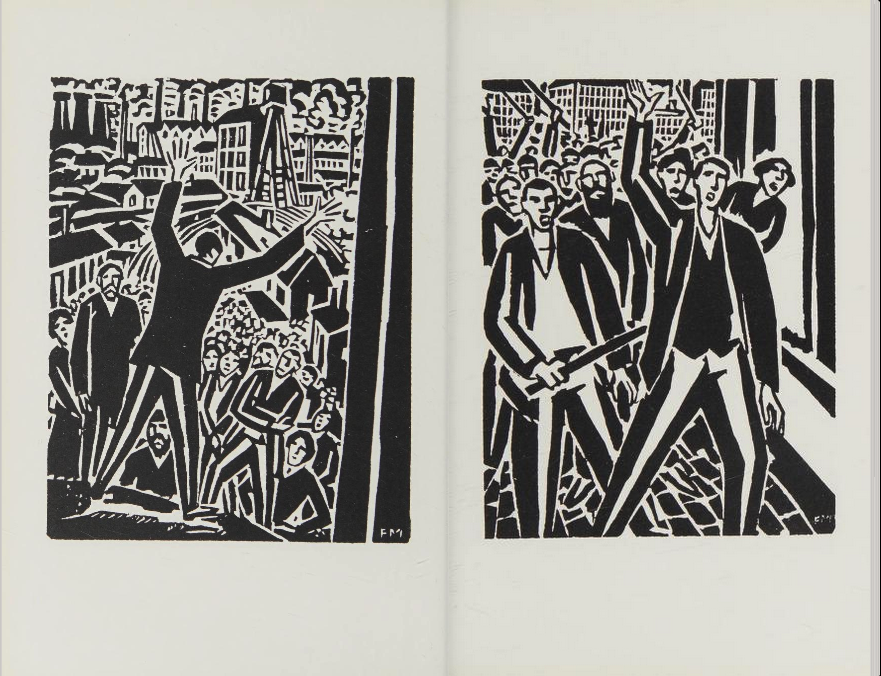
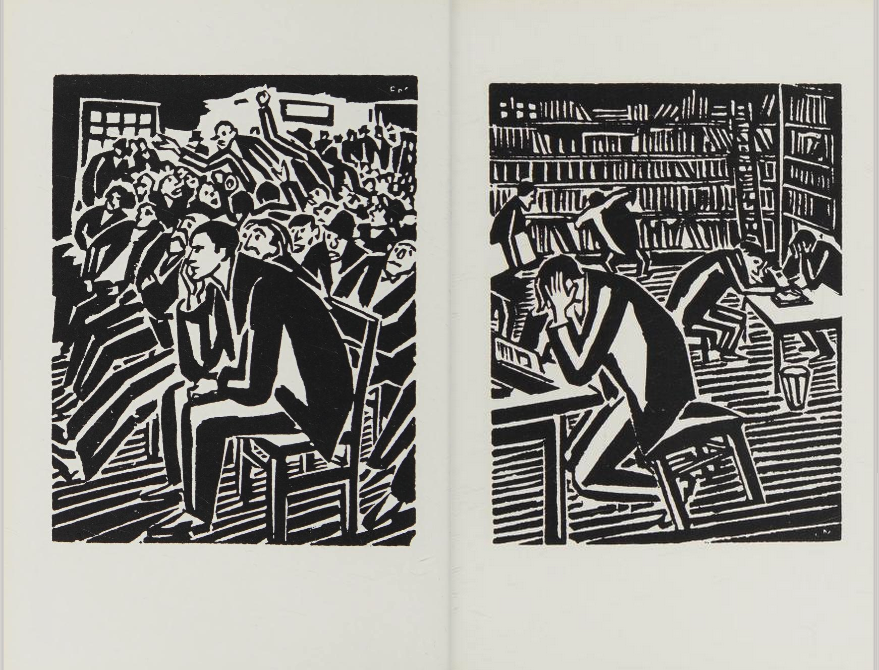
[5] In his woodcut novel, Passionate Journey, Frans Masereel blurs the line between high and low art by conflating characteristics of both forms. To begin, the novel is intended for a working-class audience, yet is intellectually engaging. The hero of Passionate Journey is an average, working-class man who enters the city and goes on many adventures, overcoming societal constraints. He wanders around the city engaging in everyday activities such as grocery shopping, having fun at a fair, and working on a farm, to name a few. If these activities are not evidence enough that the novel is geared toward the working-class, then consider the scenes in which the hero rallies a crowd to protest. First, the hero attends a meeting (maybe a union meeting); his body language—leaning forward with his hand resting under his chin—indicates that he is paying close attention . The next woodcut shows the hero reading in a library, educating himself). Then, he rallies the people, presumably workers, throwing his arms into the air. Finally, the hero leads a protest followed by an angry mob of people (Masereel 61 - 64). (Figures 1 and 2)
Figure 1, The Protagonist of Passionate Journey goes to a meeting (l), then reads in a library (r)
Figure 2, The Protagonist rallies the people (l), then leads a protest (r)
[6] Passionate Journey was likely influenced by Masereel’s personal life and beliefs. Cris Reyns-Chikuma claims that Masereel was influenced by the revolutionary texts his stepfather read to him (Defraeye et al. 332). Reyns-Chikuma describes Masereel as “not only a pacifist with communist (hence, internationalist and atheist) sympathies, but also a believer in art as transformative, compensatory and even salutary” (Defraeye et al. 332). Masereel’s apparent attitude towards art insinuates that the purpose of his novel extends far beyond mere entertainment; Rhens-Chikuma notes that Masereel’s novels may include humor or happiness, but are serious, adding that they are “complete and complex narratives,” with adult topics that are not for children (Defraeye et al. 316-318).
[7] Similar to his other novels such as Die Passion Eines Menschen (1918), Passionate Journey is inherently political—a call for action, intended to invoke an intellectual and emotional response rather than a basic bodily response from his audience. In doing so, Masereel moves to disrupt the social order, demonstrating the value of his work despite it being made for the masses. His novel is thought-provoking, yet not so dense that it is difficult to understand. Rhens-Chikuma says that Masereel “creates ‘good pictures’ in the sense that Tolstoy demands ‘good books’, that is to say, that each could understand them” (Defraeye et al. 330-331). Even the illiterate can engage intellectually with Masereel’s work since it is wordless, which may have been the perfect form to reach his target audience without alarming the upper classes, who likely dismissed his picture stories at the time. This supports my argument that Passionate Journey is intended for the working-class and is intellectually stimulating, a characteristic the classification of high art assumes is reserved for the upper class.
[8] In publishing Passionate Journey, Masereel uses the characteristics of low art to his advantage. Rather than exhibiting his woodcuts in a museum or gallery, the novel is distributed on a “large scale and as cheaper popular editions” (Defraeye et al. 319), making his work accessible to anyone. Although the hierarchy of high versus low art suggests that this choice detracts value from the novel compared to art on display, the accessibility of his work actually aids Masereel in achieving his intended effect on the audience—to inspire the working-class. This effect would have been impossible had the woodcuts been hung in museums and galleries, where it would have reached the upper class as opposed to the masses. Though mass production is specific to low art, Masereel attempted to include aesthetic qualities indicative of high art. The original edition of Passionate Journey had one woodcut per spread of pages, creating a gallery-style feel, allowing each woodcut to be individually appreciated. Unfortunately, later editions of the novel were printed with woodcuts on every page, taking away from the gallery effect and causing the images to feel rushed; it is important to note that Masereel did not agree to this.
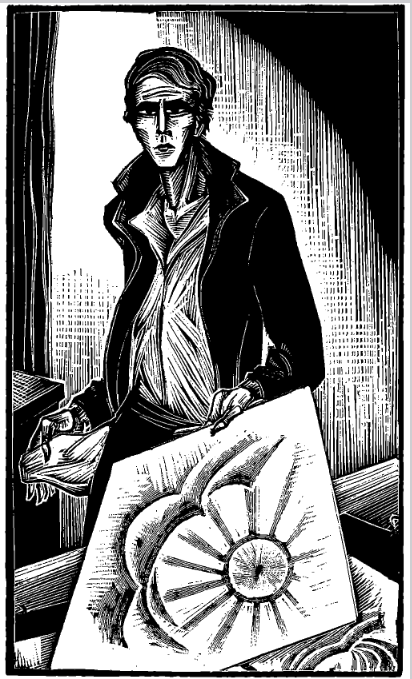
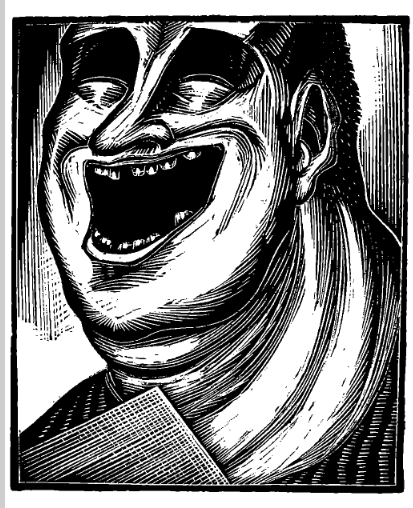
[9] About ten years after the publication of Passionate Journey, Lynd Ward tackled the hierarchy of high versus low art with his wordless novel, Gods’ Man. Gods’ Man is the story of a poor artist who signs a contract with a mysterious masked man in exchange for what appears to be a magic paint brush. The artist quickly rises to fame before realizing the pitfalls of such success. We can find evidence of high versus low art within the plot of the novel itself. For example, in the beginning of the novel, the artist eats a meal at an inn and has no way to pay for it. He attempts to trade his painting as payment for the meal, but the innkeeper laughs in his face (Ward 13-18). (Figures 3 and 4) In his article, The Silent Film, the Sketch and the Portrait in Gods’ Man, Grant F. Scott references the above scene, writing that the artist “shows no hesitation in offering his artwork to the inn-keeper as compensation for his meal indicates that the process of creating the piece far outweighs the resulting product” (Scott 42). This acknowledges the effort that goes into creating art, yet the painting would likely be categorized as low art considering it is completed by a poor, unknown artist who prices his own work to be worth one meal by trying to trade it to the innkeeper.
Figure 3, The Artist tries to trade his work for food; Figure 4: The Innkeeper laughs
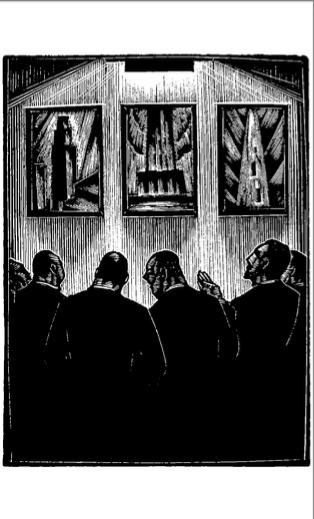
[10] The value of the painting would not be as evident if not compared to the high art “aesthetic of the portrait gallery” (Scott 43) of six famous painters throughout history, who have painted using the same brush that the masked man gives the artist. This portrait gallery provides a sharp contrast to the poor artist’s painting, especially since the sequence follows almost immediately after he attempts to trade his art. Another example of high art within the novel comes when the artist’s work is exhibited in a gallery. After the artist’s sudden success, his paintings are celebrated, hung on the wall for the upper class to appreciate and toast to his success. (Figure 5) He is introduced to the glory and riches that accompany the production of high art, along with the corruption caused by those same riches (Ward 62-72). Resisting the corruption, he eventually settles in the countryside, where he starts a family and leads a much simpler life without painting. However, the masked man finds the artist and has him paint his portrait, revealing his skeleton face and causing the artist to fall to his death (Ward 143).
Figure 5, The Artist’s work is exhibited in a gallery
[11] Scott argues that the masked man is “an agent of eternity sent to rescue the artist from his idyllic Romantic dream and reclaim him for a more enduring artistic legacy, in effect guaranteeing that he is installed as the latest in the gallery of master artists” (Scott 54). Clearly, Gods’ Man is concerned, at least in part, with high and low art forms, specifically the purposes for which artists create art in the first place—here, it is explicitly for fame or for fun (though, of course, artists are not limited to these two reasons). This idea is further supported by the masked man’s reason for returning, since he only makes a reappearance once the artist resumes painting, sharing his love of art with his wife and child. In painting with his child, the artist is engaged in a form of low art. The novel’s representations of high and low art are very suggestive, especially given the corruption associated with high art.
[12] Like Masereel, Ward attempts to combine the characteristics of high and low art to bring high art to the masses. By conjoining the concepts of silent film with that of a book, Ward brings the high art of museums and galleries to the level of common readers. Scott notes that this experience “required a new kind of visual reading strategy that differed markedly from an ordinary novel and required deeper viewing than the cinema” (Scott 41). This speaks to the stimulating intellect of Ward’s wordless novels while simultaneously building on the tradition of both film and novels, a characteristic essential to high art. The lack of words is both what makes the reading experience accessible to people with any level of education yet is exactly what allows his novels to be so intellectually engaging—without words, there is a lot of room for interpretation; each reading experience is subjective. If you read enough wordless novels, however, they teach you how to read them, meaning you learn how to identify characters and patterns, for instance. It is the new reading strategy and deeper viewing that Gods’ Man teaches you that elevates the readers’ experience and allows them to understand the true meaning of the novel no matter their level of traditional education.
[13] Although Masereel and Ward paved the way for contemporary comics and graphic novels, as a woman writer, Lynda Barry had to face an even harsher hierarchy of high versus low art. In an article titled Scrapbooking Caravaggio’s Medusa, Reconfiguring Blake: What It Is, One! Hundred! Demons! and Lynda Barry’s Feminist Intervention in the (Male) Artistic Canon, Olga Michael contends that women’s crafts have been labeled as “amateur forms of art without value and have thus remained restricted within the domestic space since the eighteenth and nineteenth centuries” (Michael 18). Within her graphic memoir, What It Is, Barry uses collage to instruct readers how to write and draw, asking many questions to engage the audience such as “what is an image?” Using waste materials to make collages, the style of the novel differs greatly from the clean gallery-feel of Masereel and Ward’s novels. Michael describes Barry’s use of everyday materials as “putting pressure on mainstream concepts of art that devalued ornamentation and handcraft as ‘women’s work’” (Michael 17). Barry’s scrapbooking-like method of creating her pages is a nod to women’s craft, and is just one way that she challenges the hierarchy of high versus low art.
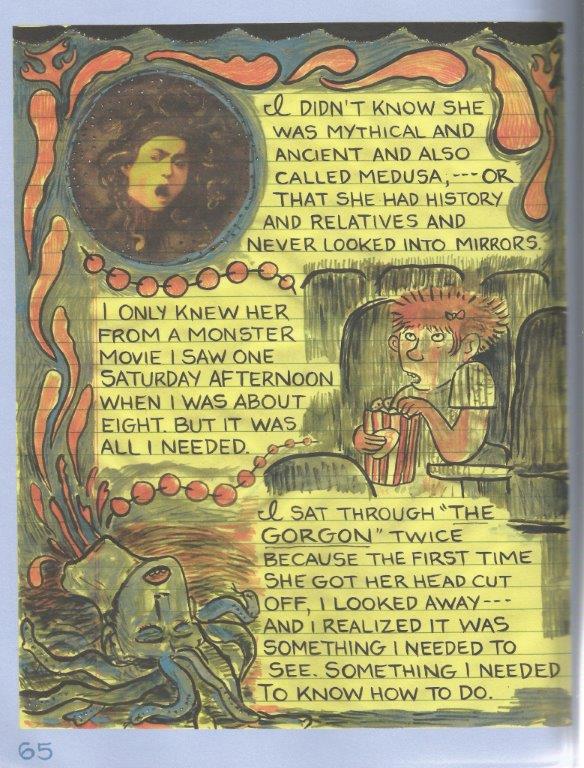
[14] Another way that Barry challenges the hierarchy of high versus low art is by bringing high art to the level of low art within What It Is. What I mean by this is that she includes the work of famous artists such as Caravaggio and Blake in her “low art graphic novel. For example, Barry recounts her experience with the 1968 film, The Gorgon, and how she came to equate her mother with the Gorgon/Medusa (Barry 65). Instead of depicting a scene from the movie, however, she chooses to illustrate Caravaggio’s famous painting of Medusa, a 400-year-old artwork preserved in a museum in Florence, Italy. Michael writes that “Barry’s choice is noteworthy because this pastiche arrangement on yellow legal paper introduces a high-artistic painting in the place of low-art film,” which “evokes two cultural formations of the monster” (Michael 6). In addition to including Caravaggio, Barry weaves lines of Blake’s poetry throughout the novel. “Barry’s vision,” Michael says, “transforms Blake’s perfectly crafted artwork in a way that underscores the significance of childish vision in the art-making process itself” (Michael 13).
[15] As Michael suggests, Barry does not merely include high art within her novel, but transforms it to fit her medium, drawing Caravaggio’s Medusa herself rather than pasting a copy of the painting into the work. (Figure 6) Reinventing Caravaggio and Blake’s work highlights the do-it-yourself amateur aspect of Barry’s novel, showing audiences that high art is not limited to just the educated upper class. The choice to bring high art to the level of low art is especially notable since she refuses to exhibit her work in art galleries, and instead mass-produces her novel“aimed at untrained readers” (Michael 17). It is interesting that, when given the opportunity, Barry refuses to elevate her work to the status of high art, though it makes sense considering her audience. Ward would likely agree with her choice, given his warnings of the corruption that comes with the success of high art within Gods’ Man.
Figure 6, Lynda Barry brings Caravaggio’s Medusa into What It Is
[16] In an interview with Hilary Chute, Barry addresses the misconceptions around comics that caused her to struggle getting her work published and taken seriously. When Chute comments that Barry’s work is heavy, Barry responds, “So people say when they buy it, ‘this is for my son.’ I always say, ‘How old?’ ‘He’s seven, he loves comics.’ ‘Well, just to let you know, there’s incest and suicide, and drug-taking’” (Chute 17). Regarding the content of her work, Barry says that people were upset and at the time, her comic strip was not published in many newspapers. “There weren’t many comic strips that had a lot of trouble [in them], that weren’t funny, you know?” (Chute 15). In What It Is, Barry uses the stigma that comics are for children to her advantage, breaking the boundaries of what a comic “should be” by mixing amateur, childish art with adult content such as abuse, eliciting real emotion. Not only are her drawings “childish” and playful, but the questions she asks are reminiscent of a curious child.
[17] The common misconception that comics are only for children, along with other misconceptions that leave picture stories, such as wordless novels and comics, to be classified as low art, is something that Masereel, Ward, and Barry have endured, making it difficult for their work to be taken seriously or even published at all. With that being said, through their collective novels, Masereel, Ward, and Barry each challenge the hierarchy of high versus low art and use the stigma surrounding low art to their advantage. At the time that Masereel began publishing his work, “comics were best seen by artists as entertaining, but certainly not as art” (Defraeye et al. 321). Although the stigma is still there today, we can see that it has lessened over time with the publication of novels such as Passionate Journey, Gods’ Man, and What It Is. The means of production of each novel, in addition to their content, has tested the limits of high and low art, each picture story author pushing the boundaries a bit more than their predecessors. All three books demonstrate characteristics of both high and low art, proving that the hierarchy of high versus low art is not so black and white, and may not be applicable in today’s world of art, at least pertaining to picture stories.
Barry, Lynda. 2008. What It Is: The Formless Thing Which Gives Things Form: Do You Wish You Could Write? Drawn & Quarterly.
Chute, Hilary. 2008. “An Interview with Lynda Barry.” Believer, 1 Dec.
Defraeye, Piet, Helga Mitterbauer, and Cris Reyns-Chikuma, eds. 2022. Brussels 1900 Vienna : Networks in Literature, Visual and Performing Arts, and Other Cultural Practices. Internationale Forschungen Zur Allgemeinen Und Vergleichenden Literaturwissenschaft, Volume 205. Leiden: Brill Rodopi.
Fisher, John A. 2013. “High Art versus Low Art.” The Routledge Companion to Aesthetics, pp. 473–484.
Masereel, Frans. 1971. Passionate Journey (Mein Stundenbuch): 167 Woodcuts. Dover Publications.
McCloud, Scott, and Mark Martin. 2018. Understanding Comics: The Invisible Art. William Morrow, HarperCollinsPublishers.
Michael, Olga. 2018. “Scrapbooking Caravaggio's Medusa, Reconfiguring Blake: What It Is, One! Hundred! Demons! and Lynda Barry's Feminist Intervention in the (Male) Artistic Canon.” ImageTexT, Volume 9, Issue 2, Mixing Visual Media in Comics. https://imagetextjournal.com/scrapbooking-caravaggios-medusa-reconfiguring-blake-what-it-is-one-hundred-demons-and-lynda-barrys-feminist-intervention-in-the-male-artistic-canon/.
Scott, Grant F. 2022. “The Silent Film, the Sketch and the Portrait in Gods' Man.” Lynd Ward's
Wordless Novels, 1929-1937: Visual Narrative, Cultural Politics, Homoeroticism, Routledge, Taylor & Francis Group, New York, pp. 35–58.
Ward, Lynd, and Art Spiegelman. 2010. Gods' Man; Madman's Drum; Wild Pilgrimage. Library of America.