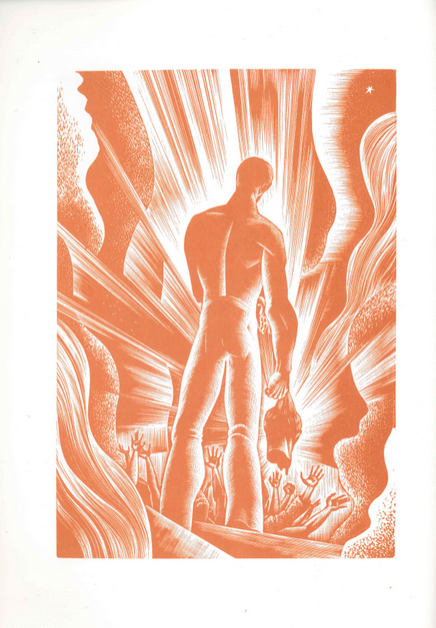
[0.1] Abstract - In both woodcut and graphic novels, there is a message of hope at the end, as well as a sense of agency through the images of hands. Woodcut novels like Frans Masereel’s Die Passion Eines Menschen and Lynd Ward’s Wild Pilgrimage give the working class a voice and highlight labor through the creation of the medium. Later graphic novels like Alison Bechdel’s Fun Home continue to highlight the working class and the concept of labor through the image of hands.
[0.2] Keywords - woodcut novels, graphic novels, labor movement
Duncan, Catherine. 2024. “Woodcut and Graphic Novels: The Hope in Hands and Labor,” Wings Of Fire. Volume 1, No. 1.
[1] Frans Masereel, the author of Die Passion Eines Menschen (1918), was a pioneer in using the medium of wood to create a narrative. Die Passion Eines Menschen follows a protagonist’s journey through life: from being abandoned as a child, to trying and failing to find work to support himself (which leads to illegal activities), to rallying the other laborers that he meets along the way to push back against the treatment of the working class. This ultimately leads to his execution. Lynd Ward, the author of Wild Pilgrimage (1932), is also famous for his woodcut novels. Wild Pilgrimage tracks the journey of a protagonist who attempts to escape the industrial working world by traveling toward nature and learning to do physical labor. Along the way, he meets a hermit who introduces him to the world of socialism, which leads the protagonist to gather the masses and attack those in power—the upper class. Finally, Alison Bechdel, author of Fun Home: A Family Tragicomic (2006), is a famous graphic novelist who utilizes similar themes to Masereel and Ward. Fun Home follows the coming of age of the protagonist—Alison Bechdel herself—as she deals with the effects of abuse from her father, explores her gender & sexuality, and experiences tragedies and hardship. She also grapples with the suicide of her father and how to grieve that complicated relationship. Throughout all of these novels, there is a message of hope at the end, as well as a sense of agency through the images of hands. Woodcut novels give the working class a voice and highlight labor through the creation of the medium. While Bechdel’s graphic novel is not the same medium as the woodcut novel, it still highlights the working class and the concept of labor through the image of hands.
[2] The progression of graphic novels begins with Masereel and Ward’s woodcut novels and moves toward cartoons and other graphic novel forms. Masereel was one of the first woodcut novelists in the twentieth century, and his use of woodcuts focuses on a variety of themes. Martin Cohen’s “The Novel in Woodcuts: A Handbook'' claims that “the themes of travel, love for women, and respect for the working class dominate the novels” (Cohen 180). The theme of the working class specifically dominates Masareel’s novels, especially as the physical novel is a man-made woodcutting. Furthermore, David M. Beronä argues that, because the woodcut novel was visual, it “reaches a wide audience of readers without regard for language or literacy” (Beronä 63), which exemplifies the medium’s accessibility. Furthermore, Cohen suggests that Masereel pays particular attention to the “hero’s hands, whether pocketed, outstretched, dangling, working-class upraised or held to the head,” (Cohen 189) which emphasizes the image of “working with your hands,” which represents the working class. Cohen specifically notes that “The hand as an image parallels his activity, touching, grasping, cutting the woodblock” (Cohen 180). Masereel’s chosen medium of a woodcut novel is reflective of the working class that he writes about, and is a nod to the labor involved in creating a woodcut novel.
[3] Masereel highlights the working class specifically in Die Passion Eines Menschen. In “The Cutting Edge of German Expressionism,” Perry Willet states that Masereel’s purposeful narrative “concerns a sympathetic main character and his martyrdom to the powerful representatives of capitalism. He is born to an unmarried mother and faces every dis-advantage: eviction, poverty, hard labor, and juvenile detention” (Willet 112). Therefore Die Passion Eines Menschen follows the progression of a protagonist living through the struggles of being working class, a topic that many people did not focus on during that time period. In Die Passion Eines Menschen, Masereel’s protagonist is a member of the working class, and therefore Masereel depicts him performing labor with his hands. When the protagonist has finally been released from jail after stealing a loaf of bread, he finds work that involves physical labor. Masereel shows the protagonist’s hands gripping a pickaxe with his body hunched over in a bowing position, while a member of the upper class watches him (Masereel 12). (Figure 1)
Figure 1, Masereel’s protagonist does manual labor
[4] The next image shows the main protagonist wiping his face with his hand. (Figure 2)
Figure 2, Masereel’s protagonist wipes his face with his hand
[5] Perry Willet notes that “Most characters in the novels appear impassive, with the crude woodcuts only outlining their expressions, while characters in despair generally hide their faces” (Willet 118), which is directly shown within the panels of labor that the protagonist performs. Masereel’s protagonist reflects the life experiences of a member of the working class and gives the class a voice.
[6] Masereel’s novels end with the execution of their protagonists; however, while their bodies die, their messages live on, thereby showing that the working class cannot be put down. Perry Willet’s “The Cutting Edge of German Expressionism” addresses this when he analyzes the scene in Die Passion Eines Menschen where the protagonist is about to be killed: “His defiant, impassive stare toward his executioners reveals his willingness to give his life for the cause of freedom and justice” (Willet 112). (Figure 3)
Figure 3, Maserell’s protagonist stares down his executioners
[7] Willet’s analysis is imaginative in that, as the audience, we do not generally get a clear vision of what the protagonist’s face looks like. For instance, at his trial, he stares at his judges and the crucifix hanging above their heads, but we only see the back of his head. (Figure 4) Furthermore, Masereel carves the wood so that light seems to shine from the crucifix and toward the protagonist, which ends the woodcut novel with a sense of hope for the working class. Willet elaborates:
[8] “In a key illustration, during his trial, a figure of Christ on the cross shines beams of redemption on him. The judges mediate this redemption, sitting between the cross and the prisoner, and yet the beams fall on them and the guards as well. This illustration echoes an earlier one, in which the protagonist stands beneath a smokestack, reading a book. The smokestack glows, with the rays radiating on him as he reads, as he achieves a different kind of redemption. These themes of injustice and martyrdom, told as a kind of socialist melodrama, are common to many other woodcut novels, and serve as a unifying element of the genre’s aesthetic” (Willet 114).
Figure 4, Light from the crucifix shines on the protagonist
[9] Willet’s reference back to the glowing smokestack shows the continued theme of redemption present in Die Passion Eines Menschen, which leaves the audience with hope for a new day, even with the execution of the protagonist.
[10] Lynd Ward’s graphic novels also highlight the actual work of woodworking, the idea of physical labor, and an anti-capitalist message—but this time with more of a narrative. Cohen suggests, “Like Masereel’s Ward’s sympathies in his woodcut books seem pacifist and socialist. His narratives are stricter and more novelistic” (Cohen 191). Ward’s novels have an underlying theme of the dangers of capitalism, and a protagonist who tries to escape the world of capitalism. Ward’s Wild Pilgrimage features a similar plot line with the protagonist learning how to overthrow the upper class and with the inclusion of images of physical labor. Ward depicts the main protagonist as a working-man performing physical labor by working as a lumberjack. For instance, when the protagonist is taken in by an older man he meets in the forest, Ward shows the protagonist sawing wood, reflecting the theme of labor as well as the medium of wood, which is central to wood-cut novels. Ward also focuses on the image of hands throughout his novels. Jennifer Camp’s article “Silent Struggles: The Graphic Radicalism of the Woodcut Novel” explores the images of hands in connection with labor. She states: “Ward focuses on hands as the place of making, the location of aesthetic work. The bones in these hands seem to strain against the very skin that contains them, each line cut with unhesitating clarity.” This shows the deliberate inclusion of the details of the hands throughout Ward’s works, especially Wild Pilgrimage (Camp 94). Furthermore, when he shows the protagonist performing labor on a farm, Ward specifically focuses on the protagonist’s physical structure with defined muscles in the arms and legs, as well as the image of his hands gripping the ax or rake (Ward 24-25). (Figure 5) The symbolism of hands present throughout the novel represents the working class and gives them a voice to reflect their struggles.
Figure 5, Ward’s protagonist does “hands-on” labor on a farm
[11] Jennifer Camp connects labor and the woodcut novel in her essay “Silent Struggles: The Graphic Radicalism of the Woodcut Novel”: “Both audience and artist perform a kind of labor that is specific to the medium--an artistic labor that abstracts, in visceral terms, the labor of the working classes” (Camp 92). Ward chose a medium to reflect the labor present in the narrative. Olivia Badoi’s article “A Feeling for Wood Itself: Lynd Ward’s Arboreal Modernism'' explores the connection between woodcut novels and the trees used to make them. Badoi explains that:
[12] “To create his novels in woodcuts, Ward hand-carved images directly onto woodblocks and printed them on paper. These books were created through a time-consuming process that demanded intimate, handcrafted contact with wood. He employed this technique in contrast to the mechanized production of other visual narrative media at the time” (Badoi).
[13] This reflects the physical and time-consuming labor that Ward dedicated to the craft. Additionally, Badoi reveals that the audience also performs a type of labor in viewing the material, in that:
[14] Ward’s woodcut novels require the reader to slow down and contemplate each image, and this act necessitates readerly contact with arboreal materials (paper, woodcut prints). Reading a woodcut novel thus becomes a more embodied experience, a remedy for an increasingly accelerating and alienating world (Badoi).
[15] This speaks to Ward’s ability to connect with all classes, but more specifically the working class through the medium of wood. Additionally, Badoi reveals that “The artist believed that, through the intimate and direct process of carving images out of wood, he could come up with a new kind of language, one that would register to readers across linguistic, cultural, and political barriers” (Badoi). Both Masereel and Ward in using the medium of woodcutting make their stories accessible for all people.
[16] Like Masereel, Ward also carves wood in a way that makes light seem to come from darkness in Wild Pilgrimage. Camp claims that: “Ward’s vision of carving light from darkness visibly abstracted the goals of communist artists who sought to “enlighten” the proletariat class to its own revolutionary potential” (Camp 94). Both the physical task of carving the woodcut novel and the image of light radiating from a source reflect a sense of hope for the working class. Similar to the protagonist’s execution in Masereel’s Die Passion Eines Menschen, the protagonist of Wild Pilgrimage is also killed; however, there is still hope after the murder. The protagonist did not die in vain, but to show the working class that they can stand up to the upper class and fight the power. Ward’s incorporation of colors reflects the protagonist’s inner thoughts, in which the protagonist has agency in his own story. For instance, in a sequence of colored pages, the protagonist comes face to face with a member of the bourgeoisie, but in this other reality, it is the protagonist who wins. We see the protagonist strangling and eventually ripping off the head of the upper-class man, thereby showing that in this fight, a member of the working class has beaten the bourgeoisie (Ward 89-92). (Figure 6)
Figure 6, In his mind, Ward’s Protagonist triumphs over the bourgeoisie
[17] In reality, the protagonist does not beat the police breaking up the protest, but rather is murdered in the street (Ward 96). While the protagonist dies, his message of resistance remains. Additionally, the book reflects hope in that the first image is of a hand reaching out of the clouds, reaching for a star, and the final image is that of the hand clutching the star, representing that the goal has been achieved. (Figure 7) Ward’s Wild Pilgrimage centers the working class voice through the image of hands associated with labor and presents an underlying hopeful tone for the continued desires of the working class.
Figure 7, The first and last images of Ward’s Wild Pilgrimage, suggesting a goal achieved
[18] Alison Bechdel’s Fun Home shifts the medium from woodcuts to drawings; however, the plotline continues to revolve around a working-class family. The medium of graphic novels itself still does require labor, which is represented again through the image of hands. In Robyn Warhol’s article “The Space Between: A Narrative Approach to Alison Bechdel’s Fun Home,” she shows that “Bechdel's text gestures toward the material body in at least two distinct ways. One is the representation of her own hand holding the subject of the voice-over narration,” which is Bechdel’s way of taking back her childhood experiences and having control over her own narrative (Warhol 7). For instance, Bechdel specifically incorporates her fingers holding the images when they depict events surrounding her dad. One such image is the telephone message slip that reveals the call that changed Bechdel’s life, because it was the message that heralded her father’s death. Bechdel’s specific inclusion of her hand holding the message reflects her new ability to control the traumatic experience (Bechdel 28). (Figure 8)
Figure 8, Bechdel puts her own hands in the image
[19] The next time that Bechdel’s fingers appear, she is holding her mother’s disapproving letter after she comes out to her family (Bechdel 77). Therefore, the images where Bechdel incorporates her own fingers in her drawings include moments in Bechdel’s life that traumatized her. Like Masereel and Ward, Bechdel pays particular attention to the specific details of the creases and grips of the hands. While Bechdel does not physically carve out the images in wood, Bechdel does still perform manual labor in drawing each page of the graphic novel and writing out the text. Bechdel’s hands and fingers represent individuality and her personal touch on her work.
[20 ] Because of the labor that surrounds making and absorbing a graphic novel, it should be respected as a legitimate artform. Graphic novels, unlike woodcut novels, typically take advantage of both words and images to convey their meaning. Philosopher and art critic Gotthold E. Lessing once said that “painting and poetry should be like two just and friendly neighbors, neither of whom indeed is allowed to take unseemly liberties in the heart of the other’s domain,” (Lessing 110) which basically argues that images and words should not be in the same space, something that Alison Bechdel’s Fun Home does not follow. While there is a common understanding that pictures make material easier to comprehend, consuming graphic novels is a type of labor itself, and meaningful. In “Bechdel: Closing the Gap in Alison Bechdel’s ‘Fun Home’” Jennifer Lemberg states that, “By framing each of her chapters with words and images that bear a complex relationship to each other, Bechdel reminds us that it is in the space between existing visual images and familiar storylines where we make meaning of our individual lives. Here, that is precisely the space described by comics” (Lemberg 130). Lemberg’s statement shows that graphic novels and “comics” are more than just for fun and entertainment, and that Bechdel puts a lot of effort into creating a meaningful graphic world of Fun Home.
[21] Bechdel’s Fun Home, while set in more modern times, also follows Bechdel and her family, members of the working class, even though her father attempts to present their house as a well-to-do mansion. Bechdel’s father gains all the artifacts in his home by upcycling them. Bechdel directly states, “In fact, we were unusual, though I wouldn’t appreciate exactly how unusual until much later. But we were not rich” (Bechdel 5). When Bechdel states of her father that “He could spin garbage into gold,'' it directly shows Bechdel’s perspective on the many upcycled materials in her house, and further proves that—like Masereel and Ward’s novels—Bechdel’s Fun Home focuses on the perspective of a lower class and the theme of labor.
[22] Similarly to Masereel and Ward, Bechdel also provides a hopeful scene at the end of her narrative despite it being “tragicomic.” The image on the last page of the book reflects back to one of the scenes at the beginning of the novel, where Bechdel is at the pool with her father. The image returns on the last page, depicting a younger Bechdel jumping into her father’s arms from a diving board, with her back turned toward the audience. Below her appears her father with his hands held out, ready to catch her, which is an interesting note to leave off on, considering Bechdel’s entire novel essentially reveals her troubled relationship with her father. The last panel text states, “But in the tricky reverse narration that impels our entwined stories, he was there to catch me when I leapt,” (Bechdel 232). In “Drawing on Modernism in Alison Bechdel’s Fun Home” Ariela Freedman observes that “the novel ends on a curiously hopeful note,” (Freedman 137) which shows with the specific diction of “curiously” that Freedman is also surprised by Bechdel’s positive spin at the end. Furthermore, Freedman continues her analysis with “The final image of the book triumphantly inverts the first page, reframing her father as the spiritual inspiration of the book, as the successful Icarus whose invention paradoxically culminated in his daughter’s artistic flight,” (Freedman 137). The specific comparison of Bechdel’s father to Icarus paints him as a hero who helps his daughter fly. So the graphic novels of Masereel, Ward, and Bechdel all leave off on a hopeful tone for their protagonists, despite the realities present.
[23] Masereel and Ward’s woodcut novels follow protagonists who labor and exist in the working class, which is shown through the specific images of their hands. Cohen’s “The Novel in Woodcut: A Handbook” especially analyzes the protagonist’s hands and their physical position and structure. T. Jennifer Camp’s “Silent Struggles: The Graphic Radicalism of the Woodcut Novel” also focuses on the specific details surrounding the hands and how they reflect the labor that the protagonist performs. Finally, Alison Bechdel’s Fun Home also focuses on the image of hands, and as Robyn Warhol explains in “The Space Between: A Narrative Approach to Alison Bechdel’s Fun Home,” this reflects Bechdel’s agency in her own narrative. Like Masereel and Ward, Bechdel also leaves the narrative on a positive note by showing her father catching her as she flies. Ward, Masereel, and Bechdel all focus on highlighting lesser-known narratives, as well as lifting up marginalized stories.
Ball, David M. 2016. “Lynd Ward’s Modernist ‘Novels in Woodcuts’: Graphic Narratives Lost Between Art History and Literature.” Journal of Modern Literature, vol. 39, no. 2, pp. 126–43.
Badoi, Olivia. 2021. “A Feeling for Wood Itself: Lynd Ward's Arboreal Modernism.”
Modernism/Modernity Print Plus, Johns Hopkins University Press, 21 July, https://modernismmodernity.org/articles/badoi-feeling-wood-itself-lynd-ward.
Bechdel, Alison. 2007. Fun Home: A Family Tragicomic. Houghton Mifflin Company.
Beronä, David A. 2003. “Wordless Novels in Woodcuts.” Print Quarterly, vol. 20, no. 1, pp. 61–73.
Camp, Jennifer. 2015. “Silent Struggles: The Graphic Radicalism of the Woodcut Novel .” Athanor, Volume 33. https://journals.flvc.org/athanor/article/view/126755
Cohen, Martin S. 1977. “The Novel in Woodcuts: A Handbook.” Journal of Modern Literature, vol. 6, no. 2, pp. 171–95.
Freedman, Ariela. 2009. “Drawing on Modernism in Alison Bechdel’s Fun
Home.” Journal of Modern Literature, vol. 32, no. 4, 2009, pp. 125–40.
Lemberg, Jennifer. 2008. “Closing the Gap in Alison Bechdel’s ‘Fun Home.’” Women’s Studies
Quarterly, vol. 36, no. 1/2, pp. 129–40.
Lessing, Gotthold Ephraim. 1965. Laocoon: An Essay upon the Limits of Painting and Poetry.
Noonday Press.
Masereel, Frans. 1924. Die Passion Eines Menschen: 25 Holzschnitte v. Frans Masereel. Kurt Wolff.
Ward, Lynd. 1960. Wild Pilgrimage. World Pub. Co.
Warhol, Robyn. 2011. “The Space Between: A Narrative Approach to Alison Bechdel’s ‘Fun Home.’” College Literature, vol. 38, no. 3, pp. 1–20.
Willett, Perry. 2005. “The Cutting Edge of German Expressionism: The Woodcut Novel of Frans Masereel and Its Influences.” A Companion to the Literature of German Expressionism, edited by Neil H. Donahue, NED-New edition, Boydell & Brewer, pp. 111–34.