[0.1] Abstract - Frans Masereel’s The Idea, Lynd Ward’s Wild Pilgrimage, and Martin Vaughn-James’s The Cage were written in different moments of the 20th century, from different countries, and with different main preoccupations, but they all explore the underlying theme of violence, specifically in the sexual, political, or metaliterary form.
[0.2] Keywords - picture stories, woodcut novels, graphic novel.
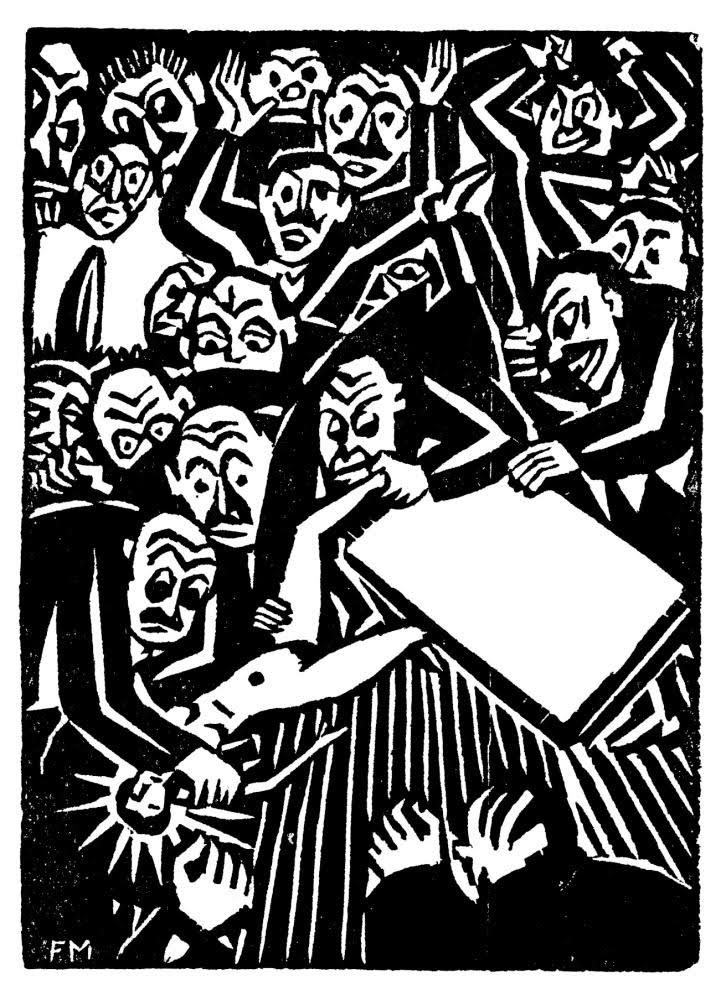
Maldonado, Faith. 2024. “Sexual, Political, and Metaliterary Violence in the Graphic Novel Tradition,” Wings Of Fire. Volume 1, No. 1.
[1] As the genre of the graphic novel has progressed, many of its original tenets have been lost in development. While early graphic novels began in the woodcut form, where images were carved into slabs of wood, inked, and stamped onto the pages, modern graphic novels now experiment with various means of artistic creation. Notably, early woodcut novels were also typically wordless. Aside from a few books with named chapter titles, like Destiny by Otto Nückel, the majority of woodcut novels dispose of language almost entirely, omitting dialogue and description in exchange for pictures in sequence. Many modern comics, in comparison, fuse art with language; indeed, the synthesis of the visual arts with the linguistic is a defining factor of the graphic novel today. Among these changes in the tradition, though, readers can still recognize a cohesive genealogy within the development of the graphic novel. Frans Masereel’s The Idea, Lynd Ward’s Wild Pilgrimage, and Martin Vaughn-James’s The Cage were written in different moments of the 20th century, from different countries, and with different main preoccupations, but they all explore the underlying theme of violence, specifically in the sexual, political, or metaliterary form. The production history of the graphic novel—its transition from woodcuts to other artistic forms—further complicates this theme. The making of woodcuts—the actual practice of cutting into wood—is forceful, even violent. The novel's material is physically destroyed for the sake of artistic creation, and this symmetry between subject matter and form brings a complexity and depth to the history of the graphic novel.
[2] Unlike many of Masereel’s wordless novels, which typically center on a working class, male protagonist, The Idea (1920) centers on a female—a miniature woman born from an artist’s head. After her creation, the Idea is packaged into an envelope and sent into a society of men who try to suppress her, persistently and often violently, by physically dressing her. The men force her into conservative gowns and hats, and their novel-long pursuit often takes on a sexual quality. Immediately upon her arrival, the group of businessmen shove her to the floor and grab her by the shoulders, thighs, and ankles (Figure 1) in what looks like a set-up for sexual assault (14). In the next panel, one man restrains her wrists, another presses his foot into her back, and another pulls her head back and covers her eyes (15). This pattern continues; they chase her through the city, shackling her ankles to the ground, where one man holds her feet and sticks his head in between her legs (20-21). Later, one man even exposes himself and urinates on her (42). Although their violence is committed in order to dress her, and not to rape her, Masereel draws the men’s assault of the Idea with such noticeably sexual qualities, with a focus on restraining her limbs and holding her down to exert their desires. Their assault, then, is an inverted rape, physically disempowering her and transgressing her body autonomy in order to dress her, suppress her, and turn her into a proper woman.
Figure 1, Businessmen hold down The Idea
[3] Masereel’s use of nudity in The Idea is by no means a new feature of his work. Many of his wordless novels openly display sex and the naked—usually female—body. In an article broadly discussing sexuality in graphic novels, David Beronä applauds the wordless novel for depicting sex in a positive light, as opposed to the seedy pornography of the underground comix movement in the 1960s and 70s. He writes, “Masereel presents the act of sexual intercourse between two adults in a pleasant, light-hearted atmosphere and not with the traditional immoral dark overtones” (Beronä 94). Masereel does seem to protest against the strict sexual culture of the early 1920s, showcasing sex as a natural part of life; for example, he depicts his protagonist in Passionate Journey soliciting prostitutes without any discernible moral judgment on them. In The Idea, though, it is hard to see the men’s brutal aggression on the naked woman and think it is somehow “pleasant” or “light-hearted.” Even though Beronä’s claim—that sex in Masereel’s novels is always depicted positively—is not exactly reflected in The Idea, he accurately notes Masereel’s desire to work against a “traditional” understanding of sex and nudity. This manifests clearly in The Idea; among their many symbolic meanings, the Idea’s nudity and the men’s continual attempts to stop it could be interpreted as our culture’s knee-jerk reaction to the naked female body, criticizing the belief that it is something shameful, to be covered up. Further, Beronä argues that “wordless novels presented a progressive display of human sexuality that was not presented in the comic strips. The wordless novels… displayed sexuality only as a component of the narrative and never… as titillating, pornographic material” (Beronä 93). The Idea’s nudity and the sexual violence inflicted upon her do seem to be particularly narrative-driven. As mentioned, the Idea’s impassioned desire to publicly undress herself could be reflective of society’s adverse reaction to literal female nudity. Her nudity, then, is a metaphor for female liberation. Alternatively—or better, additionally—the novel could be using this sexually violent reverse-rape to comment on how new ideas in an industrial society, often introduced by the working class, are stifled by the elite.
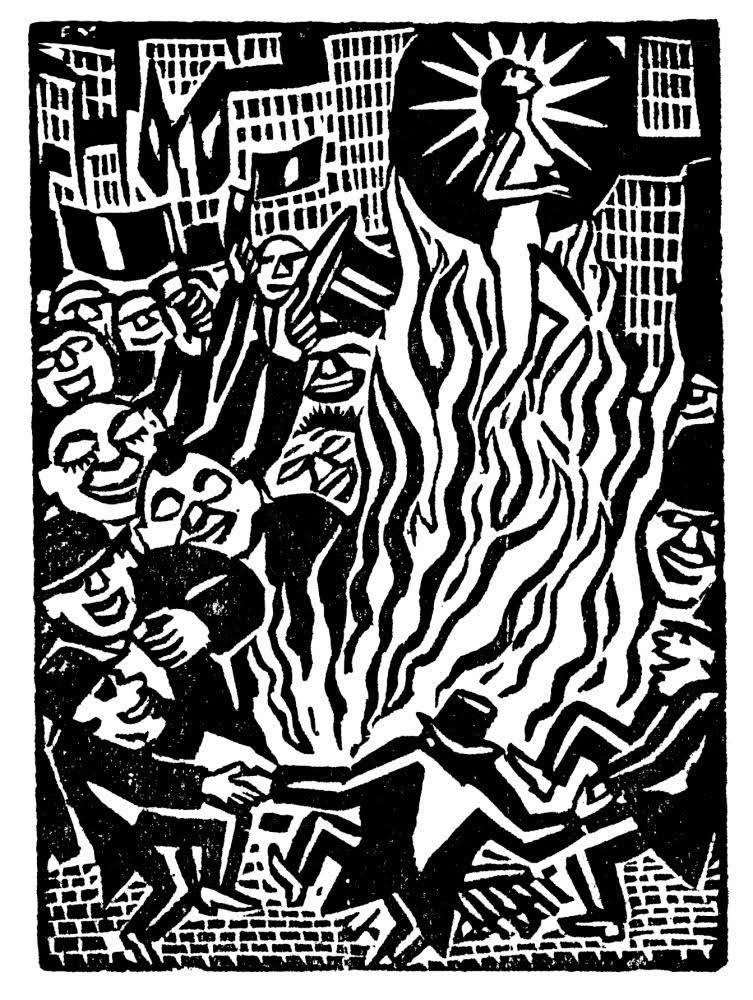
[4] In addition to her overt naming, the Idea is linked thematically to the dissemination of new thought through her connection to the press and modern communication technologies. After running into a print shop (49), the Idea dives into the press and runs across the blank pages, creating copies of herself to spread around the city—in newspapers, billboards, and flyers scattered by plane (50-55). In order to silence the Idea and end her ideological reign over the city, the group of suited men gather her pages and stage a public book burning, holding hands and dancing around the bonfire as she rises from the flames (56-57). (Figure 2) The act of book burning was especially fraught with political meaning between the two world wars, when the book was published, and especially in Germany, where much of Masereel’s readership was located. Here is reflected another interesting motif in the graphic novel tradition, one that will later repeat in Wild Pilgrimage and The Cage: violence against the book, or, on a more philosophical level, metaliterary violence. The Idea and the symbol of the book are intimately connected. The Idea is tortured, shackled, and assaulted; the book is burned. The two are continual victims, but the violence inflicted by the wealthy men does not effectively suppress them. The Idea, after the book burning, rises from the fire and continues her journey through the city, then moving to modern forms of communication technology, like the telephone (57), telegraph (62), and film camera (67). The political elite’s attempts to silence her are fruitless. She is only stopped by her own maker, who, on the last page of the novel, frames her in a painting on his wall. Her journey finally ends, as does the novel.
Figure 2, The Idea rises from the flames of a book burning
[5] Across his oeuvre, Masereel is unafraid to depict matters of political controversy, especially the conflict between the working class and the capitalist elite. In Visible Cities, Global Comics: Urban Images and Spatial Form, a book exploring the importance of urban spaces in graphic novels, Benjamin Fraser dedicates a chapter to sexuality, “passion,” and politics in comic cities, focusing on the wordless novels in particular. Referring to Masereel’s entire body of work, specifically naming The Idea among other titles, Fraser writes, “These works consistently portray the divisions between powerful industrialists and the working underclass in urban areas… Momentarily freed from the drudgery of their working hours, Masereel’s protagonists passionately embrace the hedonistic life offered up by the city streets” (Fraser 57). If we endorse Fraser’s interpretation—that the Idea is another one of Masereel’s working-class protagonists—there is another political argument attached to her nudity. Her naked gallivanting across the city can be read as an attempt to find pleasure in an industrial world that exploits her labor. It’s a “hedonistic” escape from the capitalist machinery of the workday, one that is violently thwarted by the ruling class. The working-class woman is not allowed the luxury of playful, erotic self-expression, and her assault is an act of both political censorship and a means of enforcing the limits of her socioeconomic status. In The Idea, open displays of sexuality and political freedom are intricately linked, and violence is a means of quelling both.
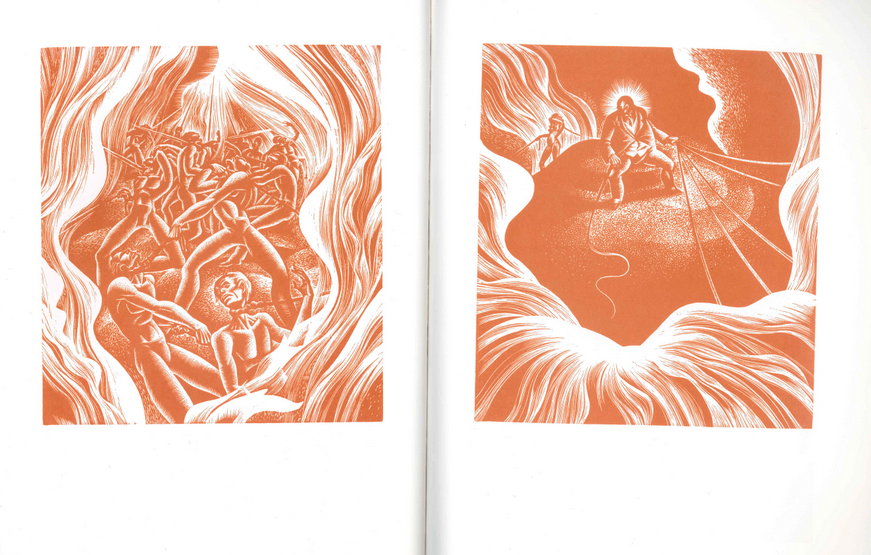
[6] The eroticization of politics is continued in the graphic novel’s genealogy through Lynd Ward’s Wild Pilgrimage (1932). More overtly than in The Idea, Wild Pilgrimage is deeply concerned with class struggles and the sustainability of urban versus rural labor. It follows a facially-distorted but clearly muscular protagonist’s journey through class consciousness, which is triggered, in part, when he witnesses the lynching of a black man (17). Along this journey, the protagonist has several visions—brief scenes of fantasy or terror—which are stamped in red ink to distinguish them from reality. After watching the murder, the protagonist leaves the industrial city and seeks refuge at two different farms. At his first homestay, he attempts to sexually assault a woman on the farm and then flees, later imagining himself being chased by the farmer and the lynching mob (41). The narrative purpose of this assault is unclear, though the woman as an object of desire is a motif that repeats; in the hero’s first vision, he emerges from a river to find a naked woman lounging on the banks (13). This theme is perhaps part of the novel’s reflections on how capitalism seeps from dictating labor practices to dictating personal behavior, like sexuality: here, the novel points to the industrial demand for heteronormativity and the importance of reproduction in creating, and sustaining, the traditional, nuclear family. This theme is further portrayed in the protagonist’s vision of the fiery pit of the industrial world (57-58). Shirtless men are shown with nooses tightening around their necks, and though it appears that they are suffocating each other, the nooses are really in the hands of a fat capitalist and a naked woman (59) (Figure 3). This may reflect the sexual slavery of capitalism, where the working class are forced into heterosexual relationships to create new laboring bodies for the ruling class to exploit. In the case of the attempted rape, the protagonist is plagued by the recurring image of the naked woman, and, overwhelmed by a desire that seems compulsory rather than genuine, he assaults her. He is later punished for his complicity in this mechanism of oppression, among his other sins, when he beheads his oppressor at the end of the novel. He lifts the head to the crowd, only to realize that it is his own face (91).
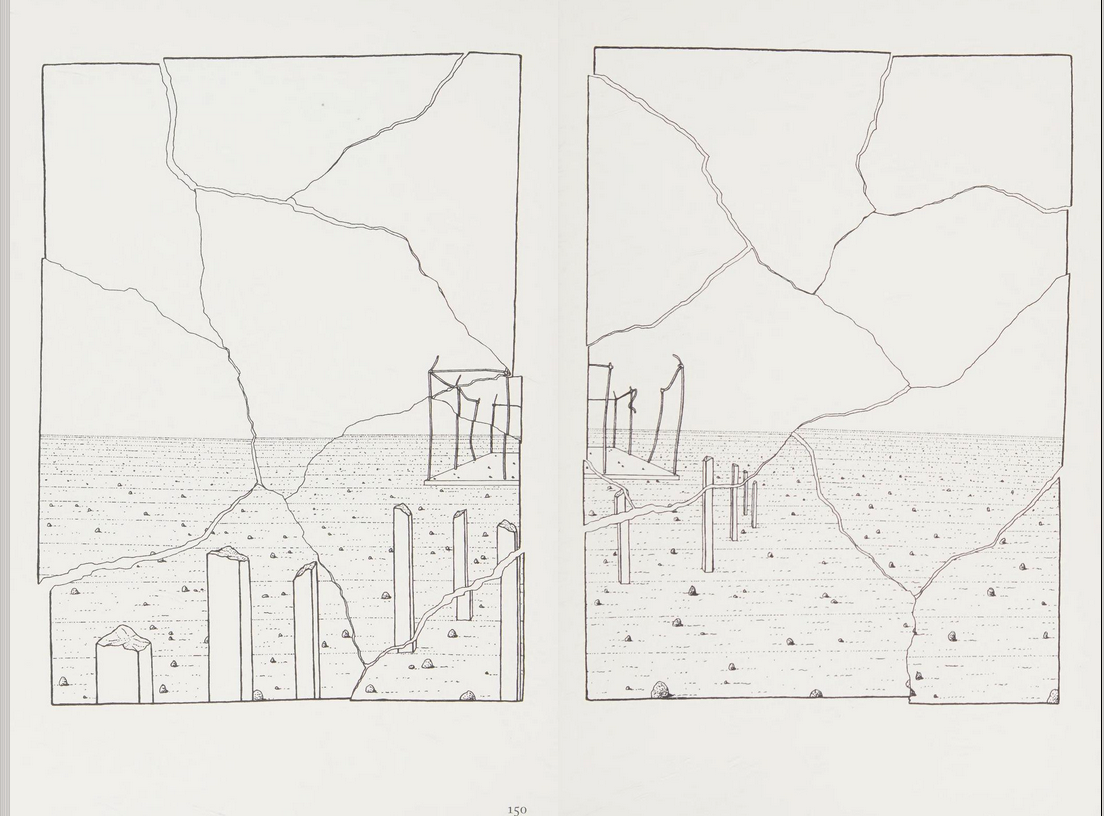
Figure 3: Though it appears that the men are suffocating each other (left), the nooses are really in the hands of a fat capitalist and a naked woman (right)
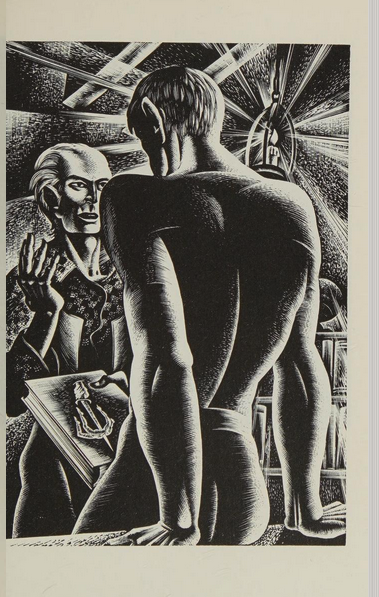
[7] In what seems like a protest against the heterosexual demands of industrialism, the protagonist temporarily lives with a male hermit in the forest. Their relationship is not explicitly sexual, but the constant visual attention paid to their bodies, the way they are often strategically positioned between each other's legs, and the phallic objects they engage with—a bunch of carrots (49), a saw (52), and a drawing of a sword (54) (Figure 4)—all contribute to a homoerotic interpretation. In addition to the sexualized relationship between the protagonist and the hermit, there is clear sexual tension between the protagonist and the violent capitalist authority figures as well. In a chapter discussing the interplay between the political and the sexual in Wild Pilgrimage, Grant Scott notes that “the hero… curiously eroticizes his relationship with the capitalist owner... The politics of labor revolt… thus intersect or more accurately, collide, with the novel’s vexed politics of homoerotic desire” (110). Indeed, the authority figures are often drawn with dominant sexual energy. In one image, for example, a police officer stands with his hips jutted forwards, his groin framed by his hand (83). In the following conflict between the police and the uprising laborers, the protagonist is pictured grabbing the officer by his throat and holding his head below his pelvis in what can be read as an erotic struggle for masculine power (92). Grant Scott sees these violent, sexualized police officers as representing “a sadomasochistic and lethal form of jackboot fascism” (114). Sexual violence is, again, political violence, and the text couples the political with the sexual in order to comment on how industrial capitalism fetishizes the human body, penetrating, controlling, and exploiting it for profit.
Figure 4, Homoerotics in Lynd Ward’s Wild Pilgrimage
[8] The thematic violence and physicality of Wild Pilgrimage is interestingly mirrored in its actual making, within the form of the woodcut novel. In his description of the wood printing process, Lynd Ward himself uses language that reflects a strange tension between physical, perhaps sexual, adoration and torture. Ward calls wood engraving “a struggle between antagonists” and a “battle of wills,” where “the wood is reluctant, the artist determined” (Storyteller 775). Further, he writes: “With wood, every movement of the tool involves overcoming resistance and demands the use of a certain amount of sheer physical force… The result is an emotional involvement between man and material that… takes on the character of … a love affair” (Storyteller 775).
[9] This odd emphasis on overpowering physical force, ignoring the “will” and “resistance” of the material, and the afterthought of “love” strangely likens the process of wood carving to a sort of sexual assault. The woodcut artist is clearly appreciative of and affectionate towards his material, but he still ignores its will, penetrating and violating it for the sake of art. The sexual, or at least physical, violence of Ward’s novel is thus reflected on the metaliterary level. Graphic novelist Sarah Boxer, writing about Ward’s woodcut novels for Slate, also notices the inherent violence of woodblock art and the metaliterary importance of trees in Ward’s novel: “The woodblock artist seems to have an almost totemistic relationship with trees: He loves them, depends on them (both paper and the block come from trees), tortures them with gouges and groovers, and then resurrects them in his art” (Boxer). In order to create, woodcut artists like Ward and Masereel must first enact violence on their medium. The tree is later “resurrected,” both in its visual depiction in the novel and the new life it takes on as a physical art form. In Wild Pilgrimage and in The Idea, Ward and Masereel both deal with themes of sexual and political violence, and in their woodcut form, they necessarily use violence to create. As the artistic genre developed, however, the violence of the graphic novel can be seen to move from being a mode of creation to a mode of destruction.
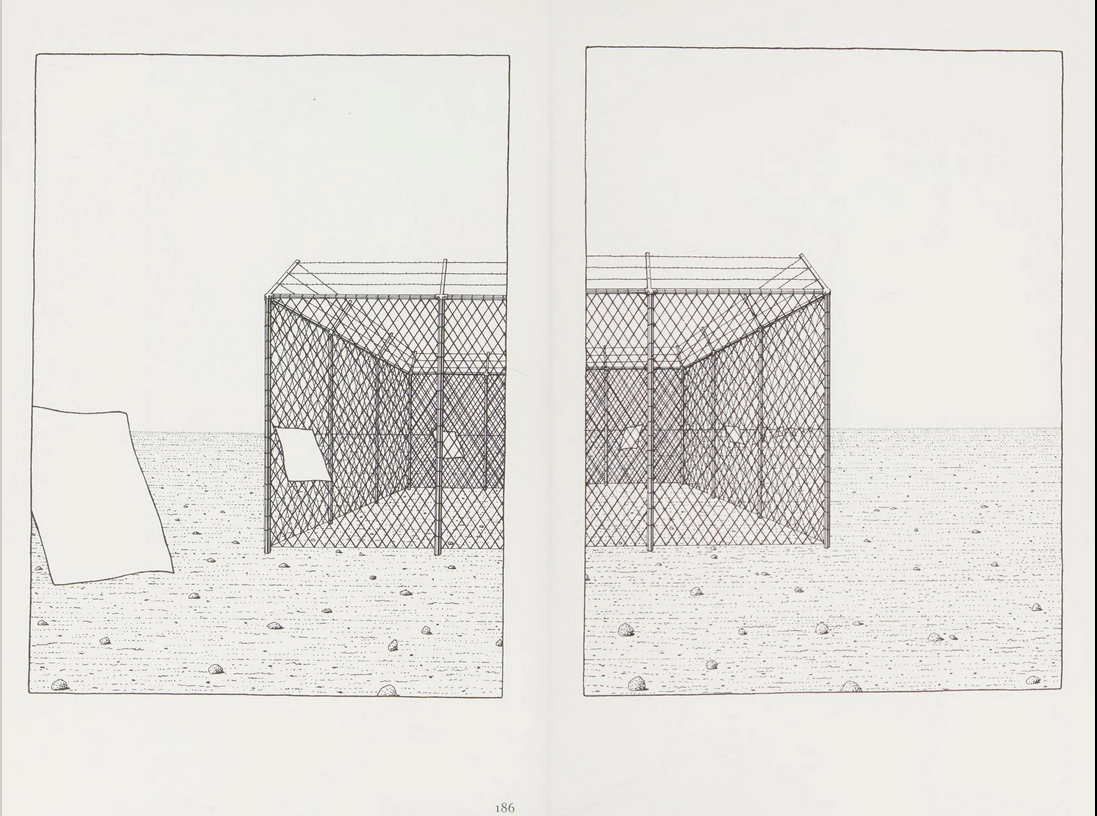
[10] Among its many complicated effects, The Cage (1975) by Martin Vaughn-James violently destroys “the novel,” both visually and ideologically. To many readers’ frustrations, it seems to have no real characters and no real narrative, and in this deconstruction of the traditional novel form, it questions what, exactly, a novel is. This is reflected visually as well. The novel opens with an image of a pebbly desert, and sheets of paper are mounted in a diagonal line leading up to a Mayan pyramid (20). As we get closer to the pyramid, we see the pages have large ink blotches on them, resembling blood stains (24). Next to the pyramid, the impaled pieces of paper evoke severed heads on pikes, presented like sacrifices at the steps of the temple. The sheets of paper return at the very end of the novel, where we see full sheets of paper float towards the cage and through it (186-187) (Figure 5). The next spread, however, shows scraps of torn paper floating through the metal contraption (188-189). It appears as if the cage itself has ripped up the sheets of paper, leading us to the lingering and difficult-to-address question: what is the cage? In her essay, “Uncaging and Reframing Martin Vaughn-James’s The Cage,” Jan Baetens answers this question as such: “The cage itself, a quadrangular fence surrounding a wide set of smaller buildings or constructions, refers… to the book as a container (in case one reads the fictional world as a transfer of written signs into a visual world)” (Baetens 74).
Figure 5, Paper floats toward the cage and through it in The Cage
[11] The symbol of the cage, then, represents The Cage itself, a container of meaning which the reader inhabits. It is violently deconstructed along with the physical book. On pages 102-103, a trail of knotted sheets weave through the cage, and the drawn panel of the image begins to crack. On 124-125, the sheets have become bloodied, and the panels have a few more cracks. Finally, on 150-151, the cage has been reduced to a frame of bent rails and broken wires, and the panels have been completely shattered. (Figure 6) The book and the cage have been destroyed, on a metaliterary level, but they also destroy. As mentioned, the sheets of paper are torn into pieces as they float through the cage. The “book,” as a concept, has thus been slaughtered by the book, The Cage, but as a sacrifice to what deity remains unclear, if we read along with Vaughn-James’s depiction of the book as a sacrifice at a temple. Perhaps the book has to be sacrificed for the greater good of art, and Vaughn-James is arguing that we need to rethink and dismantle our traditional demands of the “book” in order to elevate the literary discipline. The graphic novel, at its core, does work against these traditional expectations, both in its form and content: Masereel and Ward, for example, work against traditional aspects of sexuality and economic systems, while Vaughn-James works against traditional expectations of the novel by, as he describes it, “murdering the ‘character’” (11).
Figure 6, Both page and cage are being destroyed
[12] This violent assault on the idea of the “character” is clearly depicted in the novel, but this does not entirely mean that there are no characters. In “The Ghost of a Character: The Cage by Martin Vaughn-James,” written for the now-defunct online comics journal Indy Magazine, Domingos Isabelinho writes, “The Cage has no characters, true, but it has plenty of substitutes. The human made objects, mainly linked with communication, go as far as to mimic the human body.” The human body, though not visually present in the text, is certainly insinuated through a few anthropomorphic signifiers, like the scarecrow-like jacket tied to the bedpost (137), but also objects like the bed and the ink stains, which are perhaps less human-appearing but still serve narrative purpose, as characters do. The blood-like puddles of ink are a frequent image in the novel, appearing, for example, on page 88 and 112. Jan Baetens describes the ink stain as “a metalepsis: it reveals the labor of an extradiegetic author whose body invades— by (calculated) accident— the imaginary world of The Cage, a little as if one were to find a painter’s fingerprints or thumb traces on a painted canvas” (Baetens 72). The artist’s body “invades” the narrative in its creation, and the blood-like ink is proof of that physical struggle. This language, of the artist being an invasive body, is reminiscent of Lynd Ward’s definition of the wood engraving process as a struggle between two bodies, one of whom dominates and enters the other. Both of these descriptions are, again, strangely, if subtly, similar to descriptions of sexual assault, and this interpretation in The Cage is given additional merit by the blood-like ink’s relationship to the repeated image of a bed.
[13] The bed receives perhaps the most textual attention on pages 90-97, and this sequence concludes with an image of the bed trapped within the cage, soiled with a splotch of ink in the middle of the sheets. Before this image comes a host of phallic objects surrounding the bed: three long poles protrude from the mattress (92), barbed wire spikes point upwards from the shattered glass of a picture frame (93), and erect needles impale rocks across the bed (95). A collection of surveillance equipment—headphones, binoculars, and a microscope—points towards the bed (72), gesturing to the novel’s preoccupation with violent means of political torture. In addition, unlike the other two, Vaughn-James’s novel has words, many of which are sexual and often violent: e.g. “ejaculations” (156), “inbred” (173), “virgin” (174), and “penetrating,” “sterile,” and “impregnated” (175). This allows for an interpretation of The Cage as commenting on violent forms of sexuality, notably assault. Aside from being the site of assault—as evoked by the ink-blood stain on the mattress—the bed is also the victim, one of many. The bed is a character. As Isabelino argues, “The bed is a person. When the bed tries to leave the room on page 74 disaster occurs. Notice how the wire netting below the mattress links this person to other cages in the book. The bed discovers ‘the other’ and the outside world with its senses (the binoculars, the earphones, the microscope), but when it tries to reach it directly, it can't.” Isabelinho shows us that the bed is visually linked to the cage, another victim of assault in its deconstruction. It is also associated with communication technology, and Isabelinho argues that the bed uses the binoculars, earphones, and microscope to access the outside world. In this way, Vaughn-James’s bed is strikingly similar to the Idea in Masereel’s wordless novel. Both are victims of violence, and both use communication technologies—for the Idea, it is the telephone, telegraph, and film camera—in an attempt to liberate themselves. Both characters also ultimately fail to grasp the freedom they search for. In The Cage, the bed never successfully escapes, and in The Idea, the woman is crucified and framed on her maker’s wall, replaced by another miniature woman.
[14] The political reflections in The Idea, Wild Pilgrimage, and The Cage are all highlighted by their depictions of violent sexuality. It is further interesting to note the eroticization of violence and politics in an art form that started as an inherently violent mode of creation and storytelling—the woodcut novel. While older woodcut novelists had to physically assault their material, the wood, in order to make art, later graphic novelists like Vaughn-James illustrate the physical destruction of the novel, continuing a tradition whose success relies on the rethinking of the traditional novel form. As the graphic novel has gained popularity and established its place in literature, however, these concerns—this obsession with pushing the boundaries of the novel—seem to be fading. More modern graphic novels, like What It Is by Lynda Barry and Here by Richard Maguire, are, on the surface level, less philosophically fraught. Now that the graphic novel is more accepted in the canon, perhaps artists feel less of a pressure to make intellectually-complicated arguments about violence, politics, and sexuality to prove their worth as literature and art; they can just exist as they are. Many modern graphic novels still take on these concerns, of course, but there does seem to be less of an obligation to do so. Regardless, the intellectual contributions of artists like Masereel, Ward, and Vaughn-James have paved the way for the modern graphic novel, now a culturally accepted and critically appreciated medium.
Baetens, Jan. 2015. “Uncaging and Reframing Martin Vaughn-James’s The Cage.” Drawing from Life: Memory and Subjectivity in Comic Art, ed. Jane Tolmie. University Press of Mississippi, Jackson, MS, pp. 67–85.
Beronä , David. 1999. “Breaking Taboos: Sexuality in the Work of Will Eisner and the Early Wordless Novels.” International Journal of Comic Art, vol. 1, no. 1, 1999, pp. 90–103.
Boxer, Sarah. 2010. “America's First Wordless Novelist.” Slate Magazine, Slate, 17 Oct.,
Fraser, Benjamin. 2019. “The Passions of Everyday Urban Life.” Visible Cities, Global Comics:
Urban Images and Spatial Form, University Press of Mississippi, Jackson, MS, pp. 51–95.
Isabelinho, Domingos. 2004. “The Ghost of a Character: The Cage by Martin Vaughn-James.” Indy Magazine, Summer. https://web.archive.org/web/20080612122346/http://www.indyworld.com/indy/summer_ 2004/isabelinho_cage/.
Masereel, Frans, and Beronä David A. 2009. “The Idea.” The Sun; the Idea; & Story without
Words: Three Graphic Novels, Dover Publications, Inc., Mineola, NY, NY.
Scott, Grant F. 2022. “Lynching, Labor and Homoeroticism in Wild Pilgrimage (1932).” Lynd Ward's Wordless Novels, 1929-1937, Routledge, New York, NY, pp. 99–123.
Vaughn-James, Martin. 2013. The Cage. Coach House Books.
Ward, Lynd. 1974. “The Way of Wood Engraving.” Storyteller without Words: The Wood Engravings of Lynd Ward, Harry N. Abrams, Inc., Publishers, New York, NY, pp. 765–775.
Ward, Lynd. 2008. Wild Pilgrimage: A Novel in Woodcuts. Dover Publications, Inc.